Manju Yadav
M.A II
The alternating periods of expansion and contraction in the economic
activity has been called business cycles or trade cycles. The period of
high income, high output and high employment is called as the Period
of Expansion, Upswing or Prosperity.
The period of low income, low output and low employment is called as
the Period of Contraction, Recession, Downswing or Depression.
Definition of Trade Cycle
According to Keynes,
"A trade cycle is composed of periods of Good Trade, characterized by
rising prices and low unemployment percentages, shifting with periods of
bad trade characterized by falling prices and high unemployment
percentages."
 Movement in Economic Activity : A trade cycle in an economy showing
an upward and downward trend.
 Periodical : Trade cycles occur periodically.
 Different Phases : Trade cycles have different phases such as Prosperity,
Recession, Depression and Recovery.
 Different Types : There are minor and major trade cycles. Minor trade
cycles operate for 3-4 years, while major trade cycles operate for 4-8 years or
more.
 Duration : The duration of trade cycles may vary from a minimum of 2
years to a maximum of 12 years.
 Dynamic : Business cycles cause changes in all sectors of the economy.
Fluctuations occur in production , income and other variables like employment,
investment, consumption, rate of interest, etc.
 Prosperity Phase : Expansion or Boom or Upswing of
economy.
 Recession Phase : from prosperity to recession (upper
turning point).
 Depression Phase : Contraction or Downswing of
economy.
 Recovery Phase : from depression to prosperity (lower
turning Point).
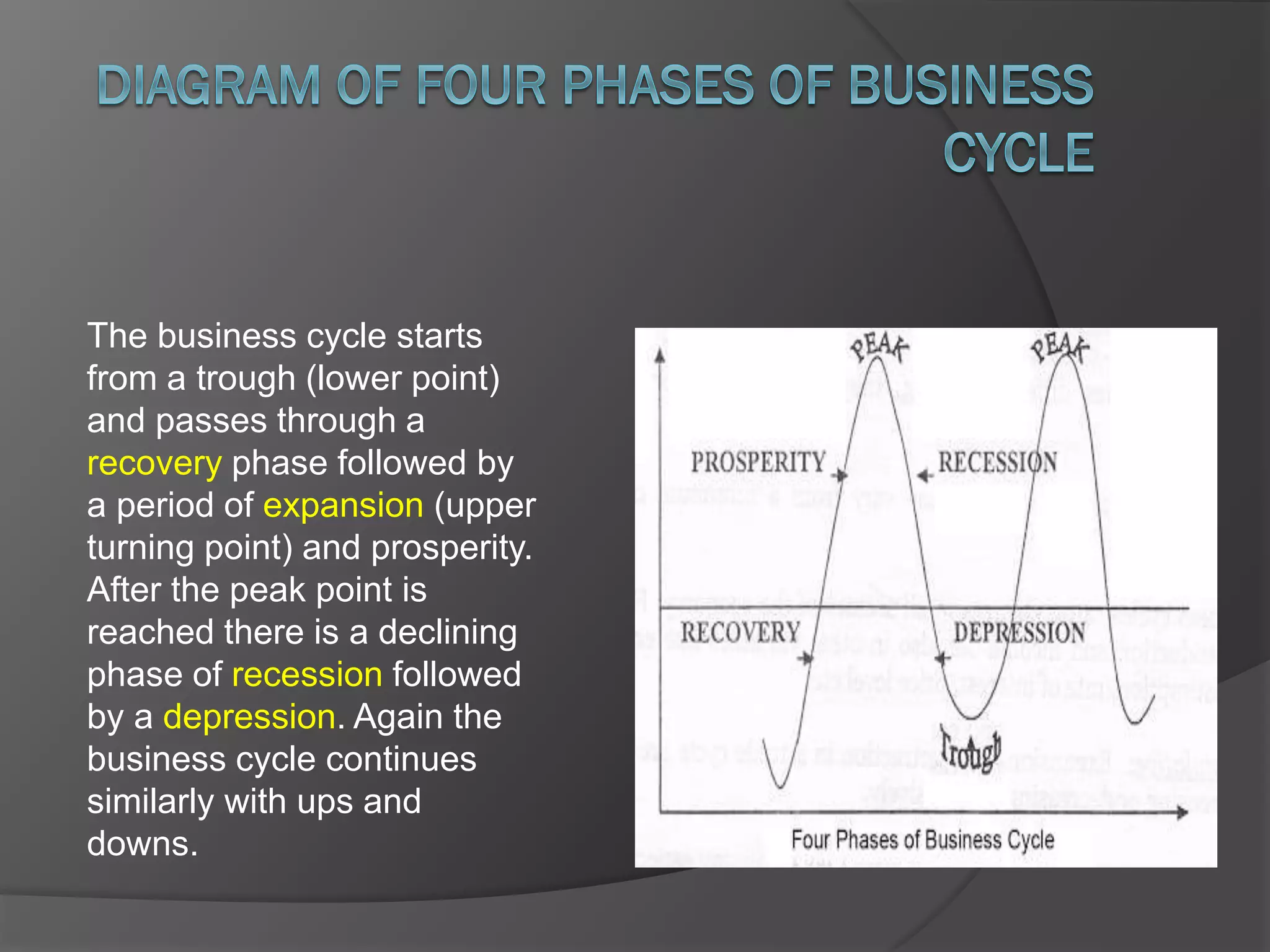
The business cycle starts
from a trough (lower point)
and passes through a
recovery phase followed by
a period of expansion (upper
turning point) and prosperity.
After the peak point is
reached there is a declining
phase of recession followed
by a depression. Again the
business cycle continues
similarly with ups and
downs.
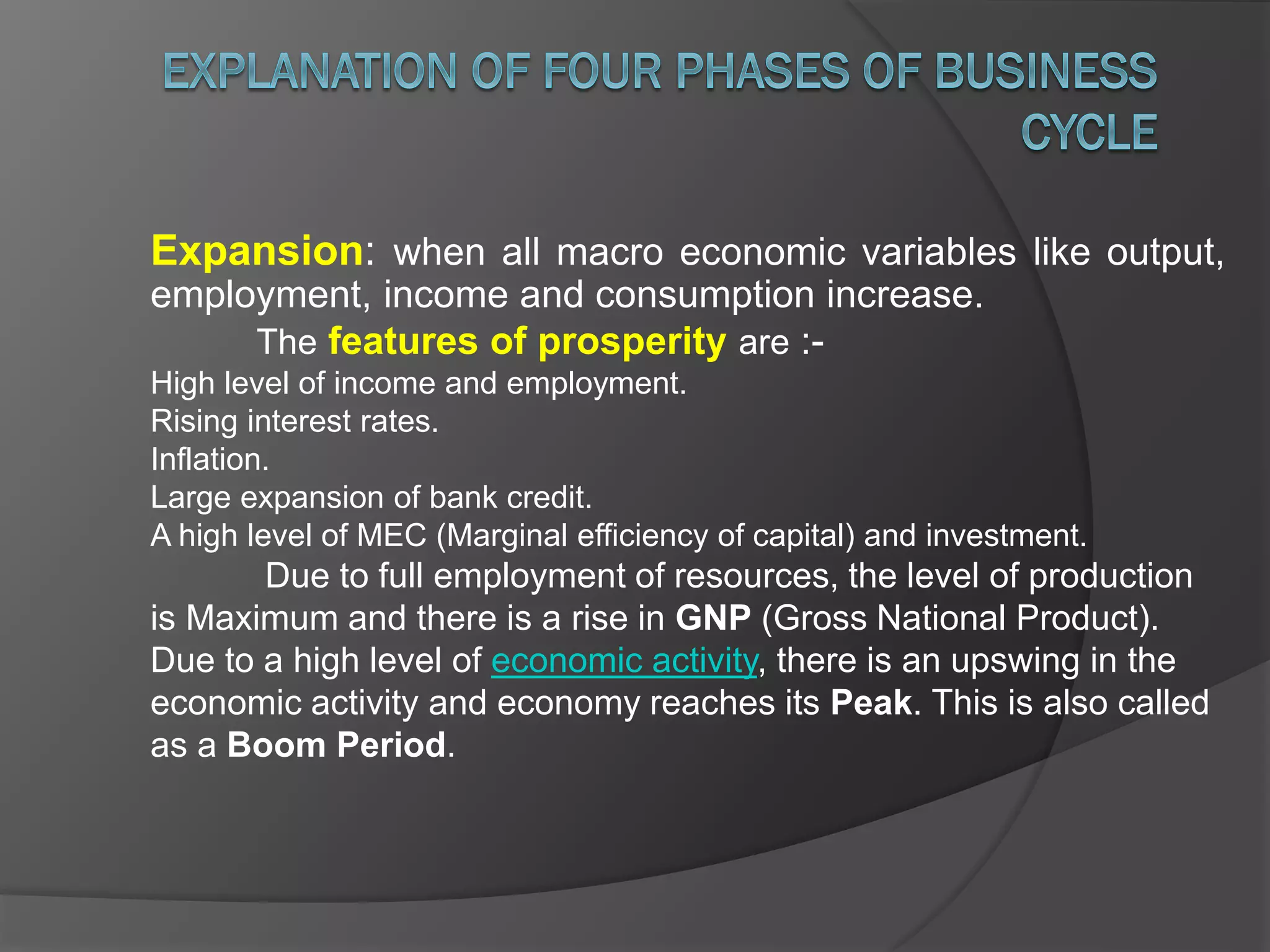
Expansion: when all macro economic variables like output,
employment, income and consumption increase.
The features of prosperity are :-
High level of income and employment.
Rising interest rates.
Inflation.
Large expansion of bank credit.
A high level of MEC (Marginal efficiency of capital) and investment.
Due to full employment of resources, the level of production
is Maximum and there is a rise in GNP (Gross National Product).
Due to a high level of economic activity, there is an upswing in the
economic activity and economy reaches its Peak. This is also called
as a Boom Period.
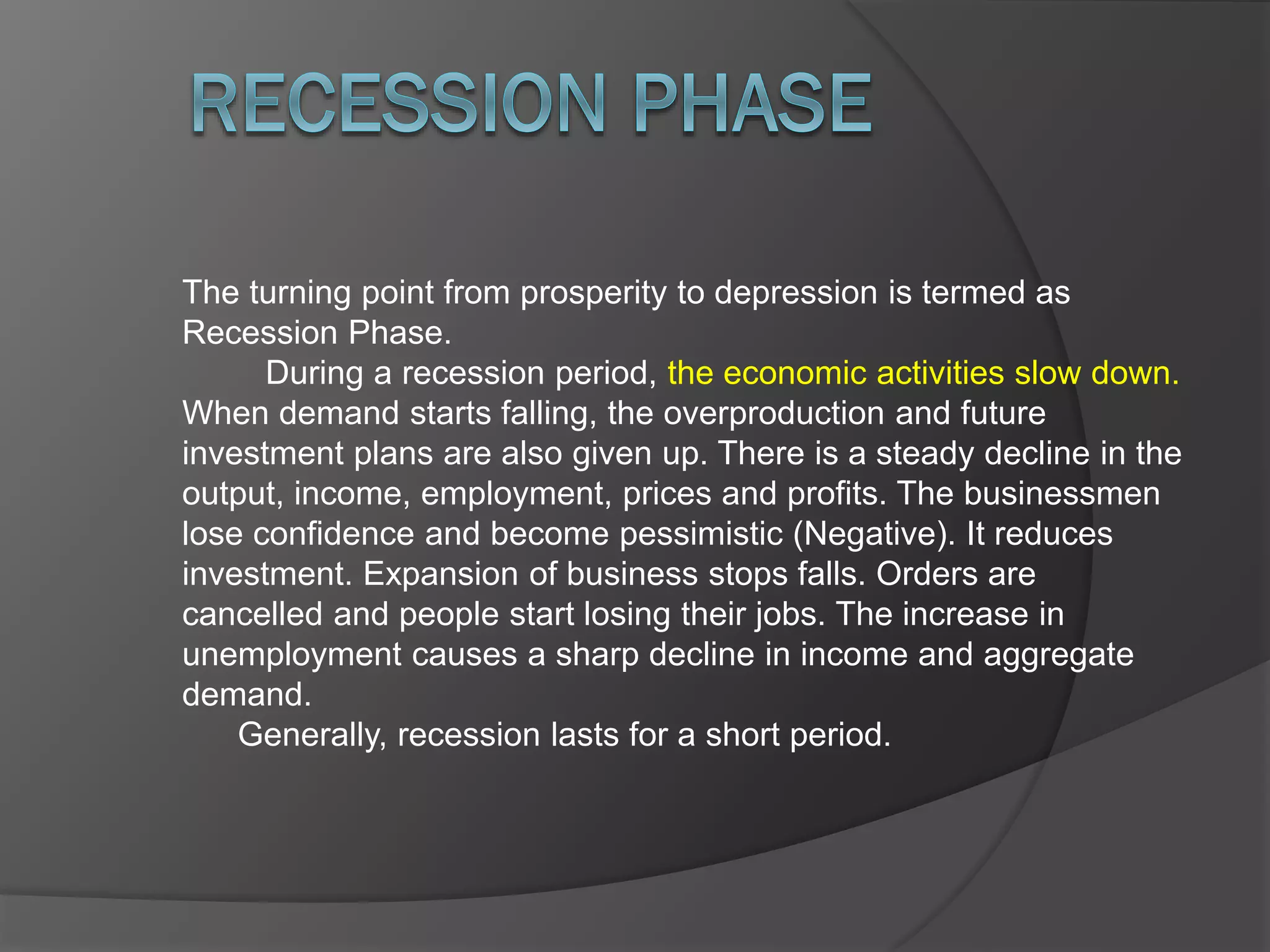
The turning point from prosperity to depression is termed as
Recession Phase.
During a recession period, the economic activities slow down.
When demand starts falling, the overproduction and future
investment plans are also given up. There is a steady decline in the
output, income, employment, prices and profits. The businessmen
lose confidence and become pessimistic (Negative). It reduces
investment. Expansion of business stops falls. Orders are
cancelled and people start losing their jobs. The increase in
unemployment causes a sharp decline in income and aggregate
demand.
Generally, recession lasts for a short period.
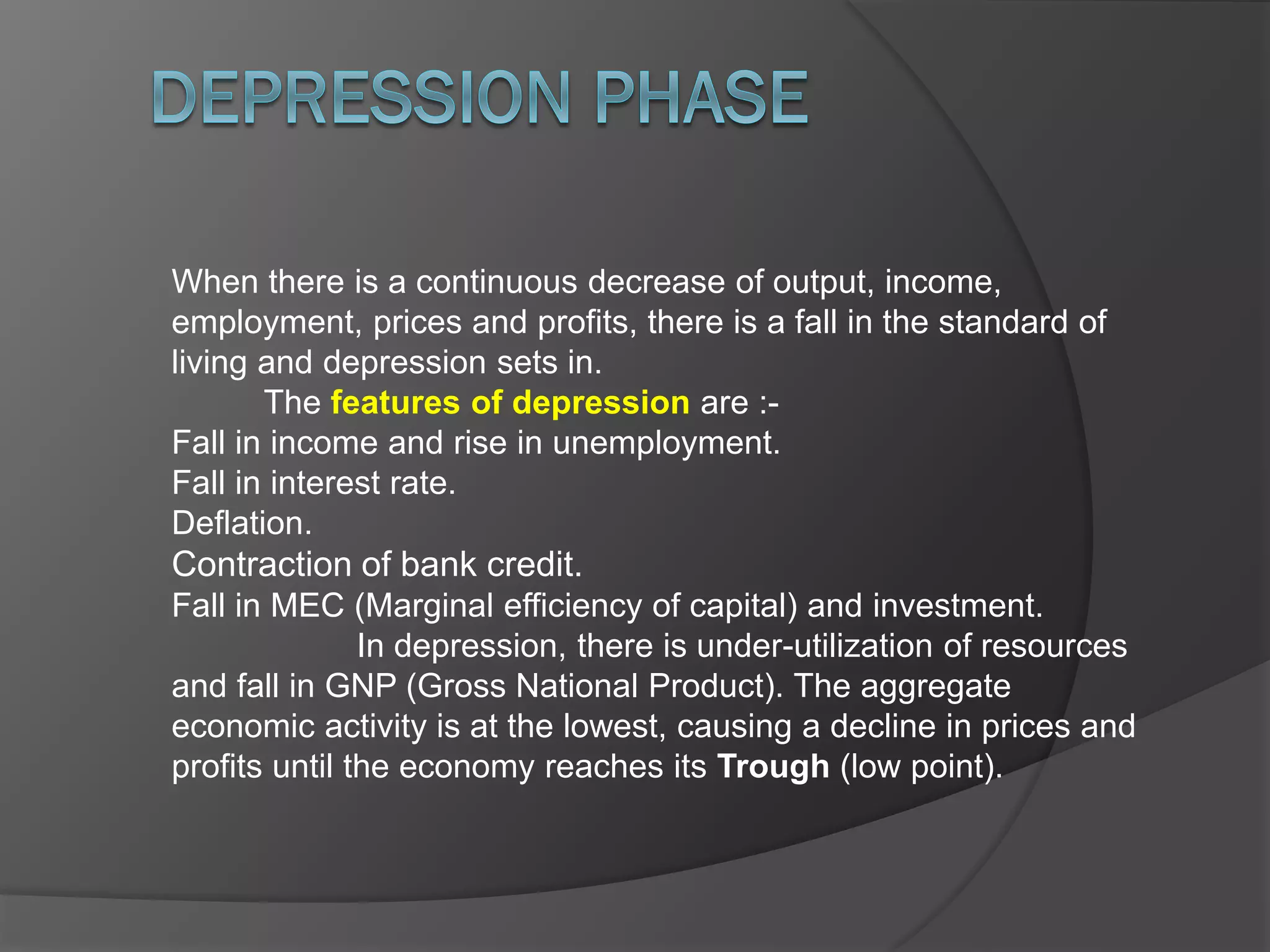
When there is a continuous decrease of output, income,
employment, prices and profits, there is a fall in the standard of
living and depression sets in.
The features of depression are :-
Fall in income and rise in unemployment.
Fall in interest rate.
Deflation.
Contraction of bank credit.
Fall in MEC (Marginal efficiency of capital) and investment.
In depression, there is under-utilization of resources
and fall in GNP (Gross National Product). The aggregate
economic activity is at the lowest, causing a decline in prices and
profits until the economy reaches its Trough (low point).
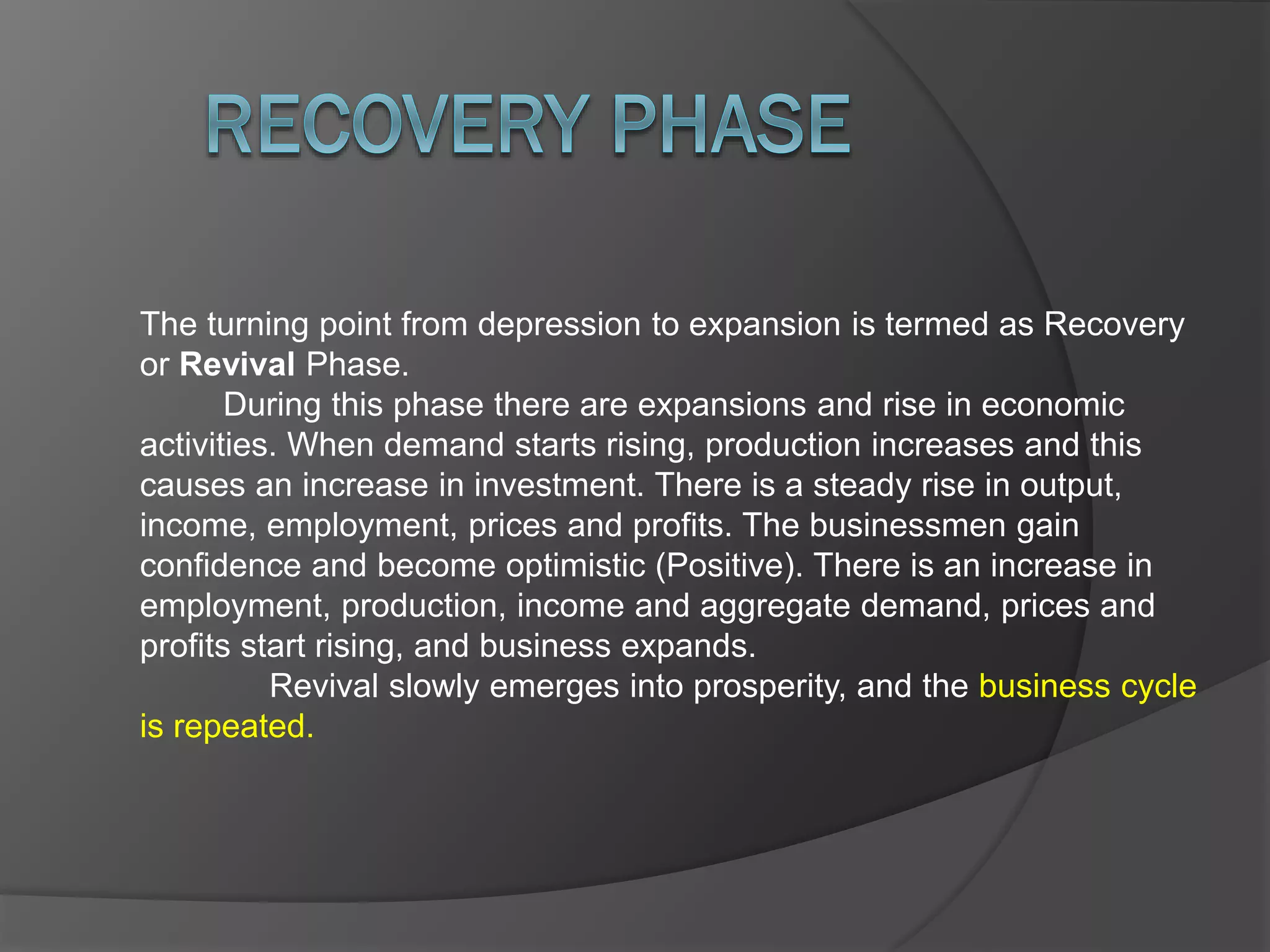
The turning point from depression to expansion is termed as Recovery
or Revival Phase.
During this phase there are expansions and rise in economic
activities. When demand starts rising, production increases and this
causes an increase in investment. There is a steady rise in output,
income, employment, prices and profits. The businessmen gain
confidence and become optimistic (Positive). There is an increase in
employment, production, income and aggregate demand, prices and
profits start rising, and business expands.
Revival slowly emerges into prosperity, and the business cycle
is repeated.
Climatic changes such as sunspots that may
cause different moods.
Psychological aspects of entrepreneurs and
consumers, such as moods of optimism and
pessimism.
Monetary phenomenon like changes in money
supply, rate of interest, etc.
Economic factors, such as over investment,
under consumption and over savings.
Phases of business cycle

Phases of business cycle

  • 1.
  • 2.
    The alternating periodsof expansion and contraction in the economic activity has been called business cycles or trade cycles. The period of high income, high output and high employment is called as the Period of Expansion, Upswing or Prosperity. The period of low income, low output and low employment is called as the Period of Contraction, Recession, Downswing or Depression. Definition of Trade Cycle According to Keynes, "A trade cycle is composed of periods of Good Trade, characterized by rising prices and low unemployment percentages, shifting with periods of bad trade characterized by falling prices and high unemployment percentages."
  • 3.
     Movement inEconomic Activity : A trade cycle in an economy showing an upward and downward trend.  Periodical : Trade cycles occur periodically.  Different Phases : Trade cycles have different phases such as Prosperity, Recession, Depression and Recovery.  Different Types : There are minor and major trade cycles. Minor trade cycles operate for 3-4 years, while major trade cycles operate for 4-8 years or more.  Duration : The duration of trade cycles may vary from a minimum of 2 years to a maximum of 12 years.  Dynamic : Business cycles cause changes in all sectors of the economy. Fluctuations occur in production , income and other variables like employment, investment, consumption, rate of interest, etc.
  • 4.
     Prosperity Phase: Expansion or Boom or Upswing of economy.  Recession Phase : from prosperity to recession (upper turning point).  Depression Phase : Contraction or Downswing of economy.  Recovery Phase : from depression to prosperity (lower turning Point).
  • 5.
    The business cyclestarts from a trough (lower point) and passes through a recovery phase followed by a period of expansion (upper turning point) and prosperity. After the peak point is reached there is a declining phase of recession followed by a depression. Again the business cycle continues similarly with ups and downs.
  • 6.
    Expansion: when allmacro economic variables like output, employment, income and consumption increase. The features of prosperity are :- High level of income and employment. Rising interest rates. Inflation. Large expansion of bank credit. A high level of MEC (Marginal efficiency of capital) and investment. Due to full employment of resources, the level of production is Maximum and there is a rise in GNP (Gross National Product). Due to a high level of economic activity, there is an upswing in the economic activity and economy reaches its Peak. This is also called as a Boom Period.
  • 7.
    The turning pointfrom prosperity to depression is termed as Recession Phase. During a recession period, the economic activities slow down. When demand starts falling, the overproduction and future investment plans are also given up. There is a steady decline in the output, income, employment, prices and profits. The businessmen lose confidence and become pessimistic (Negative). It reduces investment. Expansion of business stops falls. Orders are cancelled and people start losing their jobs. The increase in unemployment causes a sharp decline in income and aggregate demand. Generally, recession lasts for a short period.
  • 8.
    When there isa continuous decrease of output, income, employment, prices and profits, there is a fall in the standard of living and depression sets in. The features of depression are :- Fall in income and rise in unemployment. Fall in interest rate. Deflation. Contraction of bank credit. Fall in MEC (Marginal efficiency of capital) and investment. In depression, there is under-utilization of resources and fall in GNP (Gross National Product). The aggregate economic activity is at the lowest, causing a decline in prices and profits until the economy reaches its Trough (low point).
  • 9.
    The turning pointfrom depression to expansion is termed as Recovery or Revival Phase. During this phase there are expansions and rise in economic activities. When demand starts rising, production increases and this causes an increase in investment. There is a steady rise in output, income, employment, prices and profits. The businessmen gain confidence and become optimistic (Positive). There is an increase in employment, production, income and aggregate demand, prices and profits start rising, and business expands. Revival slowly emerges into prosperity, and the business cycle is repeated.
  • 10.
    Climatic changes suchas sunspots that may cause different moods. Psychological aspects of entrepreneurs and consumers, such as moods of optimism and pessimism. Monetary phenomenon like changes in money supply, rate of interest, etc. Economic factors, such as over investment, under consumption and over savings.