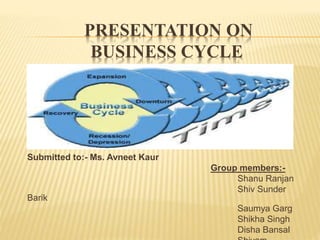
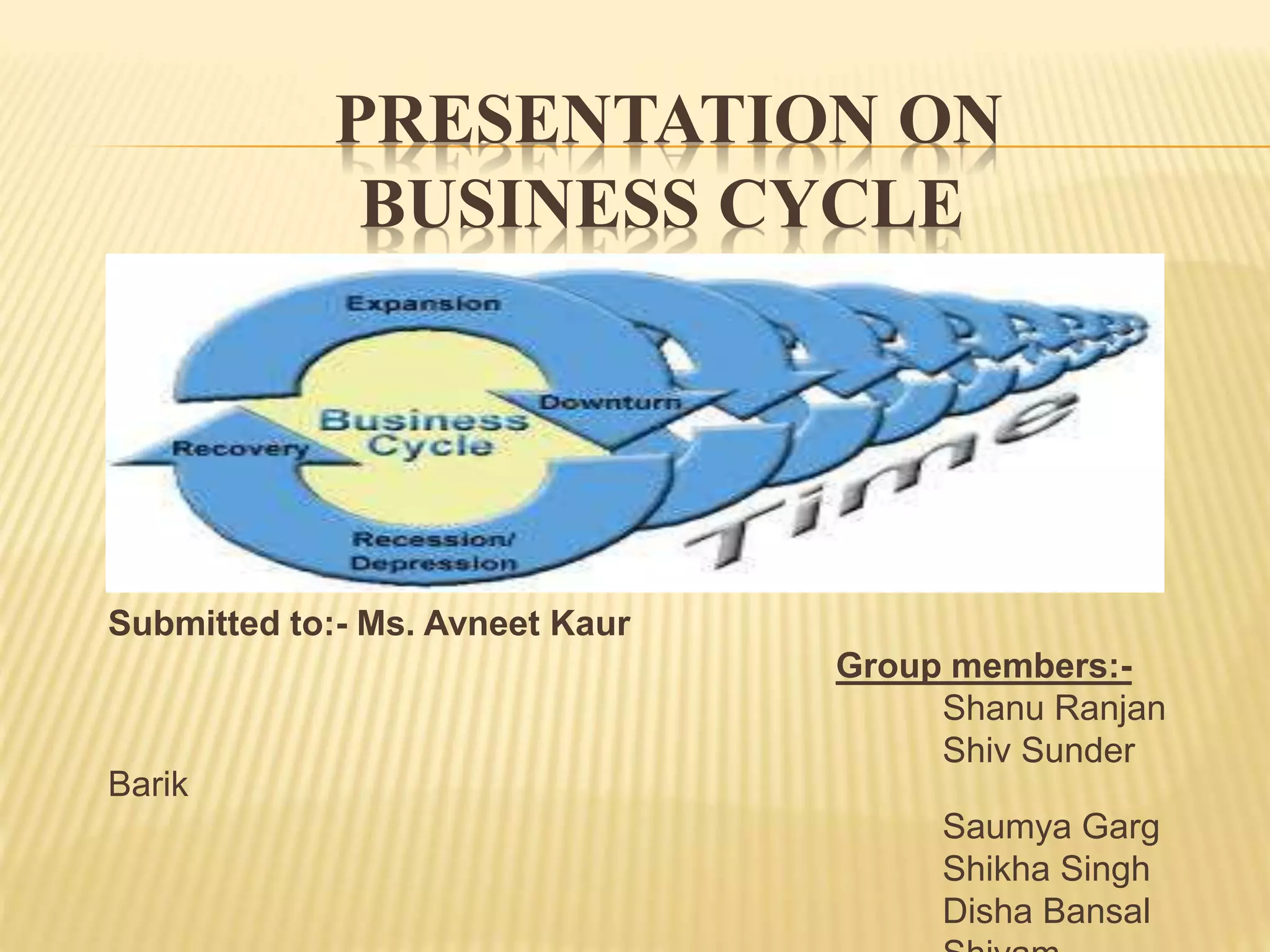
PRESENTATION ON
BUSINESS CYCLE
Submitted to:- Ms. Avneet Kaur
Group members:-
Shanu Ranjan
Shiv Sunder
Barik
Saumya Garg
Shikha Singh
Disha Bansal
INTRODUCTION
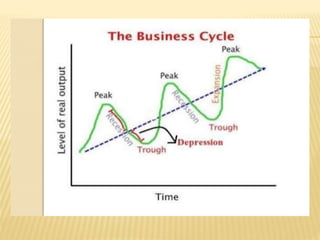
 Definition:- The business cycle is the
periodic but irregular up-and-down
movement in economic activity, measured by
fluctuations in real gross domestic product
(GDP) and other macroeconomic variables.
 They don’t have any fixed rhythm , but they
are the cycles in the phases of contraction
and expansion that recur frequently and in
fairly similar pattern.
FEATURES OF BUSINESS CYCLES
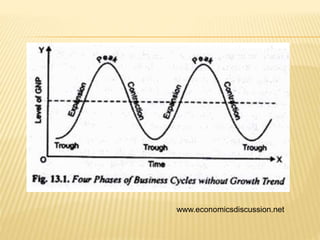
 Wave like movement :
 Wavelike movement of business cycles ,
featured by phases of expansion( prosperity )
and contraction (depression )
 Repetitive fluctuations:
 they are repetitive and rhythmic in nature ,
period of prosperity is followed by period of
depression which is again followed by a
period of prosperity
 Alternating forces:
 forces of prosperity , depression and growth
are in built in the system , each forces will
itself create a space for the next force to
occur
 Lack of symmetry :
 peak , depression etc are not symmetrical
in nature , the expansion phase is slow and
gradual where as the period of contraction is
sudden and violent
 Economy wide phenomenon :
 It may start from industrial sector, but it will
gradually move to other sectors of the
economy.
 Self reinforcing :
 Once the cycles are start on itself, it tends to
feed on itself.
 No fixed time interval :
 Business cycles are differ in time , it may last for
2 to 4 years , other can last for 8 to 10 years or
even more.
DIFFERENT PHASES OF BUSINESS CYCLE
Expansion :-increased consumer
confidence, which translates into higher
levels of business activity.
 It consists of three small stages :
1.Recovery
2.Boom
3.Peak
www.economicsdiscussion.net
1.Recovery
 The turning point from depression to
expansion is termed as Recovery or Revival
Phase.
 Consumer’s confidence starts to increase.
 Rise in economic activities.
 Higher level of output and trade.
 Higher level of effective demand.
 Larger expansion of bank credit.
 Heavy investment on capital goods.
2.Boom
 Consumer’s confidence starts to increase at
a faster pace.
 Unemployment levels fall.
 Business starts increase their construction
levels.
 Rise in National Income.
 Rapid increase in economy.
 Inflation increase at very high rates.
3.Peak
 The economy has reached its peak.
 Output starts to standstill and level off.
 Consumer’s confidence starts to decline.
 People start to stop their buying.
 Number of jobs exceed the no of workers in
the market , over full employment
 Boom in itself carries the seed of self
destruction in it , bottle necks began to
emerge in the economy
Contraction
It is a period of decrease in consumer
confidence and economic activity.
It consists of three smaller stages:
 Recession
 Depression
 Trough
1.Recession
 Recession is a period of reduced economic
activity in which levels of buying, selling,
production, and employment typically
diminish.
 Consumer’s confidence starts to decrease a
little.
 Unemployment is increasing while inflation
is dropping.
 Failure of some business create panic in
market .
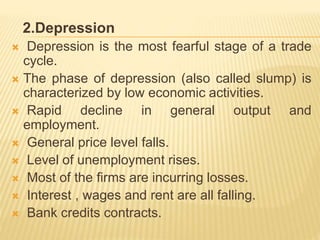
2.Depression
 Depression is the most fearful stage of a trade
cycle.
 The phase of depression (also called slump) is
characterized by low economic activities.
 Rapid decline in general output and
employment.
 General price level falls.
 Level of unemployment rises.
 Most of the firms are incurring losses.
 Interest , wages and rent are all falling.
 Bank credits contracts.
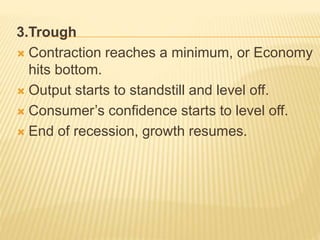
3.Trough
 Contraction reaches a minimum, or Economy
hits bottom.
 Output starts to standstill and level off.
 Consumer’s confidence starts to level off.
 End of recession, growth resumes.
CAUSES OF BUSINESS CYCLES
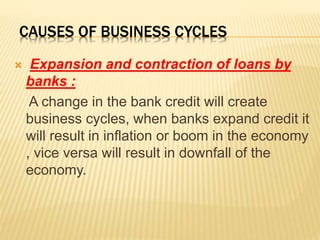
 Expansion and contraction of loans by
banks :
A change in the bank credit will create
business cycles, when banks expand credit it
will result in inflation or boom in the economy
, vice versa will result in downfall of the
economy.
 Change in the volume of investments :
Fluctuations in the volume of trade cycles
effect the capital invested and there by the
pattern of economy movement .
 Seasonal fluctuations :
 Seasonal fluctuations affect agricultural
sector and hence entire economy.
 Under consumption or excessive savings:
Basic cause of business cycles is under
consumption or excessive savings by
household sector.
 Excessive savings result in higher
investments resulting in prosperity in
economy.
 Lack of adjustments between demand and
supply :
 If demand is more than supply , it will cause
inflation.
 If supply is more than demand it will cause
depression.
 Feelings of entrepreneur:
 Optimism will cause prosperity in the
economy where as,
 Pessimism will create depression in the
economy.
 Other factors :
 Rate of growth of population , revolutions,
discoveries of new resources etc.
MEASURES TO CONTROL BUSINESS CYCLES
 Fiscal policy measures.
 Monetary policy measures.
 Non fiscal and non monetary measures.
REFERENCES
 Dwivedi, D N(2015), Managerial Economics (8th ed),India: vikas
publishing house pvt. Ltd.
 Mithani, D M (2013), Managerial Economics:Theory & Application(7th
ed.), India: Himalaya Publishing House
 Thomas, Christopher R and Maurice, s Charles (2008), Managerial
Economics :concepts & Application (7th ed.), India: Mc Graw hill Irwin
 Kumar Raj and Gupta Kuldip(2005), Managerial Economics, India:UDH
publishers & Distributors
 Ahuja, H L (2017), Managerial Economics:Analysis of Managerial
Decision Making(9th ed.), India: S chand Company Ltd.
 Geetika(2017), Managerial Economics(3rd ed.), India: Tata Mc Graw Hill
Education Pvt Ltd.
 http://www.economicsdiscussion.net/business-cycles/business-cycles-
meaning-phases-and-features/10413
THANK YOU

Business cycle final ppt

  • 1.
    PRESENTATION ON BUSINESS CYCLE Submittedto:- Ms. Avneet Kaur Group members:- Shanu Ranjan Shiv Sunder Barik Saumya Garg Shikha Singh Disha Bansal
  • 2.
    INTRODUCTION  Definition:- Thebusiness cycle is the periodic but irregular up-and-down movement in economic activity, measured by fluctuations in real gross domestic product (GDP) and other macroeconomic variables.  They don’t have any fixed rhythm , but they are the cycles in the phases of contraction and expansion that recur frequently and in fairly similar pattern.
  • 3.
    FEATURES OF BUSINESSCYCLES  Wave like movement :  Wavelike movement of business cycles , featured by phases of expansion( prosperity ) and contraction (depression )  Repetitive fluctuations:  they are repetitive and rhythmic in nature , period of prosperity is followed by period of depression which is again followed by a period of prosperity
  • 4.
     Alternating forces: forces of prosperity , depression and growth are in built in the system , each forces will itself create a space for the next force to occur  Lack of symmetry :  peak , depression etc are not symmetrical in nature , the expansion phase is slow and gradual where as the period of contraction is sudden and violent
  • 5.
     Economy widephenomenon :  It may start from industrial sector, but it will gradually move to other sectors of the economy.  Self reinforcing :  Once the cycles are start on itself, it tends to feed on itself.  No fixed time interval :  Business cycles are differ in time , it may last for 2 to 4 years , other can last for 8 to 10 years or even more.
  • 6.
    DIFFERENT PHASES OFBUSINESS CYCLE Expansion :-increased consumer confidence, which translates into higher levels of business activity.  It consists of three small stages : 1.Recovery 2.Boom 3.Peak
  • 7.
  • 8.
    1.Recovery  The turningpoint from depression to expansion is termed as Recovery or Revival Phase.  Consumer’s confidence starts to increase.  Rise in economic activities.  Higher level of output and trade.  Higher level of effective demand.  Larger expansion of bank credit.  Heavy investment on capital goods.
  • 9.
    2.Boom  Consumer’s confidencestarts to increase at a faster pace.  Unemployment levels fall.  Business starts increase their construction levels.  Rise in National Income.  Rapid increase in economy.  Inflation increase at very high rates.
  • 10.
    3.Peak  The economyhas reached its peak.  Output starts to standstill and level off.  Consumer’s confidence starts to decline.  People start to stop their buying.  Number of jobs exceed the no of workers in the market , over full employment  Boom in itself carries the seed of self destruction in it , bottle necks began to emerge in the economy
  • 11.
    Contraction It is aperiod of decrease in consumer confidence and economic activity. It consists of three smaller stages:  Recession  Depression  Trough
  • 13.
    1.Recession  Recession isa period of reduced economic activity in which levels of buying, selling, production, and employment typically diminish.  Consumer’s confidence starts to decrease a little.  Unemployment is increasing while inflation is dropping.  Failure of some business create panic in market .
  • 14.
    2.Depression  Depression isthe most fearful stage of a trade cycle.  The phase of depression (also called slump) is characterized by low economic activities.  Rapid decline in general output and employment.  General price level falls.  Level of unemployment rises.  Most of the firms are incurring losses.  Interest , wages and rent are all falling.  Bank credits contracts.
  • 15.
    3.Trough  Contraction reachesa minimum, or Economy hits bottom.  Output starts to standstill and level off.  Consumer’s confidence starts to level off.  End of recession, growth resumes.
  • 16.
    CAUSES OF BUSINESSCYCLES  Expansion and contraction of loans by banks : A change in the bank credit will create business cycles, when banks expand credit it will result in inflation or boom in the economy , vice versa will result in downfall of the economy.
  • 17.
     Change inthe volume of investments : Fluctuations in the volume of trade cycles effect the capital invested and there by the pattern of economy movement .  Seasonal fluctuations :  Seasonal fluctuations affect agricultural sector and hence entire economy.
  • 18.
     Under consumptionor excessive savings: Basic cause of business cycles is under consumption or excessive savings by household sector.  Excessive savings result in higher investments resulting in prosperity in economy.
  • 19.
     Lack ofadjustments between demand and supply :  If demand is more than supply , it will cause inflation.  If supply is more than demand it will cause depression.
  • 20.
     Feelings ofentrepreneur:  Optimism will cause prosperity in the economy where as,  Pessimism will create depression in the economy.  Other factors :  Rate of growth of population , revolutions, discoveries of new resources etc.
  • 21.
    MEASURES TO CONTROLBUSINESS CYCLES  Fiscal policy measures.  Monetary policy measures.  Non fiscal and non monetary measures.
  • 22.
    REFERENCES  Dwivedi, DN(2015), Managerial Economics (8th ed),India: vikas publishing house pvt. Ltd.  Mithani, D M (2013), Managerial Economics:Theory & Application(7th ed.), India: Himalaya Publishing House  Thomas, Christopher R and Maurice, s Charles (2008), Managerial Economics :concepts & Application (7th ed.), India: Mc Graw hill Irwin  Kumar Raj and Gupta Kuldip(2005), Managerial Economics, India:UDH publishers & Distributors  Ahuja, H L (2017), Managerial Economics:Analysis of Managerial Decision Making(9th ed.), India: S chand Company Ltd.  Geetika(2017), Managerial Economics(3rd ed.), India: Tata Mc Graw Hill Education Pvt Ltd.  http://www.economicsdiscussion.net/business-cycles/business-cycles- meaning-phases-and-features/10413 THANK YOU