Business Cycles Presentation
This is the collection
of different
presentations based
on the Business
Cycles from Slide
share.
Compiled by Thabani
The Business
Cycle

BUSINESS CYCLES

LG5

• Business Cycles -- Periodic rises and falls that occur in
economies over time.
• Four Phases of Long-Term Business Cycles:
1. Economic Boom

2. Recession – Two or more consecutive quarters of
decline in the GDP.
3. Depression – A severe recession.
4. Recovery – When the economy stabilizes and starts to
grow. This leads to an Economic Boom.
2-4
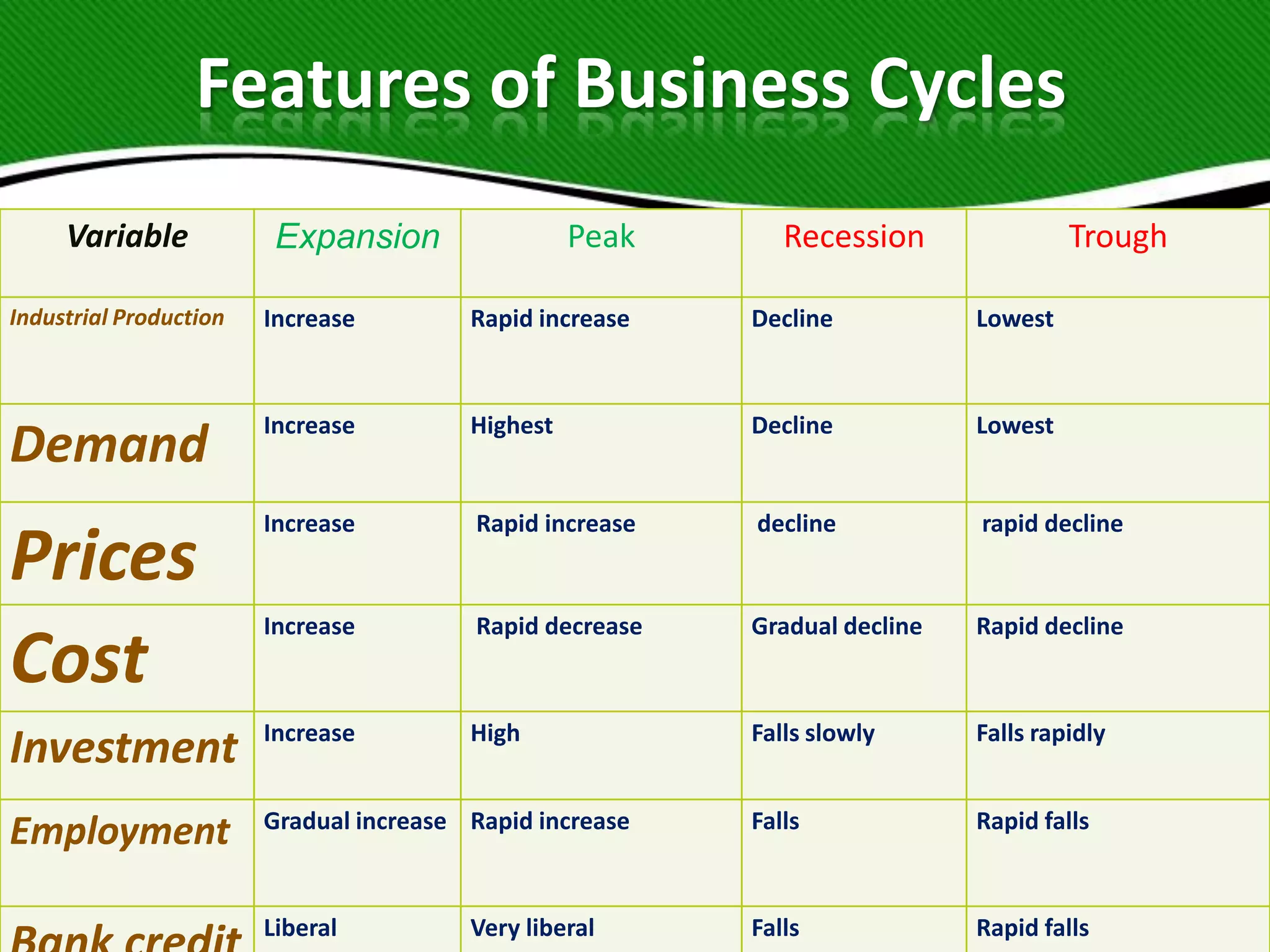
Features of Business Cycles
Variable

Peak

Expansion

Recession

Trough

Industrial Production

Increase

Rapid increase

Decline

Lowest

Demand

Increase

Highest

Decline

Lowest

Prices
Cost

Increase

Rapid increase

decline

rapid decline

Increase

Rapid decrease

Gradual decline

Rapid decline

Investment

Increase

High

Falls slowly

Falls rapidly

Employment

Gradual increase Rapid increase

Falls

Rapid falls

Liberal

Falls

Rapid falls

Very liberal
Business Cycle
• The business cycle is the periodic but irregular up-and-down
movements in economic activity, measured by fluctuations in real
GDP and other macroeconomic variables
• A business cycle is identified as a sequence of four phases:

– Contraction (A slowdown in the pace of economic
activity)
– Trough (The lower turning point of a business
cycle, where a contraction turns into an expansion)
– Expansion (A speedup in the pace of economic activity)
– Peak (The upper turning of a business cycle)
What does a model of the
business cycle look like?
The Business Cycle: diagram
Peak
Growth

Recession

GDP

Trough or
Depression
TIME
Business Cycle : Diagram
Expansion

Recession

Expansion

Total Output

Peak

Secular
growth
trend
Trough

0
WHAT ARE THE PHASES OF THE BUSINESS
CYCLE AND THE CHARACTERISTICS OF
EACH?
PHASES OF THE BUSINESS CYCLE
• Expansion/Growth: During this phase of
the business cycle, consumer and business
spending rise.
• Peak: After a period of growth, an
economy will reach a peak, where business
is producing at or near full capacity, and the
economy is at or near full employment.
Indicators of Business Cycles
There are variables other than real GDP that influence
the business cycle. They are classified into three:
(1) Leading Indicators: generally change before real
GDP changes.
Can be used to forecast future output.
(2) Coincident Indicators: tend to change at the same
time as real output changes
eg: as real output increases employment and sales
rise
Ref: MB p.136
Recession
Recession: This is a phase
when real GDP begins to
decline. Consumers and
business reduce their
spending, unemployment
rises, investment declines, and
pessimism about the economy
is likely to grow.
Recession
Trough/Depression

Trough/Depression: This is
the lowest point of the
business cycle. Factories will
be operating below capacity,
allowing unemployment to
reach high levels
Sources of Business cycle
• AGGREGATE DEMAND
• AGGREGATE SUPPLY
The degree to which real GDP declines or
increases depends on the amount by which AD
and AS curve shifts.
Business and a Boom
• A boom occurs when national output is rising
at a rate faster than the trend rate of growth
• It is characterised by HIGH consumer
spending, high business confidence,
investments and profits
• There is a lot more output.
CAUSES OF BUSINESS CYCLES

External factors
1. Inventions and innovation: Major changes in
technology can influence the business cycle.
Usually technological changes move the
economy in a positive direction, but this is not
always so.
2. Wars and political events: The impact of such
events on the economy are very fact specific- in
other words, difficult to generalize about.
A THOUGHT ON THE BUSINESS CYCLE

The business cycle tends to be selfsustaining. In other words, when in a
period of growth, the economy will
continue to grow (jobs leading to jobs)
until some event (internal or external)
intercedes.
A Good Cycle
More
goods
produced

More
spending

More
jobs
A Bad Cycle
Fewer
Jobs

Less
Spending

Fewer
Goods
Produced
GOVERNMENT AND THE BUSINESS CYCLE

• In order to prevent the economy from
running too hot (inflation) or too cold
(recession/depression), the
government often becomes involved in
efforts to try and stabilize the
economy.
• The government has two major tools to try
and stabilize the economy and achieve its
goals: fiscal policy and monetary policy.
FISCAL POLICY
Fiscal policy is the taxing and spending
decisions that are made by the President
and Congress.
• Fiscal policy actions of the government
fall into two general categories:
1. Raise or Lower Taxes
2. Increase or Decrease Government
Spending.
FISCAL POLICY
During a Recession
The Government can
• Lower taxes and/or
• Increase spending
These actions boost the economy by putting
more money in the hands of people so they can
spend it.
This is called Expansionary Fiscal Policy
Example of PEPSICo India
Business Cycle
Growth Phase – Boom Phase
Launched in India in 1988
Consistent Growth.

Waves of optimism.
Highest point of Expansion.
Rise
in
profits, investment, sales, employment etc.
Expansion
RETAIL MARKET SHARE OF BEVERAGE PRODUCTS

Bottled Water
13%

Teas
3%

Sports Drinks
2%

Fruit Drinks
16%
Colas
66%
Recession

Uncertain downfall.
Controversies.
Outcome- Decline in
profits, sales etc.
Revival
Turning point from depression into
expansion.
A result of New Innovation.
References
Aggarwal. A, Goyal. R, Jhamb. S, Gaurav. S, Karwa. A, & Rathi. R. (2012). Recesion in Japan& United
State:
http://www.slideshare.net/search/slideshow?searchfrom=header&q=Presentation+On+Recession+In+
Japan+%26+United+States.03 (March 2014)
Bobby. A, Sharma. A, Vineetha. K, Raghvandra. Y, Rohit. P& Vaibhav. J. (2010). Business Cycles:
http://www.slideshare.net/SameerAlam/mrktng-b-group5-business-cycle?qid=dbcecc0b-eb11-4020b455-84c8c7d42ac9&v=default&b=&from_search=34. (05 March 2014)
Akshbapna. D. (2014): Business cycles: http://www.slideshare.net/dakshbapna/business-cycle31444513?qid=123708e7-dd05-4886-b3f5-1ff309916edf&v=qf1&b=&from_search=2. 06 March 2014.
Becker. B, (2013). Corporate credit and Business cycle: http://www.slideshare.net/GlobalUtmaning/bobecker?qid=123708e7-dd05-4886-b3f5-1ff309916edf&v=qf1&b=&from_search=8. 05 March 2014.
Singla. H, (2012). Business Cycle: http://www.slideshare.net/harshulsingla/businesscycle1?qid=123708e7-dd05-4886-b3f5-1ff309916edf&v=default&b=&from_search=21. 05 March
2014.

Business Cycle presentation

  • 1.
    Business Cycles Presentation Thisis the collection of different presentations based on the Business Cycles from Slide share. Compiled by Thabani
  • 4.
    The Business Cycle BUSINESS CYCLES LG5 •Business Cycles -- Periodic rises and falls that occur in economies over time. • Four Phases of Long-Term Business Cycles: 1. Economic Boom 2. Recession – Two or more consecutive quarters of decline in the GDP. 3. Depression – A severe recession. 4. Recovery – When the economy stabilizes and starts to grow. This leads to an Economic Boom. 2-4
  • 5.
    Features of BusinessCycles Variable Peak Expansion Recession Trough Industrial Production Increase Rapid increase Decline Lowest Demand Increase Highest Decline Lowest Prices Cost Increase Rapid increase decline rapid decline Increase Rapid decrease Gradual decline Rapid decline Investment Increase High Falls slowly Falls rapidly Employment Gradual increase Rapid increase Falls Rapid falls Liberal Falls Rapid falls Very liberal
  • 6.
    Business Cycle • Thebusiness cycle is the periodic but irregular up-and-down movements in economic activity, measured by fluctuations in real GDP and other macroeconomic variables • A business cycle is identified as a sequence of four phases: – Contraction (A slowdown in the pace of economic activity) – Trough (The lower turning point of a business cycle, where a contraction turns into an expansion) – Expansion (A speedup in the pace of economic activity) – Peak (The upper turning of a business cycle)
  • 7.
    What does amodel of the business cycle look like?
  • 8.
    The Business Cycle:diagram Peak Growth Recession GDP Trough or Depression TIME
  • 9.
    Business Cycle :Diagram Expansion Recession Expansion Total Output Peak Secular growth trend Trough 0
  • 11.
    WHAT ARE THEPHASES OF THE BUSINESS CYCLE AND THE CHARACTERISTICS OF EACH?
  • 12.
    PHASES OF THEBUSINESS CYCLE • Expansion/Growth: During this phase of the business cycle, consumer and business spending rise. • Peak: After a period of growth, an economy will reach a peak, where business is producing at or near full capacity, and the economy is at or near full employment.
  • 13.
    Indicators of BusinessCycles There are variables other than real GDP that influence the business cycle. They are classified into three: (1) Leading Indicators: generally change before real GDP changes. Can be used to forecast future output. (2) Coincident Indicators: tend to change at the same time as real output changes eg: as real output increases employment and sales rise Ref: MB p.136
  • 14.
    Recession Recession: This isa phase when real GDP begins to decline. Consumers and business reduce their spending, unemployment rises, investment declines, and pessimism about the economy is likely to grow.
  • 15.
  • 16.
    Trough/Depression Trough/Depression: This is thelowest point of the business cycle. Factories will be operating below capacity, allowing unemployment to reach high levels
  • 17.
    Sources of Businesscycle • AGGREGATE DEMAND • AGGREGATE SUPPLY The degree to which real GDP declines or increases depends on the amount by which AD and AS curve shifts.
  • 18.
    Business and aBoom • A boom occurs when national output is rising at a rate faster than the trend rate of growth • It is characterised by HIGH consumer spending, high business confidence, investments and profits • There is a lot more output.
  • 19.
    CAUSES OF BUSINESSCYCLES External factors 1. Inventions and innovation: Major changes in technology can influence the business cycle. Usually technological changes move the economy in a positive direction, but this is not always so. 2. Wars and political events: The impact of such events on the economy are very fact specific- in other words, difficult to generalize about.
  • 20.
    A THOUGHT ONTHE BUSINESS CYCLE The business cycle tends to be selfsustaining. In other words, when in a period of growth, the economy will continue to grow (jobs leading to jobs) until some event (internal or external) intercedes.
  • 21.
  • 22.
  • 23.
    GOVERNMENT AND THEBUSINESS CYCLE • In order to prevent the economy from running too hot (inflation) or too cold (recession/depression), the government often becomes involved in efforts to try and stabilize the economy. • The government has two major tools to try and stabilize the economy and achieve its goals: fiscal policy and monetary policy.
  • 24.
    FISCAL POLICY Fiscal policyis the taxing and spending decisions that are made by the President and Congress. • Fiscal policy actions of the government fall into two general categories: 1. Raise or Lower Taxes 2. Increase or Decrease Government Spending.
  • 25.
    FISCAL POLICY During aRecession The Government can • Lower taxes and/or • Increase spending These actions boost the economy by putting more money in the hands of people so they can spend it. This is called Expansionary Fiscal Policy
  • 26.
    Example of PEPSICoIndia Business Cycle
  • 27.
    Growth Phase –Boom Phase Launched in India in 1988 Consistent Growth. Waves of optimism. Highest point of Expansion. Rise in profits, investment, sales, employment etc.
  • 28.
    Expansion RETAIL MARKET SHAREOF BEVERAGE PRODUCTS Bottled Water 13% Teas 3% Sports Drinks 2% Fruit Drinks 16% Colas 66%
  • 29.
  • 30.
    Revival Turning point fromdepression into expansion. A result of New Innovation.
  • 32.
    References Aggarwal. A, Goyal.R, Jhamb. S, Gaurav. S, Karwa. A, & Rathi. R. (2012). Recesion in Japan& United State: http://www.slideshare.net/search/slideshow?searchfrom=header&q=Presentation+On+Recession+In+ Japan+%26+United+States.03 (March 2014) Bobby. A, Sharma. A, Vineetha. K, Raghvandra. Y, Rohit. P& Vaibhav. J. (2010). Business Cycles: http://www.slideshare.net/SameerAlam/mrktng-b-group5-business-cycle?qid=dbcecc0b-eb11-4020b455-84c8c7d42ac9&v=default&b=&from_search=34. (05 March 2014) Akshbapna. D. (2014): Business cycles: http://www.slideshare.net/dakshbapna/business-cycle31444513?qid=123708e7-dd05-4886-b3f5-1ff309916edf&v=qf1&b=&from_search=2. 06 March 2014. Becker. B, (2013). Corporate credit and Business cycle: http://www.slideshare.net/GlobalUtmaning/bobecker?qid=123708e7-dd05-4886-b3f5-1ff309916edf&v=qf1&b=&from_search=8. 05 March 2014. Singla. H, (2012). Business Cycle: http://www.slideshare.net/harshulsingla/businesscycle1?qid=123708e7-dd05-4886-b3f5-1ff309916edf&v=default&b=&from_search=21. 05 March 2014.

Editor's Notes

  • #5 See Learning Goal 5: Discuss the economic system of the United States, including the significance of key economic indicators (especially GDP), productivity, and the business cycle.Yes, it is true that a recession is two or more consecutive quarters of contracting gross domestic product, but students will be interested to know that for a recession to be officially labeled a recession it must be declared by the National Bureau of Economic Research. Their website, www.nber.org, provides numerous resources to further explain this part of the business cycle.