GEETA MALIK
Assistant Professor
Advanced Educational Institutions
TRADE CYCLE
www.advanced.edu.in
Flow of The PPT
 Meaning and Definition of Trade Cycle.
 Nature of Trade Cycle.
 Fluctuations in Trade Cycle.
 Causes of Trade Cycle.
 Phases of Trade Cycle.
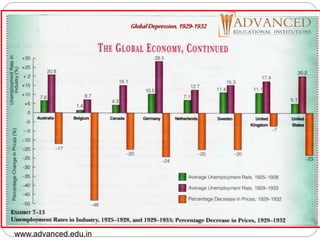
 Global Depression, 1929-1932
 Measures To Control Trade Cycle.
www.advanced.edu.in
Meaning Of Trade Cycle
The trade cycle refers to the ups and downs in
the level of economic activity which extends over
a period of several years. If we examine the past
statistical record of the business conditions, we
will find that business has never run smoothly for
ever. There are many fluctuations in the period.
Some times prosperity is followed by adversely. In
Economics this tendency of the business
activities, to fluctuate from prosperity to adversely
is called business cycle.
www.advanced.edu.in
Definition
Prof. Keynes says : " A trade cycle is composed
of periods of bad trade characterized by falling
prices and high unemployment percentages while
a period of good trade is characterized by rising
prices and high employment, percentages."
www.advanced.edu.in
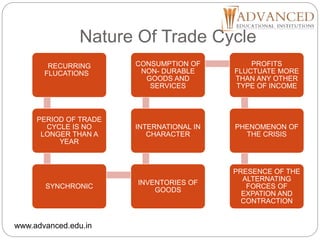
Nature Of Trade Cycle
RECURRING
FLUCATIONS
PERIOD OF TRADE
CYCLE IS NO
LONGER THAN A
YEAR
SYNCHRONIC
INVENTORIES OF
GOODS
INTERNATIONAL IN
CHARACTER
CONSUMPTION OF
NON- DURABLE
GOODS AND
SERVICES
PROFITS
FLUCTUATE MORE
THAN ANY OTHER
TYPE OF INCOME
PHENOMENON OF
THE CRISIS
PRESENCE OF THE
ALTERNATING
FORCES OF
EXPATION AND
CONTRACTION
www.advanced.edu.in
Fluctuations Of Trade Cycle
 Secular
 Seasonal variations
 Cyclical fluctuations
 Miscellaneous random fluctuations
www.advanced.edu.in
Causes Of Trade Cycle
 Banking Operations
 Capital goods and consumer goods
 Purchasing power
 Profit mania
 Human psychology
 Cyclical changes in weather
www.advanced.edu.in
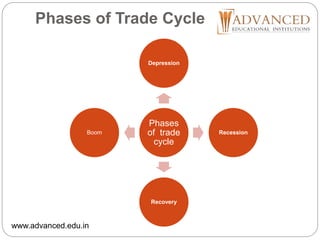
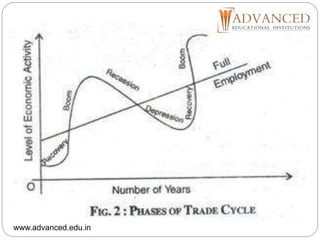
Phases of Trade Cycle
Phases
of trade
cycle
Depression
Recession
Recovery
Boom
www.advanced.edu.in
BOOM/ PEAK
 Peak or prosperity phase:
 Real output in the economy is at a high
level
 Unemployment is low
 Domestic output may be at its capacity
 Inflation may be high.
www.advanced.edu.in
RECESSION
 Contraction or recession phase:
 Real output is decreasing
 Unemployment rate is rising.
As contraction continues, inflation pressure
fades.
 If the recession is prolonged, price may
decline (deflation)
The government determinant for a recession
is two consecutive quarters of declining
output.www.advanced.edu.in
DEPRESSION
 √ Trough or depression phase:
 Lowest point of real GDP
 Output and unemployment “bottom out”
 This phase may be short-lived or prolonged
 There is no precise decline in output at which a
serious recession becomes a depression.
www.advanced.edu.in
RECOVERY
 √ Expansionary or recovery:
 Real output in the economy is increasing
 Unemployment rate is declining
 The upswing part of the cycle.
www.advanced.edu.in
www.advanced.edu.in
Global Depression, 1929-1932
www.advanced.edu.in
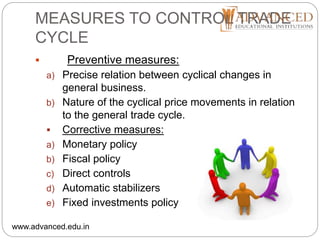
MEASURES TO CONTROL TRADE
CYCLE
 Preventive measures:
a) Precise relation between cyclical changes in
general business.
b) Nature of the cyclical price movements in relation
to the general trade cycle.
 Corrective measures:
a) Monetary policy
b) Fiscal policy
c) Direct controls
d) Automatic stabilizers
e) Fixed investments policy
www.advanced.edu.in
GEETA MALIK
Assistant Professor
Advanced Educational Institute
Advanced Educational Institutions,
70 km Milestone,
Delhi-Mathura Road, Dist. Palwal, Haryana-
121105
+91–1275–398400, 302222
gmalik16@gmail.com
www.advanced.edu.in
www.advanced.edu.in

Trade cycle

  • 1.
    GEETA MALIK Assistant Professor AdvancedEducational Institutions TRADE CYCLE www.advanced.edu.in
  • 2.
    Flow of ThePPT  Meaning and Definition of Trade Cycle.  Nature of Trade Cycle.  Fluctuations in Trade Cycle.  Causes of Trade Cycle.  Phases of Trade Cycle.  Global Depression, 1929-1932  Measures To Control Trade Cycle. www.advanced.edu.in
  • 3.
    Meaning Of TradeCycle The trade cycle refers to the ups and downs in the level of economic activity which extends over a period of several years. If we examine the past statistical record of the business conditions, we will find that business has never run smoothly for ever. There are many fluctuations in the period. Some times prosperity is followed by adversely. In Economics this tendency of the business activities, to fluctuate from prosperity to adversely is called business cycle. www.advanced.edu.in
  • 4.
    Definition Prof. Keynes says: " A trade cycle is composed of periods of bad trade characterized by falling prices and high unemployment percentages while a period of good trade is characterized by rising prices and high employment, percentages." www.advanced.edu.in
  • 5.
    Nature Of TradeCycle RECURRING FLUCATIONS PERIOD OF TRADE CYCLE IS NO LONGER THAN A YEAR SYNCHRONIC INVENTORIES OF GOODS INTERNATIONAL IN CHARACTER CONSUMPTION OF NON- DURABLE GOODS AND SERVICES PROFITS FLUCTUATE MORE THAN ANY OTHER TYPE OF INCOME PHENOMENON OF THE CRISIS PRESENCE OF THE ALTERNATING FORCES OF EXPATION AND CONTRACTION www.advanced.edu.in
  • 6.
    Fluctuations Of TradeCycle  Secular  Seasonal variations  Cyclical fluctuations  Miscellaneous random fluctuations www.advanced.edu.in
  • 7.
    Causes Of TradeCycle  Banking Operations  Capital goods and consumer goods  Purchasing power  Profit mania  Human psychology  Cyclical changes in weather www.advanced.edu.in
  • 8.
    Phases of TradeCycle Phases of trade cycle Depression Recession Recovery Boom www.advanced.edu.in
  • 9.
    BOOM/ PEAK  Peakor prosperity phase:  Real output in the economy is at a high level  Unemployment is low  Domestic output may be at its capacity  Inflation may be high. www.advanced.edu.in
  • 10.
    RECESSION  Contraction orrecession phase:  Real output is decreasing  Unemployment rate is rising. As contraction continues, inflation pressure fades.  If the recession is prolonged, price may decline (deflation) The government determinant for a recession is two consecutive quarters of declining output.www.advanced.edu.in
  • 11.
    DEPRESSION  √ Troughor depression phase:  Lowest point of real GDP  Output and unemployment “bottom out”  This phase may be short-lived or prolonged  There is no precise decline in output at which a serious recession becomes a depression. www.advanced.edu.in
  • 12.
    RECOVERY  √ Expansionaryor recovery:  Real output in the economy is increasing  Unemployment rate is declining  The upswing part of the cycle. www.advanced.edu.in
  • 13.
  • 14.
  • 15.
    MEASURES TO CONTROLTRADE CYCLE  Preventive measures: a) Precise relation between cyclical changes in general business. b) Nature of the cyclical price movements in relation to the general trade cycle.  Corrective measures: a) Monetary policy b) Fiscal policy c) Direct controls d) Automatic stabilizers e) Fixed investments policy www.advanced.edu.in
  • 16.
    GEETA MALIK Assistant Professor AdvancedEducational Institute Advanced Educational Institutions, 70 km Milestone, Delhi-Mathura Road, Dist. Palwal, Haryana- 121105 +91–1275–398400, 302222 gmalik16@gmail.com www.advanced.edu.in www.advanced.edu.in