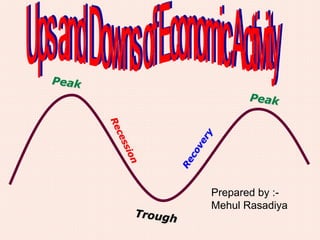
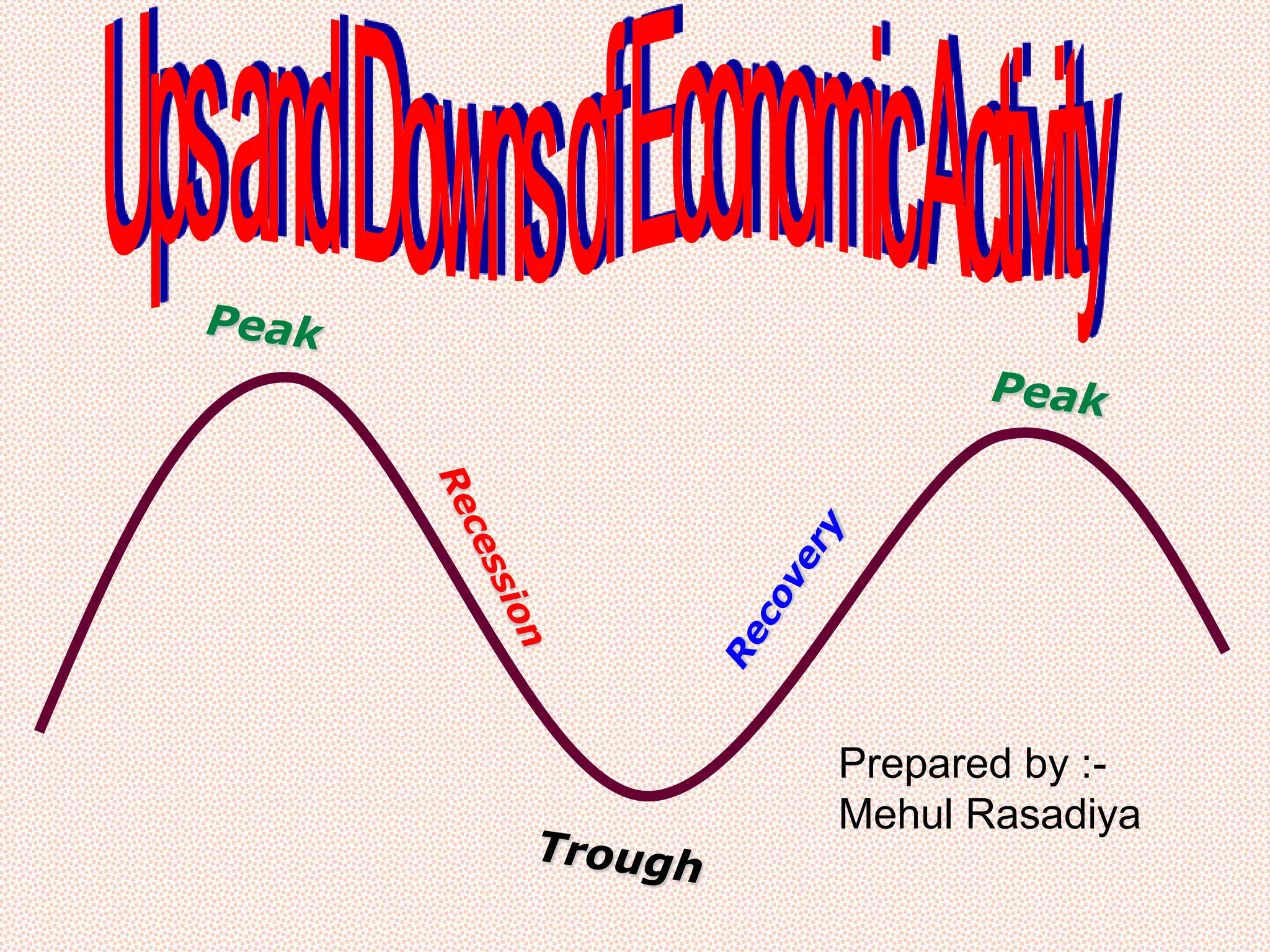
Prepared by :-
Mehul Rasadiya
Business Cycles
      √ The term business cycle
refers to the recurrent ups and
downs in the level of economic
activity, which extend over several
years.
    √ Individual business cycles
may vary greatly in duration and
intensity.
    √ All display a set of phases.
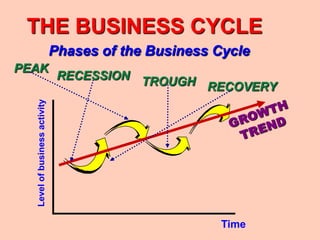
THE BUSINESS CYCLE
                               Phases of the Business Cycle
PEAK
                                RECESSION TROUGH
                                                 RECOVERY
  Level of business activity


                                                       Time
Level of business activity
                                 PEAK


                                        Time
√ Peak or prosperity phase:
    Real output in the economy is at
   a high level
    Unemployment is low
    Domestic output may be at its
   capacity
    Inflation may be high.
Level of business activity
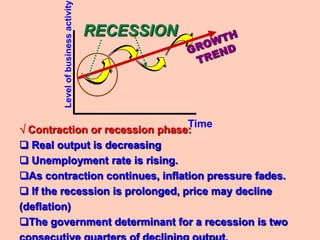
                                     RECESSION


                                  Time
√ Contraction or recession phase:
 Real output is decreasing
 Unemployment rate is rising.
As contraction continues, inflation pressure fades.
 If the recession is prolonged, price may decline
(deflation)
The government determinant for a recession is two
Level of business activity
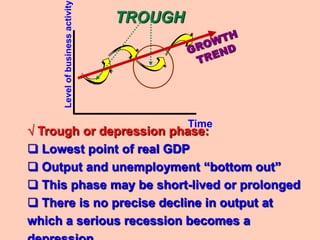
                                   TROUGH


                                            Time
√ Trough or depression phase:
 Lowest point of real GDP
 Output and unemployment “bottom out”
 This phase may be short-lived or prolonged
 There is no precise decline in output at
which a serious recession becomes a
Level of business activity
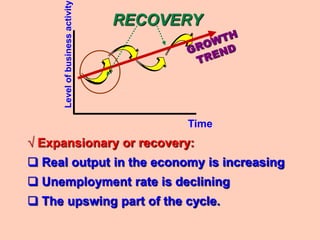
                                   RECOVERY


                                         Time
√ Expansionary or recovery:
 Real output in the economy is increasing
 Unemployment rate is declining
 The upswing part of the cycle.
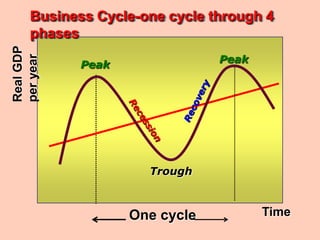
Business Cycle-one cycle through 4
     phases
Real GDP


                               Peak
per year

            Peak


                     Trough


                   One cycle          Time
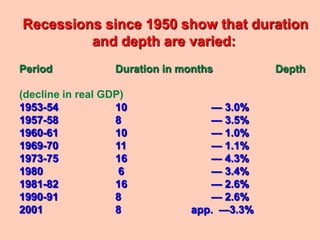
Recessions since 1950 show that duration
         and depth are varied:
Period            Duration in months        Depth

(decline in real GDP)
1953-54            10             — 3.0%
1957-58            8              — 3.5%
1960-61            10             — 1.0%
1969-70            11             — 1.1%
1973-75            16             — 4.3%
1980                6             — 3.4%
1981-82            16             — 2.6%
1990-91            8              — 2.6%
2001               8           app. —3.3%
How Indicators Monitor the
Four Phases of the Business Cycle
• The Leading Indicator System
      … provides a basis for monitoring the
tendency to move from one phase to the next.
      …assesses the strengths and
weaknesses in the economy
      … gives clues to a quickening or slowing
of future rates of economic growth
      … indicates the cyclical turning points in
moving from the upward expansion to the
downward recession, and from the recession to
the upward recovery.
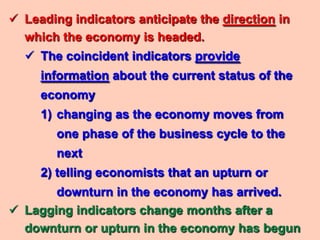
 Leading indicators anticipate the direction in
  which the economy is headed.
   The coincident indicators provide
     information about the current status of the
     economy
     1) changing as the economy moves from
        one phase of the business cycle to the
        next
     2) telling economists that an upturn or
       downturn in the economy has arrived.
 Lagging indicators change months after a
  downturn or upturn in the economy has begun
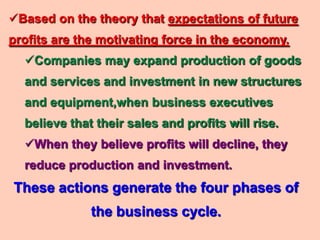
Based on the theory that expectations of future
profits are the motivating force in the economy.
  Companies may expand production of goods
  and services and investment in new structures
  and equipment,when business executives
  believe that their sales and profits will rise.
  When they believe profits will decline, they
  reduce production and investment.
These actions generate the four phases of
              the business cycle.
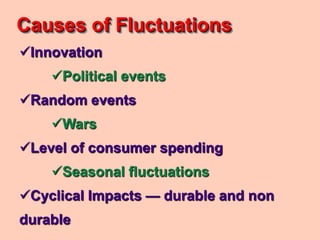
Causes of Fluctuations
Innovation
    Political events
Random events
    Wars
Level of consumer spending
    Seasonal fluctuations
Cyclical Impacts — durable and non
durable
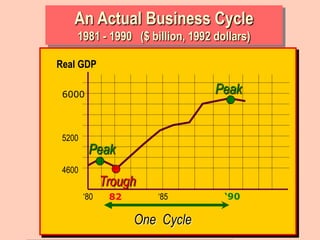
An Actual Business Cycle
    1981 - 1990 ($ billion, 1992 dollars)

Real GDP

 6000                            Peak


 5200
         Peak
 4600
              Trough
        ‘80    82      ‘85         ‘90

                    One Cycle
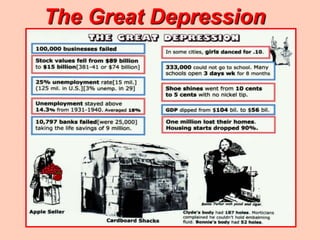
The Great Depression
The Great Depression [continued]
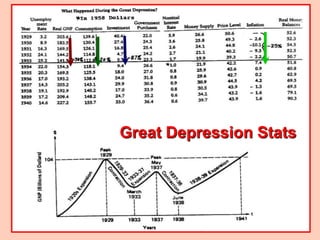
Great Depression Stats
Global Depression, 1929-1932


                Ave. Unemployment Rate, 1925-1928

                Ave. Unemployment Rate, 1929-1933

                Percent Decrease in Prices, 1929-1932
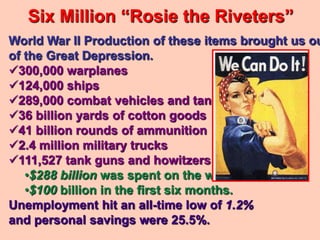
Six Million “Rosie the Riveters”
World War II Production of these items brought us ou
of the Great Depression.
300,000 warplanes
124,000 ships
289,000 combat vehicles and tanks
36 billion yards of cotton goods
41 billion rounds of ammunition
2.4 million military trucks
111,527 tank guns and howitzers
   •$288 billion was spent on the war,
   •$100 billion in the first six months.
Unemployment hit an all-time low of 1.2%
and personal savings were 25.5%.

Business cycles

  • 1.
  • 2.
    Business Cycles √ The term business cycle refers to the recurrent ups and downs in the level of economic activity, which extend over several years. √ Individual business cycles may vary greatly in duration and intensity. √ All display a set of phases.
  • 3.
    THE BUSINESS CYCLE Phases of the Business Cycle PEAK RECESSION TROUGH RECOVERY Level of business activity Time
  • 4.
    Level of businessactivity PEAK Time √ Peak or prosperity phase:  Real output in the economy is at a high level  Unemployment is low  Domestic output may be at its capacity  Inflation may be high.
  • 5.
    Level of businessactivity RECESSION Time √ Contraction or recession phase:  Real output is decreasing  Unemployment rate is rising. As contraction continues, inflation pressure fades.  If the recession is prolonged, price may decline (deflation) The government determinant for a recession is two
  • 6.
    Level of businessactivity TROUGH Time √ Trough or depression phase:  Lowest point of real GDP  Output and unemployment “bottom out”  This phase may be short-lived or prolonged  There is no precise decline in output at which a serious recession becomes a
  • 7.
    Level of businessactivity RECOVERY Time √ Expansionary or recovery:  Real output in the economy is increasing  Unemployment rate is declining  The upswing part of the cycle.
  • 8.
    Business Cycle-one cyclethrough 4 phases Real GDP Peak per year Peak Trough One cycle Time
  • 9.
    Recessions since 1950show that duration and depth are varied: Period Duration in months Depth (decline in real GDP) 1953-54 10 — 3.0% 1957-58 8 — 3.5% 1960-61 10 — 1.0% 1969-70 11 — 1.1% 1973-75 16 — 4.3% 1980 6 — 3.4% 1981-82 16 — 2.6% 1990-91 8 — 2.6% 2001 8 app. —3.3%
  • 10.
    How Indicators Monitorthe Four Phases of the Business Cycle • The Leading Indicator System … provides a basis for monitoring the tendency to move from one phase to the next. …assesses the strengths and weaknesses in the economy … gives clues to a quickening or slowing of future rates of economic growth … indicates the cyclical turning points in moving from the upward expansion to the downward recession, and from the recession to the upward recovery.
  • 11.
     Leading indicatorsanticipate the direction in which the economy is headed.  The coincident indicators provide information about the current status of the economy 1) changing as the economy moves from one phase of the business cycle to the next 2) telling economists that an upturn or downturn in the economy has arrived.  Lagging indicators change months after a downturn or upturn in the economy has begun
  • 12.
    Based on thetheory that expectations of future profits are the motivating force in the economy. Companies may expand production of goods and services and investment in new structures and equipment,when business executives believe that their sales and profits will rise. When they believe profits will decline, they reduce production and investment. These actions generate the four phases of the business cycle.
  • 13.
    Causes of Fluctuations Innovation Political events Random events Wars Level of consumer spending Seasonal fluctuations Cyclical Impacts — durable and non durable
  • 14.
    An Actual BusinessCycle 1981 - 1990 ($ billion, 1992 dollars) Real GDP 6000 Peak 5200 Peak 4600 Trough ‘80 82 ‘85 ‘90 One Cycle
  • 15.
  • 16.
  • 17.
  • 18.
    Global Depression, 1929-1932 Ave. Unemployment Rate, 1925-1928 Ave. Unemployment Rate, 1929-1933 Percent Decrease in Prices, 1929-1932
  • 19.
    Six Million “Rosiethe Riveters” World War II Production of these items brought us ou of the Great Depression. 300,000 warplanes 124,000 ships 289,000 combat vehicles and tanks 36 billion yards of cotton goods 41 billion rounds of ammunition 2.4 million military trucks 111,527 tank guns and howitzers •$288 billion was spent on the war, •$100 billion in the first six months. Unemployment hit an all-time low of 1.2% and personal savings were 25.5%.