•What is inflation?
•Measurement of Inflation
•Types of Inflation
•Causes and Effects of Inflation
•Control of Inflation
•Inflation and Economic Developement
•Inflation in India
INFLATION
What is Inflation?
In economics, inflation is a sustained increase
in the general price level of goods and services in
an economy over a period of time.
Consequently, inflation reflects a reduction in
the purchasing power per unit of money – a loss
of real value in the medium of exchange and unit
of account within the economy.
Measuring Inflation
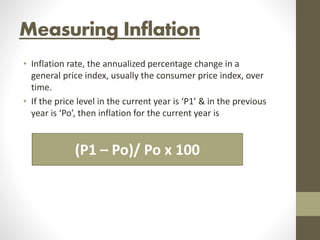
• Inflation rate, the annualized percentage change in a
general price index, usually the consumer price index, over
time.
• If the price level in the current year is ‘P1’ & in the previous
year is ‘Po’, then inflation for the current year is
(P1 – Po)/ Po x 100
CPI and WPI
• CPI: It is a comprehensive measure used for estimation of
price changes in a basket of goods and services representative
of consumption expenditure in an economy is called consumer
price index. The percentage change in this index over a period
of time gives the amount of inflation over that specific period,
i.e. the increase in prices of a representative basket of goods
consumed.
• WPI: represents the price of goods at a wholesale stage i.e.
goods that are sold in bulk and traded between organizations
instead of consumers. WPI is used as a measure of inflation in
some economies. Inflation rate is the difference between WPI
calculated at the beginning and the end of a year. The
percentage increase in WPI over a year gives the rate of
inflation for that year.
Other widely used price indices
for calculating price inflation
• Commodity price indices : It is a fixed-weight index or (weighted)
average of selected commodity prices, which may be based on spot
or futures prices. It measures the price of a selection of
commodities.
• GDP deflator : is a measure of the price of all the goods and services
included in gross domestic product (GDP).
• Asset price inflation : is an undue increase in the prices of real or
financial assets, such as stock (equity) and real estate.
• Core price indices : The "core" PCE price index is defined as personal
consumption expenditures (PCE) prices excluding food and energy
prices. The core PCE price index measures the prices paid by
consumers for goods and services without the volatility caused by
movements in food and energy prices to reveal underlying inflation
trends. This is because food and oil prices can change quickly due to
changes in supply and demand conditions in the food and oil
markets, it can be difficult to detect the long run trend in price levels
when those prices are included.
Causes of inflation
1. Cost –Push Inflation
• Cost push inflation occurs when we experience rising prices due to higher
costs of production and higher costs of raw materials. Cost push inflation is
determined by supply side factors. Cost-push inflation can lead to lower
economic growth and often causes a fall in living standards, though it often
proves to be temporary.
• CAUSES OF COST-PULL INFLATION:
1. Rising wages
2. Import prices
3. Raw material prices and commodity costs
4. Profit push inflation
5. Declining productivity
6. Higher taxes
DiagramShowingCostPushInflation
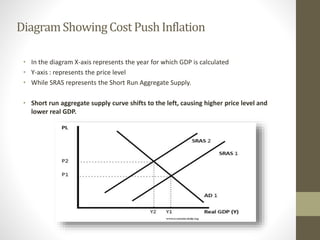
• In the diagram X-axis represents the year for which GDP is calculated
• Y-axis : represents the price level
• While SRAS represents the Short Run Aggregate Supply.
• Short run aggregate supply curve shifts to the left, causing higher price level and
lower real GDP.
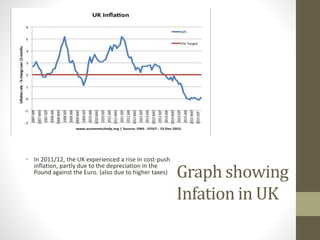
• In 2011/12, the UK experienced a rise in cost-push
inflation, partly due to the depreciation in the
Pound against the Euro. (also due to higher taxes) Graph showing
Infation in UK
2.Demand-pull inflation
• Demand pull inflation occurs when aggregate demand is
growing at an unsustainable rate leading to increased
pressure on scarce resources and a positive output gap
• When there is excess demand, producers can raise their prices
and achieve bigger profit margins
• Demand-pull inflation becomes a threat when an economy
has experienced a boom with GDP rising faster than the long-
run trend growth of potential GDP
• Demand-pull inflation is likely when there is full employment
of resources and SRAS is inelastic
Causes of Demand-Pull Inflation
• A depreciation of the exchange rate increases the price of imports and
reduces the foreign price of a country's exports. If consumers buy fewer
imports, while exports grow, AD in will rise – and there may be a
multiplier effect on the level of demand and output
• Higher demand from a fiscal stimulus e.g. lower direct or indirect taxes
or higher government spending. If direct taxes are reduced, consumers
have more disposable income causing demand to rise. Higher
government spending and increased borrowing creates extra demand in
the circular flow
• Monetary stimulus to the economy: A fall in interest rates may
stimulate too much demand – for example in raising demand for loans
or in leading to house price inflation. Monetarist economists believe
that inflation is caused by “too much money chasing too few goods" and
that governments can lose control of inflation if they allow the financial
system to expand the money supply too quickly.
• Fast growth in other countries – providing a boost to UK exports
overseas. Export sales provide an extra flow of income and spending
into the UK circular flow – so what is happening to the economic cycles
of other countries definitely affects the UK
Concepts of Deflation,
Disinflation,Reflation & Stagflation
• Deflation – is a condition of falling prices on account of
insufficient effective demand. Results in a continuous fall in
level of economic activity & growing unemployment
• Disinflation – it is a process of lowering costs & prices when
they are excessively high. Brings down inflationary trend in
prices without causing unemployment
• Reflation – is a moderate degree of inflation that is
deliberately undertaken to relieve depression
• Stagflation – a situation in which a high rate of inflation
prevails simultaneously with a high rate of unemployment or
stagnant economic condition. It is a combination of inflation &
stagnation
Effects of Inflation
General Effect
• An increase in the general level of prices implies a decrease in the
purchasing power of the currency. The effect of inflation is not distributed
evenly in the economy, and as a consequence there are hidden costs to
some and benefits to others from this decrease in the purchasing power of
money.
• Effect On Redistribution Of Income:
(1) Debtors and Creditors,: debtors gain and creditors lose.
(2) Salaried Persons: lose
(3) Wage Earners: may gain or lose
(4) Fixed Income Group: lose
(5) Equity Holders or Investors: gain
(6) Businessmen: gain
(7) Agriculturists: gain or lose
Positive Effect Of Inflation
1.Deflation (a fall in prices – negative inflation) is very harmful. When
prices are falling people are reluctant to spend money because they
are concerned that prices will be cheaper in the future, therefore,
they keep delaying purchases.
2. Moderate inflation enables adjustment of wages: example, it may
be difficult to cut nominal wages .But, if average wages are rising
due to moderate inflation, it is easier to increase the wages of
productive workers;
3. Inflation can boost growth. At times of very low inflation the
economy may be stuck in a recession. Arguably targeting a higher
rate of inflation can enable a boost in economic growth. (Although
this view is controversial).
Control of Inflation
1. Monetary Measures: Monetary measures aim at reducing money incomes.
(a) Credit Control
(b) Demonetisation of Currency
(c) Issue of New Currency
2. Fiscal Measures: Fiscal measures are highly effective for controlling government
expenditure, personal consumption expenditure, and private and public investment.
(a) Reduction in Unnecessary Expenditure
(b) Increase in Taxes
(c) Increase in Savings
(d) Surplus Budgets
(e) stop repayment of public debt
3. Other Measures: are those which aim at increasing aggregate supply and reducing
aggregate demand directly.
(a) Increase Production
(b) Adopt Rational Wage Policy
(c) Check Price Control
(d) Rationing
Inflation in India
• In India ,CPI (combined) is used for calculation of
inflation.
• Current inflation in India: august 2016:- 5.30 %
• In India WPI is published on a weekly basis and
CPI on monthly basis.
THANKYOU

Inflation

  • 1.
    •What is inflation? •Measurementof Inflation •Types of Inflation •Causes and Effects of Inflation •Control of Inflation •Inflation and Economic Developement •Inflation in India INFLATION
  • 2.
    What is Inflation? Ineconomics, inflation is a sustained increase in the general price level of goods and services in an economy over a period of time. Consequently, inflation reflects a reduction in the purchasing power per unit of money – a loss of real value in the medium of exchange and unit of account within the economy.
  • 3.
    Measuring Inflation • Inflationrate, the annualized percentage change in a general price index, usually the consumer price index, over time. • If the price level in the current year is ‘P1’ & in the previous year is ‘Po’, then inflation for the current year is (P1 – Po)/ Po x 100
  • 4.
    CPI and WPI •CPI: It is a comprehensive measure used for estimation of price changes in a basket of goods and services representative of consumption expenditure in an economy is called consumer price index. The percentage change in this index over a period of time gives the amount of inflation over that specific period, i.e. the increase in prices of a representative basket of goods consumed. • WPI: represents the price of goods at a wholesale stage i.e. goods that are sold in bulk and traded between organizations instead of consumers. WPI is used as a measure of inflation in some economies. Inflation rate is the difference between WPI calculated at the beginning and the end of a year. The percentage increase in WPI over a year gives the rate of inflation for that year.
  • 5.
    Other widely usedprice indices for calculating price inflation • Commodity price indices : It is a fixed-weight index or (weighted) average of selected commodity prices, which may be based on spot or futures prices. It measures the price of a selection of commodities. • GDP deflator : is a measure of the price of all the goods and services included in gross domestic product (GDP). • Asset price inflation : is an undue increase in the prices of real or financial assets, such as stock (equity) and real estate. • Core price indices : The "core" PCE price index is defined as personal consumption expenditures (PCE) prices excluding food and energy prices. The core PCE price index measures the prices paid by consumers for goods and services without the volatility caused by movements in food and energy prices to reveal underlying inflation trends. This is because food and oil prices can change quickly due to changes in supply and demand conditions in the food and oil markets, it can be difficult to detect the long run trend in price levels when those prices are included.
  • 6.
  • 7.
    1. Cost –PushInflation • Cost push inflation occurs when we experience rising prices due to higher costs of production and higher costs of raw materials. Cost push inflation is determined by supply side factors. Cost-push inflation can lead to lower economic growth and often causes a fall in living standards, though it often proves to be temporary. • CAUSES OF COST-PULL INFLATION: 1. Rising wages 2. Import prices 3. Raw material prices and commodity costs 4. Profit push inflation 5. Declining productivity 6. Higher taxes
  • 8.
    DiagramShowingCostPushInflation • In thediagram X-axis represents the year for which GDP is calculated • Y-axis : represents the price level • While SRAS represents the Short Run Aggregate Supply. • Short run aggregate supply curve shifts to the left, causing higher price level and lower real GDP.
  • 9.
    • In 2011/12,the UK experienced a rise in cost-push inflation, partly due to the depreciation in the Pound against the Euro. (also due to higher taxes) Graph showing Infation in UK
  • 10.
    2.Demand-pull inflation • Demandpull inflation occurs when aggregate demand is growing at an unsustainable rate leading to increased pressure on scarce resources and a positive output gap • When there is excess demand, producers can raise their prices and achieve bigger profit margins • Demand-pull inflation becomes a threat when an economy has experienced a boom with GDP rising faster than the long- run trend growth of potential GDP • Demand-pull inflation is likely when there is full employment of resources and SRAS is inelastic
  • 11.
    Causes of Demand-PullInflation • A depreciation of the exchange rate increases the price of imports and reduces the foreign price of a country's exports. If consumers buy fewer imports, while exports grow, AD in will rise – and there may be a multiplier effect on the level of demand and output • Higher demand from a fiscal stimulus e.g. lower direct or indirect taxes or higher government spending. If direct taxes are reduced, consumers have more disposable income causing demand to rise. Higher government spending and increased borrowing creates extra demand in the circular flow • Monetary stimulus to the economy: A fall in interest rates may stimulate too much demand – for example in raising demand for loans or in leading to house price inflation. Monetarist economists believe that inflation is caused by “too much money chasing too few goods" and that governments can lose control of inflation if they allow the financial system to expand the money supply too quickly. • Fast growth in other countries – providing a boost to UK exports overseas. Export sales provide an extra flow of income and spending into the UK circular flow – so what is happening to the economic cycles of other countries definitely affects the UK
  • 12.
    Concepts of Deflation, Disinflation,Reflation& Stagflation • Deflation – is a condition of falling prices on account of insufficient effective demand. Results in a continuous fall in level of economic activity & growing unemployment • Disinflation – it is a process of lowering costs & prices when they are excessively high. Brings down inflationary trend in prices without causing unemployment • Reflation – is a moderate degree of inflation that is deliberately undertaken to relieve depression • Stagflation – a situation in which a high rate of inflation prevails simultaneously with a high rate of unemployment or stagnant economic condition. It is a combination of inflation & stagnation
  • 13.
  • 14.
    General Effect • Anincrease in the general level of prices implies a decrease in the purchasing power of the currency. The effect of inflation is not distributed evenly in the economy, and as a consequence there are hidden costs to some and benefits to others from this decrease in the purchasing power of money. • Effect On Redistribution Of Income: (1) Debtors and Creditors,: debtors gain and creditors lose. (2) Salaried Persons: lose (3) Wage Earners: may gain or lose (4) Fixed Income Group: lose (5) Equity Holders or Investors: gain (6) Businessmen: gain (7) Agriculturists: gain or lose
  • 15.
    Positive Effect OfInflation 1.Deflation (a fall in prices – negative inflation) is very harmful. When prices are falling people are reluctant to spend money because they are concerned that prices will be cheaper in the future, therefore, they keep delaying purchases. 2. Moderate inflation enables adjustment of wages: example, it may be difficult to cut nominal wages .But, if average wages are rising due to moderate inflation, it is easier to increase the wages of productive workers; 3. Inflation can boost growth. At times of very low inflation the economy may be stuck in a recession. Arguably targeting a higher rate of inflation can enable a boost in economic growth. (Although this view is controversial).
  • 16.
    Control of Inflation 1.Monetary Measures: Monetary measures aim at reducing money incomes. (a) Credit Control (b) Demonetisation of Currency (c) Issue of New Currency 2. Fiscal Measures: Fiscal measures are highly effective for controlling government expenditure, personal consumption expenditure, and private and public investment. (a) Reduction in Unnecessary Expenditure (b) Increase in Taxes (c) Increase in Savings (d) Surplus Budgets (e) stop repayment of public debt 3. Other Measures: are those which aim at increasing aggregate supply and reducing aggregate demand directly. (a) Increase Production (b) Adopt Rational Wage Policy (c) Check Price Control (d) Rationing
  • 17.
    Inflation in India •In India ,CPI (combined) is used for calculation of inflation. • Current inflation in India: august 2016:- 5.30 % • In India WPI is published on a weekly basis and CPI on monthly basis.
  • 18.