Building ADAS
SYSTEM from scratch
Alex Myakov, Chief CV Advocate
Yury Gorbachev, CV Integration & Optimization lead
September, 2016
Who we are ?
Itseez was acquired by IoTG/Intel in July, 2016
Itseez was founded in 2005:
• 3 ex- Intel co-Founders + 1 Principal Engineer
• OpenCV development and support (2005-present)
• OpenVX initiative leaders: v1.0 and v1.1 were published in
October, 2014 and in May, 2016
SW Products: ADAS, Facense, AcceleratedCV (ACV)
Skills: CV algorithms, HW specific optimization, 3+
years of deep learning (DL)
Industries: automotive, security, robotics, wearables,etc
Building ADAS System from Scratch
The Dream and Ambition:
• Create state-of-the-art software based front
camera ADAS algos
• License such algos to Tier-1s and OEMs
Starting point (late 2013):
• Strong knowledge of CV
• Strong knowledge of embedded/optimization
• Good knowledge of cameras/sensors/optics
• No ADAS/automotive specific knowledge
Building ADAS solution from scratch
Strategy:
• Highly portable CV algos (pure ARM optimized code)
• Open SW platform (Android, Linux)
• Simplest system possible
• Cheapest COTS components
• Camera (optics, sensor, packaging)
• HW platform
• Easy/fast installation in any car with no dependence
on car parameters
• Automatic or simple calibration
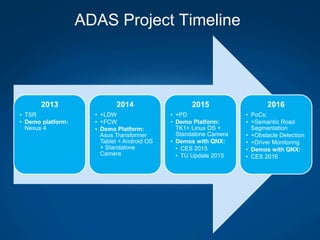
ADAS Project Timeline
2013
• TSR
• Demo platform:
Nexus 4
2014
• +LDW
• +FCW
• Demo Platform:
Asus Transformer
Tablet + Android OS
+ Standalone
Camera
2015
• +PD
• Demo Platform:
TK1+ Linux OS +
Standalone Camera
• Demos with QNX:
• CES 2015
• TU Update 2015
2016
• PoCs:
• +Semantic Road
Segmentation
• +Obstacle Detection
• +Driver Monitoring
• Demos with QNX:
• CES 2016
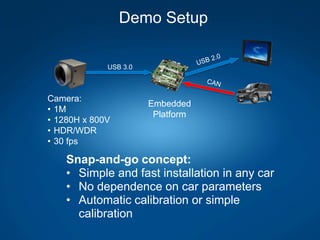
Demo Setup
Camera:
• 1M
• 1280H x 800V
• HDR/WDR
• 30 fps
Embedded
Platform
USB 3.0
Snap-and-go concept:
• Simple and fast installation in any car
• No dependence on car parameters
• Automatic calibration or simple
calibration
Lessons Learned
We expected ADAS to be just another CV application !
• we ended up running into and solving lots of issues
• SW development/testing paradigm
• HW issues
• Datasets
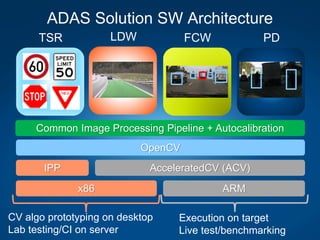
ADAS Solution SW Architecture
TSR LDW FCW PD
Common Image Processing Pipeline + Autocalibration
OpenCV
IPP AcceleratedCV (ACV)
x86 ARM
CV algo prototyping on desktop
Lab testing/CI on server
Execution on target
Live test/benchmarking
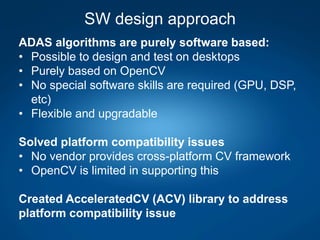
SW design approach
ADAS algorithms are purely software based:
• Possible to design and test on desktops
• Purely based on OpenCV
• No special software skills are required (GPU, DSP,
etc)
• Flexible and upgradable
Solved platform compatibility issues
• No vendor provides cross-platform CV framework
• OpenCV is limited in supporting this
Created AcceleratedCV (ACV) library to address
platform compatibility issue
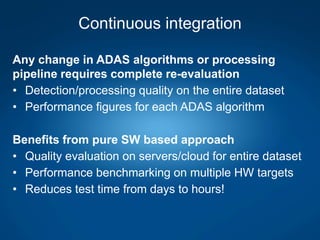
Continuous integration
Any change in ADAS algorithms or processing
pipeline requires complete re-evaluation
• Detection/processing quality on the entire dataset
• Performance figures for each ADAS algorithm
Benefits from pure SW based approach
• Quality evaluation on servers/cloud for entire dataset
• Performance benchmarking on multiple HW targets
• Reduces test time from days to hours!
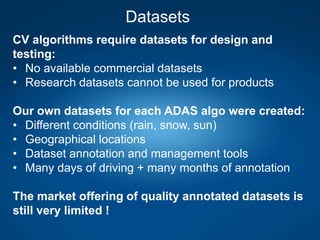
Datasets
CV algorithms require datasets for design and
testing:
• No available commercial datasets
• Research datasets cannot be used for products
Our own datasets for each ADAS algo were created:
• Different conditions (rain, snow, sun)
• Geographical locations
• Dataset annotation and management tools
• Many days of driving + many months of annotation
The market offering of quality annotated datasets is
still very limited !
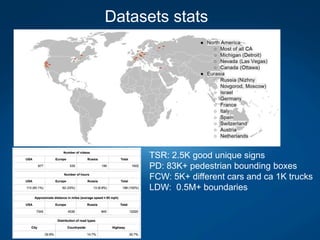
Datasets stats
TSR: 2.5K good unique signs
PD: 83K+ pedestrian bounding boxes
FCW: 5K+ different cars and ca 1K trucks
LDW: 0.5M+ boundaries
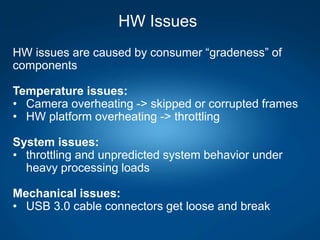
HW Issues
HW issues are caused by consumer “gradeness” of
components
Temperature issues:
• Camera overheating -> skipped or corrupted frames
• HW platform overheating -> throttling
System issues:
• throttling and unpredicted system behavior under
heavy processing loads
Mechanical issues:
• USB 3.0 cable connectors get loose and break
Where is Deep Learning in our algos?
Original ADAS algos were based on classical CV
• Embedded platforms were too weak and not able to
provide required performance Gflops
• Datasets were too small to yield quality DL results
• DL technology was not fully there
Conventional CV + small DL networks:
• PD: validation of PD results based on classical CV –
increase DR and reduce FA rate
• Driver monitoring: conventional face detector + DL
based headpose estimation
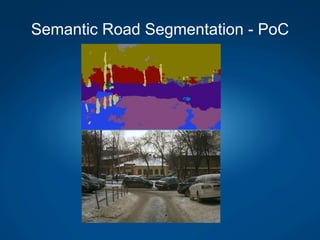
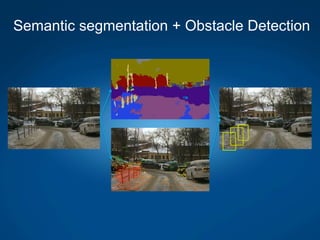
Semantic Road Segmentation - PoC
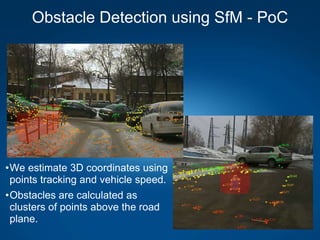
Obstacle Detection using SfM - PoC
•We estimate 3D coordinates using
points tracking and vehicle speed.
•Obstacles are calculated as
clusters of points above the road
plane.
Semantic segmentation + Obstacle Detection
Deep Learning - Silver Bullet ?
• Great new CV tool
• Large datasets
• A few orders of magnitude more compute
than classic CV
• FuSa implications
Questions ?
Contact Details:
Alex Myakov, Chief CV Advocate
Email: alex.myakov@intel.com

Building ADAS system from scratch

  • 1.
    Building ADAS SYSTEM fromscratch Alex Myakov, Chief CV Advocate Yury Gorbachev, CV Integration & Optimization lead September, 2016
  • 2.
    Who we are? Itseez was acquired by IoTG/Intel in July, 2016 Itseez was founded in 2005: • 3 ex- Intel co-Founders + 1 Principal Engineer • OpenCV development and support (2005-present) • OpenVX initiative leaders: v1.0 and v1.1 were published in October, 2014 and in May, 2016 SW Products: ADAS, Facense, AcceleratedCV (ACV) Skills: CV algorithms, HW specific optimization, 3+ years of deep learning (DL) Industries: automotive, security, robotics, wearables,etc
  • 3.
    Building ADAS Systemfrom Scratch The Dream and Ambition: • Create state-of-the-art software based front camera ADAS algos • License such algos to Tier-1s and OEMs Starting point (late 2013): • Strong knowledge of CV • Strong knowledge of embedded/optimization • Good knowledge of cameras/sensors/optics • No ADAS/automotive specific knowledge
  • 4.
    Building ADAS solutionfrom scratch Strategy: • Highly portable CV algos (pure ARM optimized code) • Open SW platform (Android, Linux) • Simplest system possible • Cheapest COTS components • Camera (optics, sensor, packaging) • HW platform • Easy/fast installation in any car with no dependence on car parameters • Automatic or simple calibration
  • 5.
    ADAS Project Timeline 2013 •TSR • Demo platform: Nexus 4 2014 • +LDW • +FCW • Demo Platform: Asus Transformer Tablet + Android OS + Standalone Camera 2015 • +PD • Demo Platform: TK1+ Linux OS + Standalone Camera • Demos with QNX: • CES 2015 • TU Update 2015 2016 • PoCs: • +Semantic Road Segmentation • +Obstacle Detection • +Driver Monitoring • Demos with QNX: • CES 2016
  • 6.
    Demo Setup Camera: • 1M •1280H x 800V • HDR/WDR • 30 fps Embedded Platform USB 3.0 Snap-and-go concept: • Simple and fast installation in any car • No dependence on car parameters • Automatic calibration or simple calibration
  • 7.
    Lessons Learned We expectedADAS to be just another CV application ! • we ended up running into and solving lots of issues • SW development/testing paradigm • HW issues • Datasets
  • 8.
    ADAS Solution SWArchitecture TSR LDW FCW PD Common Image Processing Pipeline + Autocalibration OpenCV IPP AcceleratedCV (ACV) x86 ARM CV algo prototyping on desktop Lab testing/CI on server Execution on target Live test/benchmarking
  • 9.
    SW design approach ADASalgorithms are purely software based: • Possible to design and test on desktops • Purely based on OpenCV • No special software skills are required (GPU, DSP, etc) • Flexible and upgradable Solved platform compatibility issues • No vendor provides cross-platform CV framework • OpenCV is limited in supporting this Created AcceleratedCV (ACV) library to address platform compatibility issue
  • 10.
    Continuous integration Any changein ADAS algorithms or processing pipeline requires complete re-evaluation • Detection/processing quality on the entire dataset • Performance figures for each ADAS algorithm Benefits from pure SW based approach • Quality evaluation on servers/cloud for entire dataset • Performance benchmarking on multiple HW targets • Reduces test time from days to hours!
  • 11.
    Datasets CV algorithms requiredatasets for design and testing: • No available commercial datasets • Research datasets cannot be used for products Our own datasets for each ADAS algo were created: • Different conditions (rain, snow, sun) • Geographical locations • Dataset annotation and management tools • Many days of driving + many months of annotation The market offering of quality annotated datasets is still very limited !
  • 12.
    Datasets stats TSR: 2.5Kgood unique signs PD: 83K+ pedestrian bounding boxes FCW: 5K+ different cars and ca 1K trucks LDW: 0.5M+ boundaries
  • 13.
    HW Issues HW issuesare caused by consumer “gradeness” of components Temperature issues: • Camera overheating -> skipped or corrupted frames • HW platform overheating -> throttling System issues: • throttling and unpredicted system behavior under heavy processing loads Mechanical issues: • USB 3.0 cable connectors get loose and break
  • 14.
    Where is DeepLearning in our algos? Original ADAS algos were based on classical CV • Embedded platforms were too weak and not able to provide required performance Gflops • Datasets were too small to yield quality DL results • DL technology was not fully there Conventional CV + small DL networks: • PD: validation of PD results based on classical CV – increase DR and reduce FA rate • Driver monitoring: conventional face detector + DL based headpose estimation
  • 15.
  • 16.
    Obstacle Detection usingSfM - PoC •We estimate 3D coordinates using points tracking and vehicle speed. •Obstacles are calculated as clusters of points above the road plane.
  • 17.
    Semantic segmentation +Obstacle Detection
  • 18.
    Deep Learning -Silver Bullet ? • Great new CV tool • Large datasets • A few orders of magnitude more compute than classic CV • FuSa implications
  • 19.
    Questions ? Contact Details: AlexMyakov, Chief CV Advocate Email: alex.myakov@intel.com