ADAPTIVE CRUISE 
CONTROL SYSTEM
CONTENTS 
 Introduction 
 Cruise Control 
 Adaptive Cruise Control 
 Principle 
 Components 
 Working 
 Improvement 
 Advantages 
 Disadvantages 
 Conclusion 
 References
Introduction 
 Increased accident rates 
 On average at every minute one person dies in a crash 
 Costs add up to 3% of world’s GDP 
 The concept of assisting driver in the task of longitudinal 
vehicle control is known as cruise control. 
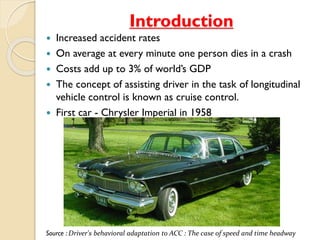
 First car - Chrysler Imperial in 1958 
Source : Driver's behavioral adaptation to ACC : The case of speed and time headway
Cruise Control 
 Cruise control - automatically controls the speed 
of a motor vehicle. 
 Also known as speed control or auto cruise. 
 The conventional cruise control has one mode of 
control, velocity control. 
 Throttle position is adjusted to maintain a speed 
set by the driver. 
 Improves driver comfort in steady traffic 
conditions.
Cruise Control 
 The conventional cruise control is capable of only 
maintaining a set speed by accelerating or 
decelerating the vehicle. 
 The driver always has to apply brake when 
approaching the target vehicle proceeding at a 
lower speed. 
 In congested traffic conditions where speeds vary 
widely these systems are no longer effective.
Adaptive Cruise Control 
 ADAPTIVE CRUISE CONTROL is a common 
term used for enhanced cruise control system. 
 Collision-avoidance system 
 Assists the driver to keep a safe distance from 
the preceding vehicle by controlling the engine 
throttle and brake. 
 Free the driver from frequent accelerations and 
decelerations and also reduces the stress of the 
driver.
Adaptive Cruise Control 
 Operates in two modes : 
 Cruise mode : Speed of the vehicle is 
controlled to maintain a set speed. 
 Follow mode : Speed of the vehicle is 
controlled to maintain a set distance from the 
preceding vehicle. 
 The driver can over-ride the system at any time. 
 Effective in the speed between 30km/h-180km/h
Adaptive Cruise Control 
 If 25% vehicles driving in a highway were equipped 
with the ACC system, traffic congestions could be 
avoided. 
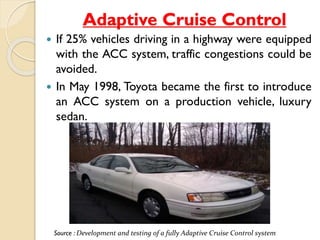
 In May 1998, Toyota became the first to introduce 
an ACC system on a production vehicle, luxury 
sedan. 
Source : Development and testing of a fully Adaptive Cruise Control system
Working Principle 
 Works by detecting the distance and speed of the 
vehicles ahead by using either a LIDAR system or 
a RADAR system. 
 The time taken by the transmission and reception 
is the key of the distance measurement. 
 The shift in frequency of the reflected beam by 
Doppler Effect is measured to know the speed. 
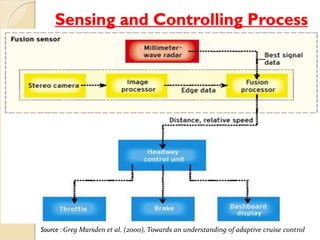
 Depending on this speed, the brake and throttle 
controls are done to keep the vehicle in a safe 
position.
Doppler Effect 
 Doppler Effect is the change in frequency of the 
waves when there is a relative motion between 
the transmitting and receiving units. 
 The Doppler Effect can be categorize in two 
ways:-
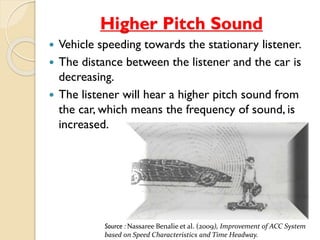
Higher Pitch Sound 
 Vehicle speeding towards the stationary listener. 
 The distance between the listener and the car is 
decreasing. 
 The listener will hear a higher pitch sound from 
the car, which means the frequency of sound, is 
increased. 
Source : Nassaree Benalie et al. (2009), Improvement of ACC System 
based on Speed Characteristics and Time Headway.
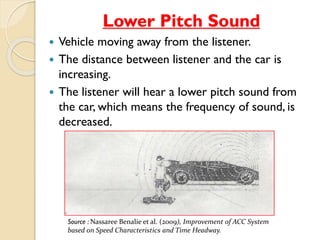
Lower Pitch Sound 
 Vehicle moving away from the listener. 
 The distance between listener and the car is 
increasing. 
 The listener will hear a lower pitch sound from 
the car, which means the frequency of sound, is 
decreased. 
Source : Nassaree Benalie et al. (2009), Improvement of ACC System 
based on Speed Characteristics and Time Headway.
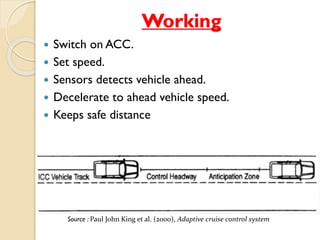
Working 
 Switch on ACC. 
 Set speed. 
 Sensors detects vehicle ahead. 
 Decelerate to ahead vehicle speed. 
 Keeps safe distance 
Source : Paul John King et al. (2000), Adaptive cruise control system
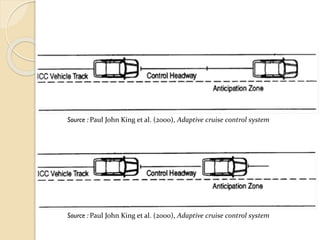
Source : Paul John King et al. (2000), Adaptive cruise control system 
Source : Paul John King et al. (2000), Adaptive cruise control system
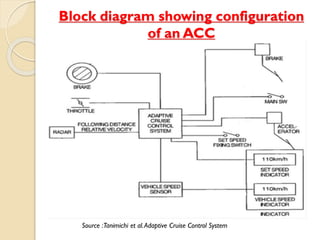
Block diagram showing configuration 
of an ACC 
Source : Tanimichi et al. Adaptive Cruise Control System
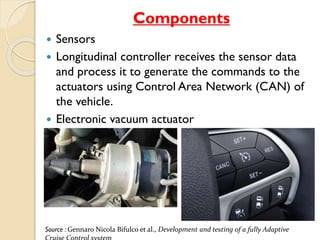
Components 
 Sensors 
 Longitudinal controller receives the sensor data 
and process it to generate the commands to the 
actuators using Control Area Network (CAN) of 
the vehicle. 
 Electronic vacuum actuator 
Source : Gennaro Nicola Bifulco et al., Development and testing of a fully Adaptive 
Cruise Control system
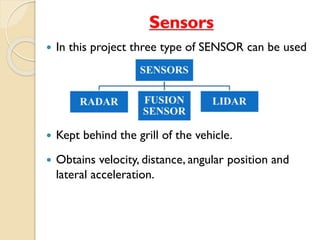
Sensors 
 In this project three type of SENSOR can be used 
 Kept behind the grill of the vehicle. 
 Obtains velocity, distance, angular position and 
lateral acceleration.
LIDAR 
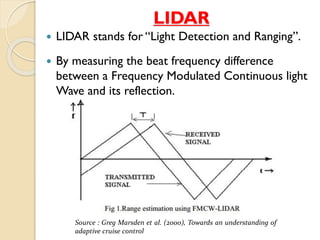
 LIDAR stands for “Light Detection and Ranging”. 
 By measuring the beat frequency difference 
between a Frequency Modulated Continuous light 
Wave and its reflection. 
Source : Greg Marsden et al. (2000), Towards an understanding of 
adaptive cruise control
LIDAR 
 It measures distance by illuminating laser and 
analyzing the reflected light. 
 Low cost 
 Provides good angular resolution 
 Weather conditions restrict its use to 30 - 40 
meters range.
RADAR 
 It operates by radiating energy into free space and 
detecting echo signal reflected from an object. 
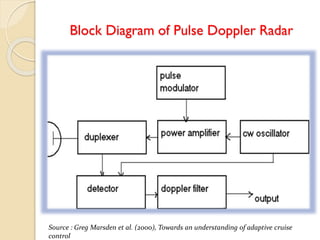
 Currently used “Pulse Doppler RADAR” uses the 
principle of Doppler effect. 
 Current ACC systems are based on 77GHz 
RADAR sensors. 
 Detects moving object up to 120m. 
 Work in poor weather conditions.
Block Diagram of Pulse Doppler Radar 
Source : Greg Marsden et al. (2000), Towards an understanding of adaptive cruise 
control
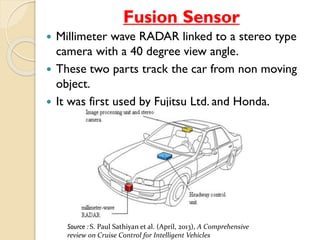
Fusion Sensor 
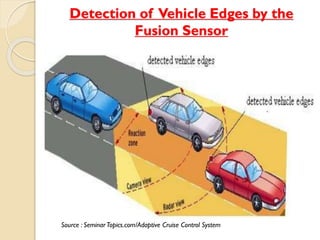
 Millimeter wave RADAR linked to a stereo type 
camera with a 40 degree view angle. 
 These two parts track the car from non moving 
object. 
 It was first used by Fujitsu Ltd. and Honda. 
Source : S. Paul Sathiyan et al. (April, 2013), A Comprehensive 
review on Cruise Control for Intelligent Vehicles
Detection of Vehicle Edges by the 
Fusion Sensor 
Source : Seminar Topics.com/Adaptive Cruise Control System
Sensing and Controlling Process 
Source : Greg Marsden et al. (2000), Towards an understanding of adaptive cruise control
Development of ACC 
 Stop and Go Adaptive Cruise Control : 
 Works primarily at lower speeds in heavy traffic. 
 If the car in front stops, it will bring vehicle to a complete stop 
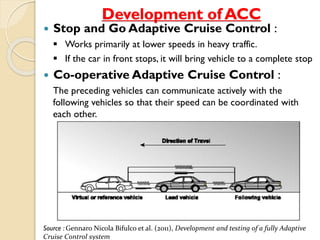
 Co-operative Adaptive Cruise Control : 
The preceding vehicles can communicate actively with the 
following vehicles so that their speed can be coordinated with 
each other. 
Source : Gennaro Nicola Bifulco et al. (2011), Development and testing of a fully Adaptive 
Cruise Control system
Advantages 
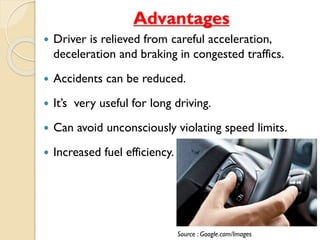
 Driver is relieved from careful acceleration, 
deceleration and braking in congested traffics. 
 Accidents can be reduced. 
 It’s very useful for long driving. 
 Can avoid unconsciously violating speed limits. 
 Increased fuel efficiency. 
Source : Google.com/Images
Disadvantages 
 High Cost. 
 Not for heavy traffic. 
 Encourages the driver to become careless. 
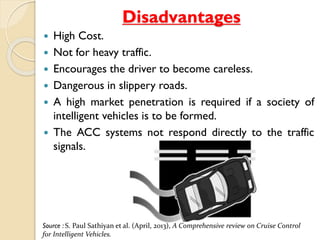
 Dangerous in slippery roads. 
 A high market penetration is required if a society of 
intelligent vehicles is to be formed. 
 The ACC systems not respond directly to the traffic 
signals. 
Source : S. Paul Sathiyan et al. (April, 2013), A Comprehensive review on Cruise Control 
for Intelligent Vehicles.
Conclusion 
 Current system ranges 150 meters can stop and 
slows if any obstruction. 
 Fully autonomous car is probably not viable in the 
foreseen future. 
 Near by vehicles would be in constant 
communication with each other and act co-operatively. 
 It will probably take decades, but car accidents may 
eventually become rare.
References 
1. S. Paul Sathiyan et al. (April, 2013), A Comprehensive review on 
Cruise Control for Intelligent Vehicles. In: International Journal of 
Innovative Technology and Exploring Engineering (IJITEE) 
2. Gennaro Nicola Bifulco et al. (2011), Development and testing of a 
fully Adaptive Cruise Control system 
3. Nassaree Benalie et al. (2009), Improvement of Adaptive Cruise 
Control System based on Speed Characteristics and Time 
Headway. In: International Conference on Intelligent Robots and 
Systems 
4. Giulio Francesco Bianchi Piccinini et al. (2014), Driver's behavioral 
adaptation to Adaptive Cruise Control (ACC): The case of speed 
and time headway 
5. Greg Marsden, Mike McDonald, Mark Brackstone (2000), 
Towards an understanding of adaptive cruise control 
6. Paul John King et al. (2000), Adaptive cruise control system 
7. www.howstuffworks.com 
8. www.youtube.com
Questions?
Thank You 


Adaptive cruise control

  • 1.
  • 2.
    CONTENTS  Introduction  Cruise Control  Adaptive Cruise Control  Principle  Components  Working  Improvement  Advantages  Disadvantages  Conclusion  References
  • 3.
    Introduction  Increasedaccident rates  On average at every minute one person dies in a crash  Costs add up to 3% of world’s GDP  The concept of assisting driver in the task of longitudinal vehicle control is known as cruise control.  First car - Chrysler Imperial in 1958 Source : Driver's behavioral adaptation to ACC : The case of speed and time headway
  • 4.
    Cruise Control Cruise control - automatically controls the speed of a motor vehicle.  Also known as speed control or auto cruise.  The conventional cruise control has one mode of control, velocity control.  Throttle position is adjusted to maintain a speed set by the driver.  Improves driver comfort in steady traffic conditions.
  • 5.
    Cruise Control The conventional cruise control is capable of only maintaining a set speed by accelerating or decelerating the vehicle.  The driver always has to apply brake when approaching the target vehicle proceeding at a lower speed.  In congested traffic conditions where speeds vary widely these systems are no longer effective.
  • 6.
    Adaptive Cruise Control  ADAPTIVE CRUISE CONTROL is a common term used for enhanced cruise control system.  Collision-avoidance system  Assists the driver to keep a safe distance from the preceding vehicle by controlling the engine throttle and brake.  Free the driver from frequent accelerations and decelerations and also reduces the stress of the driver.
  • 7.
    Adaptive Cruise Control  Operates in two modes :  Cruise mode : Speed of the vehicle is controlled to maintain a set speed.  Follow mode : Speed of the vehicle is controlled to maintain a set distance from the preceding vehicle.  The driver can over-ride the system at any time.  Effective in the speed between 30km/h-180km/h
  • 8.
    Adaptive Cruise Control  If 25% vehicles driving in a highway were equipped with the ACC system, traffic congestions could be avoided.  In May 1998, Toyota became the first to introduce an ACC system on a production vehicle, luxury sedan. Source : Development and testing of a fully Adaptive Cruise Control system
  • 9.
    Working Principle Works by detecting the distance and speed of the vehicles ahead by using either a LIDAR system or a RADAR system.  The time taken by the transmission and reception is the key of the distance measurement.  The shift in frequency of the reflected beam by Doppler Effect is measured to know the speed.  Depending on this speed, the brake and throttle controls are done to keep the vehicle in a safe position.
  • 10.
    Doppler Effect Doppler Effect is the change in frequency of the waves when there is a relative motion between the transmitting and receiving units.  The Doppler Effect can be categorize in two ways:-
  • 11.
    Higher Pitch Sound  Vehicle speeding towards the stationary listener.  The distance between the listener and the car is decreasing.  The listener will hear a higher pitch sound from the car, which means the frequency of sound, is increased. Source : Nassaree Benalie et al. (2009), Improvement of ACC System based on Speed Characteristics and Time Headway.
  • 12.
    Lower Pitch Sound  Vehicle moving away from the listener.  The distance between listener and the car is increasing.  The listener will hear a lower pitch sound from the car, which means the frequency of sound, is decreased. Source : Nassaree Benalie et al. (2009), Improvement of ACC System based on Speed Characteristics and Time Headway.
  • 13.
    Working  Switchon ACC.  Set speed.  Sensors detects vehicle ahead.  Decelerate to ahead vehicle speed.  Keeps safe distance Source : Paul John King et al. (2000), Adaptive cruise control system
  • 14.
    Source : PaulJohn King et al. (2000), Adaptive cruise control system Source : Paul John King et al. (2000), Adaptive cruise control system
  • 15.
    Block diagram showingconfiguration of an ACC Source : Tanimichi et al. Adaptive Cruise Control System
  • 16.
    Components  Sensors  Longitudinal controller receives the sensor data and process it to generate the commands to the actuators using Control Area Network (CAN) of the vehicle.  Electronic vacuum actuator Source : Gennaro Nicola Bifulco et al., Development and testing of a fully Adaptive Cruise Control system
  • 17.
    Sensors  Inthis project three type of SENSOR can be used  Kept behind the grill of the vehicle.  Obtains velocity, distance, angular position and lateral acceleration.
  • 18.
    LIDAR  LIDARstands for “Light Detection and Ranging”.  By measuring the beat frequency difference between a Frequency Modulated Continuous light Wave and its reflection. Source : Greg Marsden et al. (2000), Towards an understanding of adaptive cruise control
  • 19.
    LIDAR  Itmeasures distance by illuminating laser and analyzing the reflected light.  Low cost  Provides good angular resolution  Weather conditions restrict its use to 30 - 40 meters range.
  • 20.
    RADAR  Itoperates by radiating energy into free space and detecting echo signal reflected from an object.  Currently used “Pulse Doppler RADAR” uses the principle of Doppler effect.  Current ACC systems are based on 77GHz RADAR sensors.  Detects moving object up to 120m.  Work in poor weather conditions.
  • 21.
    Block Diagram ofPulse Doppler Radar Source : Greg Marsden et al. (2000), Towards an understanding of adaptive cruise control
  • 22.
    Fusion Sensor Millimeter wave RADAR linked to a stereo type camera with a 40 degree view angle.  These two parts track the car from non moving object.  It was first used by Fujitsu Ltd. and Honda. Source : S. Paul Sathiyan et al. (April, 2013), A Comprehensive review on Cruise Control for Intelligent Vehicles
  • 23.
    Detection of VehicleEdges by the Fusion Sensor Source : Seminar Topics.com/Adaptive Cruise Control System
  • 24.
    Sensing and ControllingProcess Source : Greg Marsden et al. (2000), Towards an understanding of adaptive cruise control
  • 25.
    Development of ACC  Stop and Go Adaptive Cruise Control :  Works primarily at lower speeds in heavy traffic.  If the car in front stops, it will bring vehicle to a complete stop  Co-operative Adaptive Cruise Control : The preceding vehicles can communicate actively with the following vehicles so that their speed can be coordinated with each other. Source : Gennaro Nicola Bifulco et al. (2011), Development and testing of a fully Adaptive Cruise Control system
  • 26.
    Advantages  Driveris relieved from careful acceleration, deceleration and braking in congested traffics.  Accidents can be reduced.  It’s very useful for long driving.  Can avoid unconsciously violating speed limits.  Increased fuel efficiency. Source : Google.com/Images
  • 27.
    Disadvantages  HighCost.  Not for heavy traffic.  Encourages the driver to become careless.  Dangerous in slippery roads.  A high market penetration is required if a society of intelligent vehicles is to be formed.  The ACC systems not respond directly to the traffic signals. Source : S. Paul Sathiyan et al. (April, 2013), A Comprehensive review on Cruise Control for Intelligent Vehicles.
  • 28.
    Conclusion  Currentsystem ranges 150 meters can stop and slows if any obstruction.  Fully autonomous car is probably not viable in the foreseen future.  Near by vehicles would be in constant communication with each other and act co-operatively.  It will probably take decades, but car accidents may eventually become rare.
  • 29.
    References 1. S.Paul Sathiyan et al. (April, 2013), A Comprehensive review on Cruise Control for Intelligent Vehicles. In: International Journal of Innovative Technology and Exploring Engineering (IJITEE) 2. Gennaro Nicola Bifulco et al. (2011), Development and testing of a fully Adaptive Cruise Control system 3. Nassaree Benalie et al. (2009), Improvement of Adaptive Cruise Control System based on Speed Characteristics and Time Headway. In: International Conference on Intelligent Robots and Systems 4. Giulio Francesco Bianchi Piccinini et al. (2014), Driver's behavioral adaptation to Adaptive Cruise Control (ACC): The case of speed and time headway 5. Greg Marsden, Mike McDonald, Mark Brackstone (2000), Towards an understanding of adaptive cruise control 6. Paul John King et al. (2000), Adaptive cruise control system 7. www.howstuffworks.com 8. www.youtube.com
  • 30.
  • 31.