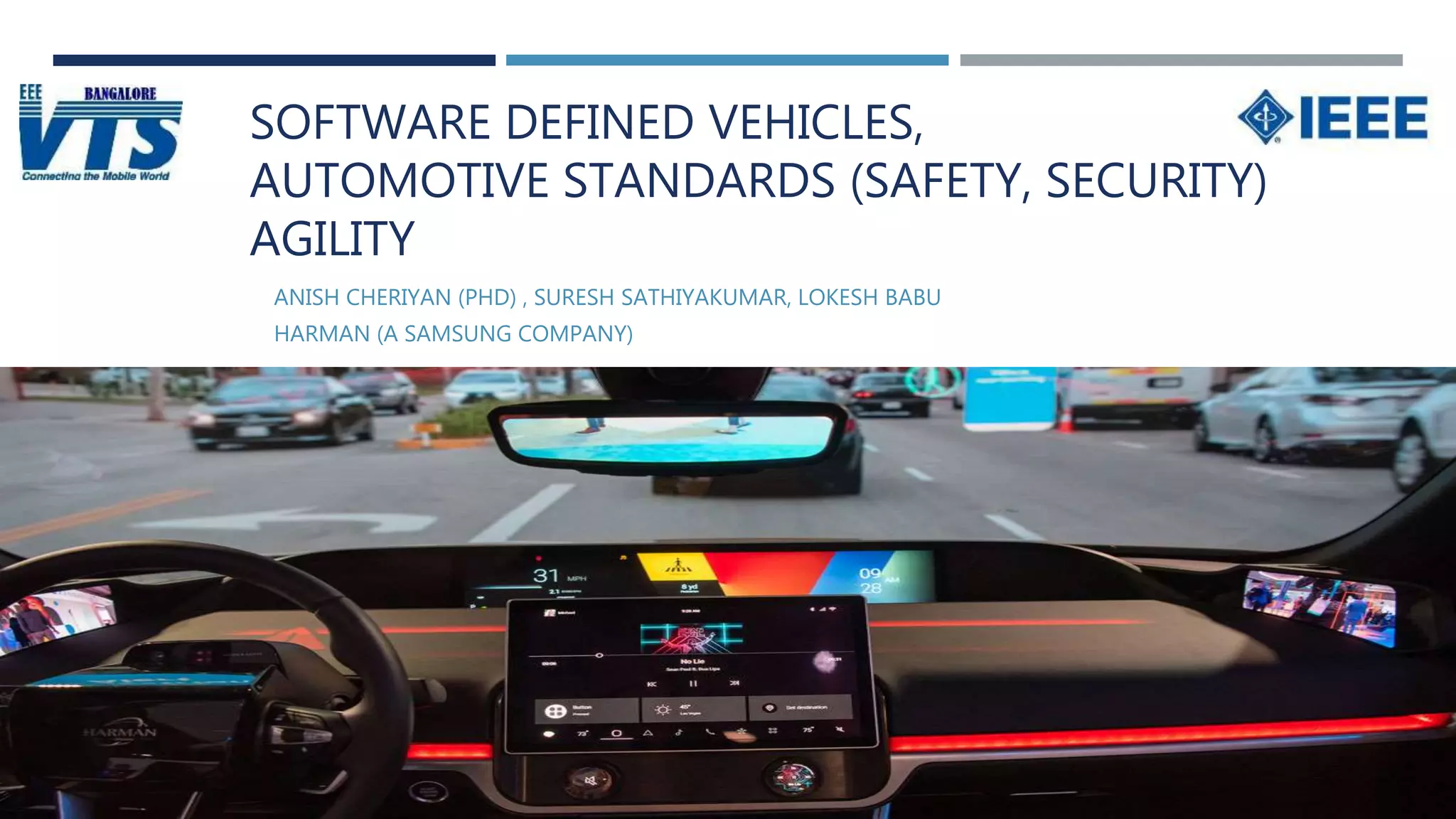

SOFTWARE DEFINED VEHICLES,
AUTOMOTIVE STANDARDS (SAFETY, SECURITY)
AGILITY
ANISH CHERIYAN (PHD) , SURESH SATHIYAKUMAR, LOKESH BABU
HARMAN (A SAMSUNG COMPANY)
AGENDA
• Quick ADAS Recap
• Next GEN Automotive Solutions
• Software Defined Vehicles
• Automotive standards
• General Standards, Safety & Security
• Functional Safety
• Cyber Security
• ASPICE, Agile and Continuous Delivery
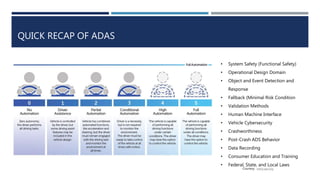
QUICK RECAP OF ADAS
Courtesy: www.sae.org
• System Safety (Functional Safety)
• Operational Design Domain
• Object and Event Detection and
Response
• Fallback (Minimal Risk Condition
• Validation Methods
• Human Machine Interface
• Vehicle Cybersecurity
• Crashworthiness
• Post-Crash ADS Behavior
• Data Recording
• Consumer Education and Training
• Federal, State, and Local Laws
NEXT GEN AUTOMOTIVE SOLUTIONS
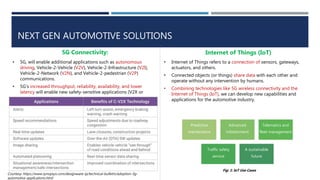
5G Connectivity:
• 5G, will enable additional applications such as autonomous
driving, Vehicle-2-Vehicle (V2V), Vehicle-2-Infrastructure (V2I),
Vehicle-2-Network (V2N), and Vehicle-2-pedestrian (V2P)
communications.
• 5G’s increased throughput, reliability, availability, and lower
latency will enable new safety-sensitive applications (V2X or
Vehicle-to-Everything)
Courtesy: https://www.synopsys.com/designware-ip/technical-bulletin/adoption-5g-
automotive-applications.html
Internet of Things (IoT)
• Internet of Things refers to a connection of sensors, gateways,
actuators, and others.
• Connected objects (or things) share data with each other and
operate without any intervention by humans.
• Combining technologies like 5G wireless connectivity and the
Internet of Things (IoT), we can develop new capabilities and
applications for the automotive industry.
Predictive
maintenance
Advanced
infotainment
Telematics and
fleet management
Traffic safety
service
A sustainable
future
Fig: 1: IoT Use Cases
NEXT GEN AUTOMOTIVE SOLUTIONS
Vehicle Electrification:
• Vehicle electrification is the
process of powering the
vehicle by electricity. The
main driving factors for
vehicle electrification are the
reduction of pollutants.
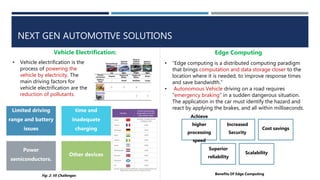
Edge Computing
Limited driving
range and battery
issues
Long charging
time and
inadequate
charging
infrastructure.
Power
semiconductors.
Other devices
Fig: 2: VE Challenges
• “Edge computing is a distributed computing paradigm
that brings computation and data storage closer to the
location where it is needed, to improve response times
and save bandwidth.”
• Autonomous Vehicle driving on a road requires
“emergency braking” in a sudden dangerous situation.
The application in the car must identify the hazard and
react by applying the brakes, and all within milliseconds.
Achieve
higher
processing
speed
Increased
Security
Cost savings
Superior
reliability
Scalability
Benefits Of Edge Computing
NEXT GEN AUTOMOTIVE SOLUTIONS
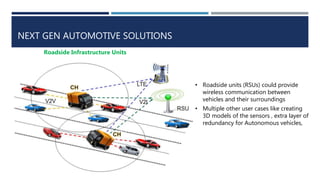
Roadside Infrastructure Units
• Roadside units (RSUs) could provide
wireless communication between
vehicles and their surroundings
• Multiple other user cases like creating
3D models of the sensors , extra layer of
redundancy for Autonomous vehicles,
SOFTWARE DEFINED VEHICLES
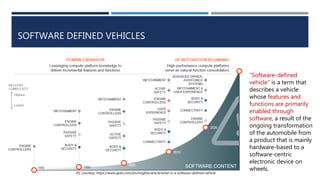
“Software-defined
vehicle” is a term that
describes a vehicle
whose features and
functions are primarily
enabled through
software, a result of the
ongoing transformation
of the automobile from
a product that is mainly
hardware-based to a
software-centric
electronic device on
wheels.
Pic courtesy: https://www.aptiv.com/en/insights/article/what-is-a-software-defined-vehicle
SOFTWARE DEFINED VEHICLES
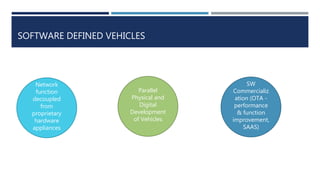
Network
function
decoupled
from
proprietary
hardware
appliances
Parallel
Physical and
Digital
Development
of Vehicles
SW
Commercializ
ation (OTA -
performance
& function
improvement,
SAAS)
SOFTWARE DEFINED VEHICLES - OTA
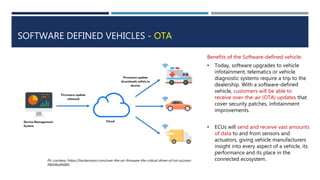
Benefits of the Software-defined vehicle:
• Today, software upgrades to vehicle
infotainment, telematics or vehicle
diagnostic systems require a trip to the
dealership. With a software-defined
vehicle, customers will be able to
receive over-the-air (OTA) updates that
cover security patches, infotainment
improvements.
• ECUs will send and receive vast amounts
of data to and from sensors and
actuators, giving vehicle manufacturers
insight into every aspect of a vehicle, its
performance and its place in the
connected ecosystem.
Pic courtesy: https://hackernoon.com/over-the-air-firmware-the-critical-driver-of-iot-success-
f4604bd0b881
SOFTWARE DEFINED VEHICLES – CHANGES EXPECTED
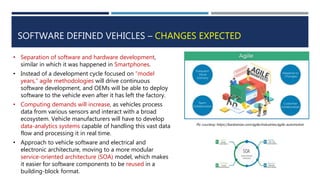
• Separation of software and hardware development,
similar in which it was happened in Smartphones.
• Instead of a development cycle focused on “model
years,” agile methodologies will drive continuous
software development, and OEMs will be able to deploy
software to the vehicle even after it has left the factory.
• Computing demands will increase, as vehicles process
data from various sensors and interact with a broad
ecosystem. Vehicle manufacturers will have to develop
data-analytics systems capable of handling this vast data
flow and processing it in real time.
• Approach to vehicle software and electrical and
electronic architecture, moving to a more modular
service-oriented architecture (SOA) model, which makes
it easier for software components to be reused in a
building-block format.
Pic courtesy: https://kanbanize.com/agile/industries/agile-automotive
SOFTWARE DEFINED VEHICLES – CHANGES EXPECTED
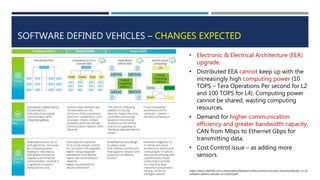
• Electronic & Electrical Architecture (EEA)
upgrade.
• Distributed EEA cannot keep up with the
increasingly high computing power (10
TOPS – Tera Operations Per second for L2
and 100 TOPS for L4). Computing power
cannot be shared, wasting computing
resources.
• Demand for higher communication
efficiency and greater bandwidth capacity.
CAN from Mbps to Ethernet Gbps for
transmitting data.
• Cost Control issue – as adding more
sensors.
https://www2.deloitte.com/content/dam/Deloitte/cn/Documents/consumer-business/deloitte-cn-cb-
software-defines-vehicles-en-210225.pdf
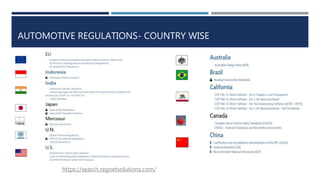
AUTOMOTIVE REGULATIONS- COUNTRY WISE
https://search.regnetsolutions.com/
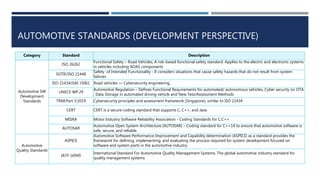
AUTOMOTIVE STANDARDS (DEVELOPMENT PERSPECTIVE)
Category Standard Description
Automotive SW
Development
Standards
ISO 26262
Functional Safety – Road Vehicles, A risk-based functional safety standard. Applies to the electric and electronic systems
in vehicles including ADAS components
SOTIF/ISO 21448
Safety of Intended Functionality - It considers situations that cause safety hazards that do not result from system
failures
ISO 21434/SAE J3061 Road vehicles — Cybersecurity engineering,
UNECE WP.29
Automotive Regulation – Defines Functional Requirements for automated/ autonomous vehicles, Cyber security on OTA
, Data Storage in automated driving vehicle and New Test/Assessment Methods
TR68:Part 3:2019 Cybersecurity principles and assessment framework (Singapore), similar to ISO 21434
CERT CERT is a secure coding standard that supports C, C++, and Java
MISRA Motor Industry Software Reliability Association - Coding Standards for C,C++
AUTOSAR
Automotive Open System Architecture (AUTOSAR) – Coding standard for C++14 to ensure that automotive software is
safe, secure, and reliable.
Automotive
Quality Standards
ASPICE
Automotive Software Performance Improvement and Capability determination (ASPICE) as a standard provides the
framework for defining, implementing, and evaluating the process required for system development focused on
software and system parts in the automotive industry.
IATF 16949
International Standard For Automotive Quality Management Systems, The global automotive industry standard for
quality management systems
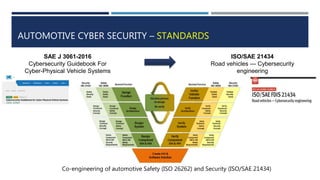
AUTOMOTIVE CYBER SECURITY – STANDARDS
SAE J 3061-2016
Cybersecurity Guidebook For
Cyber-Physical Vehicle Systems
ISO/SAE 21434
Road vehicles — Cybersecurity
engineering
Co-engineering of automotive Safety (ISO 26262) and Security (ISO/SAE 21434)
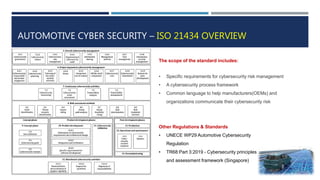
AUTOMOTIVE CYBER SECURITY – ISO 21434 OVERVIEW
The scope of the standard includes:
• Specific requirements for cybersecurity risk management
• A cybersecurity process framework
• Common language to help manufacturers(OEMs) and
organizations communicate their cybersecurity risk
Other Regulations & Standards
• UNECE WP29 Automotive Cybersecurity
Regulation
• TR68:Part 3:2019 - Cybersecurity principles
and assessment framework (Singapore)
ASPICE
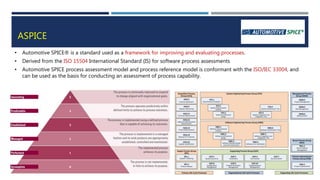
• Automotive SPICE® is a standard used as a framework for improving and evaluating processes.
• Derived from the ISO 15504 International Standard (IS) for software process assessments
• Automotive SPICE process assessment model and process reference model is conformant with the ISO/IEC 33004, and
can be used as the basis for conducting an assessment of process capability.
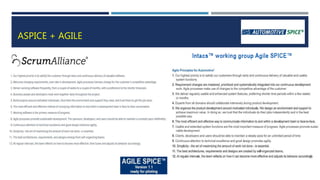
ASPICE + AGILE
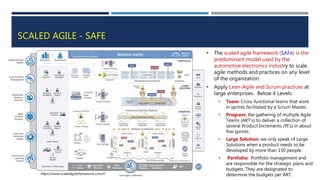
SCALED AGILE - SAFE
• The scaled agile framework (SAFe) is the
predominant model used by the
automotive electronics industry to scale
agile methods and practices on any level
of the organization.
• Apply Lean-Agile and Scrum practices at
large enterprises. Below 4 Levels:
• Team: Cross-functional teams that work
in sprints facilitated by a Scrum Master.
• Program: the gathering of multiple Agile
Teams (ART’s) to deliver a collection of
several Product Increments (PI’s) in about
five sprints.
• Large Solution: we only speak of Large
Solutions when a product needs to be
developed by more than 150 people.
• Portfolio: Portfolio management and
are responsible for the strategic plans and
budgets. They are designated to
determine the budgets per ART.
https://www.scaledagileframework.com/#
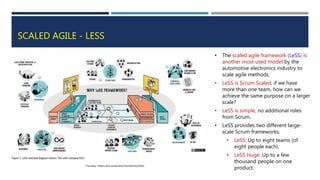
SCALED AGILE - LESS
• The scaled agile framework (LeSS) is
another most used model by the
automotive electronics industry to
scale agile methods.
• LeSS is Scrum Scaled, if we have
more than one team, how can we
achieve the same purpose on a larger
scale?
• LeSS is simple, no additional roles
from Scrum.
• LeSS provides two different large-
scale Scrum frameworks.
• LeSS: Up to eight teams (of
eight people each).
• LeSS Huge: Up to a few
thousand people on one
product.
Courtesy: https://less.works/less/framework/index
CONTINUOUS DELIVERY
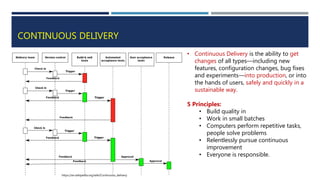
• Continuous Delivery is the ability to get
changes of all types—including new
features, configuration changes, bug fixes
and experiments—into production, or into
the hands of users, safely and quickly in a
sustainable way.
5 Principles:
• Build quality in
• Work in small batches
• Computers perform repetitive tasks,
people solve problems
• Relentlessly pursue continuous
improvement
• Everyone is responsible.
https://en.wikipedia.org/wiki/Continuous_delivery
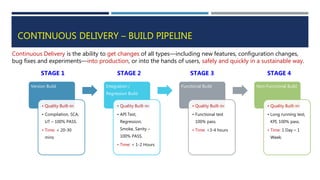
CONTINUOUS DELIVERY – BUILD PIPELINE
Continuous Delivery is the ability to get changes of all types—including new features, configuration changes,
bug fixes and experiments—into production, or into the hands of users, safely and quickly in a sustainable way.
Version Build
• Quality Built-in:
• Compilation, SCA,
UT – 100% PASS.
• Time: < 20-30
mins
Integration /
Regression Build
• Quality Built-in:
• API Test,
Regression,
Smoke, Sanity –
100% PASS.
• Time: < 1-2 Hours
Functional Build
• Quality Built-in:
• Functional test
100% pass.
• Time: <3-4 hours
Non-Functional Build
• Quality Built-in:
• Long running test,
KPI, 100% pass.
• Time: 1 Day – 1
Week.
STAGE 1 STAGE 2 STAGE 3 STAGE 4
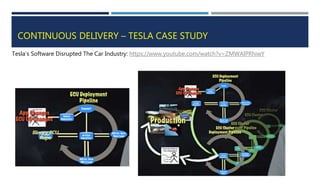
CONTINUOUS DELIVERY – TESLA CASE STUDY
Tesla’s Software Disrupted The Car Industry: https://www.youtube.com/watch?v=ZMWAlPRhiwY
SUMMARY
 ADAS and the next generation vehicles is powered by 5G, RSU, IOT, Vehicle
electrification, Cloud and Edge computing
 Software Defined Vehicles- Network function decoupled from proprietary
hardware appliances, Software Commercialization
 Automotive Standards need to be built into the product
 Cyber Security And Safety is deeply ingrained into the Automotive Product
Development
 Build Quality-in through Continuous Delivery and Build Pipeline based
approach
Software defined vehicles,automotive standards (safety, security), agile continuous delivery

Software defined vehicles,automotive standards (safety, security), agile continuous delivery

  • 1.
    SOFTWARE DEFINED VEHICLES, AUTOMOTIVESTANDARDS (SAFETY, SECURITY) AGILITY ANISH CHERIYAN (PHD) , SURESH SATHIYAKUMAR, LOKESH BABU HARMAN (A SAMSUNG COMPANY)
  • 2.
    AGENDA • Quick ADASRecap • Next GEN Automotive Solutions • Software Defined Vehicles • Automotive standards • General Standards, Safety & Security • Functional Safety • Cyber Security • ASPICE, Agile and Continuous Delivery
  • 3.
    QUICK RECAP OFADAS Courtesy: www.sae.org • System Safety (Functional Safety) • Operational Design Domain • Object and Event Detection and Response • Fallback (Minimal Risk Condition • Validation Methods • Human Machine Interface • Vehicle Cybersecurity • Crashworthiness • Post-Crash ADS Behavior • Data Recording • Consumer Education and Training • Federal, State, and Local Laws
  • 4.
    NEXT GEN AUTOMOTIVESOLUTIONS 5G Connectivity: • 5G, will enable additional applications such as autonomous driving, Vehicle-2-Vehicle (V2V), Vehicle-2-Infrastructure (V2I), Vehicle-2-Network (V2N), and Vehicle-2-pedestrian (V2P) communications. • 5G’s increased throughput, reliability, availability, and lower latency will enable new safety-sensitive applications (V2X or Vehicle-to-Everything) Courtesy: https://www.synopsys.com/designware-ip/technical-bulletin/adoption-5g- automotive-applications.html Internet of Things (IoT) • Internet of Things refers to a connection of sensors, gateways, actuators, and others. • Connected objects (or things) share data with each other and operate without any intervention by humans. • Combining technologies like 5G wireless connectivity and the Internet of Things (IoT), we can develop new capabilities and applications for the automotive industry. Predictive maintenance Advanced infotainment Telematics and fleet management Traffic safety service A sustainable future Fig: 1: IoT Use Cases
  • 5.
    NEXT GEN AUTOMOTIVESOLUTIONS Vehicle Electrification: • Vehicle electrification is the process of powering the vehicle by electricity. The main driving factors for vehicle electrification are the reduction of pollutants. Edge Computing Limited driving range and battery issues Long charging time and inadequate charging infrastructure. Power semiconductors. Other devices Fig: 2: VE Challenges • “Edge computing is a distributed computing paradigm that brings computation and data storage closer to the location where it is needed, to improve response times and save bandwidth.” • Autonomous Vehicle driving on a road requires “emergency braking” in a sudden dangerous situation. The application in the car must identify the hazard and react by applying the brakes, and all within milliseconds. Achieve higher processing speed Increased Security Cost savings Superior reliability Scalability Benefits Of Edge Computing
  • 6.
    NEXT GEN AUTOMOTIVESOLUTIONS Roadside Infrastructure Units • Roadside units (RSUs) could provide wireless communication between vehicles and their surroundings • Multiple other user cases like creating 3D models of the sensors , extra layer of redundancy for Autonomous vehicles,
  • 7.
    SOFTWARE DEFINED VEHICLES “Software-defined vehicle”is a term that describes a vehicle whose features and functions are primarily enabled through software, a result of the ongoing transformation of the automobile from a product that is mainly hardware-based to a software-centric electronic device on wheels. Pic courtesy: https://www.aptiv.com/en/insights/article/what-is-a-software-defined-vehicle
  • 8.
    SOFTWARE DEFINED VEHICLES Network function decoupled from proprietary hardware appliances Parallel Physicaland Digital Development of Vehicles SW Commercializ ation (OTA - performance & function improvement, SAAS)
  • 9.
    SOFTWARE DEFINED VEHICLES- OTA Benefits of the Software-defined vehicle: • Today, software upgrades to vehicle infotainment, telematics or vehicle diagnostic systems require a trip to the dealership. With a software-defined vehicle, customers will be able to receive over-the-air (OTA) updates that cover security patches, infotainment improvements. • ECUs will send and receive vast amounts of data to and from sensors and actuators, giving vehicle manufacturers insight into every aspect of a vehicle, its performance and its place in the connected ecosystem. Pic courtesy: https://hackernoon.com/over-the-air-firmware-the-critical-driver-of-iot-success- f4604bd0b881
  • 10.
    SOFTWARE DEFINED VEHICLES– CHANGES EXPECTED • Separation of software and hardware development, similar in which it was happened in Smartphones. • Instead of a development cycle focused on “model years,” agile methodologies will drive continuous software development, and OEMs will be able to deploy software to the vehicle even after it has left the factory. • Computing demands will increase, as vehicles process data from various sensors and interact with a broad ecosystem. Vehicle manufacturers will have to develop data-analytics systems capable of handling this vast data flow and processing it in real time. • Approach to vehicle software and electrical and electronic architecture, moving to a more modular service-oriented architecture (SOA) model, which makes it easier for software components to be reused in a building-block format. Pic courtesy: https://kanbanize.com/agile/industries/agile-automotive
  • 11.
    SOFTWARE DEFINED VEHICLES– CHANGES EXPECTED • Electronic & Electrical Architecture (EEA) upgrade. • Distributed EEA cannot keep up with the increasingly high computing power (10 TOPS – Tera Operations Per second for L2 and 100 TOPS for L4). Computing power cannot be shared, wasting computing resources. • Demand for higher communication efficiency and greater bandwidth capacity. CAN from Mbps to Ethernet Gbps for transmitting data. • Cost Control issue – as adding more sensors. https://www2.deloitte.com/content/dam/Deloitte/cn/Documents/consumer-business/deloitte-cn-cb- software-defines-vehicles-en-210225.pdf
  • 12.
    AUTOMOTIVE REGULATIONS- COUNTRYWISE https://search.regnetsolutions.com/
  • 13.
    AUTOMOTIVE STANDARDS (DEVELOPMENTPERSPECTIVE) Category Standard Description Automotive SW Development Standards ISO 26262 Functional Safety – Road Vehicles, A risk-based functional safety standard. Applies to the electric and electronic systems in vehicles including ADAS components SOTIF/ISO 21448 Safety of Intended Functionality - It considers situations that cause safety hazards that do not result from system failures ISO 21434/SAE J3061 Road vehicles — Cybersecurity engineering, UNECE WP.29 Automotive Regulation – Defines Functional Requirements for automated/ autonomous vehicles, Cyber security on OTA , Data Storage in automated driving vehicle and New Test/Assessment Methods TR68:Part 3:2019 Cybersecurity principles and assessment framework (Singapore), similar to ISO 21434 CERT CERT is a secure coding standard that supports C, C++, and Java MISRA Motor Industry Software Reliability Association - Coding Standards for C,C++ AUTOSAR Automotive Open System Architecture (AUTOSAR) – Coding standard for C++14 to ensure that automotive software is safe, secure, and reliable. Automotive Quality Standards ASPICE Automotive Software Performance Improvement and Capability determination (ASPICE) as a standard provides the framework for defining, implementing, and evaluating the process required for system development focused on software and system parts in the automotive industry. IATF 16949 International Standard For Automotive Quality Management Systems, The global automotive industry standard for quality management systems
  • 14.
    AUTOMOTIVE CYBER SECURITY– STANDARDS SAE J 3061-2016 Cybersecurity Guidebook For Cyber-Physical Vehicle Systems ISO/SAE 21434 Road vehicles — Cybersecurity engineering Co-engineering of automotive Safety (ISO 26262) and Security (ISO/SAE 21434)
  • 15.
    AUTOMOTIVE CYBER SECURITY– ISO 21434 OVERVIEW The scope of the standard includes: • Specific requirements for cybersecurity risk management • A cybersecurity process framework • Common language to help manufacturers(OEMs) and organizations communicate their cybersecurity risk Other Regulations & Standards • UNECE WP29 Automotive Cybersecurity Regulation • TR68:Part 3:2019 - Cybersecurity principles and assessment framework (Singapore)
  • 16.
    ASPICE • Automotive SPICE®is a standard used as a framework for improving and evaluating processes. • Derived from the ISO 15504 International Standard (IS) for software process assessments • Automotive SPICE process assessment model and process reference model is conformant with the ISO/IEC 33004, and can be used as the basis for conducting an assessment of process capability.
  • 17.
  • 18.
    SCALED AGILE -SAFE • The scaled agile framework (SAFe) is the predominant model used by the automotive electronics industry to scale agile methods and practices on any level of the organization. • Apply Lean-Agile and Scrum practices at large enterprises. Below 4 Levels: • Team: Cross-functional teams that work in sprints facilitated by a Scrum Master. • Program: the gathering of multiple Agile Teams (ART’s) to deliver a collection of several Product Increments (PI’s) in about five sprints. • Large Solution: we only speak of Large Solutions when a product needs to be developed by more than 150 people. • Portfolio: Portfolio management and are responsible for the strategic plans and budgets. They are designated to determine the budgets per ART. https://www.scaledagileframework.com/#
  • 19.
    SCALED AGILE -LESS • The scaled agile framework (LeSS) is another most used model by the automotive electronics industry to scale agile methods. • LeSS is Scrum Scaled, if we have more than one team, how can we achieve the same purpose on a larger scale? • LeSS is simple, no additional roles from Scrum. • LeSS provides two different large- scale Scrum frameworks. • LeSS: Up to eight teams (of eight people each). • LeSS Huge: Up to a few thousand people on one product. Courtesy: https://less.works/less/framework/index
  • 20.
    CONTINUOUS DELIVERY • ContinuousDelivery is the ability to get changes of all types—including new features, configuration changes, bug fixes and experiments—into production, or into the hands of users, safely and quickly in a sustainable way. 5 Principles: • Build quality in • Work in small batches • Computers perform repetitive tasks, people solve problems • Relentlessly pursue continuous improvement • Everyone is responsible. https://en.wikipedia.org/wiki/Continuous_delivery
  • 21.
    CONTINUOUS DELIVERY –BUILD PIPELINE Continuous Delivery is the ability to get changes of all types—including new features, configuration changes, bug fixes and experiments—into production, or into the hands of users, safely and quickly in a sustainable way. Version Build • Quality Built-in: • Compilation, SCA, UT – 100% PASS. • Time: < 20-30 mins Integration / Regression Build • Quality Built-in: • API Test, Regression, Smoke, Sanity – 100% PASS. • Time: < 1-2 Hours Functional Build • Quality Built-in: • Functional test 100% pass. • Time: <3-4 hours Non-Functional Build • Quality Built-in: • Long running test, KPI, 100% pass. • Time: 1 Day – 1 Week. STAGE 1 STAGE 2 STAGE 3 STAGE 4
  • 22.
    CONTINUOUS DELIVERY –TESLA CASE STUDY Tesla’s Software Disrupted The Car Industry: https://www.youtube.com/watch?v=ZMWAlPRhiwY
  • 23.
    SUMMARY  ADAS andthe next generation vehicles is powered by 5G, RSU, IOT, Vehicle electrification, Cloud and Edge computing  Software Defined Vehicles- Network function decoupled from proprietary hardware appliances, Software Commercialization  Automotive Standards need to be built into the product  Cyber Security And Safety is deeply ingrained into the Automotive Product Development  Build Quality-in through Continuous Delivery and Build Pipeline based approach