.
.
.
The FlexRay protocol
Master Of Control Systems
Wissam Kafa
June 17, 2014
Outline
1 Introduction
2 Why FlexRay?
3 Network Topology
4 Structure of a FlexRay Node
5 FlexRay configuration: Cycle Segments
6 Clock Synchronization
7 Summary-Conclusion
.
.
.Wissam Kafa | HIAST 2/26
1 Introduction
• FlexRay: A Communication Protocol in distributed systems within
automotive context.
• developed by the FlexRay consortium (BMW, DaimlerChrysler, Mo-
torola, Philips) founded in 1999.
• since 1999 many well-known companies joined (e.g. Bosch, GM,
VW, Mazda, etc.)
• aim: fast, flexible, fault-tolerant communication protocol.
• FlexRay was used for the first time in BMW X5 model in 2007.
.
.
.Wissam Kafa | HIAST 3/26
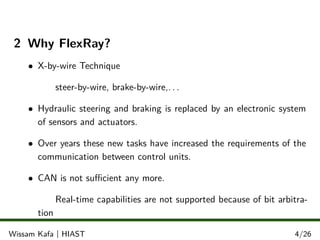
2 Why FlexRay?
• X-by-wire Technique
steer-by-wire, brake-by-wire,. . .
• Hydraulic steering and braking is replaced by an electronic system
of sensors and actuators.
• Over years these new tasks have increased the requirements of the
communication between control units.
• CAN is not sufficient any more.
Real-time capabilities are not supported because of bit arbitra-
tion
.
.
.Wissam Kafa | HIAST 4/26
3 Network Topology
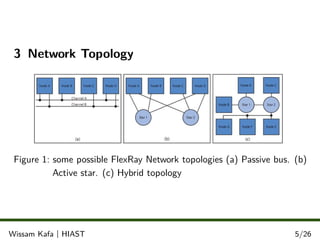
Figure 1: some possible FlexRay Network topologies (a) Passive bus. (b)
Active star. (c) Hybrid topology
.
.
.Wissam Kafa | HIAST 5/26
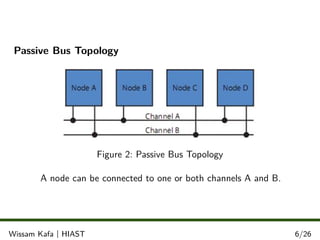
Passive Bus Topology
Figure 2: Passive Bus Topology
A node can be connected to one or both channels A and B.
.
.
.Wissam Kafa | HIAST 6/26
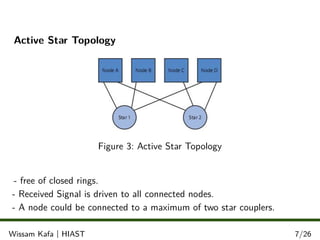
Active Star Topology
Figure 3: Active Star Topology
- free of closed rings.
- Received Signal is driven to all connected nodes.
- A node could be connected to a maximum of two star couplers.
.
.
.Wissam Kafa | HIAST 7/26
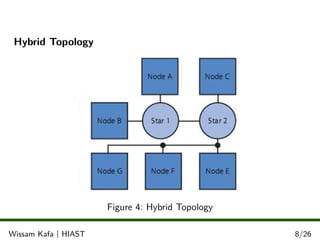
Hybrid Topology
Figure 4: Hybrid Topology
.
.
.Wissam Kafa | HIAST 8/26
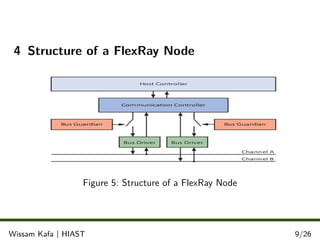
4 Structure of a FlexRay Node
Figure 5: Structure of a FlexRay Node
.
.
.Wissam Kafa | HIAST 9/26
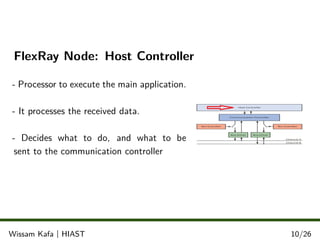
FlexRay Node: Host Controller
- Processor to execute the main application.
- It processes the received data.
- Decides what to do, and what to be
sent to the communication controller
.
.
.Wissam Kafa | HIAST 10/26
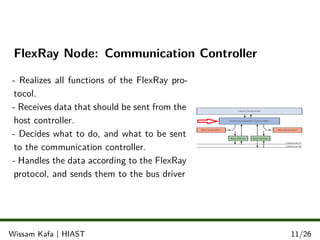
FlexRay Node: Communication Controller
- Realizes all functions of the FlexRay pro-
tocol.
- Receives data that should be sent from the
host controller.
- Decides what to do, and what to be sent
to the communication controller.
- Handles the data according to the FlexRay
protocol, and sends them to the bus driver
.
.
.Wissam Kafa | HIAST 11/26
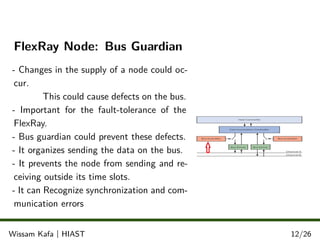
FlexRay Node: Bus Guardian
- Changes in the supply of a node could oc-
cur.
This could cause defects on the bus.
- Important for the fault-tolerance of the
FlexRay.
- Bus guardian could prevent these defects.
- It organizes sending the data on the bus.
- It prevents the node from sending and re-
ceiving outside its time slots.
- It can Recognize synchronization and com-
munication errors
.
.
.Wissam Kafa | HIAST 12/26
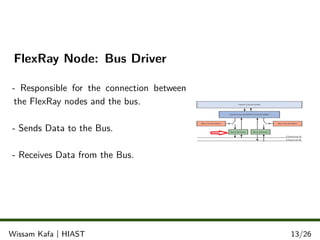
FlexRay Node: Bus Driver
- Responsible for the connection between
the FlexRay nodes and the bus.
- Sends Data to the Bus.
- Receives Data from the Bus.
.
.
.Wissam Kafa | HIAST 13/26
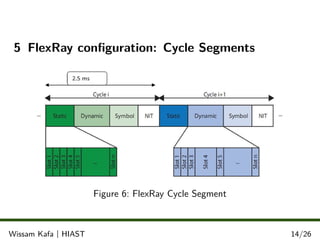
5 FlexRay configuration: Cycle Segments
Figure 6: FlexRay Cycle Segment
.
.
.Wissam Kafa | HIAST 14/26
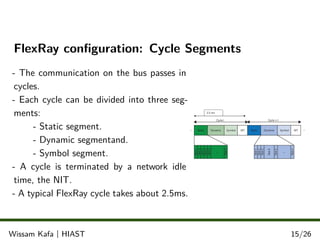
FlexRay configuration: Cycle Segments
- The communication on the bus passes in
cycles.
- Each cycle can be divided into three seg-
ments:
- Static segment.
- Dynamic segmentand.
- Symbol segment.
- A cycle is terminated by a network idle
time, the NIT.
- A typical FlexRay cycle takes about 2.5ms.
.
.
.Wissam Kafa | HIAST 15/26
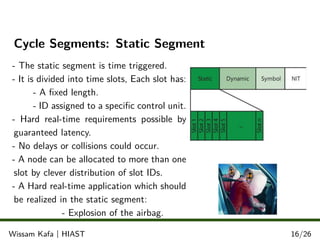
Cycle Segments: Static Segment
- The static segment is time triggered.
- It is divided into time slots, Each slot has:
- A fixed length.
- ID assigned to a specific control unit.
- Hard real-time requirements possible by
guaranteed latency.
- No delays or collisions could occur.
- A node can be allocated to more than one
slot by clever distribution of slot IDs.
- A Hard real-time application which should
be realized in the static segment:
- Explosion of the airbag.
.
.
.Wissam Kafa | HIAST 16/26
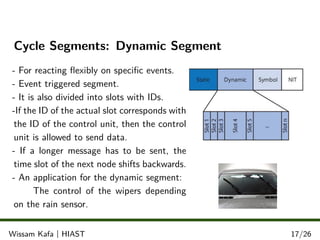
Cycle Segments: Dynamic Segment
- For reacting flexibly on specific events.
- Event triggered segment.
- It is also divided into slots with IDs.
-If the ID of the actual slot corresponds with
the ID of the control unit, then the control
unit is allowed to send data.
- If a longer message has to be sent, the
time slot of the next node shifts backwards.
- An application for the dynamic segment:
The control of the wipers depending
on the rain sensor.
.
.
.Wissam Kafa | HIAST 17/26
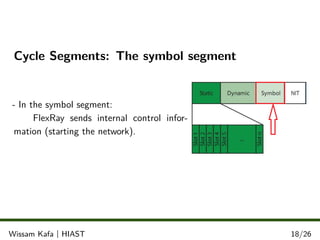
Cycle Segments: The symbol segment
- In the symbol segment:
FlexRay sends internal control infor-
mation (starting the network).
.
.
.Wissam Kafa | HIAST 18/26
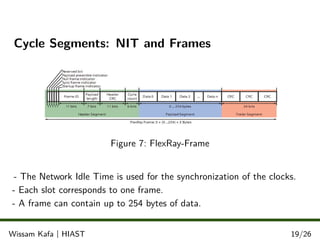
Cycle Segments: NIT and Frames
Figure 7: FlexRay-Frame
- The Network Idle Time is used for the synchronization of the clocks.
- Each slot corresponds to one frame.
- A frame can contain up to 254 bytes of data.
.
.
.Wissam Kafa | HIAST 19/26
6 Clock Synchronization
- Large temperature differences, voltage changes and production
tolerances have a negative influence on the accuracy of the clocks.
- A regular synchronization, especially for real-time and time-critical
applications is essential.
- For correct Operation, each node has to know the start time, the end
time and the number of the actual slots.
- Therefore, all nodes need a common time base.
- The Data rate also depends on the synchronization.
- The synchronization of FlexRay is an internal synchronization algorithm
and is most likely the midpoint algorithm.
.
.
.Wissam Kafa | HIAST 20/26
Clock Synchronization
- The problem is divided into two aspects:
- Nodes have to compound on a common time (offset correction).
- Nodes have to adjust the time deviation between them (rate
correction).
- Each nodes communication controller has a local clock.
counts in micro-ticks.
- For example a FlexRay network with 10MBit/s scans the bus with
80MHz. One tick of the oscillator correspond 0.0124 us. A micro-tick is
typical twice this time.
- The synchronization of the offset, as well as the rate correction uses
micro-ticks as smallest time unit.
.
.
.Wissam Kafa | HIAST 21/26
7 Summary-Conclusion
• FlexRay focuses on a set of core needs for todays automotive indus-
try.
• Higher data rates than previous standards.
• very flexible network topology.
• fault-tolerant operation.
• FlexRay thus delivers the speed and reliability required for next-
generation in-car control systems.
.
.
.Wissam Kafa | HIAST 22/26
Summary-Conclusion
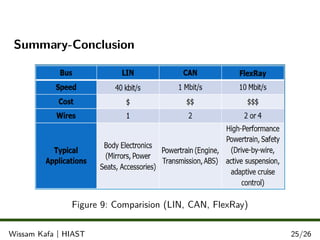
• The CAN network has reached its highest performance levels with
a maximum speed of 1 Mbps.
• With a maximum data rate of 10 Mbps available on two channels,
A gross data rate of up to 20Mbit/sec.
• Time and Event Triggered Protocol.
.
.
.Wissam Kafa | HIAST 23/26
Summary-Conclusion
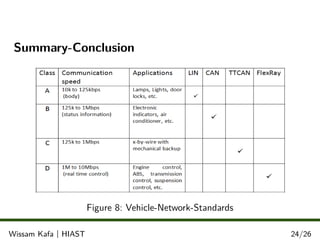
Figure 8: Vehicle-Network-Standards
.
.
.Wissam Kafa | HIAST 24/26
Summary-Conclusion
Figure 9: Comparision (LIN, CAN, FlexRay)
.
.
.Wissam Kafa | HIAST 25/26
.
.
.
Thanks!

The flex ray protocol

  • 1.
    . . . The FlexRay protocol MasterOf Control Systems Wissam Kafa June 17, 2014
  • 2.
    Outline 1 Introduction 2 WhyFlexRay? 3 Network Topology 4 Structure of a FlexRay Node 5 FlexRay configuration: Cycle Segments 6 Clock Synchronization 7 Summary-Conclusion . . .Wissam Kafa | HIAST 2/26
  • 3.
    1 Introduction • FlexRay:A Communication Protocol in distributed systems within automotive context. • developed by the FlexRay consortium (BMW, DaimlerChrysler, Mo- torola, Philips) founded in 1999. • since 1999 many well-known companies joined (e.g. Bosch, GM, VW, Mazda, etc.) • aim: fast, flexible, fault-tolerant communication protocol. • FlexRay was used for the first time in BMW X5 model in 2007. . . .Wissam Kafa | HIAST 3/26
  • 4.
    2 Why FlexRay? •X-by-wire Technique steer-by-wire, brake-by-wire,. . . • Hydraulic steering and braking is replaced by an electronic system of sensors and actuators. • Over years these new tasks have increased the requirements of the communication between control units. • CAN is not sufficient any more. Real-time capabilities are not supported because of bit arbitra- tion . . .Wissam Kafa | HIAST 4/26
  • 5.
    3 Network Topology Figure1: some possible FlexRay Network topologies (a) Passive bus. (b) Active star. (c) Hybrid topology . . .Wissam Kafa | HIAST 5/26
  • 6.
    Passive Bus Topology Figure2: Passive Bus Topology A node can be connected to one or both channels A and B. . . .Wissam Kafa | HIAST 6/26
  • 7.
    Active Star Topology Figure3: Active Star Topology - free of closed rings. - Received Signal is driven to all connected nodes. - A node could be connected to a maximum of two star couplers. . . .Wissam Kafa | HIAST 7/26
  • 8.
    Hybrid Topology Figure 4:Hybrid Topology . . .Wissam Kafa | HIAST 8/26
  • 9.
    4 Structure ofa FlexRay Node Figure 5: Structure of a FlexRay Node . . .Wissam Kafa | HIAST 9/26
  • 10.
    FlexRay Node: HostController - Processor to execute the main application. - It processes the received data. - Decides what to do, and what to be sent to the communication controller . . .Wissam Kafa | HIAST 10/26
  • 11.
    FlexRay Node: CommunicationController - Realizes all functions of the FlexRay pro- tocol. - Receives data that should be sent from the host controller. - Decides what to do, and what to be sent to the communication controller. - Handles the data according to the FlexRay protocol, and sends them to the bus driver . . .Wissam Kafa | HIAST 11/26
  • 12.
    FlexRay Node: BusGuardian - Changes in the supply of a node could oc- cur. This could cause defects on the bus. - Important for the fault-tolerance of the FlexRay. - Bus guardian could prevent these defects. - It organizes sending the data on the bus. - It prevents the node from sending and re- ceiving outside its time slots. - It can Recognize synchronization and com- munication errors . . .Wissam Kafa | HIAST 12/26
  • 13.
    FlexRay Node: BusDriver - Responsible for the connection between the FlexRay nodes and the bus. - Sends Data to the Bus. - Receives Data from the Bus. . . .Wissam Kafa | HIAST 13/26
  • 14.
    5 FlexRay configuration:Cycle Segments Figure 6: FlexRay Cycle Segment . . .Wissam Kafa | HIAST 14/26
  • 15.
    FlexRay configuration: CycleSegments - The communication on the bus passes in cycles. - Each cycle can be divided into three seg- ments: - Static segment. - Dynamic segmentand. - Symbol segment. - A cycle is terminated by a network idle time, the NIT. - A typical FlexRay cycle takes about 2.5ms. . . .Wissam Kafa | HIAST 15/26
  • 16.
    Cycle Segments: StaticSegment - The static segment is time triggered. - It is divided into time slots, Each slot has: - A fixed length. - ID assigned to a specific control unit. - Hard real-time requirements possible by guaranteed latency. - No delays or collisions could occur. - A node can be allocated to more than one slot by clever distribution of slot IDs. - A Hard real-time application which should be realized in the static segment: - Explosion of the airbag. . . .Wissam Kafa | HIAST 16/26
  • 17.
    Cycle Segments: DynamicSegment - For reacting flexibly on specific events. - Event triggered segment. - It is also divided into slots with IDs. -If the ID of the actual slot corresponds with the ID of the control unit, then the control unit is allowed to send data. - If a longer message has to be sent, the time slot of the next node shifts backwards. - An application for the dynamic segment: The control of the wipers depending on the rain sensor. . . .Wissam Kafa | HIAST 17/26
  • 18.
    Cycle Segments: Thesymbol segment - In the symbol segment: FlexRay sends internal control infor- mation (starting the network). . . .Wissam Kafa | HIAST 18/26
  • 19.
    Cycle Segments: NITand Frames Figure 7: FlexRay-Frame - The Network Idle Time is used for the synchronization of the clocks. - Each slot corresponds to one frame. - A frame can contain up to 254 bytes of data. . . .Wissam Kafa | HIAST 19/26
  • 20.
    6 Clock Synchronization -Large temperature differences, voltage changes and production tolerances have a negative influence on the accuracy of the clocks. - A regular synchronization, especially for real-time and time-critical applications is essential. - For correct Operation, each node has to know the start time, the end time and the number of the actual slots. - Therefore, all nodes need a common time base. - The Data rate also depends on the synchronization. - The synchronization of FlexRay is an internal synchronization algorithm and is most likely the midpoint algorithm. . . .Wissam Kafa | HIAST 20/26
  • 21.
    Clock Synchronization - Theproblem is divided into two aspects: - Nodes have to compound on a common time (offset correction). - Nodes have to adjust the time deviation between them (rate correction). - Each nodes communication controller has a local clock. counts in micro-ticks. - For example a FlexRay network with 10MBit/s scans the bus with 80MHz. One tick of the oscillator correspond 0.0124 us. A micro-tick is typical twice this time. - The synchronization of the offset, as well as the rate correction uses micro-ticks as smallest time unit. . . .Wissam Kafa | HIAST 21/26
  • 22.
    7 Summary-Conclusion • FlexRayfocuses on a set of core needs for todays automotive indus- try. • Higher data rates than previous standards. • very flexible network topology. • fault-tolerant operation. • FlexRay thus delivers the speed and reliability required for next- generation in-car control systems. . . .Wissam Kafa | HIAST 22/26
  • 23.
    Summary-Conclusion • The CANnetwork has reached its highest performance levels with a maximum speed of 1 Mbps. • With a maximum data rate of 10 Mbps available on two channels, A gross data rate of up to 20Mbit/sec. • Time and Event Triggered Protocol. . . .Wissam Kafa | HIAST 23/26
  • 24.
  • 25.
    Summary-Conclusion Figure 9: Comparision(LIN, CAN, FlexRay) . . .Wissam Kafa | HIAST 25/26
  • 26.