P a g e | 1 Mechanical Dept. , A.B.I.T
CONTENTS : - Page No.
ď‚· Introduction 2
ď‚· History 2
ď‚· Background 3
ď‚· Control system in Conventional cruise control 4 - 5
ď‚· Adaptive cruise control (ACC) 6
ď‚· components of ACC 7
ď‚· Working 8
ď‚· Controlling ACC 9
ď‚· Features 10
ď‚· Advantages 11
ď‚· Disadvantages 11
ď‚· Future Aspects 12
ď‚· ACC used vehicles 13 - 14
ď‚· Conclusion 15
ď‚· Reference 16
P a g e | 2 Mechanical Dept. , A.B.I.T
INTRODUCTION : -
Cruise control system has become a common feature in
automobiles nowadays. Instead of having the driver frequently
checking the speedometer and adjusting pressure on the gas pedal or
the brake, cruise control system control the speed of the car by
maintaining the constant speed set by the driver. Therefore, cruise
control system can help reduce driver’s fatigue in driving a long
road trip. This paper presents the control system behind the cruise
control.
ď‚— Increased accident rate
ď‚— Factors
ď‚— Need 0f intelligent vehicles
ď‚— Invention of Cruise control
History : -
ď‚— 1910 speed control with centrifugal governor .
ď‚— Modern cruise control - Ralph Teetor-1945 .
ď‚— First car in 1958 .
ď‚— Started in cars from 1974 .
P a g e | 3 Mechanical Dept. , A.B.I.T
BACKGROUND : -
Before getting into to the control system concepts of
cruise control, the components and the basic mechanism of the
cruise control system in a vehicle are summarized.
A. Components of Cruise Control :
Cruise control system can be divided in to three
main parts, which are the input, the processor, and the output. The
input of the system includes the setting buttons on the steering
wheel , gas pedal , brake , clutch and the feedback signal of the
cruise control.
B. Mechanism of Cruise Control :
An overview of the relationship between different
components of cruise control system is shown in Fig. 1. The
processor of the cruise control system is shown as the Cruise
Control Computer in the figure.
P a g e | 4 Mechanical Dept. , A.B.I.T
Control system in Conventional cruise control:-
A. Design Consideration :
A cruise control system needs to accelerate to the desired
speed in a short time without overshooting the speed of the car.
B. Physical Model :
First, the inertia of the wheels of the car is neglected. Second,
the friction of the car is assumed to be the friction caused by the
motion of the car.
C. Design Specification :
Since it is critical for a cruise control system to obtain the
desired speed in a short time without overshoot, the design
specification is determined:
Rise time < 5 sec
Overshoot < 10%
Steady-state error < 2%
P a g e | 5 Mechanical Dept. , A.B.I.T
D. Assumption :
For the simplified cruise control model, the mass, the friction
constantand the force from the engine of the car is assumed:
m = 1000kg
b = 50 N*sec/m
u = 500 N
E. Modeling and Simulation :
Models of cruise control system are developed from the
open-loop system to the closed-loop system. Then, models with PI
controller are further developed in terms of different control
constants.
P a g e | 6 Mechanical Dept. , A.B.I.T
ADAPTIVE CRUISE CONTROL : -
ď‚· Advanced version
ď‚— Keeps at steady speed
ď‚— Using sensors for detection
ď‚— Keeps safe distance
P a g e | 7 Mechanical Dept. , A.B.I.T
COMPONENTS OF ACC : -
ď‚— Switches and pedals
ď‚— Processor or mini computer
ď‚— Sensor
ď‚— Electronic vacuum actuator
P a g e | 8 Mechanical Dept. , A.B.I.T
WORKING OF ACC : -
ď‚— Switch on ACC.
ď‚— Set speed.
ď‚— Sensors detects vehicle ahead.
ď‚— Decelerate to ahead vehicle speed.
ď‚— Keeps safe distance.
P a g e | 9 Mechanical Dept. , A.B.I.T
CONTROLLING OF ACC : -
ď‚— BRAIN: Mini computer.
ď‚— Senses throttle position.
ď‚— Senses accelerator position.
ď‚— Adjust throttle.
ď‚— Senses ahead vehicles.
P a g e | 10 Mechanical Dept. , A.B.I.T
FEATURES : -
ď‚— Maintains a safe, comfortable distance between vehicles
without driver interventions.
ď‚— Maintains a consistent performance in poor visibility
conditions.
ď‚— Maintains a continuous performance during road turns and
elevation changes.
ď‚— Alerts drivers by way of automatic braking.
P a g e | 11 Mechanical Dept. , A.B.I.T
ADVANTAGES : -
 It’s very useful for long driving.
ď‚— Can avoid unconsciously violating speed limits.
ď‚— Reduction in accident rate , driver fatigue .
ď‚— Increased fuel efficiency.
DISADVANTAGES : -
ď‚— Cost .
ď‚— Not for heavy traffic , Dangerous in slippery roads .
ď‚— Encourages the driver to become careless.
ď‚— The ACC systems not respond directly to the traffic signals.
P a g e | 12 Mechanical Dept. , A.B.I.T
FUTURE ASPECTS : -
ď‚— Co-operative Adaptive cruise control or CACC is already being
tested in California .
ď‚— ACC respond to the distance and speed of the car ahead
,CACC communicate with two or more cars and work together
to avoid collision.
ď‚— Communication is quicker, reliable and responsive.
P a g e | 13 Mechanical Dept. , A.B.I.T
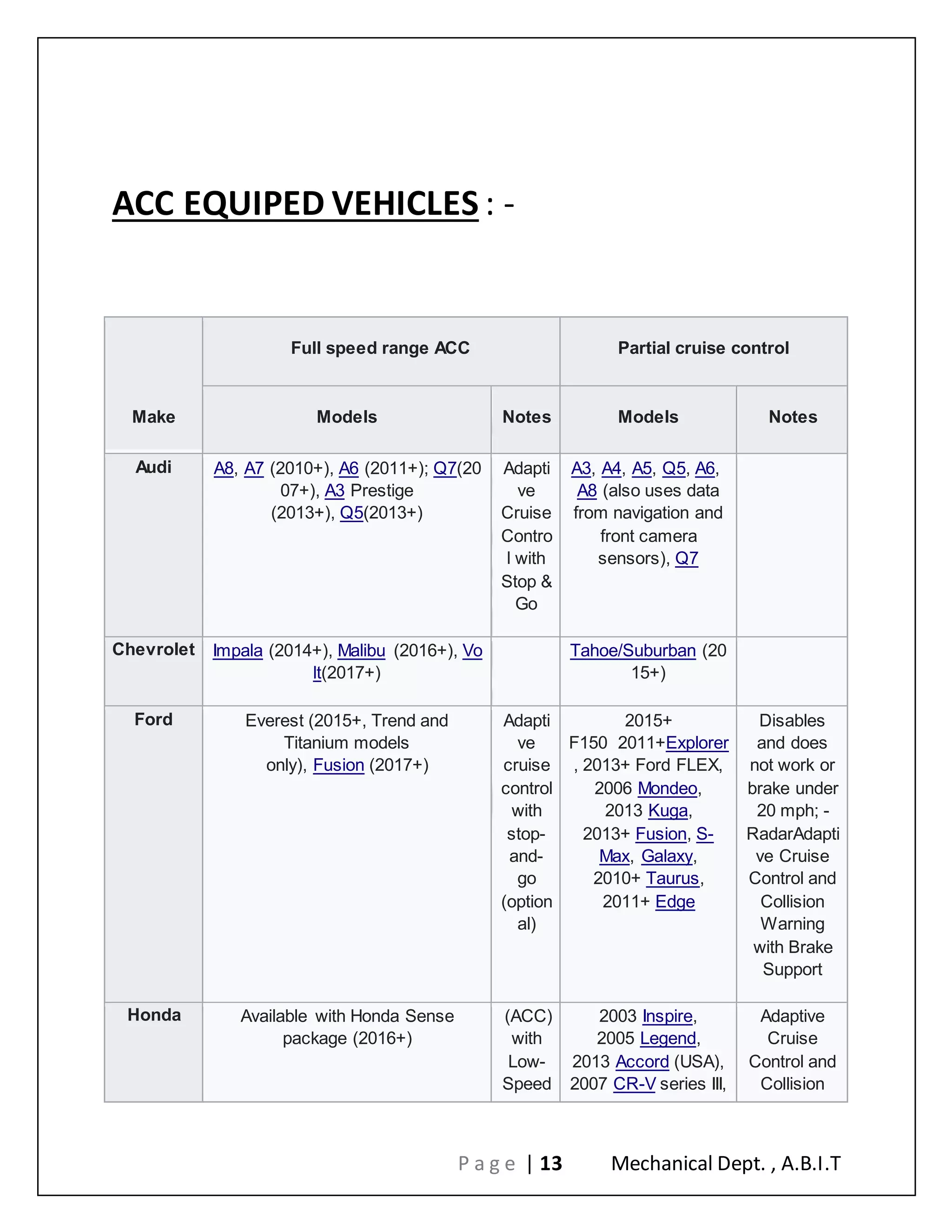
ACC EQUIPED VEHICLES : -
Make
Full speed range ACC Partial cruise control
Models Notes Models Notes
Audi A8, A7 (2010+), A6 (2011+); Q7(20
07+), A3 Prestige
(2013+), Q5(2013+)
Adapti
ve
Cruise
Contro
l with
Stop &
Go
A3, A4, A5, Q5, A6,
A8 (also uses data
from navigation and
front camera
sensors), Q7
Chevrolet Impala (2014+), Malibu (2016+), Vo
lt(2017+)
Tahoe/Suburban (20
15+)
Ford Everest (2015+, Trend and
Titanium models
only), Fusion (2017+)
Adapti
ve
cruise
control
with
stop-
and-
go
(option
al)
2015+
F150 2011+Explorer
, 2013+ Ford FLEX,
2006 Mondeo,
2013 Kuga,
2013+ Fusion, S-
Max, Galaxy,
2010+ Taurus,
2011+ Edge
Disables
and does
not work or
brake under
20 mph; -
RadarAdapti
ve Cruise
Control and
Collision
Warning
with Brake
Support
Honda Available with Honda Sense
package (2016+)
(ACC)
with
Low-
Speed
2003 Inspire,
2005 Legend,
2013 Accord (USA),
2007 CR-V series III,
Adaptive
Cruise
Control and
Collision
P a g e | 14 Mechanical Dept. , A.B.I.T
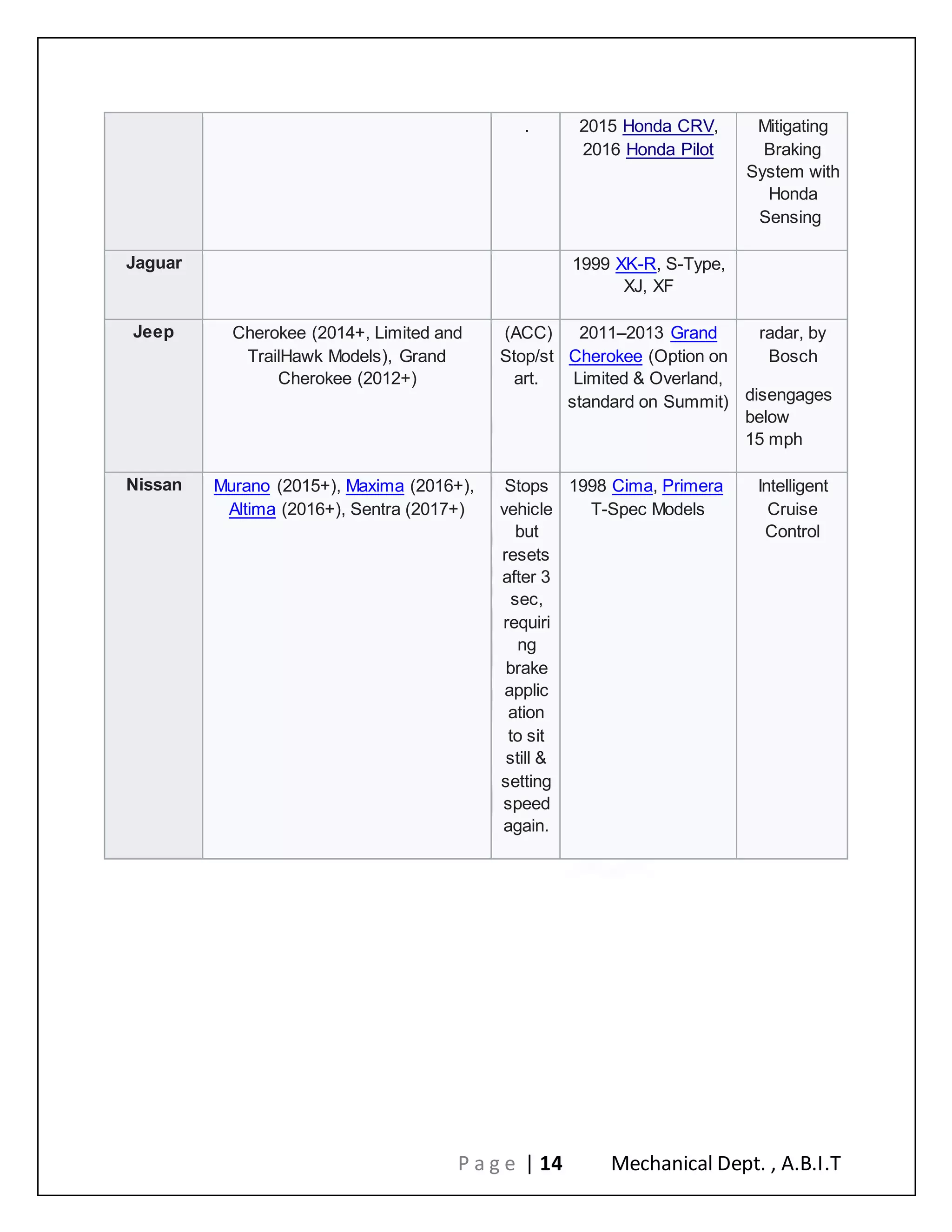
. 2015 Honda CRV,
2016 Honda Pilot
Mitigating
Braking
System with
Honda
Sensing
Jaguar 1999 XK-R, S-Type,
XJ, XF
Jeep Cherokee (2014+, Limited and
TrailHawk Models), Grand
Cherokee (2012+)
(ACC)
Stop/st
art.
2011–2013 Grand
Cherokee (Option on
Limited & Overland,
standard on Summit)
radar, by
Bosch
disengages
below
15 mph
Nissan Murano (2015+), Maxima (2016+),
Altima (2016+), Sentra (2017+)
Stops
vehicle
but
resets
after 3
sec,
requiri
ng
brake
applic
ation
to sit
still &
setting
speed
again.
1998 Cima, Primera
T-Spec Models
Intelligent
Cruise
Control
P a g e | 15 Mechanical Dept. , A.B.I.T
CONCLUSION: -
ď‚— Current system ranges 150meters can stop and slows if any
obstruction.
ď‚— Fully autonomous car is probably not viable in the foreseen
future.
ď‚— Near by vehicles would be in constantcommunication with
each other and act co-operatively.
ď‚— It will probably take decades, but car accidents may eventually
become almost as rare as plane crashes are now.
P a g e | 16 Mechanical Dept. , A.B.I.T
REFERENCE : -
[1] BMW AG, “BMW ACC Active Cruise Control Stop & Go”,
German Car Fans, LLC., 4 August 2003,
http://www.germancarfans.com/News.cfm/NewsID/2030806.002/
bmw/1.html
[2] Karim Nice, "How cruise control system works”,
http://auto.howstuffworks.com/cruise-control.htm
[3] Bob Hewitt, “Cruise Control Basic”,
http://www.minsterfixit.com/cruise1.htm
[4] Control tutorials for Matlab: Example: Modeling a cruise
control system,
http://www.engin.umich.edu/group/ctm/examples/cruise/cc.html.
[5] Willie D. Jones, “Keeping cars from crashing,” IEEE
Spectrum, Sept 01’,
http://www.gavrila.net/Computer_Vision/Smart_Vehicles/Media
_Coverage/spectrum.pdf
[6] “Nissan Develops Cruise Control System”, Nissan Corporate
Communications Dept., News Release (November 25, 1998),
http://www.nissan-global.com/GCC/Japan/NEWS/25c6.htm
[7] BMW AG, “BMW ACC Active Cruise Control”, German Car
Fans, LLC., 4 August 2003,
http://www.germancarfans.com/News.cfm/NewsID/2030805.001
[8] Raja Sengupta and Qing Xu, “Simulation, Analysis and
Comparison of ACC and CACC in Highway Merging Control”,
California Partners for Advanced Transit and Highways,
Richmond, CA. http://path.berkeley.edu/dscr/pub/iv_2003.pdf

Adaptive cruise control

  • 1.
    P a ge | 1 Mechanical Dept. , A.B.I.T CONTENTS : - Page No. ď‚· Introduction 2 ď‚· History 2 ď‚· Background 3 ď‚· Control system in Conventional cruise control 4 - 5 ď‚· Adaptive cruise control (ACC) 6 ď‚· components of ACC 7 ď‚· Working 8 ď‚· Controlling ACC 9 ď‚· Features 10 ď‚· Advantages 11 ď‚· Disadvantages 11 ď‚· Future Aspects 12 ď‚· ACC used vehicles 13 - 14 ď‚· Conclusion 15 ď‚· Reference 16
  • 2.
    P a ge | 2 Mechanical Dept. , A.B.I.T INTRODUCTION : - Cruise control system has become a common feature in automobiles nowadays. Instead of having the driver frequently checking the speedometer and adjusting pressure on the gas pedal or the brake, cruise control system control the speed of the car by maintaining the constant speed set by the driver. Therefore, cruise control system can help reduce driver’s fatigue in driving a long road trip. This paper presents the control system behind the cruise control.  Increased accident rate  Factors  Need 0f intelligent vehicles  Invention of Cruise control History : -  1910 speed control with centrifugal governor .  Modern cruise control - Ralph Teetor-1945 .  First car in 1958 .  Started in cars from 1974 .
  • 3.
    P a ge | 3 Mechanical Dept. , A.B.I.T BACKGROUND : - Before getting into to the control system concepts of cruise control, the components and the basic mechanism of the cruise control system in a vehicle are summarized. A. Components of Cruise Control : Cruise control system can be divided in to three main parts, which are the input, the processor, and the output. The input of the system includes the setting buttons on the steering wheel , gas pedal , brake , clutch and the feedback signal of the cruise control. B. Mechanism of Cruise Control : An overview of the relationship between different components of cruise control system is shown in Fig. 1. The processor of the cruise control system is shown as the Cruise Control Computer in the figure.
  • 4.
    P a ge | 4 Mechanical Dept. , A.B.I.T Control system in Conventional cruise control:- A. Design Consideration : A cruise control system needs to accelerate to the desired speed in a short time without overshooting the speed of the car. B. Physical Model : First, the inertia of the wheels of the car is neglected. Second, the friction of the car is assumed to be the friction caused by the motion of the car. C. Design Specification : Since it is critical for a cruise control system to obtain the desired speed in a short time without overshoot, the design specification is determined: Rise time < 5 sec Overshoot < 10% Steady-state error < 2%
  • 5.
    P a ge | 5 Mechanical Dept. , A.B.I.T D. Assumption : For the simplified cruise control model, the mass, the friction constantand the force from the engine of the car is assumed: m = 1000kg b = 50 N*sec/m u = 500 N E. Modeling and Simulation : Models of cruise control system are developed from the open-loop system to the closed-loop system. Then, models with PI controller are further developed in terms of different control constants.
  • 6.
    P a ge | 6 Mechanical Dept. , A.B.I.T ADAPTIVE CRUISE CONTROL : - ď‚· Advanced version ď‚— Keeps at steady speed ď‚— Using sensors for detection ď‚— Keeps safe distance
  • 7.
    P a ge | 7 Mechanical Dept. , A.B.I.T COMPONENTS OF ACC : - ď‚— Switches and pedals ď‚— Processor or mini computer ď‚— Sensor ď‚— Electronic vacuum actuator
  • 8.
    P a ge | 8 Mechanical Dept. , A.B.I.T WORKING OF ACC : - ď‚— Switch on ACC. ď‚— Set speed. ď‚— Sensors detects vehicle ahead. ď‚— Decelerate to ahead vehicle speed. ď‚— Keeps safe distance.
  • 9.
    P a ge | 9 Mechanical Dept. , A.B.I.T CONTROLLING OF ACC : - ď‚— BRAIN: Mini computer. ď‚— Senses throttle position. ď‚— Senses accelerator position. ď‚— Adjust throttle. ď‚— Senses ahead vehicles.
  • 10.
    P a ge | 10 Mechanical Dept. , A.B.I.T FEATURES : - ď‚— Maintains a safe, comfortable distance between vehicles without driver interventions. ď‚— Maintains a consistent performance in poor visibility conditions. ď‚— Maintains a continuous performance during road turns and elevation changes. ď‚— Alerts drivers by way of automatic braking.
  • 11.
    P a ge | 11 Mechanical Dept. , A.B.I.T ADVANTAGES : -  It’s very useful for long driving.  Can avoid unconsciously violating speed limits.  Reduction in accident rate , driver fatigue .  Increased fuel efficiency. DISADVANTAGES : -  Cost .  Not for heavy traffic , Dangerous in slippery roads .  Encourages the driver to become careless.  The ACC systems not respond directly to the traffic signals.
  • 12.
    P a ge | 12 Mechanical Dept. , A.B.I.T FUTURE ASPECTS : - ď‚— Co-operative Adaptive cruise control or CACC is already being tested in California . ď‚— ACC respond to the distance and speed of the car ahead ,CACC communicate with two or more cars and work together to avoid collision. ď‚— Communication is quicker, reliable and responsive.
  • 13.
    P a ge | 13 Mechanical Dept. , A.B.I.T ACC EQUIPED VEHICLES : - Make Full speed range ACC Partial cruise control Models Notes Models Notes Audi A8, A7 (2010+), A6 (2011+); Q7(20 07+), A3 Prestige (2013+), Q5(2013+) Adapti ve Cruise Contro l with Stop & Go A3, A4, A5, Q5, A6, A8 (also uses data from navigation and front camera sensors), Q7 Chevrolet Impala (2014+), Malibu (2016+), Vo lt(2017+) Tahoe/Suburban (20 15+) Ford Everest (2015+, Trend and Titanium models only), Fusion (2017+) Adapti ve cruise control with stop- and- go (option al) 2015+ F150 2011+Explorer , 2013+ Ford FLEX, 2006 Mondeo, 2013 Kuga, 2013+ Fusion, S- Max, Galaxy, 2010+ Taurus, 2011+ Edge Disables and does not work or brake under 20 mph; - RadarAdapti ve Cruise Control and Collision Warning with Brake Support Honda Available with Honda Sense package (2016+) (ACC) with Low- Speed 2003 Inspire, 2005 Legend, 2013 Accord (USA), 2007 CR-V series III, Adaptive Cruise Control and Collision
  • 14.
    P a ge | 14 Mechanical Dept. , A.B.I.T . 2015 Honda CRV, 2016 Honda Pilot Mitigating Braking System with Honda Sensing Jaguar 1999 XK-R, S-Type, XJ, XF Jeep Cherokee (2014+, Limited and TrailHawk Models), Grand Cherokee (2012+) (ACC) Stop/st art. 2011–2013 Grand Cherokee (Option on Limited & Overland, standard on Summit) radar, by Bosch disengages below 15 mph Nissan Murano (2015+), Maxima (2016+), Altima (2016+), Sentra (2017+) Stops vehicle but resets after 3 sec, requiri ng brake applic ation to sit still & setting speed again. 1998 Cima, Primera T-Spec Models Intelligent Cruise Control
  • 15.
    P a ge | 15 Mechanical Dept. , A.B.I.T CONCLUSION: - ď‚— Current system ranges 150meters can stop and slows if any obstruction. ď‚— Fully autonomous car is probably not viable in the foreseen future. ď‚— Near by vehicles would be in constantcommunication with each other and act co-operatively. ď‚— It will probably take decades, but car accidents may eventually become almost as rare as plane crashes are now.
  • 16.
    P a ge | 16 Mechanical Dept. , A.B.I.T REFERENCE : - [1] BMW AG, “BMW ACC Active Cruise Control Stop & Go”, German Car Fans, LLC., 4 August 2003, http://www.germancarfans.com/News.cfm/NewsID/2030806.002/ bmw/1.html [2] Karim Nice, "How cruise control system works”, http://auto.howstuffworks.com/cruise-control.htm [3] Bob Hewitt, “Cruise Control Basic”, http://www.minsterfixit.com/cruise1.htm [4] Control tutorials for Matlab: Example: Modeling a cruise control system, http://www.engin.umich.edu/group/ctm/examples/cruise/cc.html. [5] Willie D. Jones, “Keeping cars from crashing,” IEEE Spectrum, Sept 01’, http://www.gavrila.net/Computer_Vision/Smart_Vehicles/Media _Coverage/spectrum.pdf [6] “Nissan Develops Cruise Control System”, Nissan Corporate Communications Dept., News Release (November 25, 1998), http://www.nissan-global.com/GCC/Japan/NEWS/25c6.htm [7] BMW AG, “BMW ACC Active Cruise Control”, German Car Fans, LLC., 4 August 2003, http://www.germancarfans.com/News.cfm/NewsID/2030805.001 [8] Raja Sengupta and Qing Xu, “Simulation, Analysis and Comparison of ACC and CACC in Highway Merging Control”, California Partners for Advanced Transit and Highways, Richmond, CA. http://path.berkeley.edu/dscr/pub/iv_2003.pdf