
BRONCHIAL ASTHMA
 Asthma derived from Greek word ásthma
which means to stay awake in order to breath
or difficulty in breathing.
 Asthma is a chronic inflammatory disease in
which patient suffers with reversible episodes
of airway obstruction and bronchospasm.
 Asthma is one of the most common chronic diseases worldwide —1600 millions
patients suffered from asthma
 An overall increase in severity of asthma increases the pool of patients at risk for death.
 As per WHO, India has 30 million asthmatics which is 10% of the global asthmatic
population
 The prevalence of asthma is higher in children. Today, up to 1 out of 10 children in
India has asthma.
 As per a study, Asthma in children has doubled over the past 5 years and is rapidly
increasing.
 There will be an additional 100million asthmatics worldwide by 2025
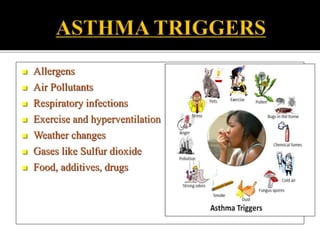
 Allergens
 Air Pollutants
 Respiratory infections
 Exercise and hyperventilation
 Weather changes
 Gases like Sulfur dioxide
 Food, additives, drugs
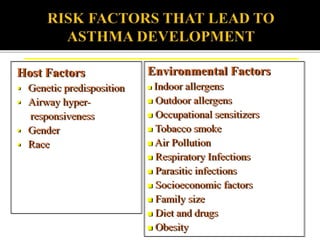
Host Factors
 Genetic predisposition
 Airway hyper-
responsiveness
 Gender
 Race
Environmental Factors
 Indoor allergens
 Outdoor allergens
 Occupational sensitizers
 Tobacco smoke
 Air Pollution
 Respiratory Infections
 Parasitic infections
 Socioeconomic factors
 Family size
 Diet and drugs
 Obesity
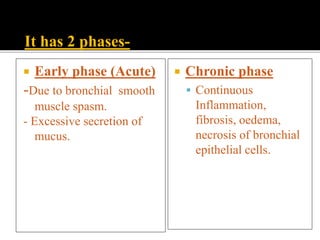
 Early phase (Acute)
-Due to bronchial smooth
muscle spasm.
- Excessive secretion of
mucus.
 Chronic phase
 Continuous
Inflammation,
fibrosis, oedema,
necrosis of bronchial
epithelial cells.
It has 2 phases-
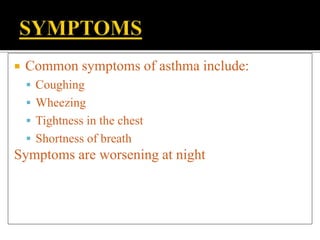
 Common symptoms of asthma include:
 Coughing
 Wheezing
 Tightness in the chest
 Shortness of breath
Symptoms are worsening at night
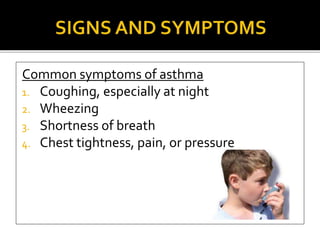
Common symptoms of asthma
1. Coughing, especially at night
2. Wheezing
3. Shortness of breath
4. Chest tightness, pain, or pressure
Mild asthma attack
1. Cough
2. Wheezing
3. Mild difficulty breathing during normal
activities
4. Difficulty sleeping
5. Hiccups
6. Peak expiratory flow rate (PEFR) is 70 to
90% of personal best
Moderate asthma attack
1. Severe cough
2. Moderate wheezing
3. Shortness of breath
4. Chest tightness
Usually worsens with exercise
5. Inability to sleep
6. Nasal congestion
7. PEFR is 50 to 70% of personal best
Severe asthma attack
1. Severe wheezing
2. Severe difficulty breathing
3. Inability to speak in complete sentences
 Sentences are interrupted by breathing
4. Inability to lie down
5. Signs of severe difficulty breathing
 Rib retractions: ribs are visible during each breath
 Nasal flaring: nostrils open wide during each breath
 Use of accessory muscles: neck muscles are prominent during each breath
6. Chest pain
 Sharp, chest pain when taking a breath, coughing
7. PEFR is <50% of personal best
8. Confusion
9. Rapid pulse
10. Fatigue
11. Rapid breathing rate
 While the exact cause of asthma is not known, it
is thought that a variety of factors interacting
with one another, early in life, result in the
development of asthma.
 Parents with asthma
 Atopy
 Childhood respiratory infections
 Exposure to allergens or infections while the
immune system is developing
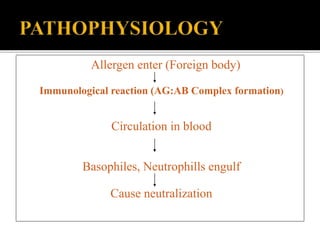
Allergen enter (Foreign body)
Immunological reaction (AG:AB Complex formation)
Circulation in blood
Basophiles, Neutrophills engulf
Cause neutralization
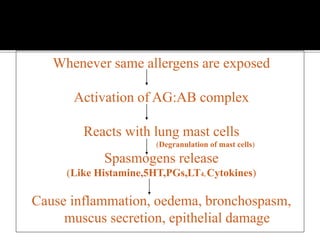
Whenever same allergens are exposed
Activation of AG:AB complex
Reacts with lung mast cells
(Degranulation of mast cells)
Spasmogens release
(Like Histamine,5HT,PGs,LT4, Cytokines)
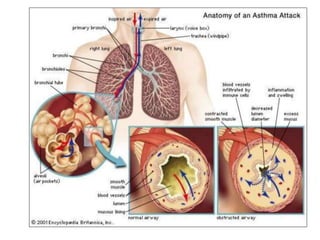
Cause inflammation, oedema, bronchospasm,
muscus secretion, epithelial damage
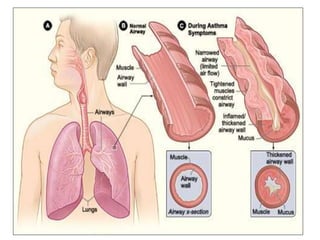
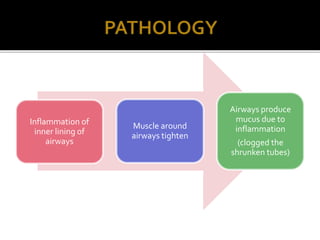
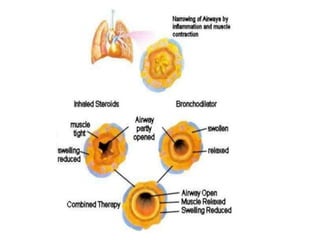
Inflammation of
inner lining of
airways
Muscle around
airways tighten
Airways produce
mucus due to
inflammation
(clogged the
shrunken tubes)
Initial exam (conducted by doctor):
 Medical history
 Asthma symptoms, how you feel, known
asthma and allergy triggers, your activity level
and diet, your home and work environment, and
family history.
 Then, some tests will be conducted to diagnose
asthma
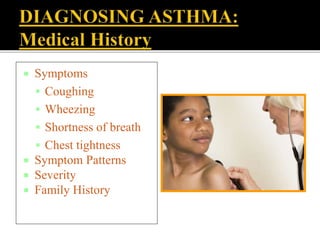
 Symptoms
 Coughing
 Wheezing
 Shortness of breath
 Chest tightness
 Symptom Patterns
 Severity
 Family History
 Troublesome cough, particularly at night
 Awakened by coughing
 Coughing or wheezing after physical activity
 Breathing problems during particular seasons
 Coughing, wheezing, or chest tightness after
allergen exposure
 Colds that last more than 10 days
 Relief when medication is used
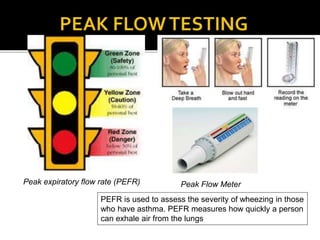
Peak Flow Meter
PEFR is used to assess the severity of wheezing in those
who have asthma. PEFR measures how quickly a person
can exhale air from the lungs
Peak expiratory flow rate (PEFR)
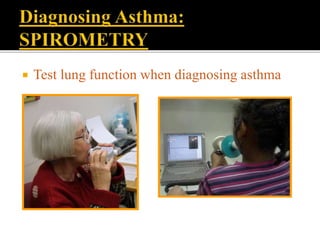
 Test lung function when diagnosing asthma
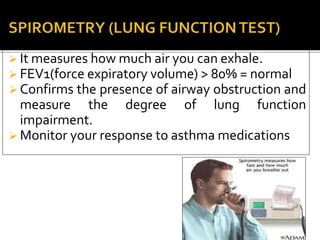
 It measures how much air you can exhale.
 FEV1(force expiratory volume) > 80% = normal
 Confirms the presence of airway obstruction and
measure the degree of lung function
impairment.
 Monitor your response to asthma medications
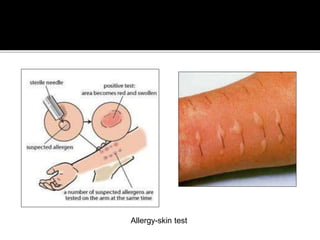
 A drop of liquid containing the allergen in placed
on your skin (generally forearms is used).
 A small lance with a pinpoint is poked through
the liquid into the top layer of skin (prick test).
 If you are allergic to the allergen, after about 2
minutes the skin begins to form a reaction (red,
slightly swollen, and itchy: it makes a hive).
 The size of the hive is measured and recorded.
 The larger the hive, the more likely it is that you
are allergic to the allergen tested.
Allergy-skin test
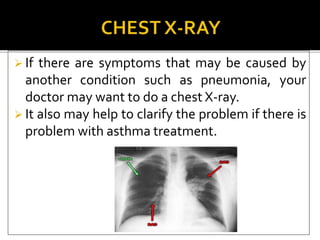
 If there are symptoms that may be caused by
another condition such as pneumonia, your
doctor may want to do a chest X-ray.
 It also may help to clarify the problem if there is
problem with asthma treatment.
 While asthma cannot be cured, it can be controlled:
 Medications
▪ Long term
▪ Quick relief
▪ Bronchial thermoplasty (therapeutic
radiofrequency energy to the airway wall, thus
heating the tissue and reducing the amount of
smooth muscle present in the airway wall.)
 Learning to recognize one’s own triggers and
taking steps to avoid them.
 Medication
 Long term:
• Taken daily over a long period of time
• Used to reduce inflammation, relax airway muscles,
and improve symptoms and lung function
▪ Inhaled corticosteroid
▪ Leukotriene modifiers
▪ Long-acting beta agonists
▪ Combination inhalers
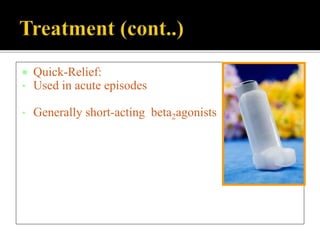
 Quick-Relief:
• Used in acute episodes
• Generally short-acting beta2agonists
1. Allergic asthma (extrinsic)
2. Non-allergic asthma (intrinsic)
3. Cough variant asthma
4. Occupational asthma
5. Exercise induced asthma
6. Medication induced asthma
7. Nocturnal asthma
 It is triggered when you inhale one of the following allergens:
a) Tobacco smoke
b) Animal dander
c) Dust mites
d) Cockroaches
e) Molds
f) Pollens
 Age onset over 40 y/o
 Specific symptoms:
 Runny nose, watery eyes, you are wheezing more, swollen nasal
passages, excess mucus, and a scratchy throat. A cough may result
from the constant postnasal drip
 Not triggered by allergens
 Age onset under 40 y/o
 Triggers:
 Irritants- Tobacco smoke, wood smoke, room
deodorizers, fresh paint, household cleaning
products, cooking odours, workplace chemicals,
perfumes, and outdoor air pollution, heartburn,
changes in temperature.
 Specific symptoms:
Respiratory infections, such as the common cold,
Influenza or a sinus infection.
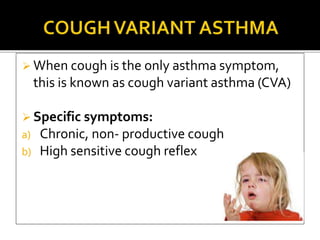
 When cough is the only asthma symptom,
this is known as cough variant asthma (CVA)
 Specific symptoms:
a) Chronic, non- productive cough
b) High sensitive cough reflex
 A common respiratory condition that results from
exposures in the workplace
 Examples of the occupations and the potential
irritants include:
a) Dental hygienists: latex
b) Bakers: flour
c) Roofers, insulators and painters: isocyanates (toluene)
d) Welders and metal workers: metals: metals (nickel,
platinum and chromic acid)
e) Plastic manufacturers: glues and resins
f) Farmers and veterinarians: animal proteins
g) Carpenters: wood dust
 Specific symptoms:
 Airway irritation, obstruction, and inflammation.
 Worsening after arriving at work and
improvement on weekends or during extended
periods away from work.
 Treatment :
a) Engineering controls (such as improved
ventilation) to reduce or eliminate the
substance
b) Use respiratory protective equipment
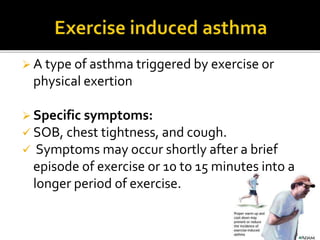
 A type of asthma triggered by exercise or
physical exertion
 Specific symptoms:
 SOB, chest tightness, and cough.
 Symptoms may occur shortly after a brief
episode of exercise or 10 to 15 minutes into a
longer period of exercise.
 The asthma getting worse because of
medication you take for another health
condition.
 Causes:
a) Anti- inflammatories for aches and pain:
Motrin, Advil
b) Heart disease drugs :inderal, coreg (beta-
blockers)
c) Glaucoma drugs: beta-blockers eyes drop
d) Hypertension and congestive heart failure
drugs: angotensive converting enzyme
inhibitors (ACE)
 The chances of having asthma symptoms are much
higher during sleep because asthma is powerfully
influenced by the sleep-wake cycle (circadian
rhythms)
 Causes : Exposure to allergens, cooling of the airways,
reclining position, hormone secretions that follow a
circadian pattern, heartburn at night
 Specific symptoms: wheezing, cough, and trouble
breathing are common and dangerous, particularly at
night time.
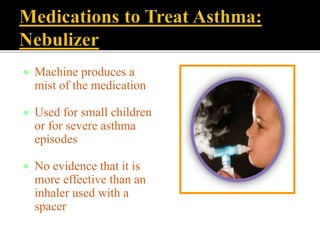
 Machine produces a
mist of the medication
 Used for small children
or for severe asthma
episodes
 No evidence that it is
more effective than an
inhaler used with a
spacer
Bronchial asthma
Bronchial asthma

Bronchial asthma

  • 1.
  • 2.
     Asthma derivedfrom Greek word ásthma which means to stay awake in order to breath or difficulty in breathing.  Asthma is a chronic inflammatory disease in which patient suffers with reversible episodes of airway obstruction and bronchospasm.
  • 3.
     Asthma isone of the most common chronic diseases worldwide —1600 millions patients suffered from asthma  An overall increase in severity of asthma increases the pool of patients at risk for death.  As per WHO, India has 30 million asthmatics which is 10% of the global asthmatic population  The prevalence of asthma is higher in children. Today, up to 1 out of 10 children in India has asthma.  As per a study, Asthma in children has doubled over the past 5 years and is rapidly increasing.  There will be an additional 100million asthmatics worldwide by 2025
  • 4.
     Allergens  AirPollutants  Respiratory infections  Exercise and hyperventilation  Weather changes  Gases like Sulfur dioxide  Food, additives, drugs
  • 5.
    Host Factors  Geneticpredisposition  Airway hyper- responsiveness  Gender  Race Environmental Factors  Indoor allergens  Outdoor allergens  Occupational sensitizers  Tobacco smoke  Air Pollution  Respiratory Infections  Parasitic infections  Socioeconomic factors  Family size  Diet and drugs  Obesity
  • 6.
     Early phase(Acute) -Due to bronchial smooth muscle spasm. - Excessive secretion of mucus.  Chronic phase  Continuous Inflammation, fibrosis, oedema, necrosis of bronchial epithelial cells. It has 2 phases-
  • 8.
     Common symptomsof asthma include:  Coughing  Wheezing  Tightness in the chest  Shortness of breath Symptoms are worsening at night
  • 10.
    Common symptoms ofasthma 1. Coughing, especially at night 2. Wheezing 3. Shortness of breath 4. Chest tightness, pain, or pressure
  • 11.
    Mild asthma attack 1.Cough 2. Wheezing 3. Mild difficulty breathing during normal activities 4. Difficulty sleeping 5. Hiccups 6. Peak expiratory flow rate (PEFR) is 70 to 90% of personal best
  • 12.
    Moderate asthma attack 1.Severe cough 2. Moderate wheezing 3. Shortness of breath 4. Chest tightness Usually worsens with exercise 5. Inability to sleep 6. Nasal congestion 7. PEFR is 50 to 70% of personal best
  • 13.
    Severe asthma attack 1.Severe wheezing 2. Severe difficulty breathing 3. Inability to speak in complete sentences  Sentences are interrupted by breathing 4. Inability to lie down 5. Signs of severe difficulty breathing  Rib retractions: ribs are visible during each breath  Nasal flaring: nostrils open wide during each breath  Use of accessory muscles: neck muscles are prominent during each breath 6. Chest pain  Sharp, chest pain when taking a breath, coughing 7. PEFR is <50% of personal best 8. Confusion 9. Rapid pulse 10. Fatigue 11. Rapid breathing rate
  • 14.
     While theexact cause of asthma is not known, it is thought that a variety of factors interacting with one another, early in life, result in the development of asthma.  Parents with asthma  Atopy  Childhood respiratory infections  Exposure to allergens or infections while the immune system is developing
  • 15.
    Allergen enter (Foreignbody) Immunological reaction (AG:AB Complex formation) Circulation in blood Basophiles, Neutrophills engulf Cause neutralization
  • 16.
    Whenever same allergensare exposed Activation of AG:AB complex Reacts with lung mast cells (Degranulation of mast cells) Spasmogens release (Like Histamine,5HT,PGs,LT4, Cytokines) Cause inflammation, oedema, bronchospasm, muscus secretion, epithelial damage
  • 17.
    Inflammation of inner liningof airways Muscle around airways tighten Airways produce mucus due to inflammation (clogged the shrunken tubes)
  • 18.
    Initial exam (conductedby doctor):  Medical history  Asthma symptoms, how you feel, known asthma and allergy triggers, your activity level and diet, your home and work environment, and family history.  Then, some tests will be conducted to diagnose asthma
  • 19.
     Symptoms  Coughing Wheezing  Shortness of breath  Chest tightness  Symptom Patterns  Severity  Family History
  • 20.
     Troublesome cough,particularly at night  Awakened by coughing  Coughing or wheezing after physical activity  Breathing problems during particular seasons  Coughing, wheezing, or chest tightness after allergen exposure  Colds that last more than 10 days  Relief when medication is used
  • 21.
    Peak Flow Meter PEFRis used to assess the severity of wheezing in those who have asthma. PEFR measures how quickly a person can exhale air from the lungs Peak expiratory flow rate (PEFR)
  • 22.
     Test lungfunction when diagnosing asthma
  • 23.
     It measureshow much air you can exhale.  FEV1(force expiratory volume) > 80% = normal  Confirms the presence of airway obstruction and measure the degree of lung function impairment.  Monitor your response to asthma medications
  • 24.
     A dropof liquid containing the allergen in placed on your skin (generally forearms is used).  A small lance with a pinpoint is poked through the liquid into the top layer of skin (prick test).  If you are allergic to the allergen, after about 2 minutes the skin begins to form a reaction (red, slightly swollen, and itchy: it makes a hive).  The size of the hive is measured and recorded.  The larger the hive, the more likely it is that you are allergic to the allergen tested.
  • 25.
  • 26.
     If thereare symptoms that may be caused by another condition such as pneumonia, your doctor may want to do a chest X-ray.  It also may help to clarify the problem if there is problem with asthma treatment.
  • 27.
     While asthmacannot be cured, it can be controlled:  Medications ▪ Long term ▪ Quick relief ▪ Bronchial thermoplasty (therapeutic radiofrequency energy to the airway wall, thus heating the tissue and reducing the amount of smooth muscle present in the airway wall.)  Learning to recognize one’s own triggers and taking steps to avoid them.
  • 28.
     Medication  Longterm: • Taken daily over a long period of time • Used to reduce inflammation, relax airway muscles, and improve symptoms and lung function ▪ Inhaled corticosteroid ▪ Leukotriene modifiers ▪ Long-acting beta agonists ▪ Combination inhalers
  • 29.
     Quick-Relief: • Usedin acute episodes • Generally short-acting beta2agonists
  • 30.
    1. Allergic asthma(extrinsic) 2. Non-allergic asthma (intrinsic) 3. Cough variant asthma 4. Occupational asthma 5. Exercise induced asthma 6. Medication induced asthma 7. Nocturnal asthma
  • 31.
     It istriggered when you inhale one of the following allergens: a) Tobacco smoke b) Animal dander c) Dust mites d) Cockroaches e) Molds f) Pollens  Age onset over 40 y/o  Specific symptoms:  Runny nose, watery eyes, you are wheezing more, swollen nasal passages, excess mucus, and a scratchy throat. A cough may result from the constant postnasal drip
  • 32.
     Not triggeredby allergens  Age onset under 40 y/o  Triggers:  Irritants- Tobacco smoke, wood smoke, room deodorizers, fresh paint, household cleaning products, cooking odours, workplace chemicals, perfumes, and outdoor air pollution, heartburn, changes in temperature.  Specific symptoms: Respiratory infections, such as the common cold, Influenza or a sinus infection.
  • 33.
     When coughis the only asthma symptom, this is known as cough variant asthma (CVA)  Specific symptoms: a) Chronic, non- productive cough b) High sensitive cough reflex
  • 34.
     A commonrespiratory condition that results from exposures in the workplace  Examples of the occupations and the potential irritants include: a) Dental hygienists: latex b) Bakers: flour c) Roofers, insulators and painters: isocyanates (toluene) d) Welders and metal workers: metals: metals (nickel, platinum and chromic acid) e) Plastic manufacturers: glues and resins f) Farmers and veterinarians: animal proteins g) Carpenters: wood dust
  • 35.
     Specific symptoms: Airway irritation, obstruction, and inflammation.  Worsening after arriving at work and improvement on weekends or during extended periods away from work.  Treatment : a) Engineering controls (such as improved ventilation) to reduce or eliminate the substance b) Use respiratory protective equipment
  • 36.
     A typeof asthma triggered by exercise or physical exertion  Specific symptoms:  SOB, chest tightness, and cough.  Symptoms may occur shortly after a brief episode of exercise or 10 to 15 minutes into a longer period of exercise.
  • 37.
     The asthmagetting worse because of medication you take for another health condition.  Causes: a) Anti- inflammatories for aches and pain: Motrin, Advil b) Heart disease drugs :inderal, coreg (beta- blockers) c) Glaucoma drugs: beta-blockers eyes drop d) Hypertension and congestive heart failure drugs: angotensive converting enzyme inhibitors (ACE)
  • 38.
     The chancesof having asthma symptoms are much higher during sleep because asthma is powerfully influenced by the sleep-wake cycle (circadian rhythms)  Causes : Exposure to allergens, cooling of the airways, reclining position, hormone secretions that follow a circadian pattern, heartburn at night  Specific symptoms: wheezing, cough, and trouble breathing are common and dangerous, particularly at night time.
  • 40.
     Machine producesa mist of the medication  Used for small children or for severe asthma episodes  No evidence that it is more effective than an inhaler used with a spacer