Nucleic acids : structure and function
Ravish Yadav
There are two types of nucleic acid—
• DNA (deoxyribonucleic acid)
• RNA (ribonucleic acid).
We first consider the structure of DNA.
Structure of DNA
Like proteins, DNA has-
1. Primary structure
2. Secondary structure
3. tertiary structure
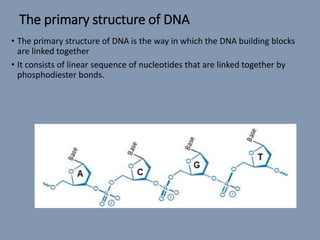
The primary structure of DNA
• The primary structure of DNA is the way in which the DNA building blocks
are linked together
• It consists of linear sequence of nucleotides that are linked together by
phosphodiester bonds.
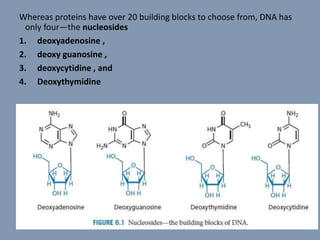
Whereas proteins have over 20 building blocks to choose from, DNA has
only four—the nucleosides
1. deoxyadenosine ,
2. deoxy guanosine ,
3. deoxycytidine , and
4. Deoxythymidine
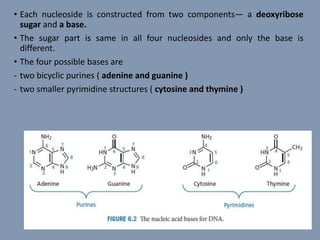
• Each nucleoside is constructed from two components— a deoxyribose
sugar and a base.
• The sugar part is same in all four nucleosides and only the base is
different.
• The four possible bases are
- two bicyclic purines ( adenine and guanine )
- two smaller pyrimidine structures ( cytosine and thymine )
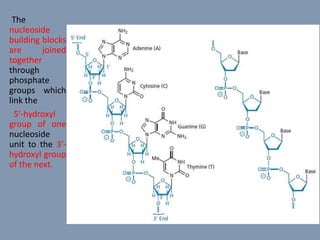
The
nucleoside
building blocks
are joined
together
through
phosphate
groups which
link the
5′-hydroxyl
group of one
nucleoside
unit to the 3′-
hydroxyl group
of the next.
The secondary structure of DNA
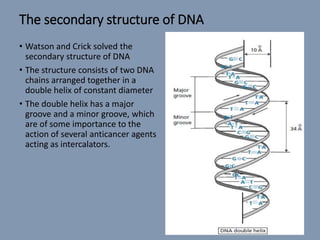
• Watson and Crick solved the
secondary structure of DNA
• The structure consists of two DNA
chains arranged together in a
double helix of constant diameter
• The double helix has a major
groove and a minor groove, which
are of some importance to the
action of several anticancer agents
acting as intercalators.
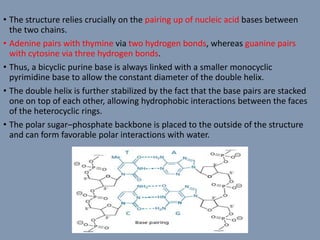
• The structure relies crucially on the pairing up of nucleic acid bases between
the two chains.
• Adenine pairs with thymine via two hydrogen bonds, whereas guanine pairs
with cytosine via three hydrogen bonds.
• Thus, a bicyclic purine base is always linked with a smaller monocyclic
pyrimidine base to allow the constant diameter of the double helix.
• The double helix is further stabilized by the fact that the base pairs are stacked
one on top of each other, allowing hydrophobic interactions between the faces
of the heterocyclic rings.
• The polar sugar–phosphate backbone is placed to the outside of the structure
and can form favorable polar interactions with water.
The tertiary structure of DNA
• DNA is an extremely long molecule: so long, in fact, that it would not
fit into the nucleus of the cell if it existed as a linear molecule.
• It has to be coiled into a more compact 3D shape(tertiary structure)
which can fit into the nucleus—a process known as supercoiling .
• This process requires the action of a family of enzymes called
topoisomerases , which can catalyze the impossible act of passing
one stretch of DNA helix across another stretch. They do this by
temporarily cleaving one, or both, strands of the DNA helix to create
a temporary gap, then resealing the strand(s) once the crossover has
taken place.
• Supercoiling allows the efficient storage of DNA, but the DNA has to
be uncoiled again if replication and transcription are to take place.
Nucleic acids as drug targets
• there are many important drugs which target nucleic acids, especially
in the areas of antibacterial and anticancer therapy.
• In general, the drugs that interact with DNA can be grouped under
the following categories:
1. intercalating agents;(part of syllabus)
2. topoisomerase poisons (non-intercalating);
3. alkylating agents; (part of syllabus)
4. chain cutters;
5. chain terminators.
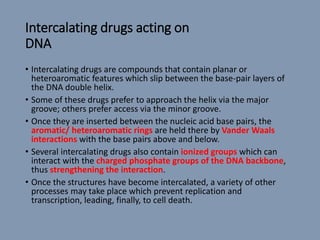
Intercalating drugs acting on
DNA
• Intercalating drugs are compounds that contain planar or
heteroaromatic features which slip between the base-pair layers of
the DNA double helix.
• Some of these drugs prefer to approach the helix via the major
groove; others prefer access via the minor groove.
• Once they are inserted between the nucleic acid base pairs, the
aromatic/ heteroaromatic rings are held there by Vander Waals
interactions with the base pairs above and below.
• Several intercalating drugs also contain ionized groups which can
interact with the charged phosphate groups of the DNA backbone,
thus strengthening the interaction.
• Once the structures have become intercalated, a variety of other
processes may take place which prevent replication and
transcription, leading, finally, to cell death.
examples of drugs that are capable of
intercalating DNA.
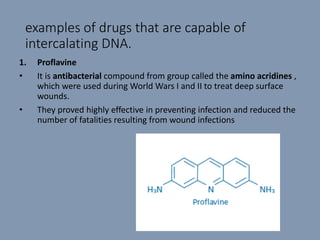
1. Proflavine
• It is antibacterial compound from group called the amino acridines ,
which were used during World Wars I and II to treat deep surface
wounds.
• They proved highly effective in preventing infection and reduced the
number of fatalities resulting from wound infections
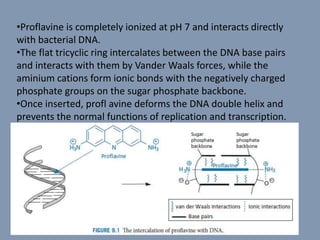
•Proflavine is completely ionized at pH 7 and interacts directly
with bacterial DNA.
•The flat tricyclic ring intercalates between the DNA base pairs
and interacts with them by Vander Waals forces, while the
aminium cations form ionic bonds with the negatively charged
phosphate groups on the sugar phosphate backbone.
•Once inserted, profl avine deforms the DNA double helix and
prevents the normal functions of replication and transcription.
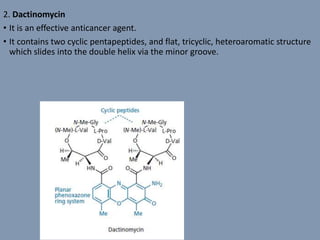
2. Dactinomycin
• It is an effective anticancer agent.
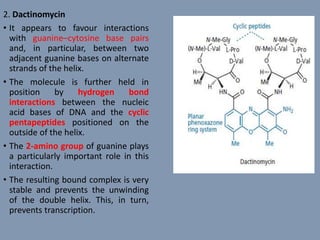
• It contains two cyclic pentapeptides, and flat, tricyclic, heteroaromatic structure
which slides into the double helix via the minor groove.
2. Dactinomycin
• It appears to favour interactions
with guanine–cytosine base pairs
and, in particular, between two
adjacent guanine bases on alternate
strands of the helix.
• The molecule is further held in
position by hydrogen bond
interactions between the nucleic
acid bases of DNA and the cyclic
pentapeptides positioned on the
outside of the helix.
• The 2-amino group of guanine plays
a particularly important role in this
interaction.
• The resulting bound complex is very
stable and prevents the unwinding
of the double helix. This, in turn,
prevents transcription.
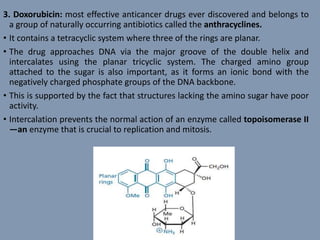
3. Doxorubicin: most effective anticancer drugs ever discovered and belongs to
a group of naturally occurring antibiotics called the anthracyclines.
• It contains a tetracyclic system where three of the rings are planar.
• The drug approaches DNA via the major groove of the double helix and
intercalates using the planar tricyclic system. The charged amino group
attached to the sugar is also important, as it forms an ionic bond with the
negatively charged phosphate groups of the DNA backbone.
• This is supported by the fact that structures lacking the amino sugar have poor
activity.
• Intercalation prevents the normal action of an enzyme called topoisomerase II
—an enzyme that is crucial to replication and mitosis.
Alkylating agents
• Alkylating agents are highly electrophilic compounds that react with
nucleophiles to form strong covalent bonds.
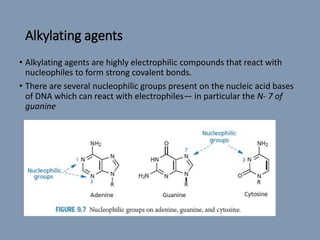
• There are several nucleophilic groups present on the nucleic acid bases
of DNA which can react with electrophiles— in particular the N- 7 of
guanine
Anticancer mechanism of alkylation
• Drugs with two alkylating groups can react with a nucleic acid base
on each chain of DNA to cross-link the strands such that replication
or transcription is disrupted.
• Alternatively, the drug could link two nucleophilic groups on the
same chain such that the drug is attached like a limpet to the side of
the DNA helix. That portion of DNA then becomes masked from the
enzymes required to catalyze DNA replication and transcription.
Anticancer mechanism of alkylation
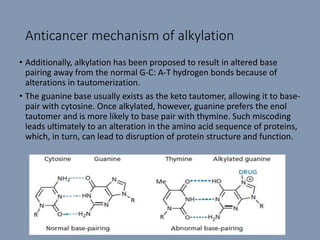
• Additionally, alkylation has been proposed to result in altered base
pairing away from the normal G-C: A-T hydrogen bonds because of
alterations in tautomerization.
• The guanine base usually exists as the keto tautomer, allowing it to base-
pair with cytosine. Once alkylated, however, guanine prefers the enol
tautomer and is more likely to base pair with thymine. Such miscoding
leads ultimately to an alteration in the amino acid sequence of proteins,
which, in turn, can lead to disruption of protein structure and function.
Examples of alkylatig drugs
1.Cisplatin
2.Busulfan
3.Chlorambucil
4.Lomustine
5.carmustine

Nucleic acids: structure and function

  • 1.
    Nucleic acids :structure and function Ravish Yadav
  • 2.
    There are twotypes of nucleic acid— • DNA (deoxyribonucleic acid) • RNA (ribonucleic acid). We first consider the structure of DNA.
  • 3.
    Structure of DNA Likeproteins, DNA has- 1. Primary structure 2. Secondary structure 3. tertiary structure
  • 4.
    The primary structureof DNA • The primary structure of DNA is the way in which the DNA building blocks are linked together • It consists of linear sequence of nucleotides that are linked together by phosphodiester bonds.
  • 5.
    Whereas proteins haveover 20 building blocks to choose from, DNA has only four—the nucleosides 1. deoxyadenosine , 2. deoxy guanosine , 3. deoxycytidine , and 4. Deoxythymidine
  • 6.
    • Each nucleosideis constructed from two components— a deoxyribose sugar and a base. • The sugar part is same in all four nucleosides and only the base is different. • The four possible bases are - two bicyclic purines ( adenine and guanine ) - two smaller pyrimidine structures ( cytosine and thymine )
  • 7.
    The nucleoside building blocks are joined together through phosphate groupswhich link the 5′-hydroxyl group of one nucleoside unit to the 3′- hydroxyl group of the next.
  • 8.
    The secondary structureof DNA • Watson and Crick solved the secondary structure of DNA • The structure consists of two DNA chains arranged together in a double helix of constant diameter • The double helix has a major groove and a minor groove, which are of some importance to the action of several anticancer agents acting as intercalators.
  • 9.
    • The structurerelies crucially on the pairing up of nucleic acid bases between the two chains. • Adenine pairs with thymine via two hydrogen bonds, whereas guanine pairs with cytosine via three hydrogen bonds. • Thus, a bicyclic purine base is always linked with a smaller monocyclic pyrimidine base to allow the constant diameter of the double helix. • The double helix is further stabilized by the fact that the base pairs are stacked one on top of each other, allowing hydrophobic interactions between the faces of the heterocyclic rings. • The polar sugar–phosphate backbone is placed to the outside of the structure and can form favorable polar interactions with water.
  • 10.
    The tertiary structureof DNA • DNA is an extremely long molecule: so long, in fact, that it would not fit into the nucleus of the cell if it existed as a linear molecule. • It has to be coiled into a more compact 3D shape(tertiary structure) which can fit into the nucleus—a process known as supercoiling . • This process requires the action of a family of enzymes called topoisomerases , which can catalyze the impossible act of passing one stretch of DNA helix across another stretch. They do this by temporarily cleaving one, or both, strands of the DNA helix to create a temporary gap, then resealing the strand(s) once the crossover has taken place. • Supercoiling allows the efficient storage of DNA, but the DNA has to be uncoiled again if replication and transcription are to take place.
  • 11.
    Nucleic acids asdrug targets
  • 12.
    • there aremany important drugs which target nucleic acids, especially in the areas of antibacterial and anticancer therapy. • In general, the drugs that interact with DNA can be grouped under the following categories: 1. intercalating agents;(part of syllabus) 2. topoisomerase poisons (non-intercalating); 3. alkylating agents; (part of syllabus) 4. chain cutters; 5. chain terminators.
  • 13.
    Intercalating drugs actingon DNA • Intercalating drugs are compounds that contain planar or heteroaromatic features which slip between the base-pair layers of the DNA double helix. • Some of these drugs prefer to approach the helix via the major groove; others prefer access via the minor groove. • Once they are inserted between the nucleic acid base pairs, the aromatic/ heteroaromatic rings are held there by Vander Waals interactions with the base pairs above and below. • Several intercalating drugs also contain ionized groups which can interact with the charged phosphate groups of the DNA backbone, thus strengthening the interaction. • Once the structures have become intercalated, a variety of other processes may take place which prevent replication and transcription, leading, finally, to cell death.
  • 14.
    examples of drugsthat are capable of intercalating DNA. 1. Proflavine • It is antibacterial compound from group called the amino acridines , which were used during World Wars I and II to treat deep surface wounds. • They proved highly effective in preventing infection and reduced the number of fatalities resulting from wound infections
  • 15.
    •Proflavine is completelyionized at pH 7 and interacts directly with bacterial DNA. •The flat tricyclic ring intercalates between the DNA base pairs and interacts with them by Vander Waals forces, while the aminium cations form ionic bonds with the negatively charged phosphate groups on the sugar phosphate backbone. •Once inserted, profl avine deforms the DNA double helix and prevents the normal functions of replication and transcription.
  • 16.
    2. Dactinomycin • Itis an effective anticancer agent. • It contains two cyclic pentapeptides, and flat, tricyclic, heteroaromatic structure which slides into the double helix via the minor groove.
  • 17.
    2. Dactinomycin • Itappears to favour interactions with guanine–cytosine base pairs and, in particular, between two adjacent guanine bases on alternate strands of the helix. • The molecule is further held in position by hydrogen bond interactions between the nucleic acid bases of DNA and the cyclic pentapeptides positioned on the outside of the helix. • The 2-amino group of guanine plays a particularly important role in this interaction. • The resulting bound complex is very stable and prevents the unwinding of the double helix. This, in turn, prevents transcription.
  • 18.
    3. Doxorubicin: mosteffective anticancer drugs ever discovered and belongs to a group of naturally occurring antibiotics called the anthracyclines. • It contains a tetracyclic system where three of the rings are planar. • The drug approaches DNA via the major groove of the double helix and intercalates using the planar tricyclic system. The charged amino group attached to the sugar is also important, as it forms an ionic bond with the negatively charged phosphate groups of the DNA backbone. • This is supported by the fact that structures lacking the amino sugar have poor activity. • Intercalation prevents the normal action of an enzyme called topoisomerase II —an enzyme that is crucial to replication and mitosis.
  • 19.
    Alkylating agents • Alkylatingagents are highly electrophilic compounds that react with nucleophiles to form strong covalent bonds. • There are several nucleophilic groups present on the nucleic acid bases of DNA which can react with electrophiles— in particular the N- 7 of guanine
  • 20.
    Anticancer mechanism ofalkylation • Drugs with two alkylating groups can react with a nucleic acid base on each chain of DNA to cross-link the strands such that replication or transcription is disrupted. • Alternatively, the drug could link two nucleophilic groups on the same chain such that the drug is attached like a limpet to the side of the DNA helix. That portion of DNA then becomes masked from the enzymes required to catalyze DNA replication and transcription.
  • 21.
    Anticancer mechanism ofalkylation • Additionally, alkylation has been proposed to result in altered base pairing away from the normal G-C: A-T hydrogen bonds because of alterations in tautomerization. • The guanine base usually exists as the keto tautomer, allowing it to base- pair with cytosine. Once alkylated, however, guanine prefers the enol tautomer and is more likely to base pair with thymine. Such miscoding leads ultimately to an alteration in the amino acid sequence of proteins, which, in turn, can lead to disruption of protein structure and function.
  • 22.
    Examples of alkylatigdrugs 1.Cisplatin 2.Busulfan 3.Chlorambucil 4.Lomustine 5.carmustine