Counselling Research

Phenomenological Research
FdA and BA (Hons) Counselling with
Brief Interventions
Aims
1. Phenomenology in counselling
2. Phenomenology as a research method
3. Data analysis using the phenomenological
approach: procedure
4. Conclusions
Phenomenology
The way we experience the world determines how we
respond and is based on our own unique mixture of
needs, history and expectations
Each of us lives in our own subjective world, which
cannot be fully and completely understood by anyone
else

Tony Merry (2002)
Phenomenology in Counselling
•
•
•
•

Frames of Reference
Bracketing
Equalisation
Description
Phenomenological Research
As in counselling this is an attempt to
understand the structure of lived experience
rather than explain it
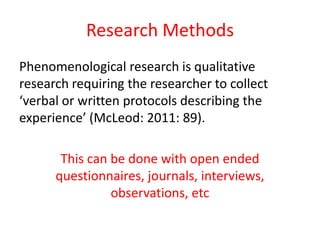
Research Methods
Phenomenological research is qualitative
research requiring the researcher to collect
‘verbal or written protocols describing the
experience’ (McLeod: 2011: 89).
This can be done with open ended
questionnaires, journals, interviews,
observations, etc
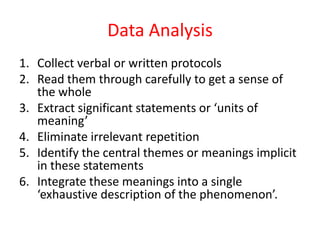
Data Analysis
1. Collect verbal or written protocols
2. Read them through carefully to get a sense of
the whole
3. Extract significant statements or ‘units of
meaning’
4. Eliminate irrelevant repetition
5. Identify the central themes or meanings implicit
in these statements
6. Integrate these meanings into a single
‘exhaustive description of the phenomenon’.
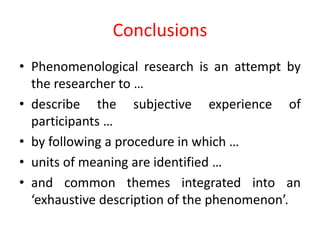
Conclusions
• Phenomenological research is an attempt by
the researcher to …
• describe the subjective experience of
participants …
• by following a procedure in which …
• units of meaning are identified …
• and common themes integrated into an
‘exhaustive description of the phenomenon’.
Brief Introduction to Phenomenological Research

Brief Introduction to Phenomenological Research

  • 1.
    Counselling Research Phenomenological Research FdAand BA (Hons) Counselling with Brief Interventions
  • 2.
    Aims 1. Phenomenology incounselling 2. Phenomenology as a research method 3. Data analysis using the phenomenological approach: procedure 4. Conclusions
  • 3.
    Phenomenology The way weexperience the world determines how we respond and is based on our own unique mixture of needs, history and expectations Each of us lives in our own subjective world, which cannot be fully and completely understood by anyone else Tony Merry (2002)
  • 4.
    Phenomenology in Counselling • • • • Framesof Reference Bracketing Equalisation Description
  • 6.
    Phenomenological Research As incounselling this is an attempt to understand the structure of lived experience rather than explain it
  • 8.
    Research Methods Phenomenological researchis qualitative research requiring the researcher to collect ‘verbal or written protocols describing the experience’ (McLeod: 2011: 89). This can be done with open ended questionnaires, journals, interviews, observations, etc
  • 10.
    Data Analysis 1. Collectverbal or written protocols 2. Read them through carefully to get a sense of the whole 3. Extract significant statements or ‘units of meaning’ 4. Eliminate irrelevant repetition 5. Identify the central themes or meanings implicit in these statements 6. Integrate these meanings into a single ‘exhaustive description of the phenomenon’.
  • 12.
    Conclusions • Phenomenological researchis an attempt by the researcher to … • describe the subjective experience of participants … • by following a procedure in which … • units of meaning are identified … • and common themes integrated into an ‘exhaustive description of the phenomenon’.