Phenomenological
Research
Understanding meaning of people's lived experience
Dr. J D Chandrapal
MBA – marketing , PGDHRM, P HD, CII (Award) – London
Development Officer - LIC of India – Ahmedabad - 9825070933
Goal of Phenomenology
To try to help us get at the world that exists prior to our
conceptualizing it. The "LIFE-WORLD" of experience as
lived by them. We begin with the "NAIVE," PRE-
THEORETICAL, PRE-THEMATIZED, PRE-REFLECTED
UPON world of the subject.
Phenomenology – What?
• Phenomenology helps us to understand the meaning of people's lived
experience.
• An attempt to capture experience in process as lived, through
descriptive analysis. It studies how things appear to consciousness
or are given in experience, and not how they are in themselves, even if
it is known that the given contains more than or is different from what
is presented. (For instance, assault victims may experience fear for
months or years after the assault, even when no apparent danger exists.
What does this fear mean? Where does it come from? How is it
experienced? The Answers bring us closer to the phenomenon that is lived)
• A method of learning about another person by listening to their
descriptions of what their subjective world is like for them, together
with an attempt to understand this in their own terms as fully as
possible, free of our preconceptions and interferences.
Phenomenology – What?
• Phenomenology studies the structure of various types of experience
ranging from perception, thought, memory, imagination, emotion,
desire, and volition to bodily awareness, embodied action, and social
activity, including linguistic activity.
• Phenomenology as a methodological framework has evolved into a
process that seeks reality in individuals’ description of their lived
experiences of phenomena.
• Phenomenology strives to clarify our receiving abilities and rediscover
the actuality of what is.
• Kantian phenomenology is based on constructivist philosophy for the
reason that the phenomena are constructed by cognitive subject who
is human being.
Phenomenology – What?
• Phenomenology studies the structure of various types of experience
ranging from perception, thought, memory, imagination, emotion,
desire, and volition to bodily awareness, embodied action, and social
activity, including linguistic activity.
• Phenomenology as a methodological framework has evolved into a
process that seeks reality in individuals’ description of their lived
experiences of phenomena.
• Phenomenology strives to clarify our receiving abilities and rediscover
the actuality of what is.
• Kantian phenomenology is based on constructivist philosophy for the
reason that the phenomena are constructed by cognitive subject who
is human being.
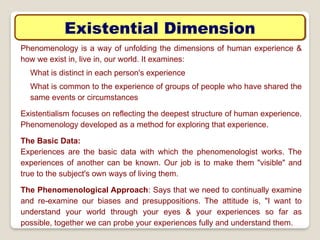
Existential Dimension
Phenomenology is a way of unfolding the dimensions of human experience &
how we exist in, live in, our world. It examines:
What is distinct in each person's experience
What is common to the experience of groups of people who have shared the
same events or circumstances
Existentialism focuses on reflecting the deepest structure of human experience.
Phenomenology developed as a method for exploring that experience.
The Basic Data:
Experiences are the basic data with which the phenomenologist works. The
experiences of another can be known. Our job is to make them "visible" and
true to the subject's own ways of living them.
The Phenomenological Approach: Says that we need to continually examine
and re-examine our biases and presuppositions. The attitude is, "I want to
understand your world through your eyes & your experiences so far as
possible, together we can probe your experiences fully and understand them.
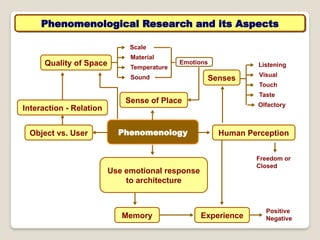
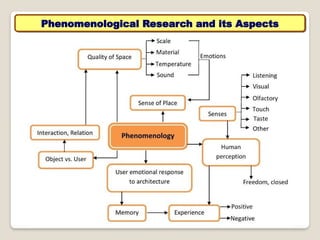
Quality of Space
Scale
Material
Temperature
Sound
Emotions
Object vs. User Human Perception
Use emotional response
to architecture
Senses
Phenomenology
Memory
Sense of Place
Interaction - Relation
Listening
Visual
Touch
Taste
Olfactory
Freedom or
Closed
Experience
Positive
Negative
Phenomenological Research and its Aspects
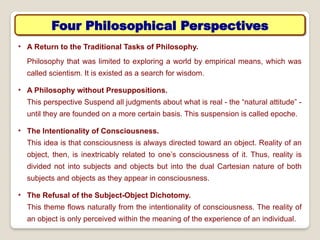
Four Philosophical Perspectives
• A Return to the Traditional Tasks of Philosophy.
Philosophy that was limited to exploring a world by empirical means, which was
called scientism. It is existed as a search for wisdom.
• A Philosophy without Presuppositions.
This perspective Suspend all judgments about what is real - the “natural attitude” -
until they are founded on a more certain basis. This suspension is called epoche.
• The Intentionality of Consciousness.
This idea is that consciousness is always directed toward an object. Reality of an
object, then, is inextricably related to one’s consciousness of it. Thus, reality is
divided not into subjects and objects but into the dual Cartesian nature of both
subjects and objects as they appear in consciousness.
• The Refusal of the Subject-Object Dichotomy.
This theme flows naturally from the intentionality of consciousness. The reality of
an object is only perceived within the meaning of the experience of an individual.
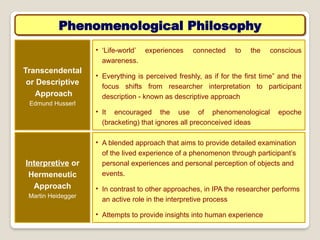
Phenomenological Philosophy
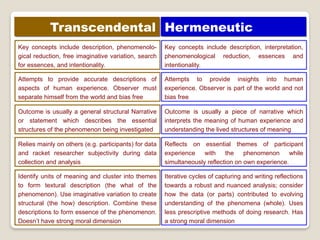
Transcendental
or Descriptive
Approach
Edmund Husserl
• ‘Life-world’ experiences connected to the conscious
awareness.
• Everything is perceived freshly, as if for the first time” and the
focus shifts from researcher interpretation to participant
description - known as descriptive approach
• It encouraged the use of phenomenological epoche
(bracketing) that ignores all preconceived ideas
Interpretive or
Hermeneutic
Approach
Martin Heidegger
• A blended approach that aims to provide detailed examination
of the lived experience of a phenomenon through participant’s
personal experiences and personal perception of objects and
events.
• In contrast to other approaches, in IPA the researcher performs
an active role in the interpretive process
• Attempts to provide insights into human experience
Transcendental
Key concepts include description, phenomenolo-
gical reduction, free imaginative variation, search
for essences, and intentionality.
Key concepts include description, interpretation,
phenomenological reduction, essences and
intentionality.
Hermeneutic
Attempts to provide accurate descriptions of
aspects of human experience. Observer must
separate himself from the world and bias free
Attempts to provide insights into human
experience. Observer is part of the world and not
bias free
Outcome is usually a general structural Narrative
or statement which describes the essential
structures of the phenomenon being investigated
Outcome is usually a piece of narrative which
interprets the meaning of human experience and
understanding the lived structures of meaning
Relies mainly on others (e.g. participants) for data
and racket researcher subjectivity during data
collection and analysis
Reflects on essential themes of participant
experience with the phenomenon while
simultaneously reflection on own experience.
Identify units of meaning and cluster into themes
to form textural description (the what of the
phenomenon). Use imaginative variation to create
structural (the how) description. Combine these
descriptions to form essence of the phenomenon.
Doesn’t have strong moral dimension
Iterative cycles of capturing and writing reflections
towards a robust and nuanced analysis; consider
how the data (or parts) contributed to evolving
understanding of the phenomena (whole). Uses
less prescriptive methods of doing research. Has
a strong moral dimension
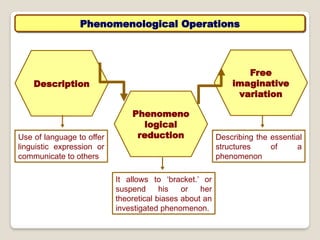
Phenomenological Operations
Description
Phenomeno
logical
reduction
Free
imaginative
variation
Use of language to offer
linguistic expression or
communicate to others
It allows to ‘bracket.’ or
suspend his or her
theoretical biases about an
investigated phenomenon.
Describing the essential
structures of a
phenomenon
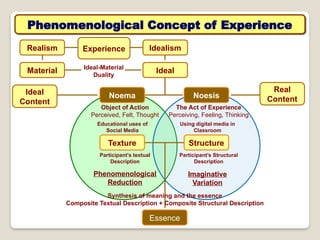
Realism Idealism
Material Ideal
Noema Noesis
Experience
Texture Structure
Essence
Object of Action
Perceived, Felt, Thought
The Act of Experience
Perceiving, Feeling, Thinking
Participant’s textual
Description
Participant’s Structural
Description
Phenomenological
Reduction
Imaginative
Variation
Synthesis of meaning and the essence
Composite Textual Description + Composite Structural Description
Ideal-Material
Duality
Educational uses of
Social Media
Using digital media in
Classroom
Phenomenological Concept of Experience
Ideal
Content
Real
Content
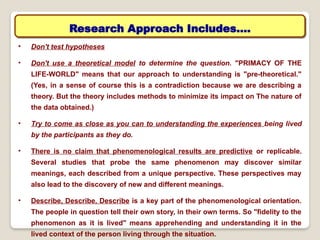
• Don't test hypotheses
• Don't use a theoretical model to determine the question. "PRIMACY OF THE
LIFE-WORLD" means that our approach to understanding is "pre-theoretical."
(Yes, in a sense of course this is a contradiction because we are describing a
theory. But the theory includes methods to minimize its impact on The nature of
the data obtained.)
• Try to come as close as you can to understanding the experiences being lived
by the participants as they do.
• There is no claim that phenomenological results are predictive or replicable.
Several studies that probe the same phenomenon may discover similar
meanings, each described from a unique perspective. These perspectives may
also lead to the discovery of new and different meanings.
• Describe, Describe, Describe is a key part of the phenomenological orientation.
The people in question tell their own story, in their own terms. So "fidelity to the
phenomenon as it is lived" means apprehending and understanding it in the
lived context of the person living through the situation.
Research Approach Includes….
• Bracketing is suspending or setting aside our biases, everyday understandings,
theories, beliefs, habitual modes of thought, and judgments. Part of the larger
process of epoche. Since bias is an inevitable part of the study of human
beings, phenomenologists deal with it by putting it completely in the situation,
by attempting to become aware of their preconceptions and biases before
beginning the study and while the study is occurring, and then "bracketing" or
suspending them so as to be as open as possible to what the subject wants to
share.
• Epoche´: Learning to look at things in a way such that we see only what stands
before our eyes, only what we can describe and define.
• Facticity: a belief in factual characteristics of real objects. In phenomenology,
by bracketing our facticity, we transfer our focus from assumed things "out
there" to our experience.
• "First Opening": (A direct experience of a person, object, or event, before any of
our mental screens of filters change it.)
• "Phenomenological Reduction" is (1) an attempt to suspend the observer's
viewpoint. (2) Hearing another person's reality and focusing on the central,
dominant, or recurring themes which represent the essential qualities or
meanings of that person's experience.
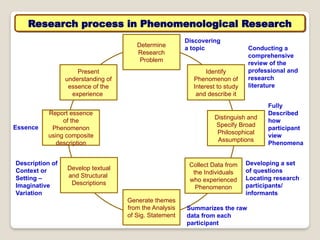
Determine
Research
Problem
Identify
Phenomenon of
Interest to study
and describe it
Distinguish and
Specify Broad
Philosophical
Assumptions
Present
understanding of
essence of the
experience
Report essence
of the
Phenomenon
using composite
description
Collect Data from
the Individuals
who experienced
Phenomenon
Develop textual
and Structural
Descriptions
Generate themes
from the Analysis
of Sig. Statement
Research process in Phenomenological Research
Developing a set
of questions
Locating research
participants/
informants
Summarizes the raw
data from each
participant
Fully
Described
how
participant
view
Phenomena
Description of
Context or
Setting –
Imaginative
Variation
Essence
Conducting a
comprehensive
review of the
professional and
research
literature
Discovering
a topic
Explicitation of Data
• The word “analysis has dangerous connotations for phenomenology.
‟
The term [analysis] usually means a “breaking into parts” and therefore
often means a loss of the whole phenomenon
• “Explicitation” implies an investigation of the constituents of a
phenomenon while keeping the context of the whole.
• This Explicitation process has five “steps or phases, which are:
‟
1. Bracketing and phenomenological reduction.
2. Delineating units of meaning.
3. Clustering of units of meaning to form themes.
4. Summarising each interview, validating and modifying necessary .
5. Extracting general and unique themes from all the interviews and
making a composite summary
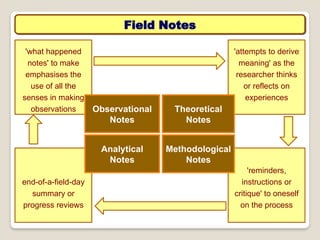
'what happened
notes' to make
emphasises the
use of all the
senses in making
observations
end-of-a-field-day
summary or
progress reviews
'attempts to derive
meaning' as the
researcher thinks
or reflects on
experiences
'reminders,
instructions or
critique' to oneself
on the process
Field Notes
Observational
Notes
Theoretical
Notes
Analytical
Notes
Methodological
Notes
What is the process of bracketing?
Gearing (2004) explains bracketing as a 'scientific
process in which a researcher suspends or holds in
abeyance his or her presuppositions, biases,
assumptions, theories, or previous experiences to see
and describe the phenomenon’
Functions of Transcendental Phenomenology
perception of the reality of an object is dependent on a subject.
functions of transcendental phenomenology:
1. It is the first method of knowledge because it begins with the things
themselves, which are the final court of appeal for all we know. It is a logical
approach because it seeks to identify presuppositions and “put
them out of play.”
2. It is not concerned with matters of fact but seeks to determine meanings.
3. It deals both with real essences and with “possible” essences.
4. It offers direct insight into the essence of things, growing out of the self-
givenness of objects and
reflective description.
Phenomenological Research and its Aspects
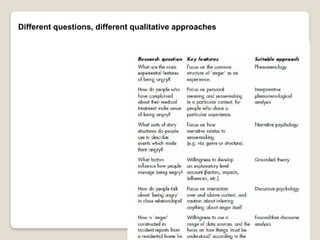
Different questions, different qualitative approaches
Thank You

00 Phenomenological Research, Qualitative Data Analysis.pptx

  • 1.
    Phenomenological Research Understanding meaning ofpeople's lived experience Dr. J D Chandrapal MBA – marketing , PGDHRM, P HD, CII (Award) – London Development Officer - LIC of India – Ahmedabad - 9825070933
  • 2.
    Goal of Phenomenology Totry to help us get at the world that exists prior to our conceptualizing it. The "LIFE-WORLD" of experience as lived by them. We begin with the "NAIVE," PRE- THEORETICAL, PRE-THEMATIZED, PRE-REFLECTED UPON world of the subject.
  • 3.
    Phenomenology – What? •Phenomenology helps us to understand the meaning of people's lived experience. • An attempt to capture experience in process as lived, through descriptive analysis. It studies how things appear to consciousness or are given in experience, and not how they are in themselves, even if it is known that the given contains more than or is different from what is presented. (For instance, assault victims may experience fear for months or years after the assault, even when no apparent danger exists. What does this fear mean? Where does it come from? How is it experienced? The Answers bring us closer to the phenomenon that is lived) • A method of learning about another person by listening to their descriptions of what their subjective world is like for them, together with an attempt to understand this in their own terms as fully as possible, free of our preconceptions and interferences.
  • 4.
    Phenomenology – What? •Phenomenology studies the structure of various types of experience ranging from perception, thought, memory, imagination, emotion, desire, and volition to bodily awareness, embodied action, and social activity, including linguistic activity. • Phenomenology as a methodological framework has evolved into a process that seeks reality in individuals’ description of their lived experiences of phenomena. • Phenomenology strives to clarify our receiving abilities and rediscover the actuality of what is. • Kantian phenomenology is based on constructivist philosophy for the reason that the phenomena are constructed by cognitive subject who is human being.
  • 5.
    Phenomenology – What? •Phenomenology studies the structure of various types of experience ranging from perception, thought, memory, imagination, emotion, desire, and volition to bodily awareness, embodied action, and social activity, including linguistic activity. • Phenomenology as a methodological framework has evolved into a process that seeks reality in individuals’ description of their lived experiences of phenomena. • Phenomenology strives to clarify our receiving abilities and rediscover the actuality of what is. • Kantian phenomenology is based on constructivist philosophy for the reason that the phenomena are constructed by cognitive subject who is human being.
  • 6.
    Existential Dimension Phenomenology isa way of unfolding the dimensions of human experience & how we exist in, live in, our world. It examines: What is distinct in each person's experience What is common to the experience of groups of people who have shared the same events or circumstances Existentialism focuses on reflecting the deepest structure of human experience. Phenomenology developed as a method for exploring that experience. The Basic Data: Experiences are the basic data with which the phenomenologist works. The experiences of another can be known. Our job is to make them "visible" and true to the subject's own ways of living them. The Phenomenological Approach: Says that we need to continually examine and re-examine our biases and presuppositions. The attitude is, "I want to understand your world through your eyes & your experiences so far as possible, together we can probe your experiences fully and understand them.
  • 7.
    Quality of Space Scale Material Temperature Sound Emotions Objectvs. User Human Perception Use emotional response to architecture Senses Phenomenology Memory Sense of Place Interaction - Relation Listening Visual Touch Taste Olfactory Freedom or Closed Experience Positive Negative Phenomenological Research and its Aspects
  • 8.
    Four Philosophical Perspectives •A Return to the Traditional Tasks of Philosophy. Philosophy that was limited to exploring a world by empirical means, which was called scientism. It is existed as a search for wisdom. • A Philosophy without Presuppositions. This perspective Suspend all judgments about what is real - the “natural attitude” - until they are founded on a more certain basis. This suspension is called epoche. • The Intentionality of Consciousness. This idea is that consciousness is always directed toward an object. Reality of an object, then, is inextricably related to one’s consciousness of it. Thus, reality is divided not into subjects and objects but into the dual Cartesian nature of both subjects and objects as they appear in consciousness. • The Refusal of the Subject-Object Dichotomy. This theme flows naturally from the intentionality of consciousness. The reality of an object is only perceived within the meaning of the experience of an individual.
  • 9.
    Phenomenological Philosophy Transcendental or Descriptive Approach EdmundHusserl • ‘Life-world’ experiences connected to the conscious awareness. • Everything is perceived freshly, as if for the first time” and the focus shifts from researcher interpretation to participant description - known as descriptive approach • It encouraged the use of phenomenological epoche (bracketing) that ignores all preconceived ideas Interpretive or Hermeneutic Approach Martin Heidegger • A blended approach that aims to provide detailed examination of the lived experience of a phenomenon through participant’s personal experiences and personal perception of objects and events. • In contrast to other approaches, in IPA the researcher performs an active role in the interpretive process • Attempts to provide insights into human experience
  • 10.
    Transcendental Key concepts includedescription, phenomenolo- gical reduction, free imaginative variation, search for essences, and intentionality. Key concepts include description, interpretation, phenomenological reduction, essences and intentionality. Hermeneutic Attempts to provide accurate descriptions of aspects of human experience. Observer must separate himself from the world and bias free Attempts to provide insights into human experience. Observer is part of the world and not bias free Outcome is usually a general structural Narrative or statement which describes the essential structures of the phenomenon being investigated Outcome is usually a piece of narrative which interprets the meaning of human experience and understanding the lived structures of meaning Relies mainly on others (e.g. participants) for data and racket researcher subjectivity during data collection and analysis Reflects on essential themes of participant experience with the phenomenon while simultaneously reflection on own experience. Identify units of meaning and cluster into themes to form textural description (the what of the phenomenon). Use imaginative variation to create structural (the how) description. Combine these descriptions to form essence of the phenomenon. Doesn’t have strong moral dimension Iterative cycles of capturing and writing reflections towards a robust and nuanced analysis; consider how the data (or parts) contributed to evolving understanding of the phenomena (whole). Uses less prescriptive methods of doing research. Has a strong moral dimension
  • 11.
    Phenomenological Operations Description Phenomeno logical reduction Free imaginative variation Use oflanguage to offer linguistic expression or communicate to others It allows to ‘bracket.’ or suspend his or her theoretical biases about an investigated phenomenon. Describing the essential structures of a phenomenon
  • 12.
    Realism Idealism Material Ideal NoemaNoesis Experience Texture Structure Essence Object of Action Perceived, Felt, Thought The Act of Experience Perceiving, Feeling, Thinking Participant’s textual Description Participant’s Structural Description Phenomenological Reduction Imaginative Variation Synthesis of meaning and the essence Composite Textual Description + Composite Structural Description Ideal-Material Duality Educational uses of Social Media Using digital media in Classroom Phenomenological Concept of Experience Ideal Content Real Content
  • 13.
    • Don't testhypotheses • Don't use a theoretical model to determine the question. "PRIMACY OF THE LIFE-WORLD" means that our approach to understanding is "pre-theoretical." (Yes, in a sense of course this is a contradiction because we are describing a theory. But the theory includes methods to minimize its impact on The nature of the data obtained.) • Try to come as close as you can to understanding the experiences being lived by the participants as they do. • There is no claim that phenomenological results are predictive or replicable. Several studies that probe the same phenomenon may discover similar meanings, each described from a unique perspective. These perspectives may also lead to the discovery of new and different meanings. • Describe, Describe, Describe is a key part of the phenomenological orientation. The people in question tell their own story, in their own terms. So "fidelity to the phenomenon as it is lived" means apprehending and understanding it in the lived context of the person living through the situation. Research Approach Includes….
  • 14.
    • Bracketing issuspending or setting aside our biases, everyday understandings, theories, beliefs, habitual modes of thought, and judgments. Part of the larger process of epoche. Since bias is an inevitable part of the study of human beings, phenomenologists deal with it by putting it completely in the situation, by attempting to become aware of their preconceptions and biases before beginning the study and while the study is occurring, and then "bracketing" or suspending them so as to be as open as possible to what the subject wants to share. • Epoche´: Learning to look at things in a way such that we see only what stands before our eyes, only what we can describe and define. • Facticity: a belief in factual characteristics of real objects. In phenomenology, by bracketing our facticity, we transfer our focus from assumed things "out there" to our experience. • "First Opening": (A direct experience of a person, object, or event, before any of our mental screens of filters change it.) • "Phenomenological Reduction" is (1) an attempt to suspend the observer's viewpoint. (2) Hearing another person's reality and focusing on the central, dominant, or recurring themes which represent the essential qualities or meanings of that person's experience.
  • 15.
    Determine Research Problem Identify Phenomenon of Interest tostudy and describe it Distinguish and Specify Broad Philosophical Assumptions Present understanding of essence of the experience Report essence of the Phenomenon using composite description Collect Data from the Individuals who experienced Phenomenon Develop textual and Structural Descriptions Generate themes from the Analysis of Sig. Statement Research process in Phenomenological Research Developing a set of questions Locating research participants/ informants Summarizes the raw data from each participant Fully Described how participant view Phenomena Description of Context or Setting – Imaginative Variation Essence Conducting a comprehensive review of the professional and research literature Discovering a topic
  • 16.
    Explicitation of Data •The word “analysis has dangerous connotations for phenomenology. ‟ The term [analysis] usually means a “breaking into parts” and therefore often means a loss of the whole phenomenon • “Explicitation” implies an investigation of the constituents of a phenomenon while keeping the context of the whole. • This Explicitation process has five “steps or phases, which are: ‟ 1. Bracketing and phenomenological reduction. 2. Delineating units of meaning. 3. Clustering of units of meaning to form themes. 4. Summarising each interview, validating and modifying necessary . 5. Extracting general and unique themes from all the interviews and making a composite summary
  • 17.
    'what happened notes' tomake emphasises the use of all the senses in making observations end-of-a-field-day summary or progress reviews 'attempts to derive meaning' as the researcher thinks or reflects on experiences 'reminders, instructions or critique' to oneself on the process Field Notes Observational Notes Theoretical Notes Analytical Notes Methodological Notes
  • 18.
    What is theprocess of bracketing? Gearing (2004) explains bracketing as a 'scientific process in which a researcher suspends or holds in abeyance his or her presuppositions, biases, assumptions, theories, or previous experiences to see and describe the phenomenon’
  • 20.
    Functions of TranscendentalPhenomenology perception of the reality of an object is dependent on a subject. functions of transcendental phenomenology: 1. It is the first method of knowledge because it begins with the things themselves, which are the final court of appeal for all we know. It is a logical approach because it seeks to identify presuppositions and “put them out of play.” 2. It is not concerned with matters of fact but seeks to determine meanings. 3. It deals both with real essences and with “possible” essences. 4. It offers direct insight into the essence of things, growing out of the self- givenness of objects and reflective description.
  • 21.
  • 22.
    Different questions, differentqualitative approaches
  • 23.

Editor's Notes

  • #16 What is the process of bracketing? Gearing (2004) explains bracketing as a 'scientific process in which a researcher suspends or holds in abeyance his or her presuppositions, biases, assumptions, theories, or previous experiences to see and describe the phenomenon'