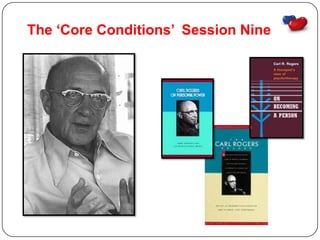
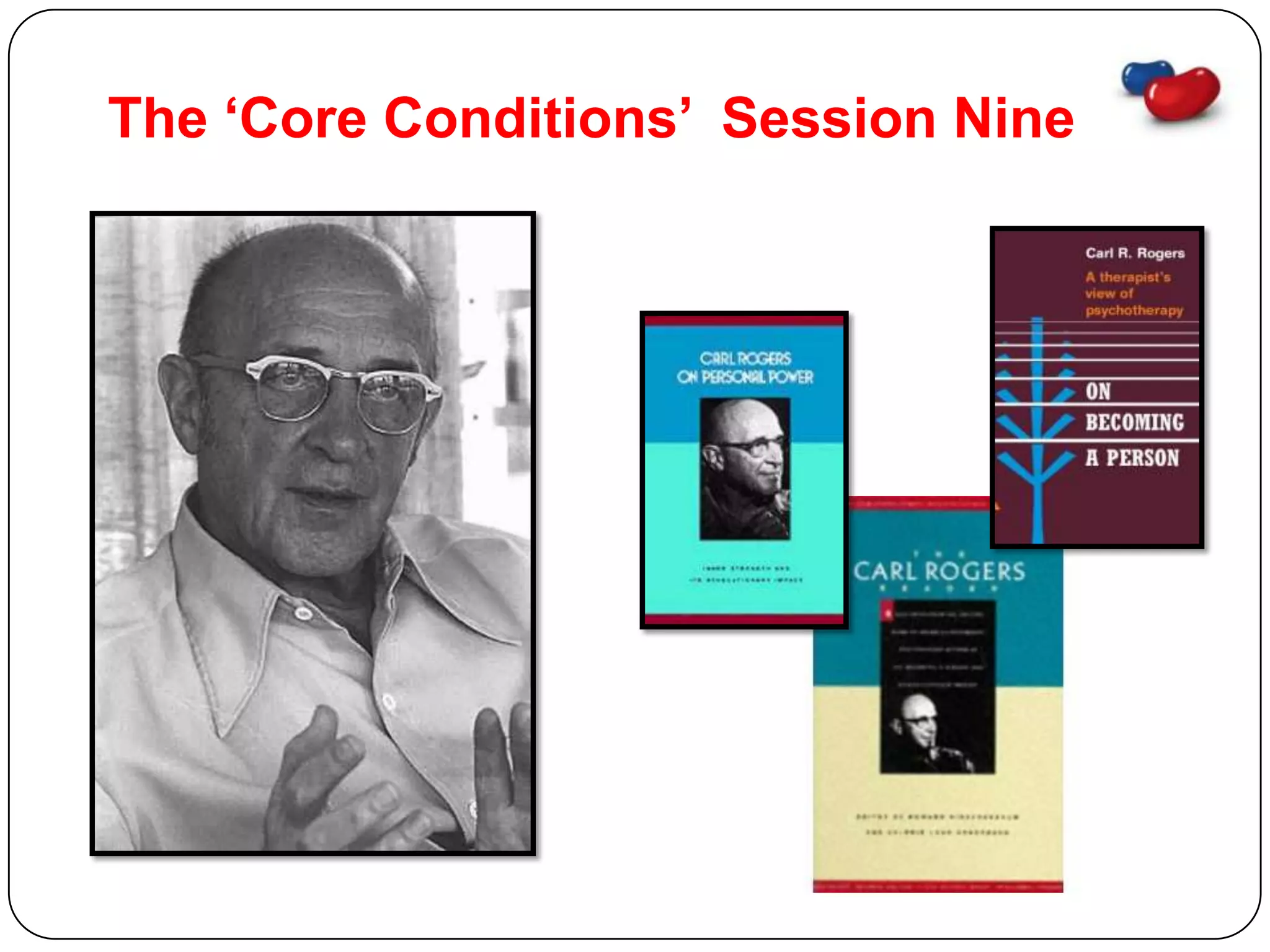






The ‘Core Conditions’ Session Nine
Session Aims


Find evidence of meeting the CPCAB criteria in
  your portfolios

Introduce the ideas of Carl Rogers and in particular
  his ‘core conditions’ for a therapeutic relationship.
Learning Outcomes
By the end of this session you will be able to:

Demonstrate how you meet the CPCAB criteria

Explain what is meant by empathy, congruence and
unconditional positive regard

Define the phrase ‘conditions of worth’

Describe what Carl Rogers means by therapeutic
change.
Last Session


1. Learnt the difference between open and closed
   questions
2. Demonstrated the use of creative questions using
   the Change Model
Contents of this Session

 Extended ice-breaker – Family Rules
 Meeting the CPCAB criteria – small groups
 The ‘core conditions’- small groups
 Presentation on core conditions and conditions of
    worth
   Worksheet – the difference between sympathy
    and empathy
   Presentation on Conditions of Worth and
    Therapeutic Change
   The final week
   A round
Ice-Breaker – Family Rules
 Working in pairs


 Take ten minutes to explore and list the overt
 and covert rules that governed your family life as
 you grew up

 From your list choose one or two that can be
 shared with the whole group when we discuss
 this topic
Portfolios and Criteria
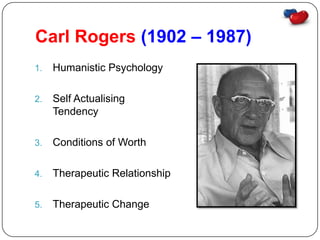
Carl Rogers (1902 – 1987)
1.   Humanistic Psychology

2.   Self Actualising
     Tendency

3.   Conditions of Worth

4.   Therapeutic Relationship

5.   Therapeutic Change
Core Conditions Exercise 15
minutes
Form three groups:

 Empathy
 Congruence
 Unconditional Positive Regard (UPR)

 Discuss what your concept means
 Say why it is important within a therapeutic
  relationship
 Say how you would demonstrate that quality in your
  listening.

Record your findings on flip chart paper to present to
 the whole group
Presentations
Empathy

To understand and share in the client’s experience
  without judging.

To feel emotionally connected to the client and their
  experience; to be fully present whilst they explore
  and develop their own understanding

Prizing our uniqueness and our common humanity
Congruence


Being honest and straight with people

Being transparent

Being trust worthy
Unconditional Positive Regard

Acceptance

To respect, prize and value the client for who they
  are - without conditions

Being non-judgemental
Any Thoughts?
Empathy and Sympathy


Take a few minutes, with a partner, to consider the
differences between these two approaches:


   Empathy                  Sympathy
Feedback
Conditions of Worth
               The conditions we must meet
               as children in order to gain love
               and affection from our parents
               and carers.

               Conditions of worth influence
               our personality development.

               We may end up living a life
               determined by the values and
               beliefs of others, a life that is
               inhibited and closed off.
Therapeutic Change
If the client experiences a relationship marked by
   the core conditions then he or she can be their
   selves.

They can be congruent: their social self is softened
 and their authentic self emerges.

Self-actualisation begins.
Final Session
Next week is the final session and you will be:

1.   Ending
2.   Handing in your Portfolio
3.   Having fun
4.   Giving positive affirmations
5.   Giving feedback
6.   Saying goodbye
7.   Bringing food along is optional
Learning Outcomes
You are now able to:

1. Hand in your portfolio next week (well … nearly)
2. Explain what is meant by empathy, congruence and
   unconditional positive regard
3. Identify conditions of worth
4. Describe what Rogers means by therapeutic change.
Well done Everybody!

Level II Counselling Skills Session Nine

  • 1.
  • 2.
    Session Aims Find evidenceof meeting the CPCAB criteria in your portfolios Introduce the ideas of Carl Rogers and in particular his ‘core conditions’ for a therapeutic relationship.
  • 3.
    Learning Outcomes By theend of this session you will be able to: Demonstrate how you meet the CPCAB criteria Explain what is meant by empathy, congruence and unconditional positive regard Define the phrase ‘conditions of worth’ Describe what Carl Rogers means by therapeutic change.
  • 4.
    Last Session 1. Learntthe difference between open and closed questions 2. Demonstrated the use of creative questions using the Change Model
  • 5.
    Contents of thisSession  Extended ice-breaker – Family Rules  Meeting the CPCAB criteria – small groups  The ‘core conditions’- small groups  Presentation on core conditions and conditions of worth  Worksheet – the difference between sympathy and empathy  Presentation on Conditions of Worth and Therapeutic Change  The final week  A round
  • 6.
    Ice-Breaker – FamilyRules  Working in pairs  Take ten minutes to explore and list the overt and covert rules that governed your family life as you grew up  From your list choose one or two that can be shared with the whole group when we discuss this topic
  • 7.
  • 8.
    Carl Rogers (1902– 1987) 1. Humanistic Psychology 2. Self Actualising Tendency 3. Conditions of Worth 4. Therapeutic Relationship 5. Therapeutic Change
  • 9.
    Core Conditions Exercise15 minutes Form three groups:  Empathy  Congruence  Unconditional Positive Regard (UPR)  Discuss what your concept means  Say why it is important within a therapeutic relationship  Say how you would demonstrate that quality in your listening. Record your findings on flip chart paper to present to the whole group
  • 10.
  • 11.
    Empathy To understand andshare in the client’s experience without judging. To feel emotionally connected to the client and their experience; to be fully present whilst they explore and develop their own understanding Prizing our uniqueness and our common humanity
  • 12.
    Congruence Being honest andstraight with people Being transparent Being trust worthy
  • 13.
    Unconditional Positive Regard Acceptance Torespect, prize and value the client for who they are - without conditions Being non-judgemental
  • 14.
  • 15.
    Empathy and Sympathy Takea few minutes, with a partner, to consider the differences between these two approaches: Empathy Sympathy
  • 16.
  • 17.
    Conditions of Worth The conditions we must meet as children in order to gain love and affection from our parents and carers. Conditions of worth influence our personality development. We may end up living a life determined by the values and beliefs of others, a life that is inhibited and closed off.
  • 18.
    Therapeutic Change If theclient experiences a relationship marked by the core conditions then he or she can be their selves. They can be congruent: their social self is softened and their authentic self emerges. Self-actualisation begins.
  • 19.
    Final Session Next weekis the final session and you will be: 1. Ending 2. Handing in your Portfolio 3. Having fun 4. Giving positive affirmations 5. Giving feedback 6. Saying goodbye 7. Bringing food along is optional
  • 20.
    Learning Outcomes You arenow able to: 1. Hand in your portfolio next week (well … nearly) 2. Explain what is meant by empathy, congruence and unconditional positive regard 3. Identify conditions of worth 4. Describe what Rogers means by therapeutic change.
  • 21.