Problem Definition: Design a Bridge to span a
given distance while supporting a maximum
load using a minimum materials.
Bridge Project
Project Goals
The goals for this project are for students to:
• Learn the design process.
• See practical applications for trigonometry, physics,
and engineering statics (force analysis).
• Improve skills associated with collecting data and
drawing meaningful conclusions.
• Experience the usefulness of prototype testing.
• Recognize the necessity of good communication
skills for engineers by completing memos, reports,
drawings, and presentations.
Introduction to Bridge
• Bridge Type
–Truss Bridge
–Arch bridge
–Suspension Bridge
–Cantilever Bridge
Truss Bridge
• Truss design is
to support the
bridge deck
• The truss may
have ompression
or tension
• The joint of truss
is important
Truss(force analysis)
• Loads members in tension and compression.
• Members are pinned at joints (Moment = 0).
• Triangles provide stability and strength.
•Top members in Compression.
•Bottom members in Tension.
Hint - Imagine entire truss wrapped in rubber skin, so you
have a large rubber box. When you bend it, where would the
wrinkles be? They indicate compression.
Beam
• Ways to strengthen members in bending.
– Decrease overall length (deflections).
– Cross section design (moment of inertia)
– Use stronger materials (elastic modulus).
Tension
Compression
Steel
=
Axis of
bending
vs.
Arch bridge
• Appear mostly
in Ancient time
• New arch
bridge is
modified to
reduce the
material
Function of Arch structure
• Puts members in compression.
• Need horizontal support at abutments.
Abutment
Suspension Bridge
• Replace the
Beam with
cable
• Reduce the
need for the
Pier , Girder
and Truss
Suspension
• Puts members in tension.
• Carries weight up to the top of the towers.
• Good for long spans.
Cantilever Bridge
• No support at
the bridge it
self
• The material
must be very
strong
• Or the structure
must be
different
Box Girder Bridge
• Box structure reduce
the weight and
material
• Increase the strength
on top and bottom to
resist compression
and tension
Project Constraints
Size: See above & 100 stick limit per bridge
Shape: Original ideas encouraged!
Strength: Must support a minimum of 15 lbs.
Constraints:
Building
Materials
• 100 Wood tongue depressors (6”)
• Glue guns and glue sticks and
wood glue
• String
Scoring Equation
Score = Load at Failure(performance)
Weight of Bridge(cost)
As engineers, you want to maximize the
load held using the least amount of
material.
Testing Procedure
2” dowel
2” x 6”
thin plate
testing jig
Project Break-down
• Project Intro (Problem Definition)
• Component Strength Tests (Information Gathering)
• Individual Brainstorming of Ideas (Idea Generation)
• Group Prototype Brainstorming (Idea generation)
• Prototype Selection (Idea selection)
• Full-Scale Prototype Construction (Implementation)
• Prototype Testing (Information Gathering)
• Engineering Analysis w/ software (Information Gathering)
• Redesign (Idea generation)
• Final bridge construction (Implementation)
• Final Test Competition! (Information Gathering)
Project Schedule
Timeline:
• Prototype Design, Build, Test – 1 week
• Final Design, Build, Test – 2 weeks
• Presentation and report – 1 to 2 classes
after Final Test
Grading
• Design and testing
– Bridge Ideas -10%
– Components test Memo-5%
– Prototype bridge performance-5%
– Draft Report-5%
• Project report
– Bridge Final Presentation-10%
– Competition-5%
Engineering Fundamentals
• Mechanics of Materials
• Construction Methods & Hints!
What is the easiest way to
break a tongue depressor?
• Pull?
• Push?
• Twist?
• Shear?
• Bend?
Engineering terms - tension, compression, torsion,
shear, & bending
Principle of Scissors
Bending! Thus bridge design Do’s & Don’ts:
• DON’Ts
– avoid bending bridge members when
possible.
– avoid compressing long bridge members -
causes buckling (a kind of bending).
• DO’s
– load members in tension and compression
(short) when possible.
– brace bending members when possible.
Bridge Type we have learned
• Truss Bridge
• Arch Bridge
• Suspension Bridge
• Cantilever Bridge
– Box Girder Bridge
Quiz
• Which orientation of a beam is stronger
under bending and why?
• Arch members are in T or C?
• Label members in T and C
I
I
vs.
Axis of
bending
C C
T T T
How can you improve your
bridge design?
• Incorporate truss structure (triangles).
• Design a 3-D structure from the start!
• Use short members in compression.
• Use string for tension members.(Reduce material and
weight)
• Avoid overloading joints.
• Strengthen base supports and load point.
Component Test-Compression
and buckle Test-1
• Compress your spaghetti until it start to buckle(When you don’t feel
you need to apply additional force but the structure still keep bending)
• Hold(use you hand) the center point to see how much force you need
to increase to have buckling
• Hold another two point to see how much force you need to increase to
reach buckling
Component Test-Compression
and buckle Test-2
• Cut the spaghetti in half and try again
• Cut the spaghetti in half again and try again
• Record all the force and Test
Situation
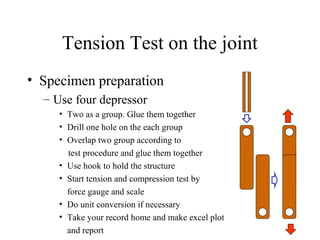
Tension Test on the joint
• Specimen preparation
– Use four depressor
• Two as a group. Glue them together
• Drill one hole on the each group
• Overlap two group according to
test procedure and glue them together
• Use hook to hold the structure
• Start tension and compression test by
force gauge and scale
• Do unit conversion if necessary
• Take your record home and make excel plot
and report
Fatigue Test
• Bend Paper clip and count how many cycle
it is needed to break it!
• Test 5 Paper clip
Torsion Test
• Twist a chalk and see how it break
• Explain why it happen(explain in
Components test Memo )

Bridge project

  • 1.
    Problem Definition: Designa Bridge to span a given distance while supporting a maximum load using a minimum materials. Bridge Project
  • 2.
    Project Goals The goalsfor this project are for students to: • Learn the design process. • See practical applications for trigonometry, physics, and engineering statics (force analysis). • Improve skills associated with collecting data and drawing meaningful conclusions. • Experience the usefulness of prototype testing. • Recognize the necessity of good communication skills for engineers by completing memos, reports, drawings, and presentations.
  • 3.
    Introduction to Bridge •Bridge Type –Truss Bridge –Arch bridge –Suspension Bridge –Cantilever Bridge
  • 4.
    Truss Bridge • Trussdesign is to support the bridge deck • The truss may have ompression or tension • The joint of truss is important
  • 5.
    Truss(force analysis) • Loadsmembers in tension and compression. • Members are pinned at joints (Moment = 0). • Triangles provide stability and strength. •Top members in Compression. •Bottom members in Tension. Hint - Imagine entire truss wrapped in rubber skin, so you have a large rubber box. When you bend it, where would the wrinkles be? They indicate compression.
  • 6.
    Beam • Ways tostrengthen members in bending. – Decrease overall length (deflections). – Cross section design (moment of inertia) – Use stronger materials (elastic modulus). Tension Compression Steel = Axis of bending vs.
  • 7.
    Arch bridge • Appearmostly in Ancient time • New arch bridge is modified to reduce the material
  • 8.
    Function of Archstructure • Puts members in compression. • Need horizontal support at abutments. Abutment
  • 9.
    Suspension Bridge • Replacethe Beam with cable • Reduce the need for the Pier , Girder and Truss
  • 10.
    Suspension • Puts membersin tension. • Carries weight up to the top of the towers. • Good for long spans.
  • 11.
    Cantilever Bridge • Nosupport at the bridge it self • The material must be very strong • Or the structure must be different
  • 12.
    Box Girder Bridge •Box structure reduce the weight and material • Increase the strength on top and bottom to resist compression and tension
  • 13.
    Project Constraints Size: Seeabove & 100 stick limit per bridge Shape: Original ideas encouraged! Strength: Must support a minimum of 15 lbs.
  • 14.
    Constraints: Building Materials • 100 Woodtongue depressors (6”) • Glue guns and glue sticks and wood glue • String
  • 15.
    Scoring Equation Score =Load at Failure(performance) Weight of Bridge(cost) As engineers, you want to maximize the load held using the least amount of material.
  • 16.
    Testing Procedure 2” dowel 2”x 6” thin plate testing jig
  • 17.
    Project Break-down • ProjectIntro (Problem Definition) • Component Strength Tests (Information Gathering) • Individual Brainstorming of Ideas (Idea Generation) • Group Prototype Brainstorming (Idea generation) • Prototype Selection (Idea selection) • Full-Scale Prototype Construction (Implementation) • Prototype Testing (Information Gathering) • Engineering Analysis w/ software (Information Gathering) • Redesign (Idea generation) • Final bridge construction (Implementation) • Final Test Competition! (Information Gathering)
  • 18.
    Project Schedule Timeline: • PrototypeDesign, Build, Test – 1 week • Final Design, Build, Test – 2 weeks • Presentation and report – 1 to 2 classes after Final Test
  • 19.
    Grading • Design andtesting – Bridge Ideas -10% – Components test Memo-5% – Prototype bridge performance-5% – Draft Report-5% • Project report – Bridge Final Presentation-10% – Competition-5%
  • 20.
    Engineering Fundamentals • Mechanicsof Materials • Construction Methods & Hints!
  • 21.
    What is theeasiest way to break a tongue depressor? • Pull? • Push? • Twist? • Shear? • Bend? Engineering terms - tension, compression, torsion, shear, & bending Principle of Scissors
  • 22.
    Bending! Thus bridgedesign Do’s & Don’ts: • DON’Ts – avoid bending bridge members when possible. – avoid compressing long bridge members - causes buckling (a kind of bending). • DO’s – load members in tension and compression (short) when possible. – brace bending members when possible.
  • 23.
    Bridge Type wehave learned • Truss Bridge • Arch Bridge • Suspension Bridge • Cantilever Bridge – Box Girder Bridge
  • 24.
    Quiz • Which orientationof a beam is stronger under bending and why? • Arch members are in T or C? • Label members in T and C I I vs. Axis of bending C C T T T
  • 25.
    How can youimprove your bridge design? • Incorporate truss structure (triangles). • Design a 3-D structure from the start! • Use short members in compression. • Use string for tension members.(Reduce material and weight) • Avoid overloading joints. • Strengthen base supports and load point.
  • 26.
    Component Test-Compression and buckleTest-1 • Compress your spaghetti until it start to buckle(When you don’t feel you need to apply additional force but the structure still keep bending) • Hold(use you hand) the center point to see how much force you need to increase to have buckling • Hold another two point to see how much force you need to increase to reach buckling
  • 27.
    Component Test-Compression and buckleTest-2 • Cut the spaghetti in half and try again • Cut the spaghetti in half again and try again • Record all the force and Test Situation
  • 28.
    Tension Test onthe joint • Specimen preparation – Use four depressor • Two as a group. Glue them together • Drill one hole on the each group • Overlap two group according to test procedure and glue them together • Use hook to hold the structure • Start tension and compression test by force gauge and scale • Do unit conversion if necessary • Take your record home and make excel plot and report
  • 29.
    Fatigue Test • BendPaper clip and count how many cycle it is needed to break it! • Test 5 Paper clip
  • 30.
    Torsion Test • Twista chalk and see how it break • Explain why it happen(explain in Components test Memo )

Editor's Notes

  • #19 Prototype test: 10/10 Final design test 10/19