Logo
                   FINITE ELEMENT ANALYSIS


  FINITE ELEMENT ANALYSIS OF THIN PLATE WEB I-
  BEAM SECTION UNDER CONCENTRATED LOAD

 Presented by : Yousef Hasanain
 Submitted to : Prof. Ir. Dr. Wan Hamidon
Logo
Contents
           1   INTRODUCTION

           2   Problem statement


           3   Model geometry and properties


           4    Finite Element Modeling


           5   Result and discussions


           6   Bibliography
Logo
INTRODUCTION

 The finite element method has become a powerful tool
 for the numerical solution of a wide range of engineering
 problems and the primary objectives of analysis by finite
 elements are to calculate approximately stresses and
 deflections in a structure.

 The F.E.M is particularly useful for solving a deferential
 equation, together with its boundary conditions, over the
 domain of complex shape.
Logo
  Problem statement
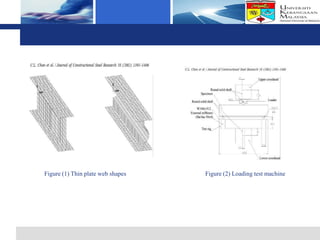
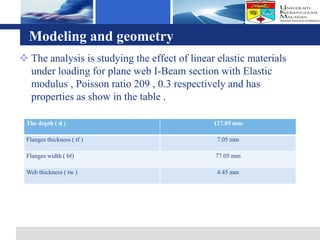
 The case study for various thin plate shapes of I-Beam sections
  under loading have been studied by (Chan et al.2002) which
  showed the effort of plane web and corrugated web under
  loading test machine through different specimens .
 The analyses of finite element method by LUSAS software is
  focused in this study for one specimen of the plane web shape
  to show the displacement under concentrated load and
  compare the results of the analysis with the results of loading
  test machine which done by (Chan et al.2002) previously.
Logo


Figure (1) Thin plate web shapes   Figure (2) Loading test machine
Logo
  Modeling and geometry
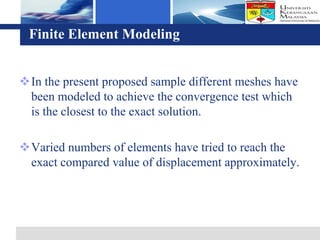
 The analysis is studying the effect of linear elastic materials
  under loading for plane web I-Beam section with Elastic
  modulus , Poisson ratio 209 , 0.3 respectively and has
  properties as show in the table .

 The depth ( d )                               127.05 mm

 Flanges thickness ( tf )                       7.05 mm

 Flanges width ( bf)                           77.05 mm

 Web thickness ( tw )                           4.45 mm
Logo
 Finite Element Modeling


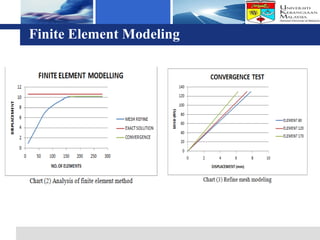
In the present proposed sample different meshes have
 been modeled to achieve the convergence test which
 is the closest to the exact solution.

Varied numbers of elements have tried to reach the
 exact compared value of displacement approximately.
Logo
Finite Element Modeling
Logo
 Result and discussions
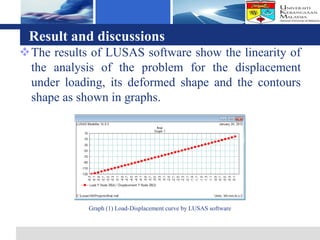
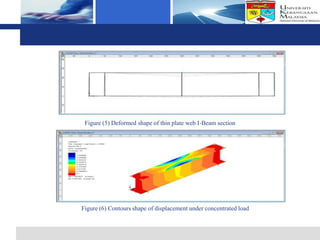
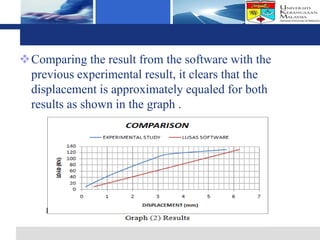
The results of LUSAS software show the linearity of
 the analysis of the problem for the displacement
 under loading, its deformed shape and the contours
 shape as shown in graphs.


            Graph (1) Load-Displacement curve by LUSAS software
Logo


 Figure (5) Deformed shape of thin plate web I-Beam section


Figure (6) Contours shape of displacement under concentrated load
Logo


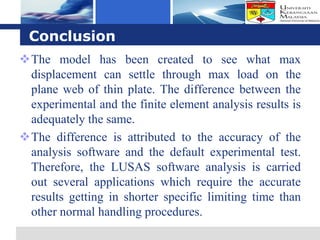
Comparing the result from the software with the
 previous experimental result, it clears that the
 displacement is approximately equaled for both
 results as shown in the graph .
Logo

 Conclusion
The model has been created to see what max
 displacement can settle through max load on the
 plane web of thin plate. The difference between the
 experimental and the finite element analysis results is
 adequately the same.
The difference is attributed to the accuracy of the
 analysis software and the default experimental test.
 Therefore, the LUSAS software analysis is carried
 out several applications which require the accurate
 results getting in shorter specific limiting time than
 other normal handling procedures.
Logo
    Bibliography

 [1] C.L Chan, Y.A Khalid, B.B Sahari, A.M.S. Hamouda. Finite element analysis of
  corrugated web beams under bending. Department of Mechanical and Manufacturing
  Engineering, Universiti Putra Malaysia, Malaysia. 2002
 [2] Elgaaly M, Seshadri A, Hamilton RW. Beams with corrugated webs, research to practice.
  In: Proceedings of the Jun 14-16 1995 NSF Research Transformed into Practice:
  implementation Conference.VA (USA): Arlington; 1995, p. 603–12.
 [3] Elgaaly M, Hamilton RW, Seshadri A. Shear strength of beams with corrugated webs.
  Journal of Structural Engineering ASCE 1996;122(4):390–8.
 [4] Elgaaly M, Seshadri A, Hamilton RW. Bending strength of steel beams with corrugated
  webs. Journal of Structural Engineering ASCE 1997;123(6):772–82.
 [5] Elgaaly M, Seshadri A. Girders with corrugated webs under partial compressive edge
  loading. Journal of Structural Engineering ASCE 1997;123(6):783–91.
Logo


       Click to edit company slogan .

Finite Element Analysis

  • 1.
    Logo FINITE ELEMENT ANALYSIS FINITE ELEMENT ANALYSIS OF THIN PLATE WEB I- BEAM SECTION UNDER CONCENTRATED LOAD Presented by : Yousef Hasanain Submitted to : Prof. Ir. Dr. Wan Hamidon
  • 2.
    Logo Contents 1 INTRODUCTION 2 Problem statement 3 Model geometry and properties 4 Finite Element Modeling 5 Result and discussions 6 Bibliography
  • 3.
    Logo INTRODUCTION The finiteelement method has become a powerful tool for the numerical solution of a wide range of engineering problems and the primary objectives of analysis by finite elements are to calculate approximately stresses and deflections in a structure. The F.E.M is particularly useful for solving a deferential equation, together with its boundary conditions, over the domain of complex shape.
  • 4.
    Logo Problemstatement  The case study for various thin plate shapes of I-Beam sections under loading have been studied by (Chan et al.2002) which showed the effort of plane web and corrugated web under loading test machine through different specimens .  The analyses of finite element method by LUSAS software is focused in this study for one specimen of the plane web shape to show the displacement under concentrated load and compare the results of the analysis with the results of loading test machine which done by (Chan et al.2002) previously.
  • 5.
    Logo Figure (1) Thinplate web shapes Figure (2) Loading test machine
  • 6.
    Logo Modelingand geometry  The analysis is studying the effect of linear elastic materials under loading for plane web I-Beam section with Elastic modulus , Poisson ratio 209 , 0.3 respectively and has properties as show in the table . The depth ( d ) 127.05 mm Flanges thickness ( tf ) 7.05 mm Flanges width ( bf) 77.05 mm Web thickness ( tw ) 4.45 mm
  • 7.
    Logo Finite ElementModeling In the present proposed sample different meshes have been modeled to achieve the convergence test which is the closest to the exact solution. Varied numbers of elements have tried to reach the exact compared value of displacement approximately.
  • 8.
  • 9.
    Logo Result anddiscussions The results of LUSAS software show the linearity of the analysis of the problem for the displacement under loading, its deformed shape and the contours shape as shown in graphs. Graph (1) Load-Displacement curve by LUSAS software
  • 10.
    Logo Figure (5)Deformed shape of thin plate web I-Beam section Figure (6) Contours shape of displacement under concentrated load
  • 11.
    Logo Comparing the resultfrom the software with the previous experimental result, it clears that the displacement is approximately equaled for both results as shown in the graph .
  • 12.
    Logo Conclusion The modelhas been created to see what max displacement can settle through max load on the plane web of thin plate. The difference between the experimental and the finite element analysis results is adequately the same. The difference is attributed to the accuracy of the analysis software and the default experimental test. Therefore, the LUSAS software analysis is carried out several applications which require the accurate results getting in shorter specific limiting time than other normal handling procedures.
  • 13.
    Logo Bibliography  [1] C.L Chan, Y.A Khalid, B.B Sahari, A.M.S. Hamouda. Finite element analysis of corrugated web beams under bending. Department of Mechanical and Manufacturing Engineering, Universiti Putra Malaysia, Malaysia. 2002  [2] Elgaaly M, Seshadri A, Hamilton RW. Beams with corrugated webs, research to practice. In: Proceedings of the Jun 14-16 1995 NSF Research Transformed into Practice: implementation Conference.VA (USA): Arlington; 1995, p. 603–12.  [3] Elgaaly M, Hamilton RW, Seshadri A. Shear strength of beams with corrugated webs. Journal of Structural Engineering ASCE 1996;122(4):390–8.  [4] Elgaaly M, Seshadri A, Hamilton RW. Bending strength of steel beams with corrugated webs. Journal of Structural Engineering ASCE 1997;123(6):772–82.  [5] Elgaaly M, Seshadri A. Girders with corrugated webs under partial compressive edge loading. Journal of Structural Engineering ASCE 1997;123(6):783–91.
  • 14.
    Logo Click to edit company slogan .