Bridge
Geometry of Bridge Construction
Arch Bridge are one of the oldest types of bridges and have great natural
strength. Instead of pushing straight down, the weight of an arch bridge is
carried outward along the curve of the arch to the supports at each end.
These supports, called the abutments, carry the load and keep the ends of
the bridge from spreading out.
How do the abutments support an arch bridge?
Cut a strip of cardboard that's about one inch by 11 inches. Gently bend the strip
so that it has a curve. Position the cardboard on a table so that it resembles an
arch. Press down on the center of the arch. What happens to the ends of the
cardboard?
Next, place a stack of books at each end of the arch. Press again. Now what
happens? Notice how the stacks of books act as abutments, keeping the ends of
the arch from spreading apart.
When supporting its own weight and the weight of crossing traffic, every part of
the arch is under compression. For this reason, arch bridges must be made of
materials that are strong under compression.
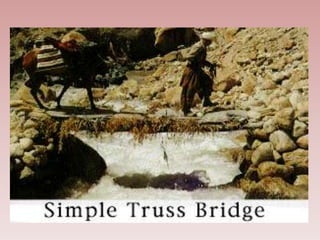
A beam or "girder" bridge is the simplest and most inexpensive kind of bridge.
According to Craig Finley of Finley/McNary Engineering, "they're basically the
vanillas of the bridge world."
In its most basic form, a beam bridge consists of a horizontal beam that is
supported at each end by piers. The weight of the beam pushes straight down on
the piers. The beam itself must be strong so that it doesn't bend under its own
weight and the added weight of crossing traffic. When a load pushes down on the
beam, the beam's top edge is pushed together
(compression) while the bottom edge is stretched (tension).
Try It! What happens when a load pushes down on a beam bridge?
Take a flat eraser or a small sponge and slice a shallow notch across the
top and bottom. Create a beam bridge by supporting each end of the
eraser (or sponge) with a stack of books. Press down on the center of the
bridge. What happens to the top and bottom notches? Notice how the
top notch squeezes together in compression, while the bottom notch
spreads apart under tension.
Pre-stressed concrete is an ideal material for beam bridge construction;
the concrete withstands the forces of compression well and the steel rods
imbedded within resist the forces of tension. Pre-stressed concrete also
tends to be one of the least expensive materials in construction. But even
the best materials can't compensate for the beam bridge's biggest
limitation: its length.
The farther apart its supports, the weaker a beam bridge gets. As a result,
beam bridges rarely span more than 250 feet. This doesn't mean beam
bridges aren't used to cross great distances—it only means that they must
be daisy-chained together, creating what's known in the bridge world as a
"continuous span."
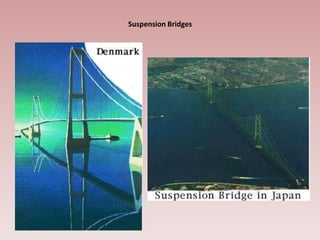
Aesthetic, light, and strong, suspension bridges can span distances
from 2,000 to 7,000 feet—far longer than any other kind of bridge.
They also tend to be the most expensive to build. True to its name, a
suspension bridge suspends the roadway from huge main cables,
which extend from one end of the bridge to the other. These cables
rest on top of high towers and are secured at each end by
anchorages. The towers enable the main cables to be draped over
long distances. Most of the weight of the bridge is carried by the
cables to the anchorages, which are imbedded in either solid rock or
massive concrete blocks. Inside the anchorages, the cables are
spread over a large area to evenly distribute the load and to prevent
the cables from breaking free.
Try It!
What are the anchorages for?
Tie two loops of string around the tops of two hard cover books of
similar size. Tie a third piece of string to each loop so that it hangs
loosely between the books. Press down on the center string. What
happens?
Next, stand two books about 10 inches apart. Put a stack of heavy
books on one ed of string to secure it to the table. Then pass the string
over each book (letting some string hang loosely between the books).
Place a second stack of books on the other end of the string. Press
again on the center of the string. What happens? Notice how the
anchorages (stacks of books) help to stabilize the bridge.
Cable-stayed bridges may look similar to suspensions bridges—both have
roadways that hang from cables and both have towers. But the two
bridges support the load of the roadway in very different ways. The
difference lies in how the cables are connected to the towers. In
suspension bridges, the cables ride freely across the towers, transmitting
the load to the anchorages at either end. In cable-stayed bridges, the
cables are attached to the towers, which alone bear the load.
The cables can be attached to the roadway in a variety of ways. In a
radial pattern, cables extend from several points on the road to a single
point at the top of the tower. In a parallel pattern, cables are attached at
different heights along the tower, running parallel to one other.
How do cable-stayeds work?
Stand up and hold your arms out horizontally at each side. Imagine that your
arms are a bridge, and your head is a tower in the middle. In this position, your
muscles are holding up your arms.
Try making cable-stayeds to support your arms. Take a piece of rope (about five
feet long), and have a partner tie each end of the rope to each of your elbows.
Then lay the middle of the rope on top of your head. The rope acts as a cable-
stayed and holds your elbows up.
Have yur partner tie a second piece of rope (about 6 feet long) to each wrist.
Lay the second rope over your head. You now have two cable-stayeds. Where
do you feel a pushing force, or compression? Notice how the cable-stayeds
transfer the load of the bridge (your arms) to the tower (your head).
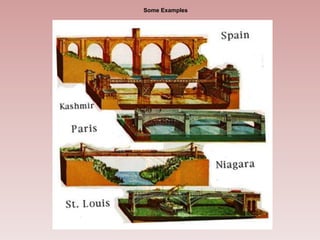
Some Examples
Suspension Bridges
Bridge
Bridge

Bridge

  • 1.
  • 4.
    Arch Bridge areone of the oldest types of bridges and have great natural strength. Instead of pushing straight down, the weight of an arch bridge is carried outward along the curve of the arch to the supports at each end. These supports, called the abutments, carry the load and keep the ends of the bridge from spreading out. How do the abutments support an arch bridge? Cut a strip of cardboard that's about one inch by 11 inches. Gently bend the strip so that it has a curve. Position the cardboard on a table so that it resembles an arch. Press down on the center of the arch. What happens to the ends of the cardboard? Next, place a stack of books at each end of the arch. Press again. Now what happens? Notice how the stacks of books act as abutments, keeping the ends of the arch from spreading apart. When supporting its own weight and the weight of crossing traffic, every part of the arch is under compression. For this reason, arch bridges must be made of materials that are strong under compression.
  • 5.
    A beam or"girder" bridge is the simplest and most inexpensive kind of bridge. According to Craig Finley of Finley/McNary Engineering, "they're basically the vanillas of the bridge world." In its most basic form, a beam bridge consists of a horizontal beam that is supported at each end by piers. The weight of the beam pushes straight down on the piers. The beam itself must be strong so that it doesn't bend under its own weight and the added weight of crossing traffic. When a load pushes down on the beam, the beam's top edge is pushed together (compression) while the bottom edge is stretched (tension).
  • 6.
    Try It! Whathappens when a load pushes down on a beam bridge? Take a flat eraser or a small sponge and slice a shallow notch across the top and bottom. Create a beam bridge by supporting each end of the eraser (or sponge) with a stack of books. Press down on the center of the bridge. What happens to the top and bottom notches? Notice how the top notch squeezes together in compression, while the bottom notch spreads apart under tension. Pre-stressed concrete is an ideal material for beam bridge construction; the concrete withstands the forces of compression well and the steel rods imbedded within resist the forces of tension. Pre-stressed concrete also tends to be one of the least expensive materials in construction. But even the best materials can't compensate for the beam bridge's biggest limitation: its length. The farther apart its supports, the weaker a beam bridge gets. As a result, beam bridges rarely span more than 250 feet. This doesn't mean beam bridges aren't used to cross great distances—it only means that they must be daisy-chained together, creating what's known in the bridge world as a "continuous span."
  • 7.
    Aesthetic, light, andstrong, suspension bridges can span distances from 2,000 to 7,000 feet—far longer than any other kind of bridge. They also tend to be the most expensive to build. True to its name, a suspension bridge suspends the roadway from huge main cables, which extend from one end of the bridge to the other. These cables rest on top of high towers and are secured at each end by anchorages. The towers enable the main cables to be draped over long distances. Most of the weight of the bridge is carried by the cables to the anchorages, which are imbedded in either solid rock or massive concrete blocks. Inside the anchorages, the cables are spread over a large area to evenly distribute the load and to prevent the cables from breaking free.
  • 8.
    Try It! What arethe anchorages for? Tie two loops of string around the tops of two hard cover books of similar size. Tie a third piece of string to each loop so that it hangs loosely between the books. Press down on the center string. What happens? Next, stand two books about 10 inches apart. Put a stack of heavy books on one ed of string to secure it to the table. Then pass the string over each book (letting some string hang loosely between the books). Place a second stack of books on the other end of the string. Press again on the center of the string. What happens? Notice how the anchorages (stacks of books) help to stabilize the bridge.
  • 9.
    Cable-stayed bridges maylook similar to suspensions bridges—both have roadways that hang from cables and both have towers. But the two bridges support the load of the roadway in very different ways. The difference lies in how the cables are connected to the towers. In suspension bridges, the cables ride freely across the towers, transmitting the load to the anchorages at either end. In cable-stayed bridges, the cables are attached to the towers, which alone bear the load. The cables can be attached to the roadway in a variety of ways. In a radial pattern, cables extend from several points on the road to a single point at the top of the tower. In a parallel pattern, cables are attached at different heights along the tower, running parallel to one other.
  • 11.
    How do cable-stayedswork? Stand up and hold your arms out horizontally at each side. Imagine that your arms are a bridge, and your head is a tower in the middle. In this position, your muscles are holding up your arms. Try making cable-stayeds to support your arms. Take a piece of rope (about five feet long), and have a partner tie each end of the rope to each of your elbows. Then lay the middle of the rope on top of your head. The rope acts as a cable- stayed and holds your elbows up. Have yur partner tie a second piece of rope (about 6 feet long) to each wrist. Lay the second rope over your head. You now have two cable-stayeds. Where do you feel a pushing force, or compression? Notice how the cable-stayeds transfer the load of the bridge (your arms) to the tower (your head).
  • 14.
  • 17.