CONCRETE AND
STEEL BRIDGES
2
Steel Bridges
3
Advantages of Steel
• High tensile and compressive strength
• High strength to weight ratio – low self weight & less
loading on substructure
• Uniformity
• High quality material
• Speed of construction
• Versatility of construction
• Elasticity – follows Hooke’s Law very accurately
• Ductility – can withstand high deformations before
failure ➔ gives a warning before failure
• Modifications can be made easily – strengthening of
beams
4
4
Design Stress Strain Curve for Concrete – BS8110
55
Design Stress Strain Curve for Reinforcement – BS8110
6
Disadvantages of Steel
• Maintenance cost is high – corrodes when
exposed to air, water and humidity
• Fire proofing cost – strength reduces at high
temperatures
• Susceptible to buckling – slender structures
• Fatigue – strength reduces due to cyclic loading
7
Types of Steel Bridges
• Beam / Girder
• Truss
• Plate girder
• Box girder
• Cantilever
• Arch
• Cable stayed
• Suspension
• Movable
• Temporary / emergency
8
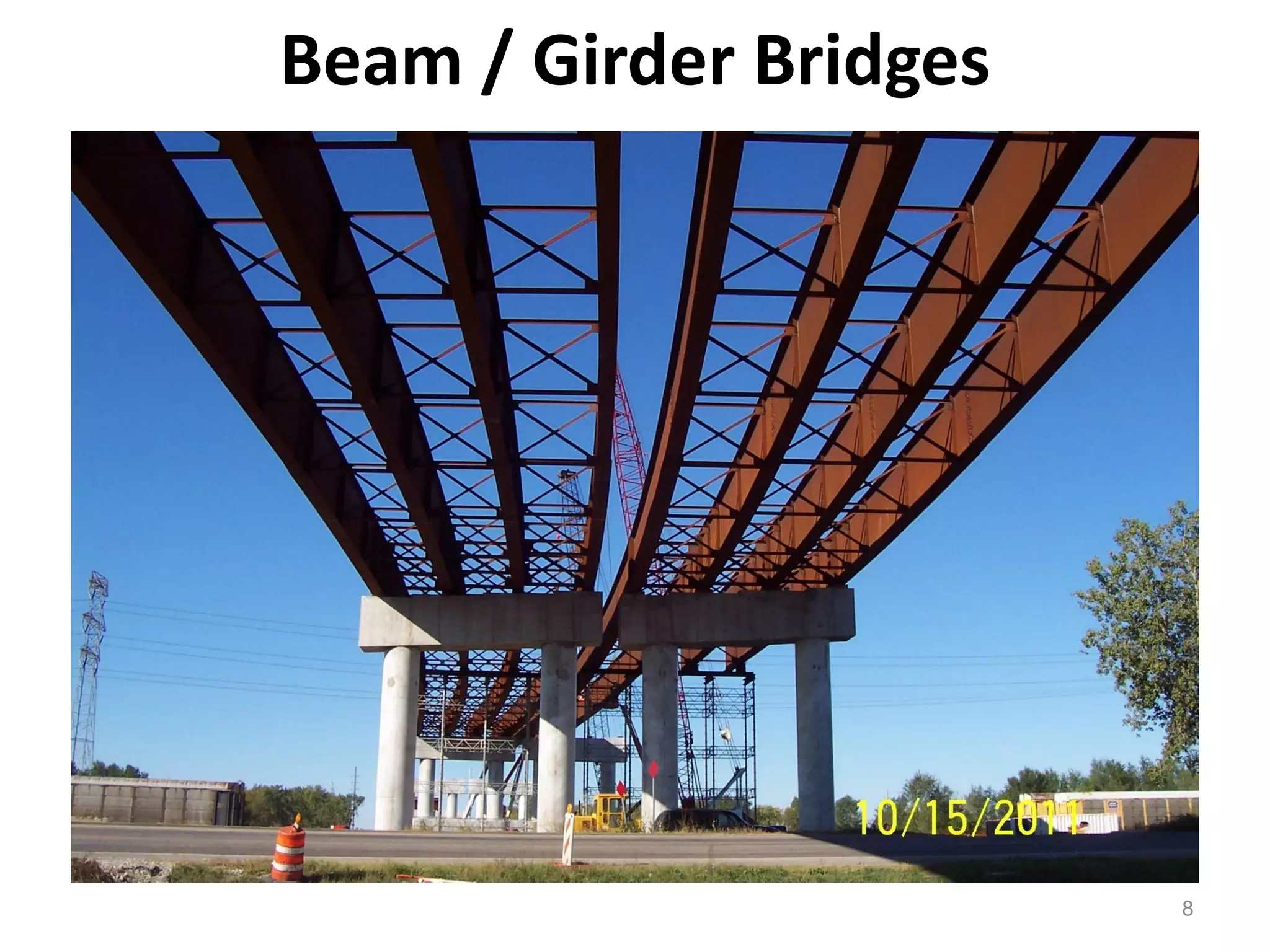
Beam / Girder Bridges
9
Beam / Girder Bridges (Contd.)
• Rolled I sections are used as the main support
system
• Other members – cross girders, stringers, deck,
bracings
• Two beam/girder system or multiple beam/girder
system with cross beams (cross girders)
10
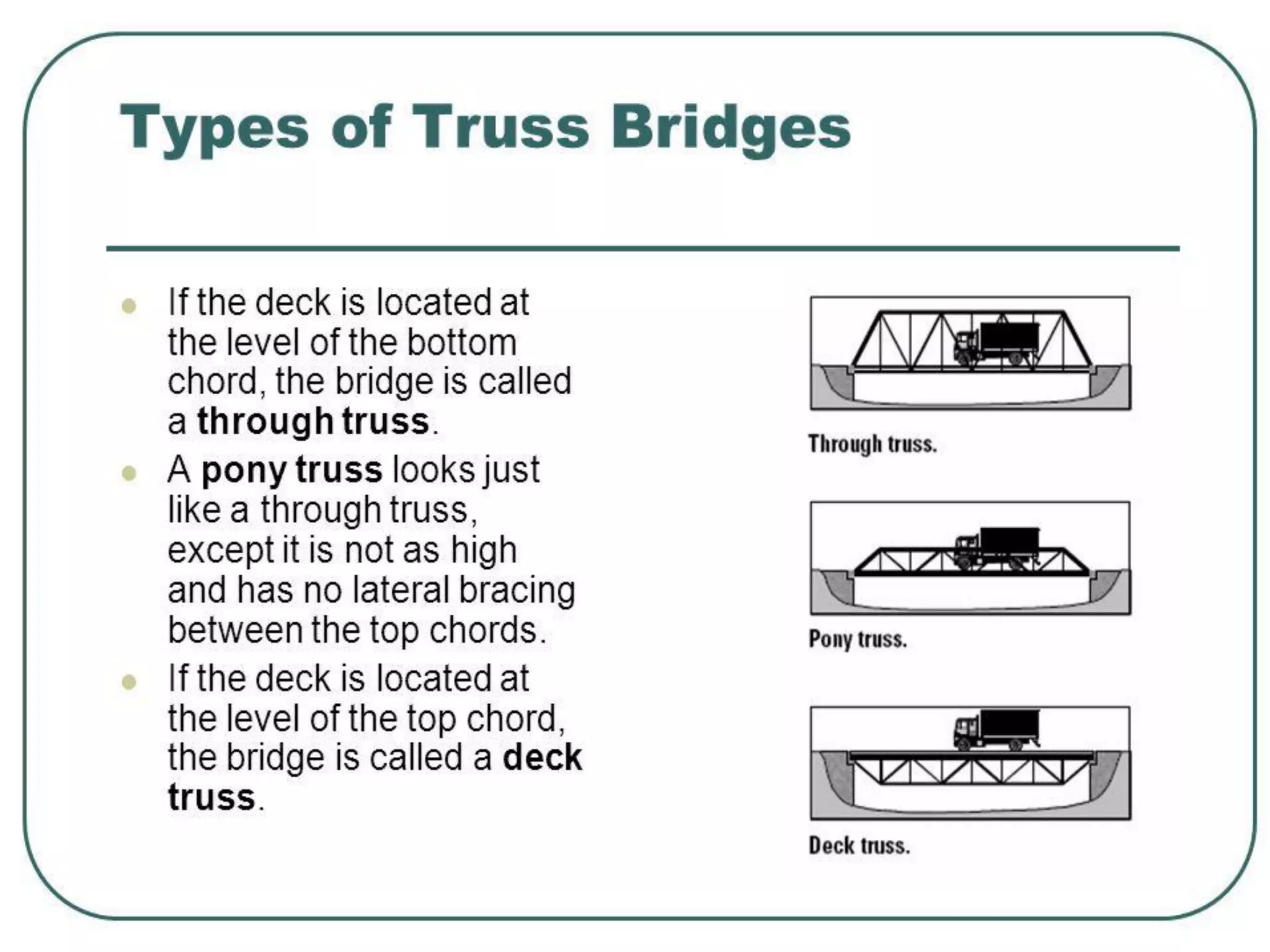
Truss Bridges
11
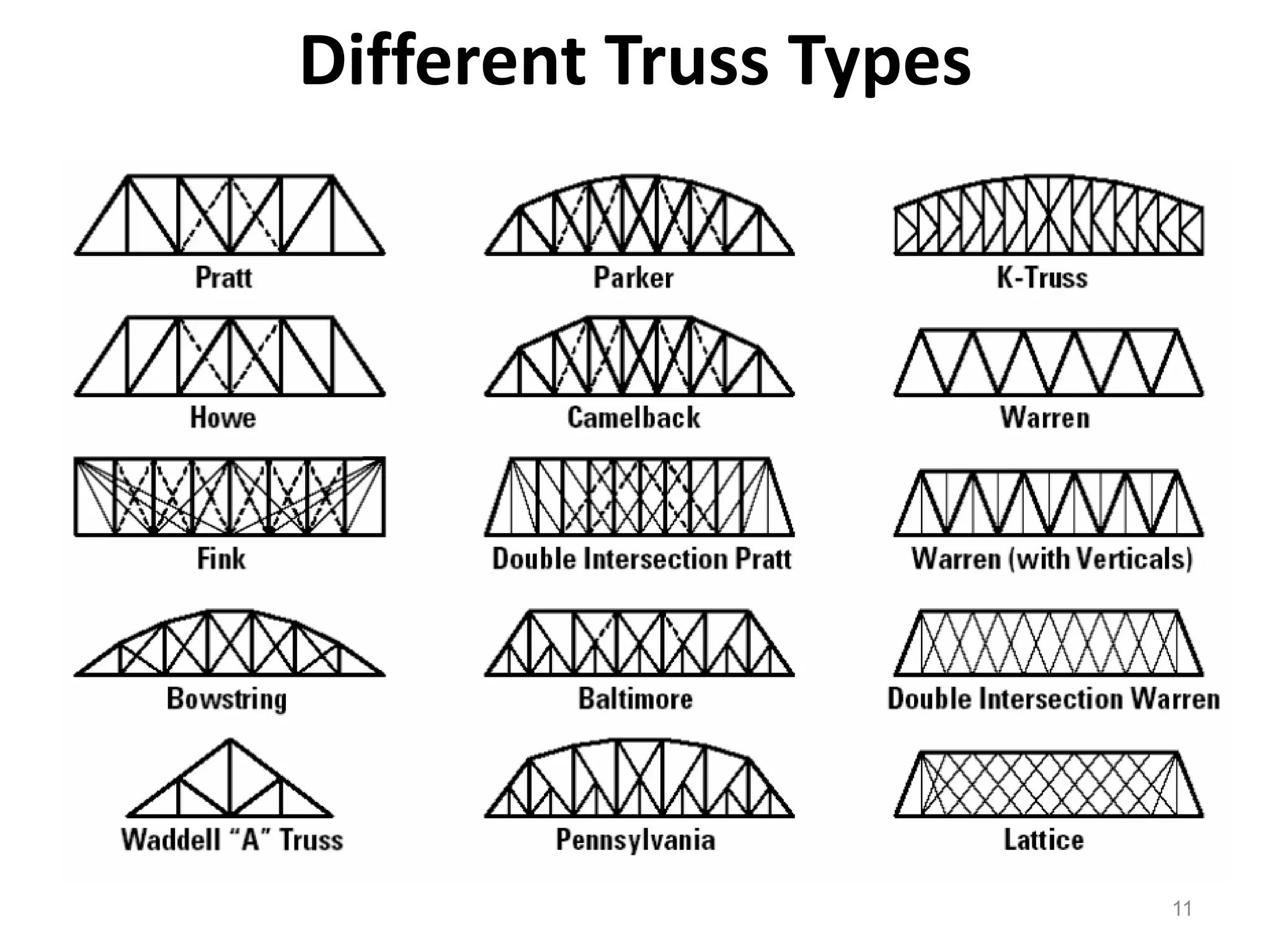
Different Truss Types
12
C
13
Truss Bridges (Contd.)
• Spans up to 200m possible
• Structurally efficient
• Reduced self weight
• Several types of truss arrangements possible –
Warren, Modified Warren, Pratt, Fink, Howe etc.
14
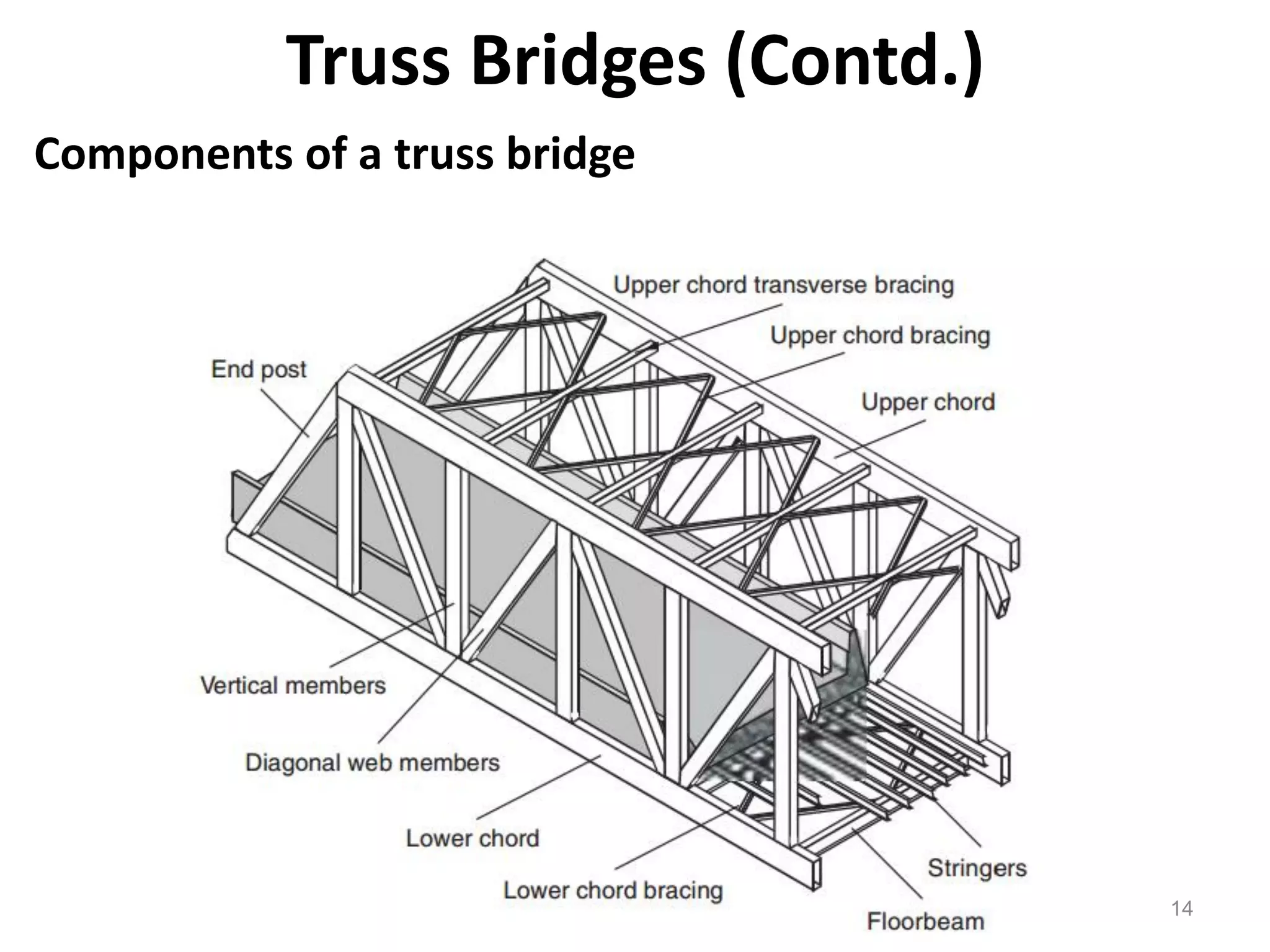
Truss Bridges (Contd.)
Components of a truss bridge
Warren Truss Pratt Truss
Equal length
members
Easy
fabrication
economy
Longer members
in tension
Slender diagonals
are possible
Efficient structure
Truss Bridges (Contd.)
16
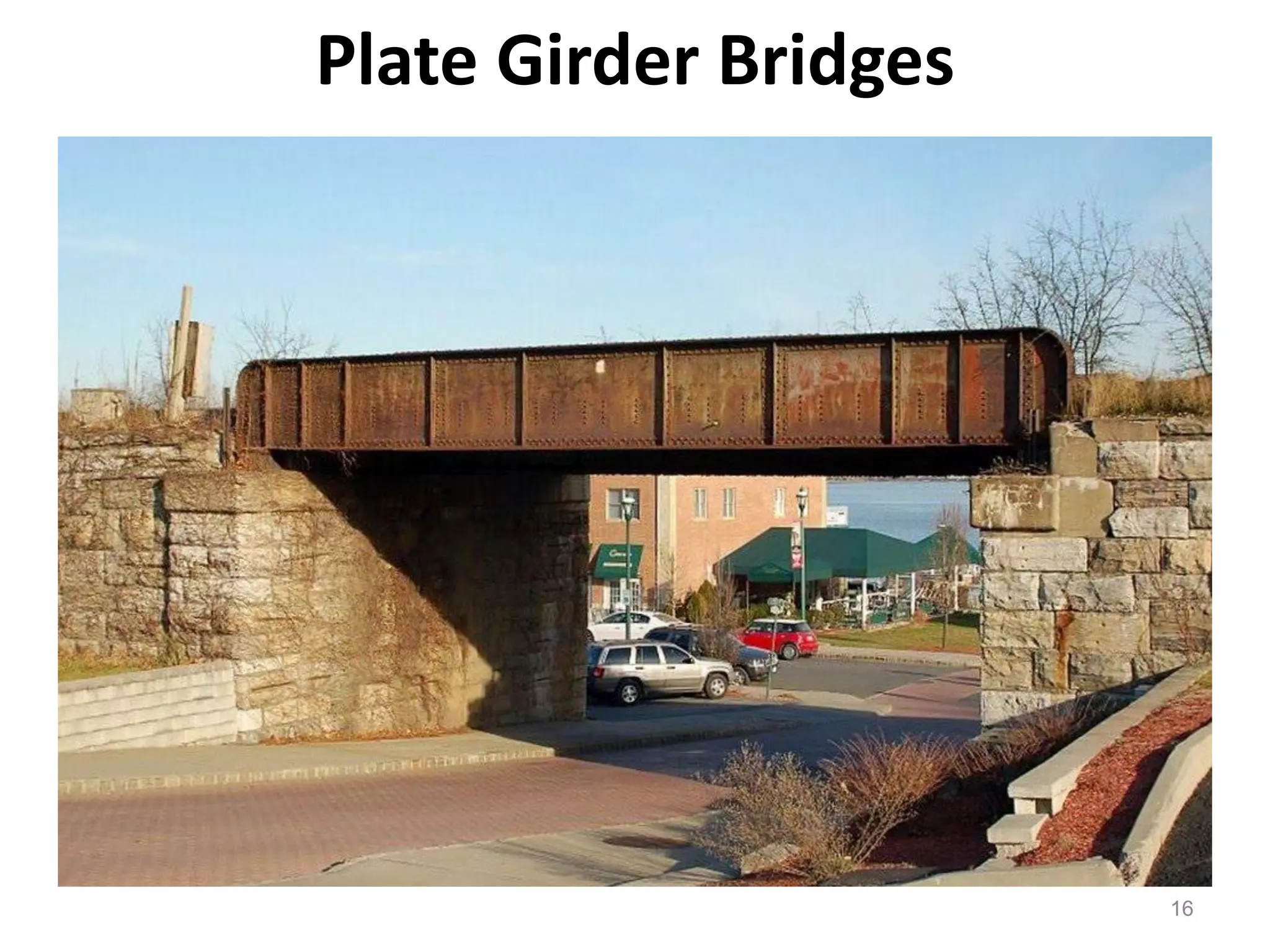
Plate Girder Bridges
17
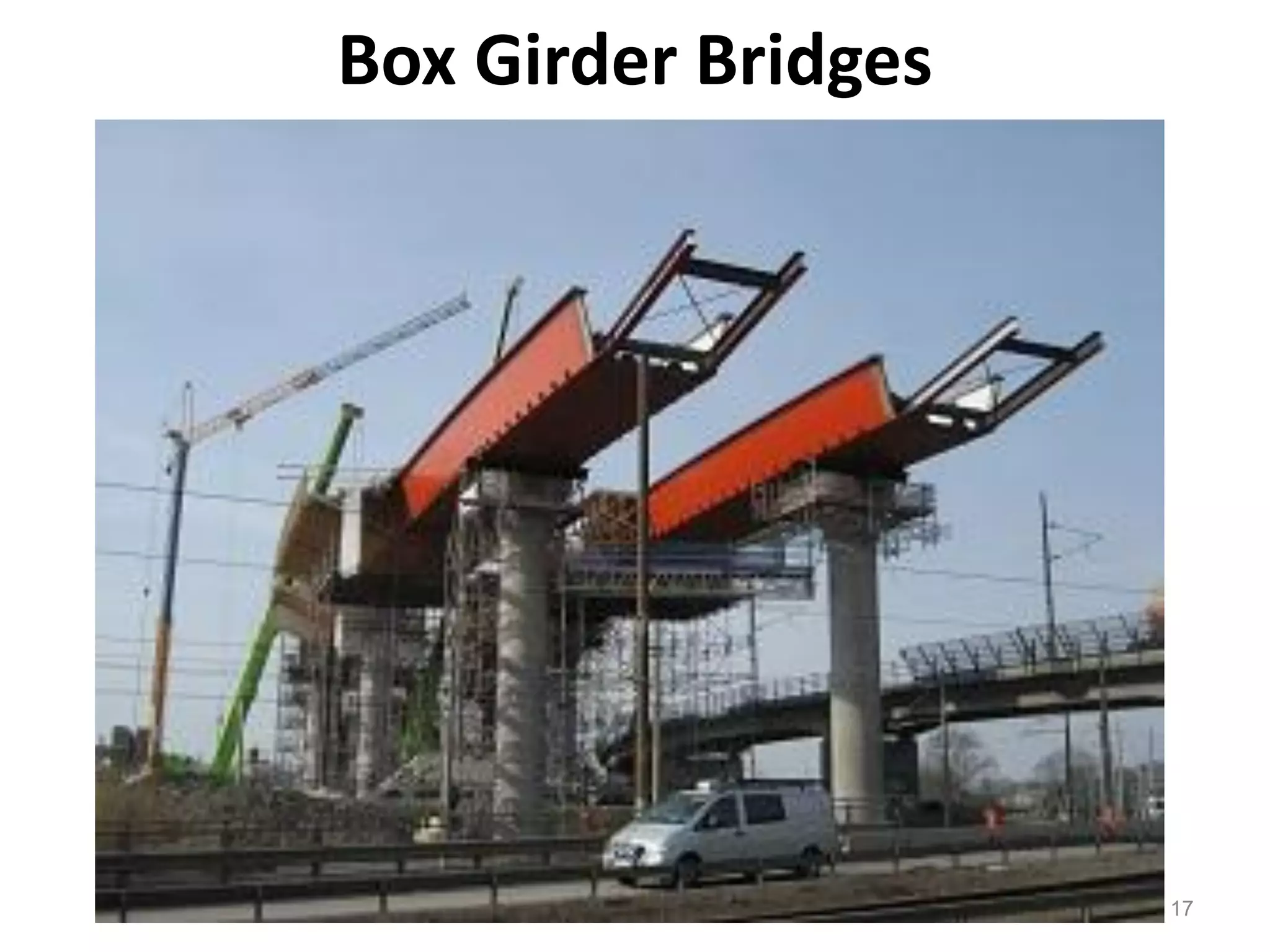
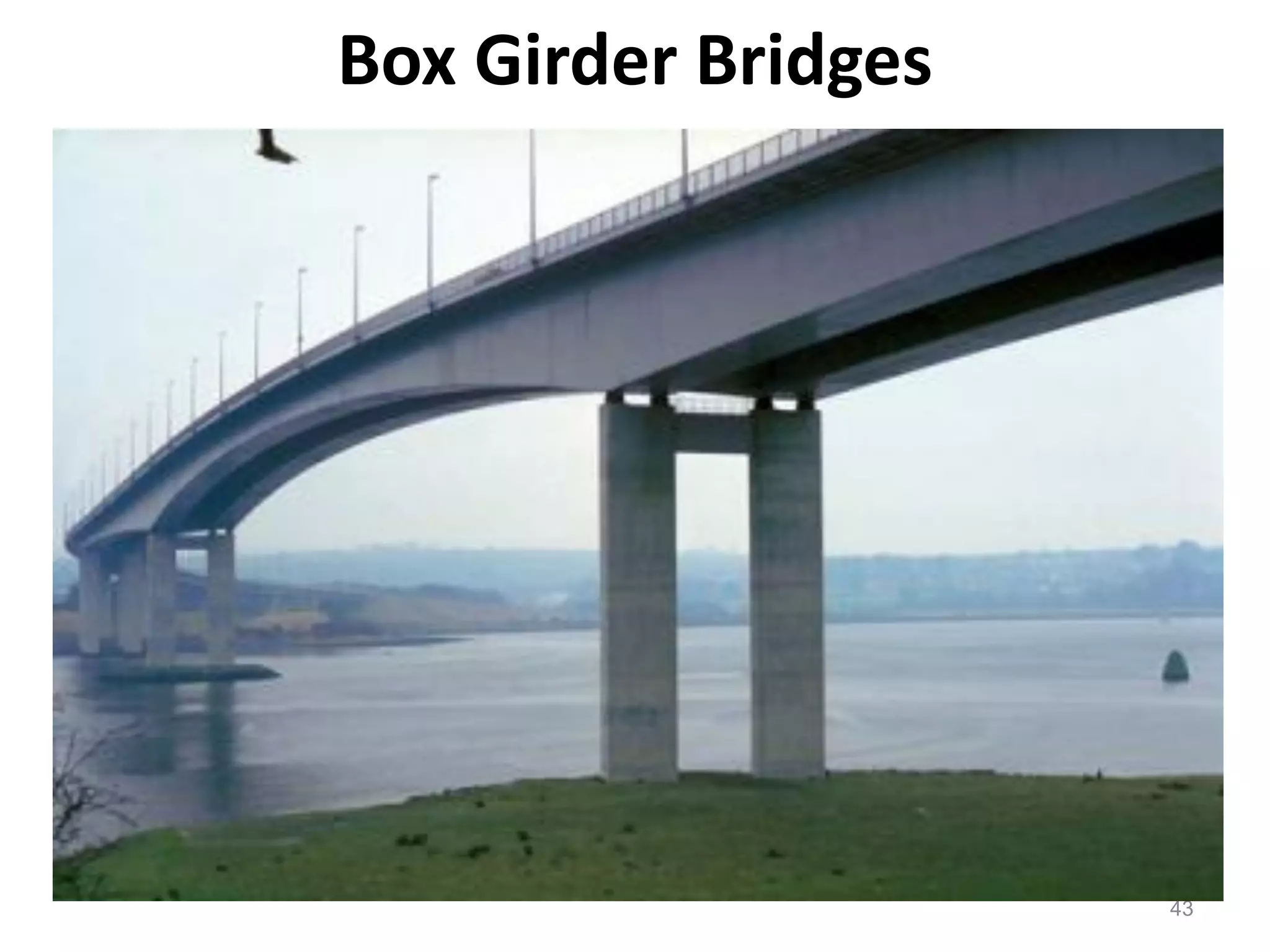
Box Girder Bridges
18
Box Girder Bridges (Contd.)
• Very high torsional rigidity
• Effective use of construction materials
• Longer spans possible
• Complex execution
19
Cantilever Bridges
20
Cantilever Bridges (Contd.)
• Permits a long clear span for navigation
• Main structural elements are anchor arm,
cantilever arm and suspended span
21
Arch Bridges
22
Arch Bridges (Contd.)
23
Arch Bridges (Contd.)
• Structural action similar to old masonry arches –
bending moments much lower than in typical
bridges
• Deck support – Hangers or struts
24
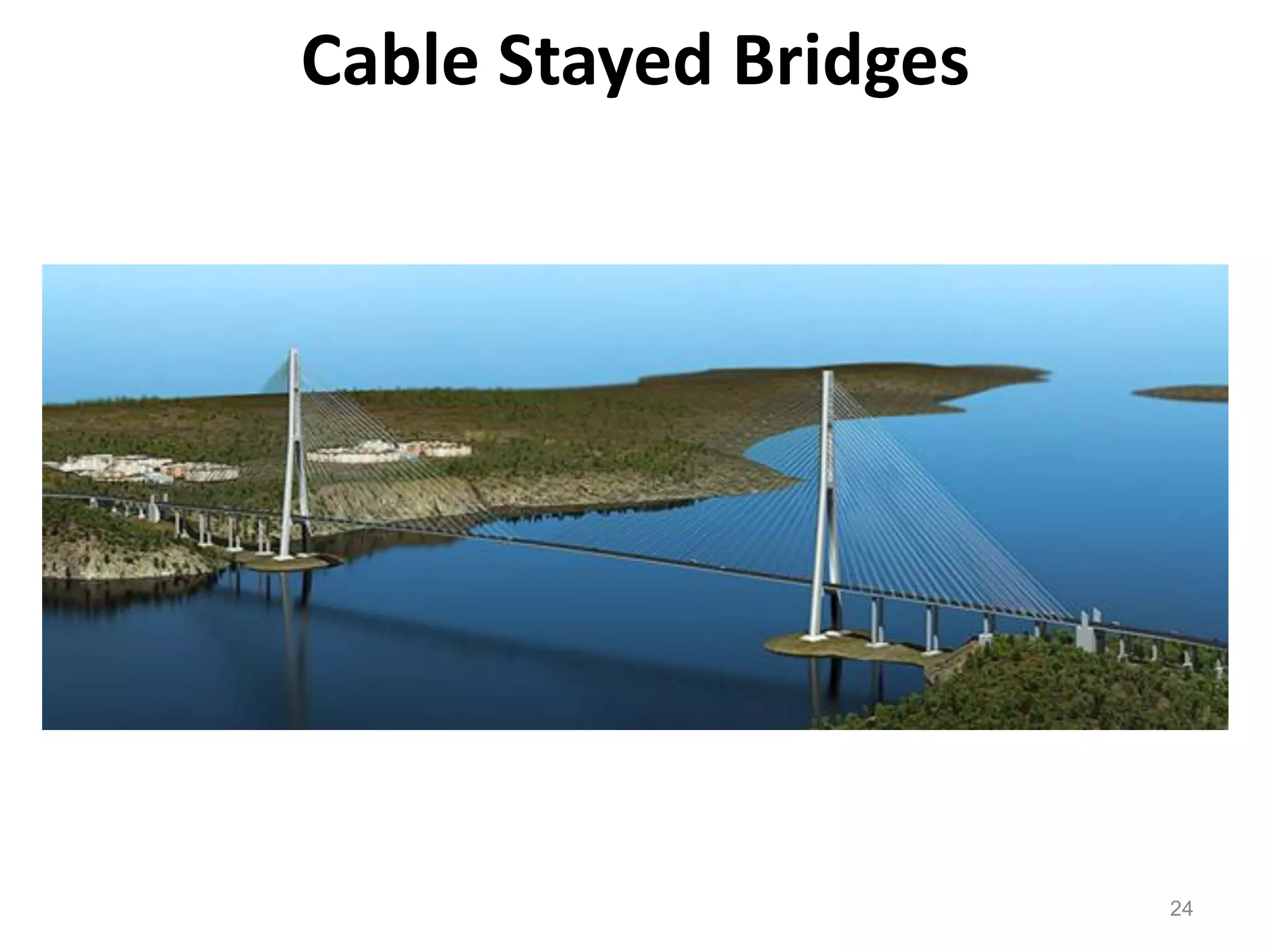
Cable Stayed Bridges
25
Cable Stayed Bridges
• Spans : 200 – 500m
• Main structural elements – Cables, towers (pylons)
and deck
26
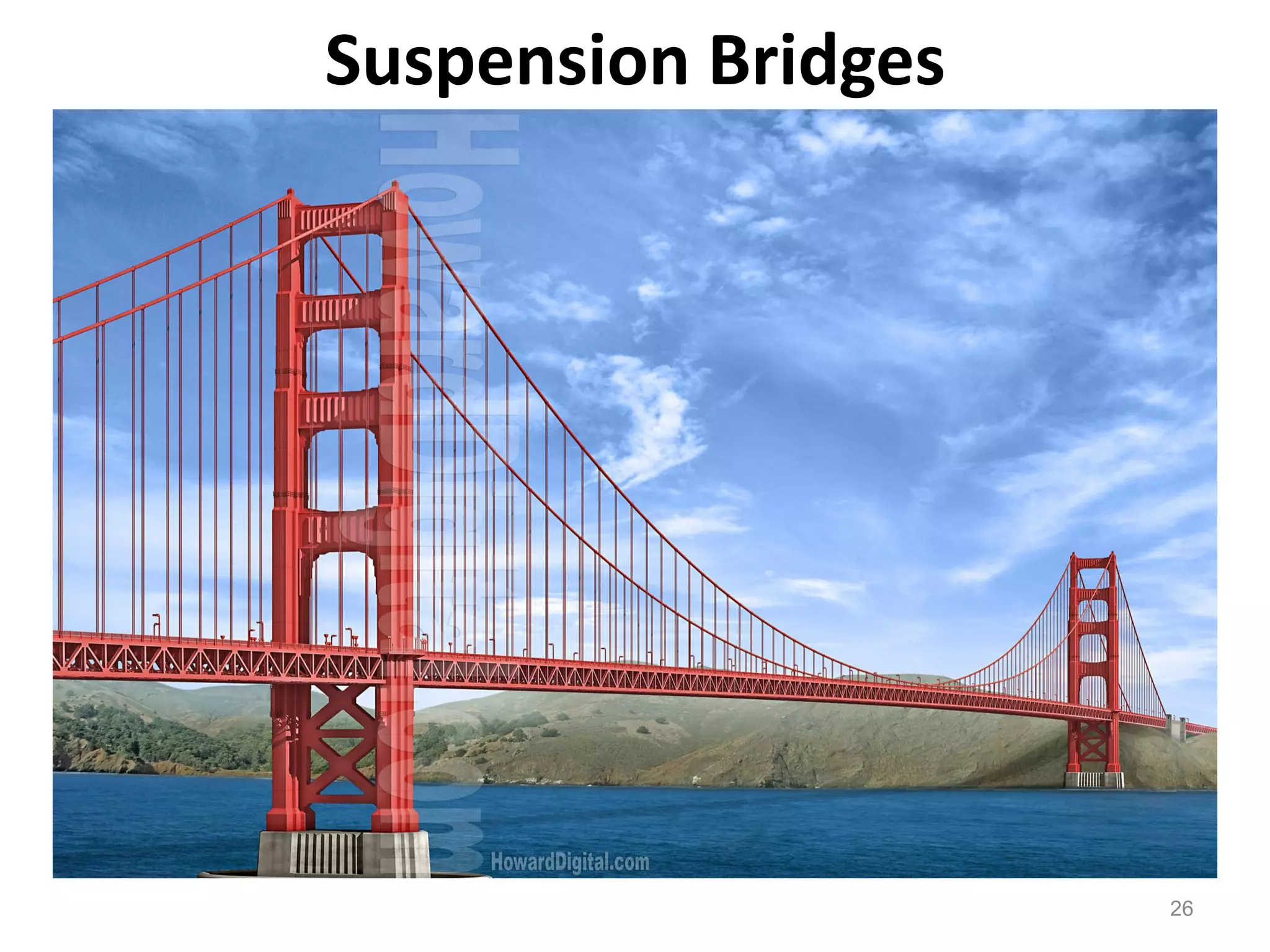
Suspension Bridges
27
Suspension Bridges (Contd.)
• Spans exceeding 600m
• Main structural elements – Flexible cables, towers
(pylons), anchorages, hangers, deck
• Light and strong
• Very expensive
28
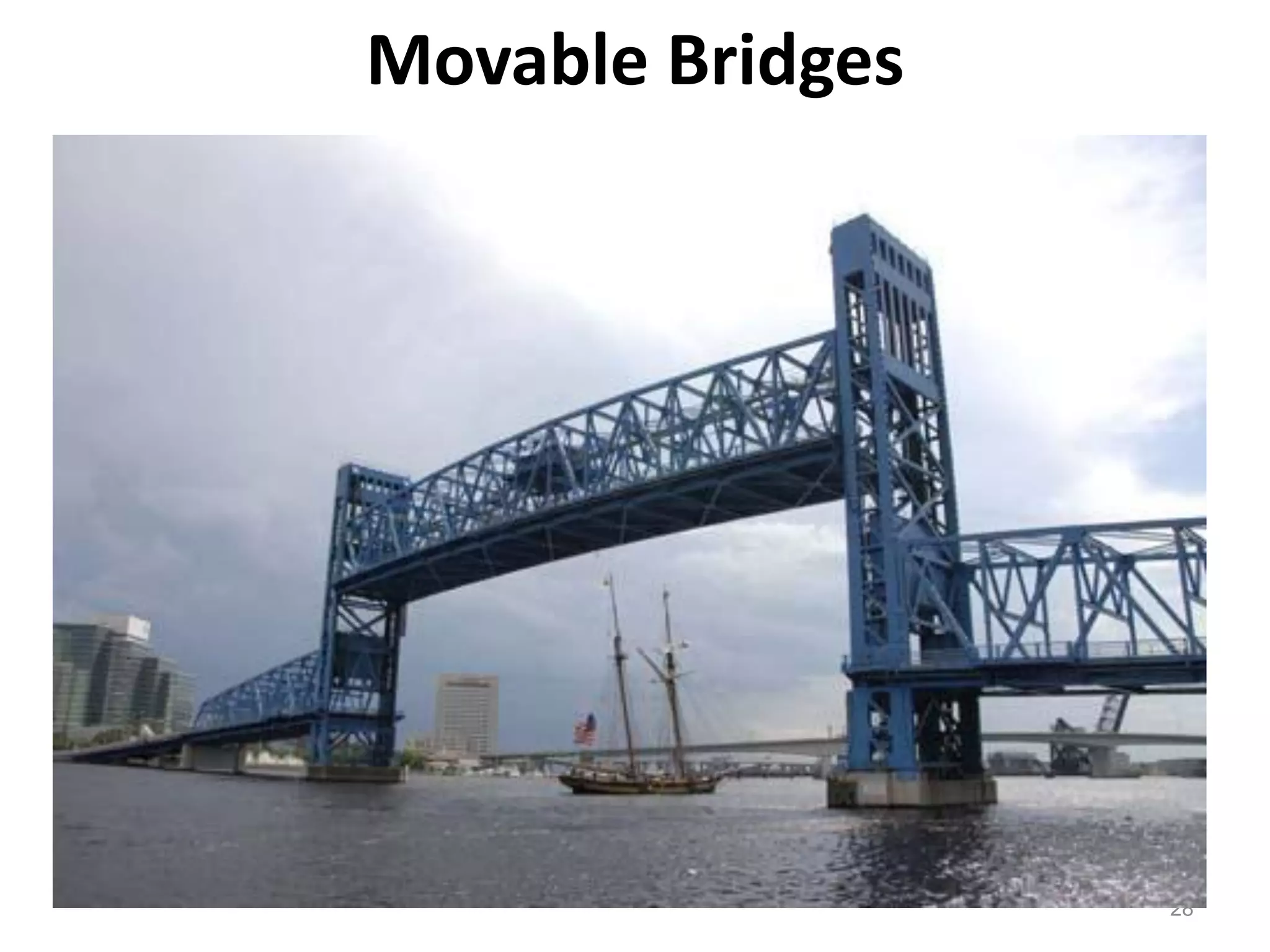
Movable Bridges
29
Movable Bridges
30
Movable Bridges (Contd.)
• Permits passage for navigation by moving /
swinging the bridge deck
• When it is either impractical or too expensive to
provide a bridge with sufficient vertical clearance
• Moving action – Lift/sink or swing
31
Temporary / Emergency Bridges
32
Temporary / Emergency Bridges (Contd.)
33
Temporary / Emergency Bridges (Contd.)
• Erected within a very short period (1 day)
• No permanent abutments / piers
• Specially provided during wars and after natural
disasters
34
Concrete Bridges
35
Advantages of Concrete
• Ingredients of concrete are easily available.
• Unlike natural stones Concrete is free from
defects and flaws (faults, joints, stratifications
etc.).
• Concrete can be manufactured to desired strength
with economy.
• The durability of concrete is very high.
• It can be cast to any desired shape.
• Casting of concrete can be done at work site
which makes it economical.
• Maintenance cost of concrete is almost negligible.
36
Disadvantages of Concrete
• Compared to other binding materials, the tensile
strength of concreter is relatively low.
• Concrete is less ductile.
• The weight is high compared to its strength.
37
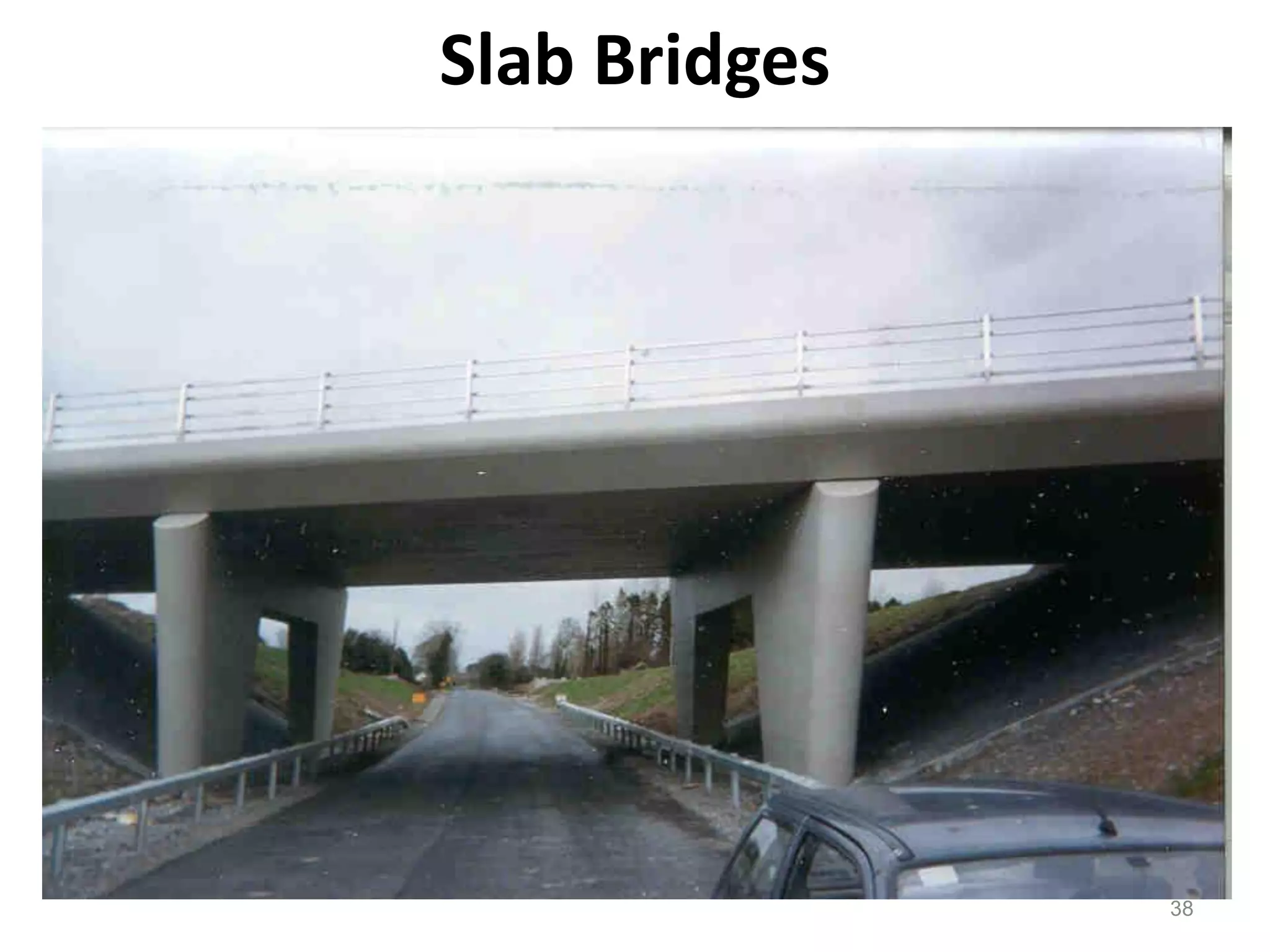
RC Bridges
• Suitable for small and medium spans
• Special requirements – restriction on provision of
formwork, construction period
• Most of highway bridges are RC
• Several types available
• Slab
• Beam
• Box girder
• Continuous girder
• Balanced cantilever
• Arch
38
Slab Bridges
39
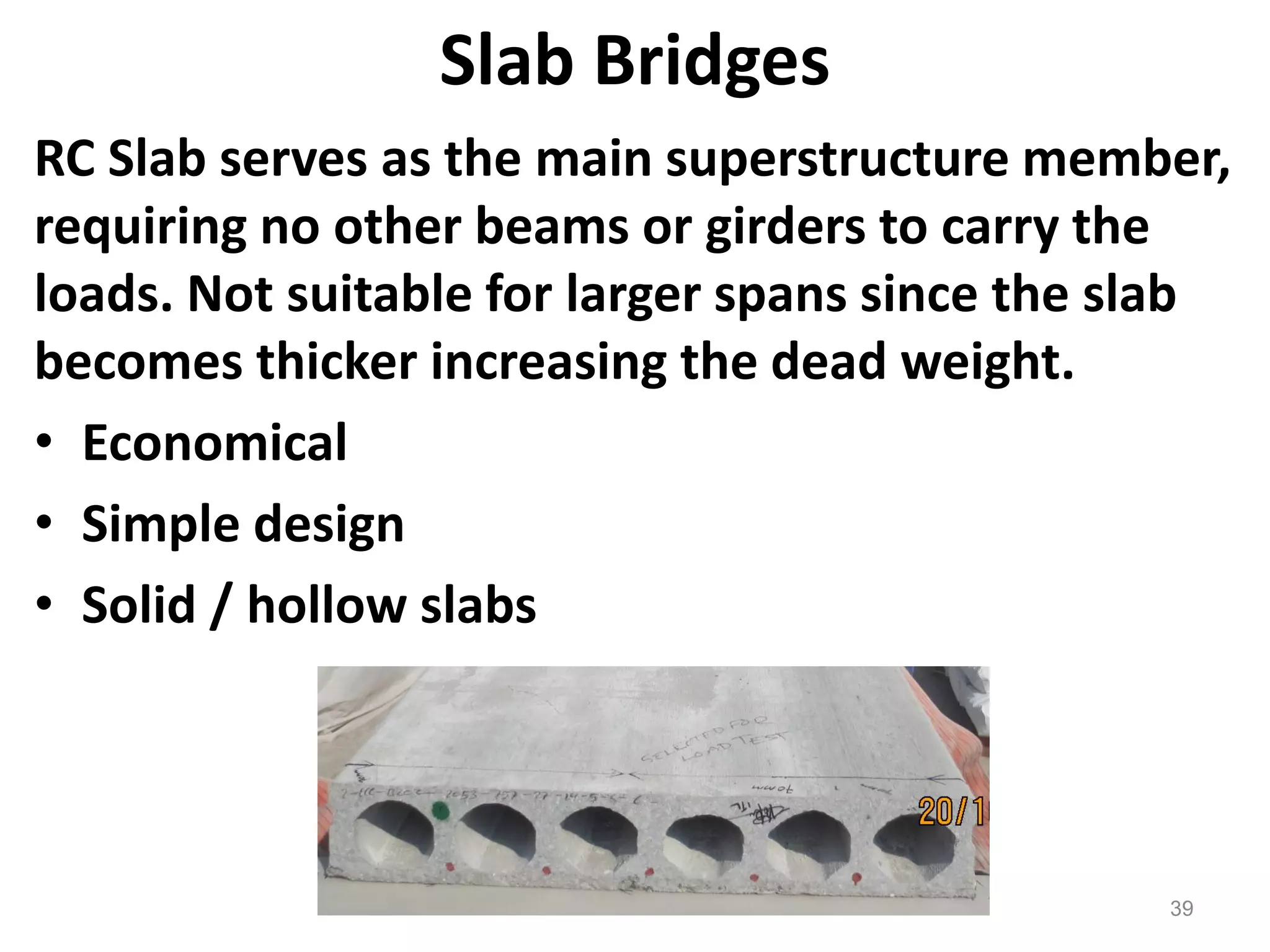
Slab Bridges
RC Slab serves as the main superstructure member,
requiring no other beams or girders to carry the
loads. Not suitable for larger spans since the slab
becomes thicker increasing the dead weight.
• Economical
• Simple design
• Solid / hollow slabs
40
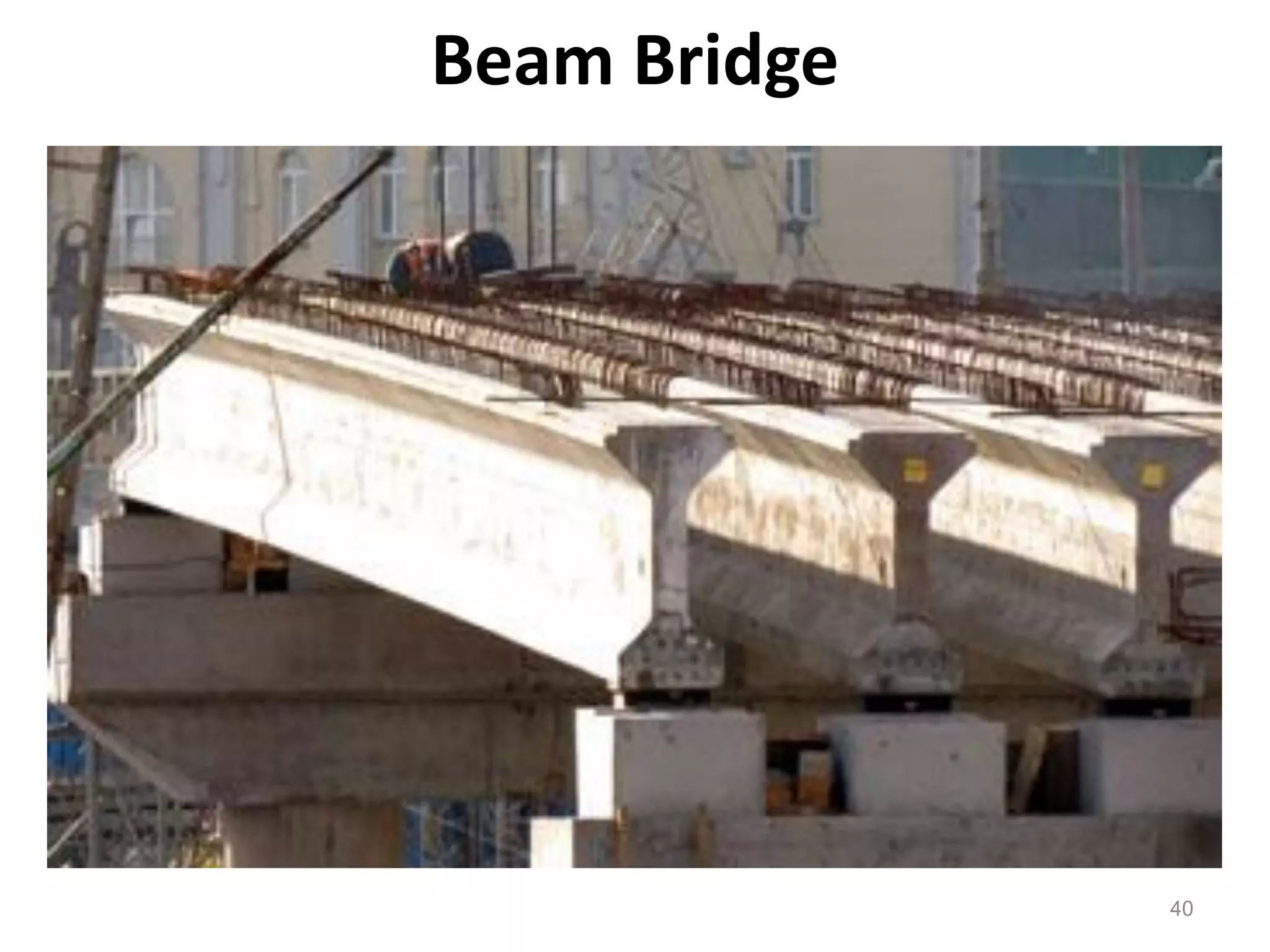
Beam Bridge
41
Beam Bridge
RC beams serve as the main superstructure member.
Widely used due to simplicity, economy, wide
availability of the standard sections, and speed of
erection. Precast beams are placed on the
supporting piers or abutments, usually on rubber
bearings which are maintenance free.
• I beams are used
• A deck is constructed on top of beams spanning
between the beams
42
Box Girder Bridges
For spans greater than around 45 metres, pre-
stressed concrete box girders are the most common
method of concrete bridge construction. The main
spans are hollow and the shape of the 'box' will
vary from bridge to bridge and along the span,
being deeper in cross-section at the abutments and
piers and shallower at mid span.
• Incrementally launched
• Span by span
• Balanced cantilever
43
Box Girder Bridges
44
Bridge Design
45
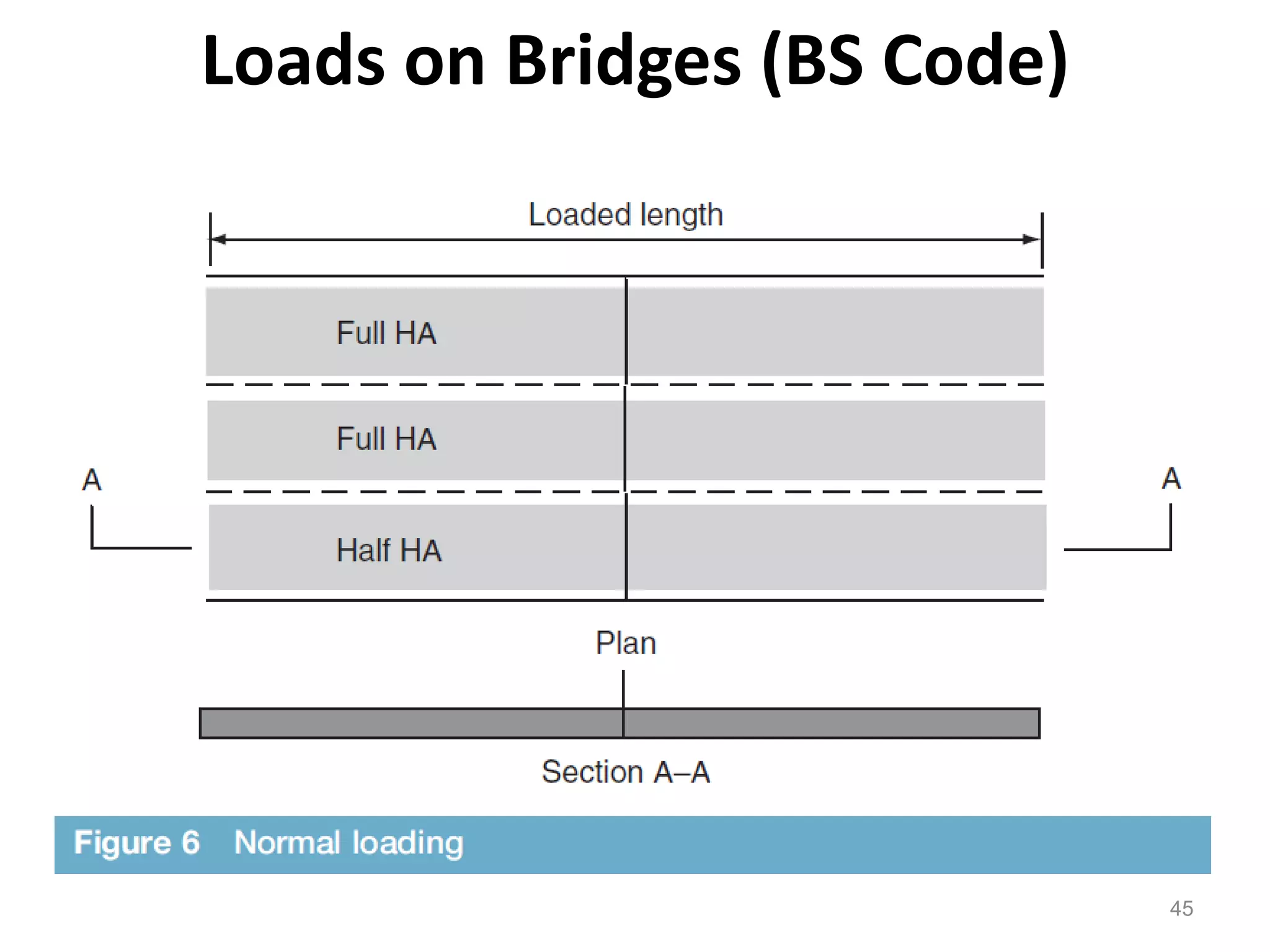
Loads on Bridges (BS Code)
46
Loads on Bridges (Eurocode)
47
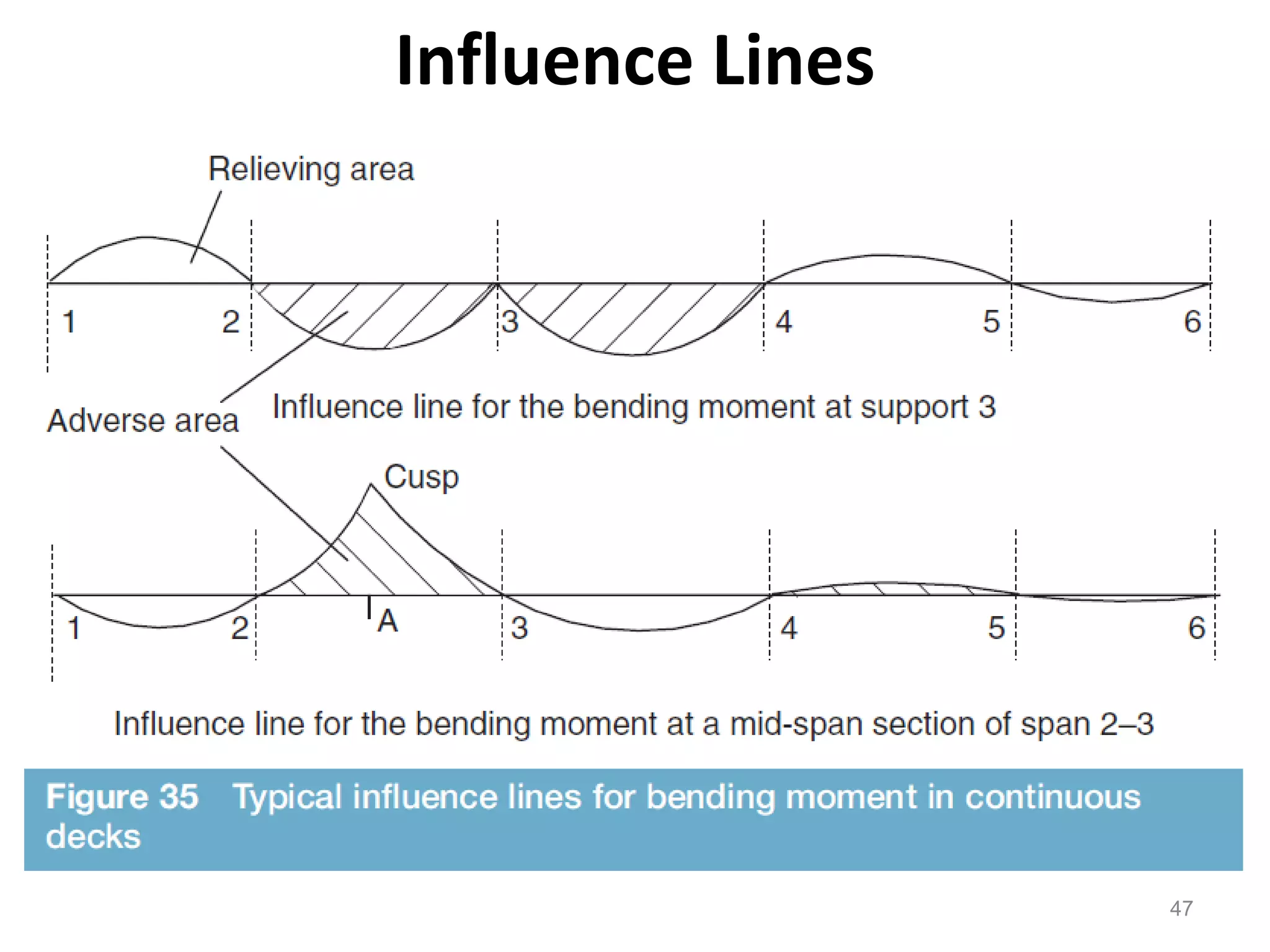
Influence Lines
48
Influence Lines
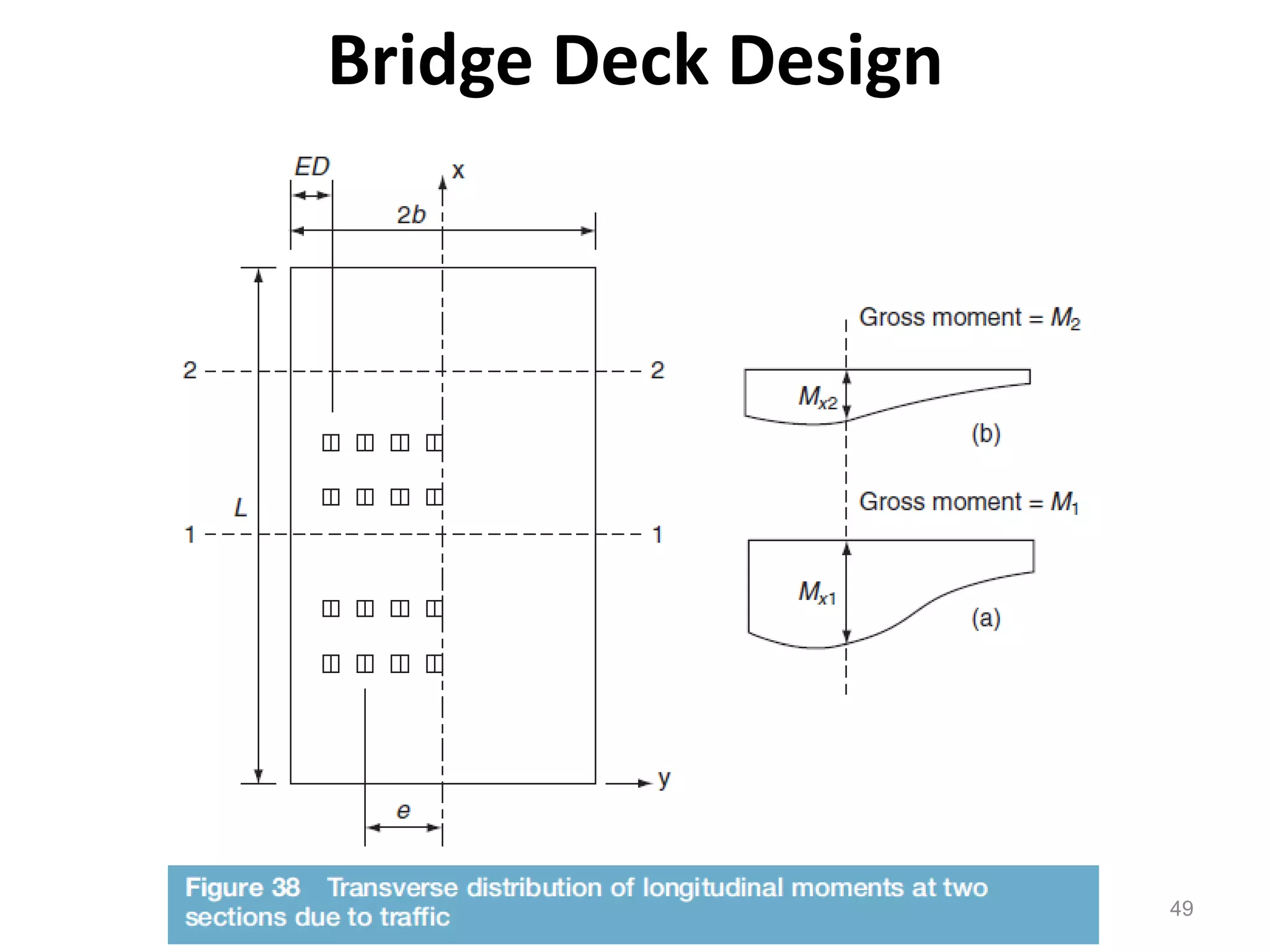
49
Bridge Deck Design
50
Bridge Deck Design
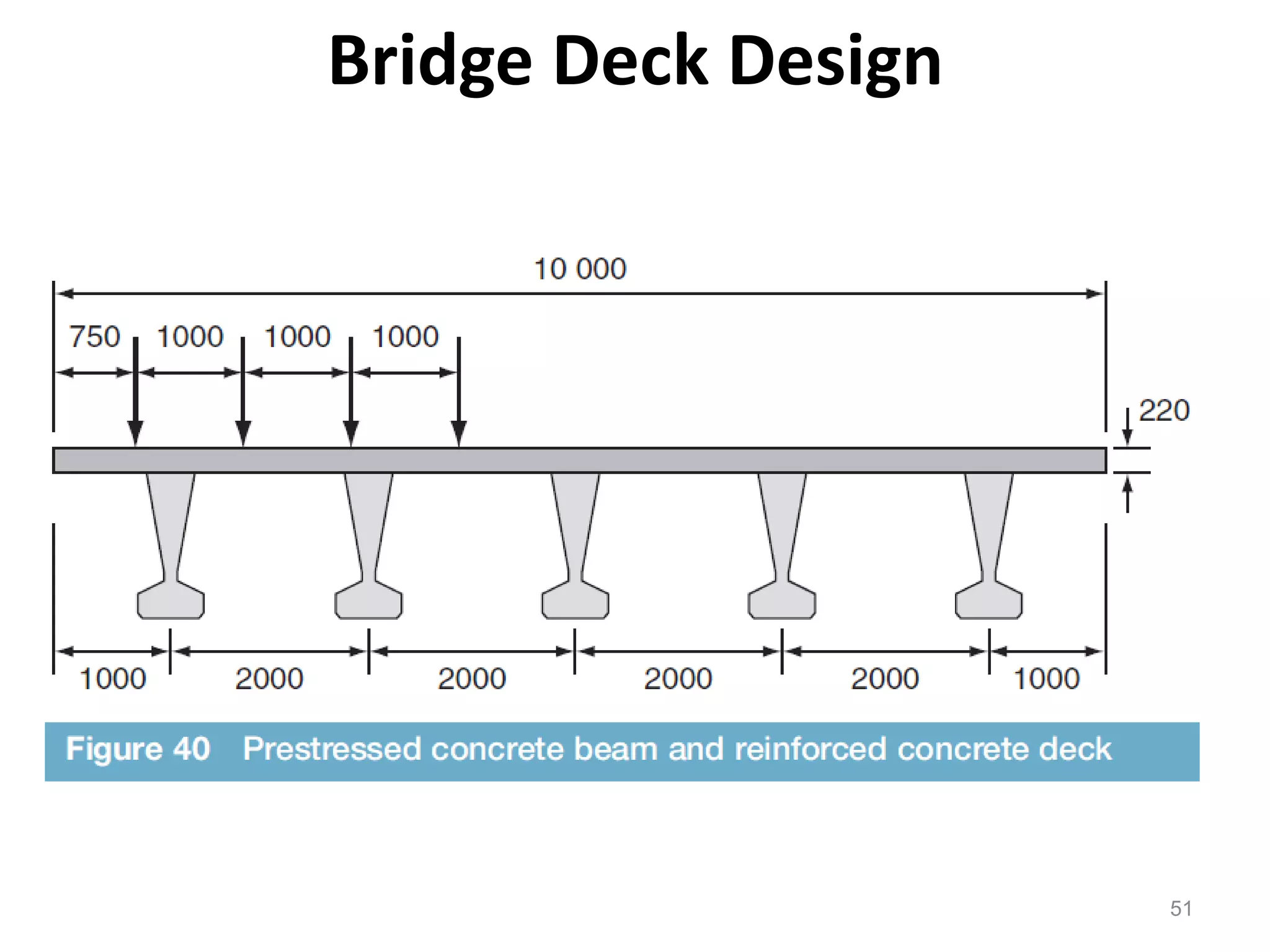
51
Bridge Deck Design
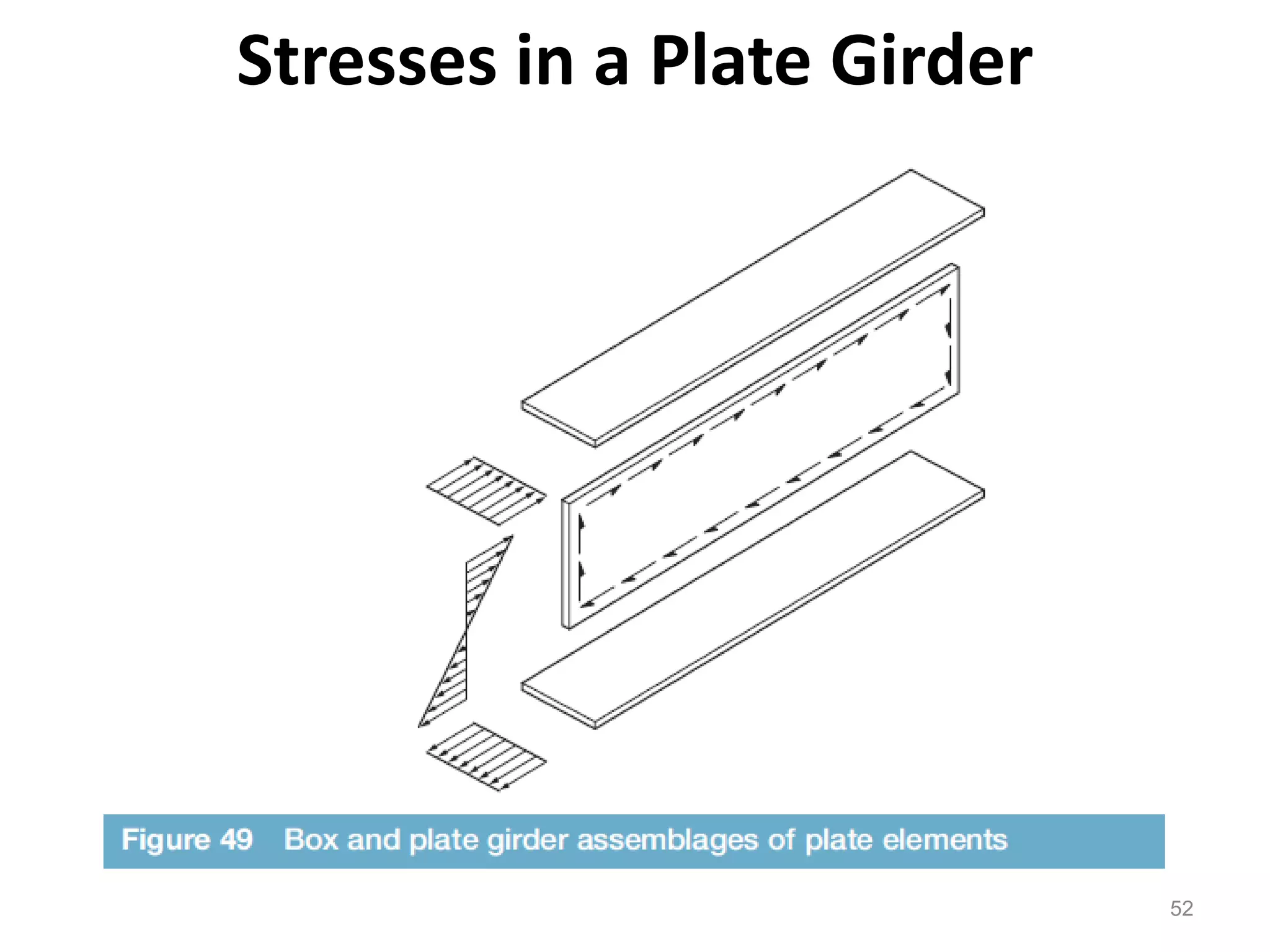
52
Stresses in a Plate Girder
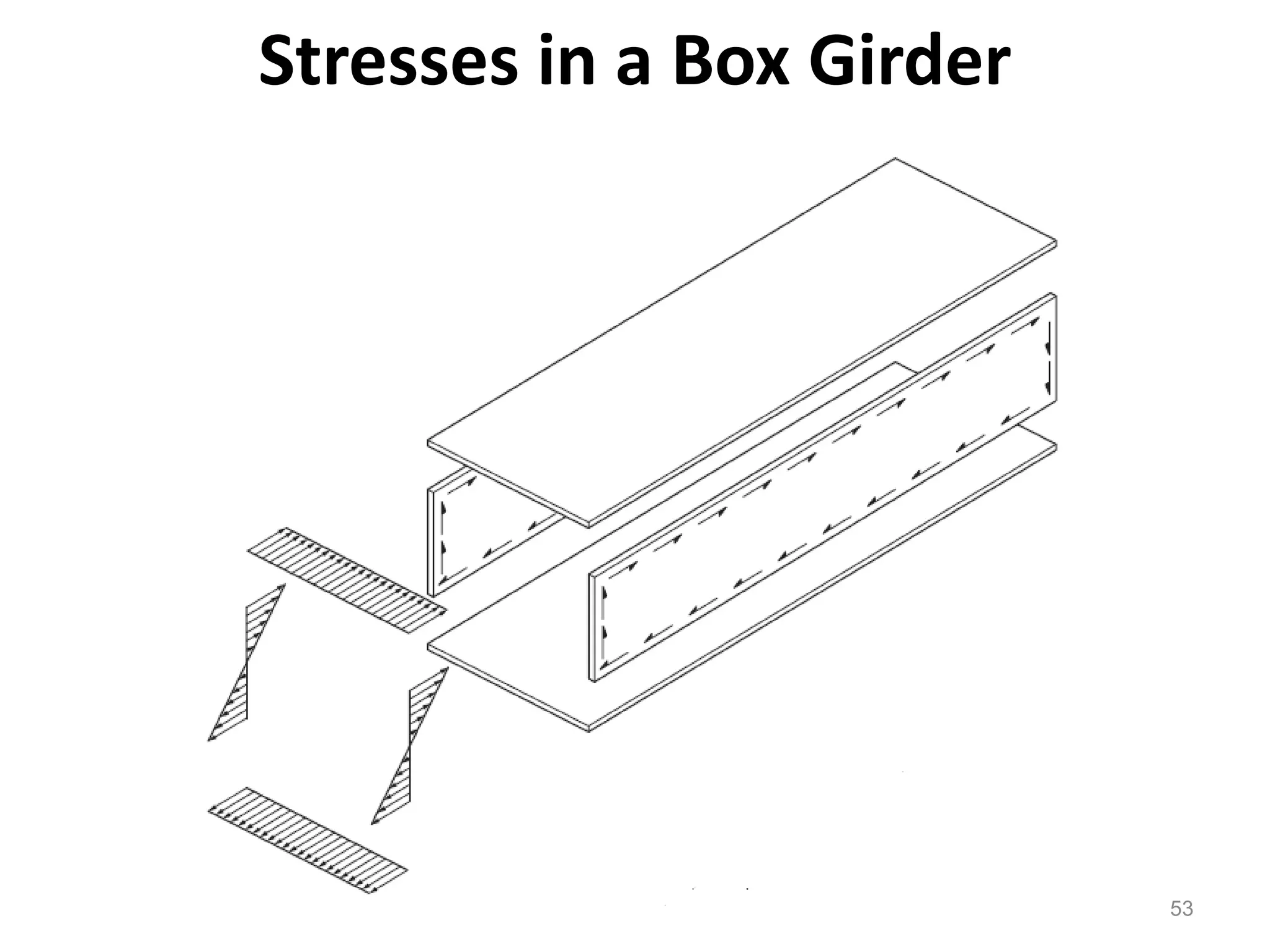
53
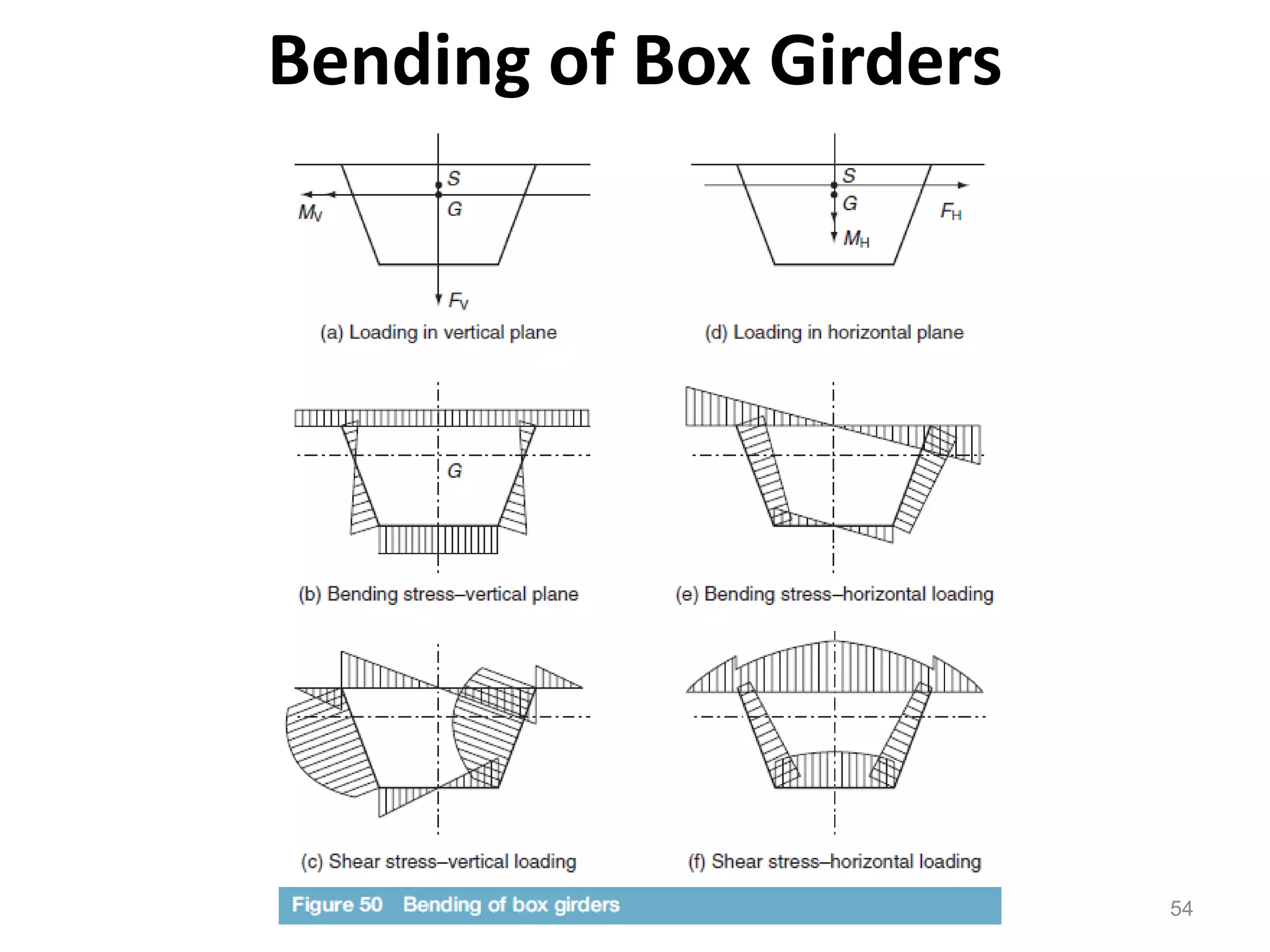
Stresses in a Box Girder
54
Bending of Box Girders
55
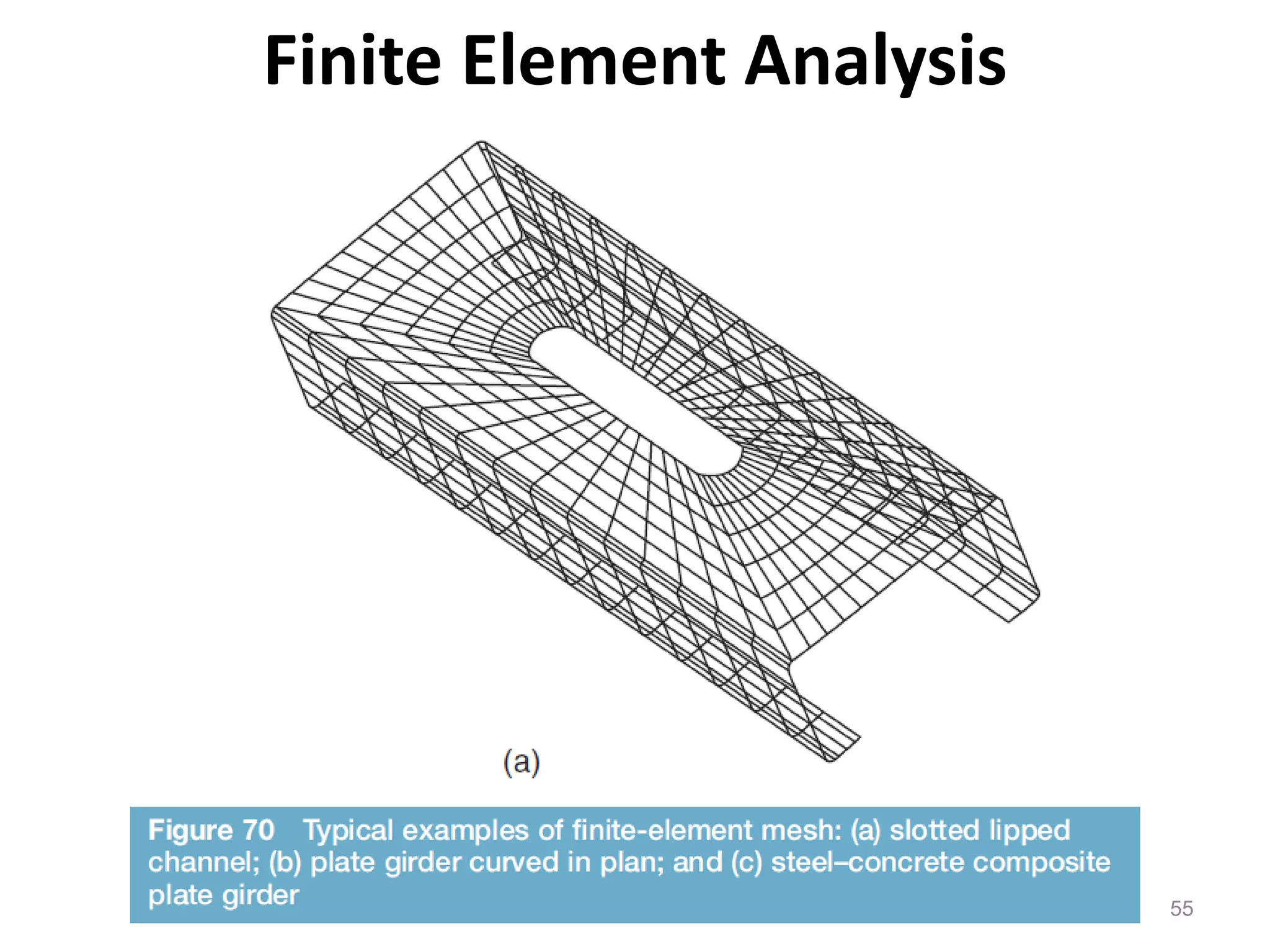
Finite Element Analysis
56
Finite Element Analysis
57
Finite Element Analysis

Concrete and steel bridges