SOIL-STRUCTURE INTERACTION
     AND FOUNDATION VIBRATIONS


                       BY :

             AHMAD HALLAK, M.Sc, P.Eng


29/02/2012                               1
AGENDA

  12:00 – 12:05 Safety Moment

  12:05 – 12:50 Presentation

  12:50 – 1:00 Questions and Answers


29/02/2012                              2
SOIL STRUCTURE INTERACTION (SSI):
         Definition:
         The process in which the response of the soil influences the motion of the structure
         and the motion of the structure influences the response of the soil is termed as SSI.
         In this case neither the structural displacements nor the ground displacements are
         independent from each other.
      Traditional Structural Engineering methods disregard SSI effects, which is
       acceptable only for Light structures on relatively stiff soil (low rise structures
       and simple rigid retaining walls).
      SSI effects become prominent and must be regarded for structures where P-δ
       effects play a significant role,structures with massive or deep seated
       foundations,slender tall structures and structures supported on a very soft
       soils with average shear velocity less than 100 m/s.[Euro Code 8].
      Modern Seismic Design Codes such as Standard Specifications for Concrete
       Structures: Seismic Performance Verification JSCE 2005 (Japan Society of Civil
       Engineers) highlight that the response analysis should take into account the whole
       structural system ( superstructure + foundation + soil ).


29/02/2012                                                                                   3
   SSI Effects
      Alter the Natural Frequency of the Structure :
              Considering soil-structure interaction makes a structure more flexible and thus
               increases the natural period of the structure as compared to the corresponding
               rigidly supported structure.
      Add Damping :
              Considering the SSI effect increases the effective damping ratio of the system
               ( Superstructure + Foundation + Soil ).
      Based on these assumptions, SSI reduces the dynamic response of the
       structure and improves the safety margins.


              With this assumption, it has traditionally been considered that SSI can
               conveniently be neglected for conservative design. In addition, neglecting SSI
               tremendously reduces the complication in the analysis of the structures.
              This conservative simplification is valid for certain classes of structures and soil
               conditions, such as light structures in relatively stiff soil.
              However SSI can have a detrimental effect on the structural response, and
               neglecting SSI in the analysis may lead to unsafe design for both the
               superstructure and the foundation .
29/02/2012                                                                                        4
Detrimental effects of SSI
     Mylonakis,G and Gazetas,G. (2000a):
      An Increase in the natural period of a structure due to SSI is not always beneficial
       as suggested by the simplified design spectrums.
        Example :
      Soft Soil Sediments can significantly elongate the period of seismic waves. The
       increase in the natural period of a structure (due to SSI) may lead to resonance
       with this long period ground vibration.
      The ductility demand can increase significantly with the increase in the natural
       period of the structure due to SSI effect. The permanent deformation and failure of
       soil may further aggravate the seismic response of the structure.


29/02/2012                                                                                    5
 SSI – Problem Definition
            Soil-structure interaction can be broadly divided into two phenomena:

             A.   Kinematic interaction.
             B.   Inertial interaction.
         Examples:
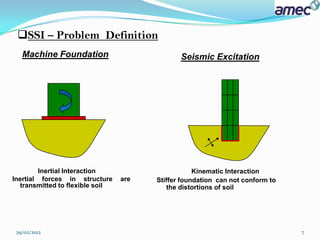
             -    An Embedded Foundation into soil does not follow the free field motion
                  ( Earthquake ground motion causes soil displacement known as free-filed
                  motion), this instability of the foundation to match the free field motion causes
                  the kinematic interaction.
             -    The mass of the super-structure transmits the inertial force to the soil causing
                  further deformation in the soil, which is termed as inertial interaction .
             At low level of ground shaking, kinematic effect is more dominant causing the
             lengthening of period and increase in radiation damping(dissipation of energy
             behaves like a damper for the structure even if the soil is considered as elastic
             medium without material damping) .
      With the onset of stronger shaking, near-field soil modulus degradation and soil-
       pile gapping limit radiation damping, and inertial interaction becomes predominant,
       causing excessive displacements and bending strains concentrated near the
       ground surface, resulting in pile damage near the ground level .
29/02/2012                                                                                            6
SSI – Problem Definition
   Machine Foundation                         Seismic Excitation


        Inertial Interaction                       Kinematic Interaction
Inertial forces in structure     are   Stiffer foundation can not conform to
  transmitted to flexible soil            the distortions of soil


 29/02/2012                                                                    7
FOUNDATIONS VIBRATIONS


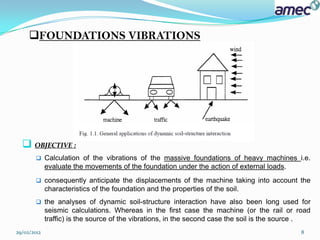
   OBJECTIVE :
         Calculation of the vibrations of the massive foundations of heavy machines i.e.
             evaluate the movements of the foundation under the action of external loads.
         consequently anticipate the displacements of the machine taking into account the
             characteristics of the foundation and the properties of the soil.
         the analyses of dynamic soil-structure interaction have also been long used for
             seismic calculations. Whereas in the first case the machine (or the rail or road
             traffic) is the source of the vibrations, in the second case the soil is the source .
29/02/2012                                                                                     8
 GENERAL DESCRIPTION OF IMPEDANCE FUNCTIONS
          Impedance functions (Dynamic Stiffness):
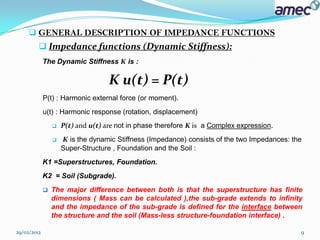
             The Dynamic Stiffness K is :

                                  K u(t) = P(t)
             P(t) : Harmonic external force (or moment).
             u(t) : Harmonic response (rotation, displacement)
                  P(t) and u(t) are not in phase therefore K is a Complex expression.
                  K is the dynamic Stiffness (Impedance) consists of the two Impedances: the
                   Super-Structure , Foundation and the Soil :
             K1 =Superstructures, Foundation.
             K2 = Soil (Subgrade).
              The major difference between both is that the superstructure has finite
               dimensions ( Mass can be calculated ),the sub-grade extends to infinity
               and the impedance of the sub-grade is defined for the interface between
               the structure and the soil (Mass-less structure-foundation interface) .

29/02/2012                                                                                  9
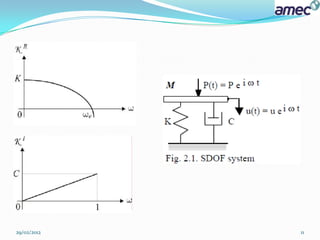
 SDOF with mass(Sup-structure & Foundation ):

      M ü +C ù +K u = P(t)


      K1 = KR + iKI


        = [(K –Mω2)] +iC ω

      KSTR = - Mω2


      KFDN = K +iC ω.


29/02/2012                                        10
29/02/2012   11
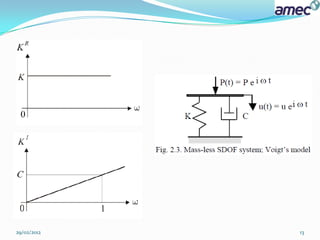
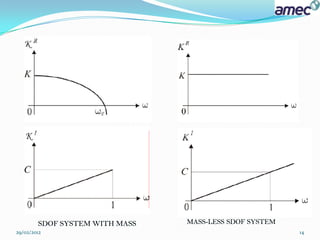
 Mass-less SDOF system (SOIL):

      K2 = K+ iC ω    .

      KR = K .


      KI = C ω.

      It is important to note that Impedance functions for the soil are always
       derived from the massless foundation model.

      K2 : can be obtained by setting M=0 in K1.


      The impedance function of the soil is equal to Foundation impedance
       component for SDOF system with mass [ KFDN ].


29/02/2012                                                                    12
29/02/2012   13
29/02/2012   14
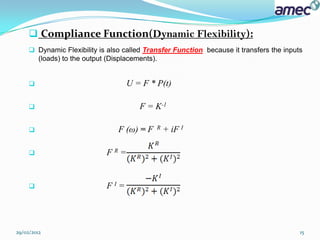
 Compliance Function(Dynamic Flexibility):
      Dynamic Flexibility is also called Transfer Function because it transfers the inputs
       (loads) to the output (Displacements).


                                  U = F * P(t)

                                      F = K-1

                                F (ω) = F   R   + iF I

                            FR=


                            FI=


29/02/2012                                                                                15
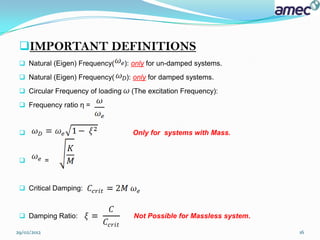
IMPORTANT DEFINITIONS
  Natural (Eigen) Frequency(      ): only for un-damped systems.
  Natural (Eigen) Frequency(      ): only for damped systems.
  Circular Frequency of loading     (The excitation Frequency):
  Frequency ratio η =


                                    Only for systems with Mass.


            =


  Critical Damping:


  Damping Ratio:                    Not Possible for Massless system.

29/02/2012                                                               16
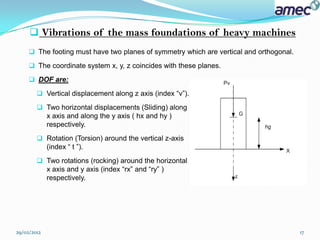
 Vibrations of the mass foundations of heavy machines
      The footing must have two planes of symmetry which are vertical and orthogonal.

      The coordinate system x, y, z coincides with these planes.

      DOF are:

         Vertical displacement along z axis (index “v”).

         Two horizontal displacements (Sliding) along
          x axis and along the y axis ( hx and hy )
          respectively.
         Rotation (Torsion) around the vertical z-axis
          (index “ t ”).
         Two rotations (rocking) around the horizontal
          x axis and y axis (index “rx” and “ry” )
          respectively.


29/02/2012                                                                               17
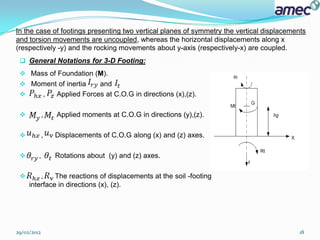
In the case of footings presenting two vertical planes of symmetry the vertical displacements
and torsion movements are uncoupled, whereas the horizontal displacements along x
(respectively -y) and the rocking movements about y-axis (respectively-x) are coupled.
  General Notations for 3-D Footing:
  Mass of Foundation (M).
  Moment of inertia              and
                ,   Applied Forces at C.O.G in directions (x),(z).

            ,       Applied moments at C.O.G in directions (y),(z).

            ,       Displacements of C.O.G along (x) and (z) axes.

        ,           Rotations about (y) and (z) axes.

        ,    The reactions of displacements at the soil -footing
     interface in directions (x), (z).


29/02/2012                                                                                 18
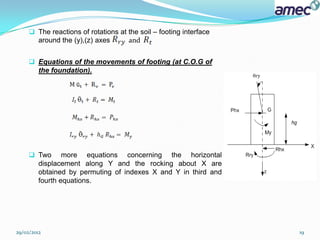
 The reactions of rotations at the soil – footing interface
       around the (y),(z) axes       and


      Equations of the movements of footing (at C.O.G of
       the foundation).


      Two more equations concerning the horizontal
       displacement along Y and the rocking about X are
       obtained by permuting of indexes X and Y in third and
       fourth equations.


29/02/2012                                                          19
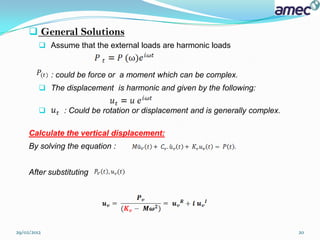
 General Solutions
          Assume that the external loads are harmonic loads


             : could be force or a moment which can be complex.
          The displacement is harmonic and given by the following:

               : Could be rotation or displacement and is generally complex.

     Calculate the vertical displacement:
     By solving the equation :


     After substituting


29/02/2012                                                                      20
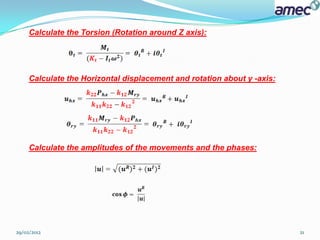
Calculate the Torsion (Rotation around Z axis):


     Calculate the Horizontal displacement and rotation about y -axis:


     Calculate the amplitudes of the movements and the phases:


29/02/2012                                                               21
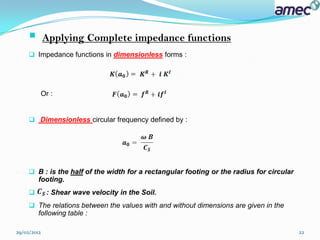
Applying Complete impedance functions
      Impedance functions in dimensionless forms :


         Or :


      Dimensionless circular frequency defined by :


      B : is the half of the width for a rectangular footing or the radius for circular
       footing.
            : Shear wave velocity in the Soil.
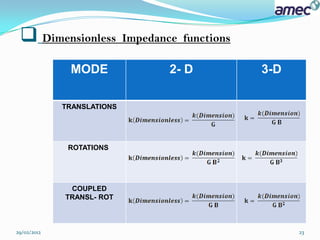
      The relations between the values with and without dimensions are given in the
       following table :

29/02/2012                                                                                 22
 Dimensionless            Impedance functions

              MODE                  2- D          3-D

             TRANSLATIONS


              ROTATIONS


              COUPLED
             TRANSL- ROT


29/02/2012                                              23
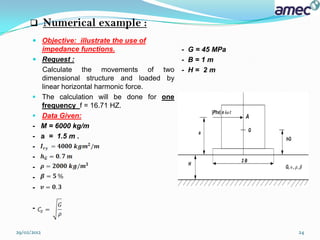
       Numerical example :
       Objective: illustrate the use of
        impedance functions.                     - G = 45 MPa
       Request :                                - B=1m
          Calculate the movements of two         - H= 2m
          dimensional structure and loaded by
          linear horizontal harmonic force.
         The calculation will be done for one
                                                 -
          frequency f = 16.71 HZ.
         Data Given:
      -   M = 6000 kg/m
      -   a = 1.5 m .
      -
      -
      -
      -
      -

      -


29/02/2012                                                      24
Step One :
      Dimensionless Circular frequency is given by the following equation:


                 = (2*PI*16.71*1)/[SQR(45000/2)] = 0.7

      Comments:
             - In 2D structures only three DOF are considered:
               1- Vertical displacement along Z-axis.
               2- Horizontal displacement along X- axis.
               3- Rotation around horizontal Y- axis.
      For our example, we do not have vertical Oscillation of the center of gravity,
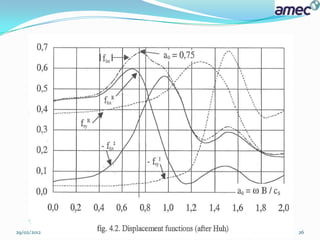
       therefore the following Displacement functions developed by HUH (1986) [ for strip
       foundation without embedment resting on horizontal layer,             ,           ,
       H/B=2 ] will not include the vertical displacement functions.
      For foundations that are not embedded, the rotation around Y-axis and the
       translation along X-axis are uncoupled. In General Cases these two modes are
       always coupled.

29/02/2012                                                                              25
29/02/2012   26
Step Two :
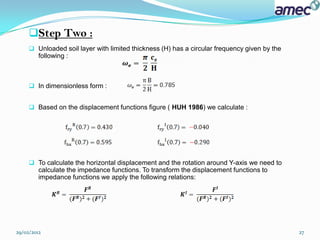
      Unloaded soil layer with limited thickness (H) has a circular frequency given by the
         following :


      In dimensionless form :


      Based on the displacement functions figure ( HUH 1986) we calculate :


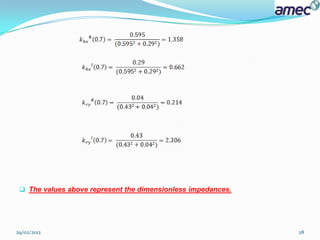
      To calculate the horizontal displacement and the rotation around Y-axis we need to
         calculate the impedance functions. To transform the displacement functions to
         impedance functions we apply the following relations:


29/02/2012                                                                                    27
 The values above represent the dimensionless impedances.


29/02/2012                                                    28
Step Three :
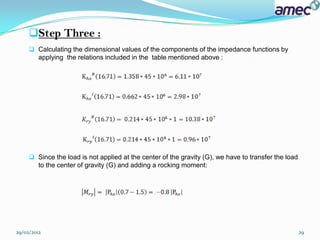
      Calculating the dimensional values of the components of the impedance functions by
         applying the relations included in the table mentioned above :


      Since the load is not applied at the center of the gravity (G), we have to transfer the load
         to the center of gravity (G) and adding a rocking moment:


29/02/2012                                                                                            29
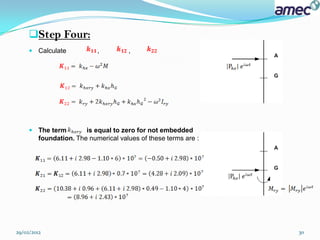
Step Four:
      Calculate            ,         ,


      The term         is equal to zero for not embedded
         foundation. The numerical values of these terms are :


29/02/2012                                                       30
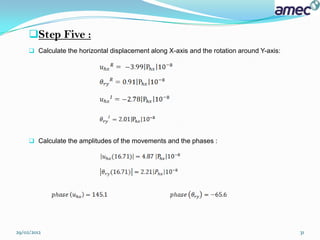
Step Five :
      Calculate the horizontal displacement along X-axis and the rotation around Y-axis:


      Calculate the amplitudes of the movements and the phases :


29/02/2012                                                                                  31
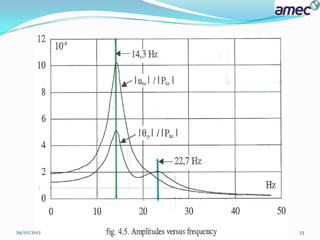
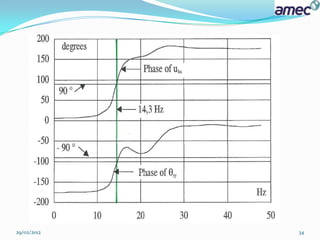
 The complete curves are given on the following figures. From these curves we find
       that the maximum amplitudes of the displacement and the rotation are obtained for
       14.3 HZ [ first mode ].
      the natural (Eigen) frequency of the soil layer without footing which is 18.7 HZ :

         The dynamic effect of the soil structure interaction is clear.
      From the second figure we see that the phases are close to (+/-)90 degrees at the
       first maximum of the amplitude.


29/02/2012                                                                                  32
29/02/2012   33
29/02/2012   34
 Questions & Answers


29/02/2012              35

Soil structure interaction amec presentation-final

  • 1.
    SOIL-STRUCTURE INTERACTION AND FOUNDATION VIBRATIONS BY : AHMAD HALLAK, M.Sc, P.Eng 29/02/2012 1
  • 2.
    AGENDA  12:00– 12:05 Safety Moment  12:05 – 12:50 Presentation  12:50 – 1:00 Questions and Answers 29/02/2012 2
  • 3.
    SOIL STRUCTURE INTERACTION(SSI): Definition: The process in which the response of the soil influences the motion of the structure and the motion of the structure influences the response of the soil is termed as SSI. In this case neither the structural displacements nor the ground displacements are independent from each other.  Traditional Structural Engineering methods disregard SSI effects, which is acceptable only for Light structures on relatively stiff soil (low rise structures and simple rigid retaining walls).  SSI effects become prominent and must be regarded for structures where P-δ effects play a significant role,structures with massive or deep seated foundations,slender tall structures and structures supported on a very soft soils with average shear velocity less than 100 m/s.[Euro Code 8].  Modern Seismic Design Codes such as Standard Specifications for Concrete Structures: Seismic Performance Verification JSCE 2005 (Japan Society of Civil Engineers) highlight that the response analysis should take into account the whole structural system ( superstructure + foundation + soil ). 29/02/2012 3
  • 4.
    SSI Effects  Alter the Natural Frequency of the Structure :  Considering soil-structure interaction makes a structure more flexible and thus increases the natural period of the structure as compared to the corresponding rigidly supported structure.  Add Damping :  Considering the SSI effect increases the effective damping ratio of the system ( Superstructure + Foundation + Soil ).  Based on these assumptions, SSI reduces the dynamic response of the structure and improves the safety margins.  With this assumption, it has traditionally been considered that SSI can conveniently be neglected for conservative design. In addition, neglecting SSI tremendously reduces the complication in the analysis of the structures.  This conservative simplification is valid for certain classes of structures and soil conditions, such as light structures in relatively stiff soil.  However SSI can have a detrimental effect on the structural response, and neglecting SSI in the analysis may lead to unsafe design for both the superstructure and the foundation . 29/02/2012 4
  • 5.
    Detrimental effects ofSSI Mylonakis,G and Gazetas,G. (2000a):  An Increase in the natural period of a structure due to SSI is not always beneficial as suggested by the simplified design spectrums. Example :  Soft Soil Sediments can significantly elongate the period of seismic waves. The increase in the natural period of a structure (due to SSI) may lead to resonance with this long period ground vibration.  The ductility demand can increase significantly with the increase in the natural period of the structure due to SSI effect. The permanent deformation and failure of soil may further aggravate the seismic response of the structure. 29/02/2012 5
  • 6.
     SSI –Problem Definition  Soil-structure interaction can be broadly divided into two phenomena: A. Kinematic interaction. B. Inertial interaction. Examples: - An Embedded Foundation into soil does not follow the free field motion ( Earthquake ground motion causes soil displacement known as free-filed motion), this instability of the foundation to match the free field motion causes the kinematic interaction. - The mass of the super-structure transmits the inertial force to the soil causing further deformation in the soil, which is termed as inertial interaction .  At low level of ground shaking, kinematic effect is more dominant causing the lengthening of period and increase in radiation damping(dissipation of energy behaves like a damper for the structure even if the soil is considered as elastic medium without material damping) .  With the onset of stronger shaking, near-field soil modulus degradation and soil- pile gapping limit radiation damping, and inertial interaction becomes predominant, causing excessive displacements and bending strains concentrated near the ground surface, resulting in pile damage near the ground level . 29/02/2012 6
  • 7.
    SSI – ProblemDefinition Machine Foundation Seismic Excitation Inertial Interaction Kinematic Interaction Inertial forces in structure are Stiffer foundation can not conform to transmitted to flexible soil the distortions of soil 29/02/2012 7
  • 8.
    FOUNDATIONS VIBRATIONS  OBJECTIVE :  Calculation of the vibrations of the massive foundations of heavy machines i.e. evaluate the movements of the foundation under the action of external loads.  consequently anticipate the displacements of the machine taking into account the characteristics of the foundation and the properties of the soil.  the analyses of dynamic soil-structure interaction have also been long used for seismic calculations. Whereas in the first case the machine (or the rail or road traffic) is the source of the vibrations, in the second case the soil is the source . 29/02/2012 8
  • 9.
     GENERAL DESCRIPTIONOF IMPEDANCE FUNCTIONS  Impedance functions (Dynamic Stiffness): The Dynamic Stiffness K is : K u(t) = P(t) P(t) : Harmonic external force (or moment). u(t) : Harmonic response (rotation, displacement)  P(t) and u(t) are not in phase therefore K is a Complex expression.  K is the dynamic Stiffness (Impedance) consists of the two Impedances: the Super-Structure , Foundation and the Soil : K1 =Superstructures, Foundation. K2 = Soil (Subgrade).  The major difference between both is that the superstructure has finite dimensions ( Mass can be calculated ),the sub-grade extends to infinity and the impedance of the sub-grade is defined for the interface between the structure and the soil (Mass-less structure-foundation interface) . 29/02/2012 9
  • 10.
     SDOF withmass(Sup-structure & Foundation ):  M ü +C ù +K u = P(t)  K1 = KR + iKI = [(K –Mω2)] +iC ω  KSTR = - Mω2  KFDN = K +iC ω. 29/02/2012 10
  • 11.
  • 12.
     Mass-less SDOFsystem (SOIL):  K2 = K+ iC ω .  KR = K .  KI = C ω.  It is important to note that Impedance functions for the soil are always derived from the massless foundation model.  K2 : can be obtained by setting M=0 in K1.  The impedance function of the soil is equal to Foundation impedance component for SDOF system with mass [ KFDN ]. 29/02/2012 12
  • 13.
  • 14.
  • 15.
     Compliance Function(DynamicFlexibility):  Dynamic Flexibility is also called Transfer Function because it transfers the inputs (loads) to the output (Displacements).  U = F * P(t)  F = K-1  F (ω) = F R + iF I  FR=  FI= 29/02/2012 15
  • 16.
    IMPORTANT DEFINITIONS Natural (Eigen) Frequency( ): only for un-damped systems.  Natural (Eigen) Frequency( ): only for damped systems.  Circular Frequency of loading (The excitation Frequency):  Frequency ratio η =  Only for systems with Mass.  =  Critical Damping:  Damping Ratio: Not Possible for Massless system. 29/02/2012 16
  • 17.
     Vibrations ofthe mass foundations of heavy machines  The footing must have two planes of symmetry which are vertical and orthogonal.  The coordinate system x, y, z coincides with these planes.  DOF are:  Vertical displacement along z axis (index “v”).  Two horizontal displacements (Sliding) along x axis and along the y axis ( hx and hy ) respectively.  Rotation (Torsion) around the vertical z-axis (index “ t ”).  Two rotations (rocking) around the horizontal x axis and y axis (index “rx” and “ry” ) respectively. 29/02/2012 17
  • 18.
    In the caseof footings presenting two vertical planes of symmetry the vertical displacements and torsion movements are uncoupled, whereas the horizontal displacements along x (respectively -y) and the rocking movements about y-axis (respectively-x) are coupled.  General Notations for 3-D Footing:  Mass of Foundation (M).  Moment of inertia and  , Applied Forces at C.O.G in directions (x),(z).  , Applied moments at C.O.G in directions (y),(z).  , Displacements of C.O.G along (x) and (z) axes.  , Rotations about (y) and (z) axes.  , The reactions of displacements at the soil -footing interface in directions (x), (z). 29/02/2012 18
  • 19.
     The reactionsof rotations at the soil – footing interface around the (y),(z) axes and  Equations of the movements of footing (at C.O.G of the foundation).  Two more equations concerning the horizontal displacement along Y and the rocking about X are obtained by permuting of indexes X and Y in third and fourth equations. 29/02/2012 19
  • 20.
     General Solutions  Assume that the external loads are harmonic loads : could be force or a moment which can be complex.  The displacement is harmonic and given by the following:  : Could be rotation or displacement and is generally complex. Calculate the vertical displacement: By solving the equation : After substituting 29/02/2012 20
  • 21.
    Calculate the Torsion(Rotation around Z axis): Calculate the Horizontal displacement and rotation about y -axis: Calculate the amplitudes of the movements and the phases: 29/02/2012 21
  • 22.
    Applying Complete impedancefunctions  Impedance functions in dimensionless forms : Or :  Dimensionless circular frequency defined by :  B : is the half of the width for a rectangular footing or the radius for circular footing.  : Shear wave velocity in the Soil.  The relations between the values with and without dimensions are given in the following table : 29/02/2012 22
  • 23.
     Dimensionless Impedance functions MODE 2- D 3-D TRANSLATIONS ROTATIONS COUPLED TRANSL- ROT 29/02/2012 23
  • 24.
    Numerical example :  Objective: illustrate the use of impedance functions. - G = 45 MPa  Request : - B=1m Calculate the movements of two - H= 2m dimensional structure and loaded by linear horizontal harmonic force.  The calculation will be done for one - frequency f = 16.71 HZ.  Data Given: - M = 6000 kg/m - a = 1.5 m . - - - - - - 29/02/2012 24
  • 25.
    Step One :  Dimensionless Circular frequency is given by the following equation: = (2*PI*16.71*1)/[SQR(45000/2)] = 0.7  Comments: - In 2D structures only three DOF are considered: 1- Vertical displacement along Z-axis. 2- Horizontal displacement along X- axis. 3- Rotation around horizontal Y- axis.  For our example, we do not have vertical Oscillation of the center of gravity, therefore the following Displacement functions developed by HUH (1986) [ for strip foundation without embedment resting on horizontal layer, , , H/B=2 ] will not include the vertical displacement functions.  For foundations that are not embedded, the rotation around Y-axis and the translation along X-axis are uncoupled. In General Cases these two modes are always coupled. 29/02/2012 25
  • 26.
  • 27.
    Step Two :  Unloaded soil layer with limited thickness (H) has a circular frequency given by the following :  In dimensionless form :  Based on the displacement functions figure ( HUH 1986) we calculate :  To calculate the horizontal displacement and the rotation around Y-axis we need to calculate the impedance functions. To transform the displacement functions to impedance functions we apply the following relations: 29/02/2012 27
  • 28.
     The valuesabove represent the dimensionless impedances. 29/02/2012 28
  • 29.
    Step Three :  Calculating the dimensional values of the components of the impedance functions by applying the relations included in the table mentioned above :  Since the load is not applied at the center of the gravity (G), we have to transfer the load to the center of gravity (G) and adding a rocking moment: 29/02/2012 29
  • 30.
    Step Four:  Calculate , ,  The term is equal to zero for not embedded foundation. The numerical values of these terms are : 29/02/2012 30
  • 31.
    Step Five :  Calculate the horizontal displacement along X-axis and the rotation around Y-axis:  Calculate the amplitudes of the movements and the phases : 29/02/2012 31
  • 32.
     The completecurves are given on the following figures. From these curves we find that the maximum amplitudes of the displacement and the rotation are obtained for 14.3 HZ [ first mode ].  the natural (Eigen) frequency of the soil layer without footing which is 18.7 HZ : The dynamic effect of the soil structure interaction is clear.  From the second figure we see that the phases are close to (+/-)90 degrees at the first maximum of the amplitude. 29/02/2012 32
  • 33.
  • 34.
  • 35.
     Questions &Answers 29/02/2012 35