OO R T FP LIO
in
EDUCATIONAL
TECHNOLOGY II
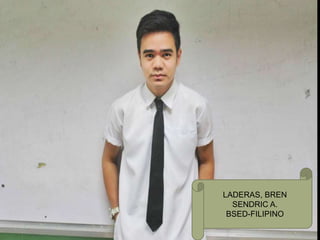
LADERAS, BREN
SENDRIC A.
BSED-FILIPINO
EDUCATIONAL TECHNOLOGY II
The computer and its multi
or hypermedia capabilities
must still be used not simply
for direct instruction, but for
integration into the curricula
and its various courses or
subjects. Integration is the
present challenge.
At the end, we look
forward to further enrichment
of the lessons which can be
done by the Educational
Technology 2 teachers
themselves. This serves as a
basic manual, and the teacher
becomes final fashioner of
learning in this course as well
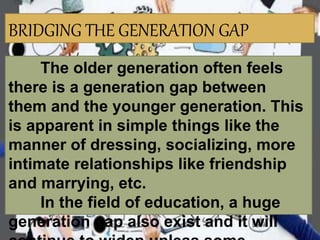
BRIDGING THE GENERATION GAP
The older generation often feels
there is a generation gap between
them and the younger generation. This
is apparent in simple things like the
manner of dressing, socializing, more
intimate relationships like friendship
and marrying, etc.
In the field of education, a huge
generation gap also exist and it will
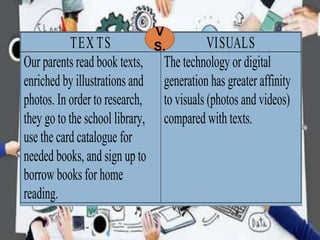
TEX TS VISUALS
Our parents read book texts,
enriched by illustrations and
photos. In order to research,
they go to the school library,
use the card catalogue for
needed books, and sign up to
borrow books for home
reading.
The technology or digital
generation has greater affinity
to visuals (photos and videos)
compared with texts.
V
S.
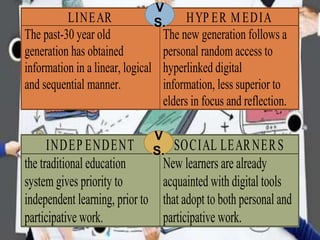
LINEAR HYP ER M EDIA
The past-30 year old
generation has obtained
information in a linear, logical
and sequential manner.
The new generation follows a
personal random access to
hyperlinked digital
information, less superior to
elders in focus and reflection.
INDEP ENDENT SOCIAL LEARNERS
the traditional education
system gives priority to
independent learning, prior to
participative work.
New learners are already
acquainted with digital tools
that adopt to both personal and
participative work.
V
S.
V
S.
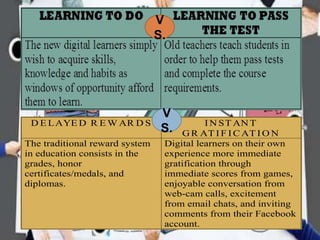
D E LAYE D R E W AR D S I N ST AN T
GR AT I F I C AT I O N
The traditional reward system
in education consists in the
grades, honor
certificates/medals, and
diplomas.
Digital learners on their own
experience more immediate
gratification through
immediate scores from games,
enjoyable conversation from
web-cam calls, excitement
from email chats, and inviting
comments from their Facebook
account.
V
S.
V
S.
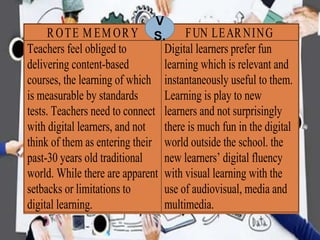
ROTE M EM ORY FUN LEARNING
Teachers feel obliged to
delivering content-based
courses, the learning of which
is measurable by standards
tests. Teachers need to connect
with digital learners, and not
think of them as entering their
past-30 years old traditional
world. While there are apparent
setbacks or limitations to
digital learning.
Digital learners prefer fun
learning which is relevant and
instantaneously useful to them.
Learning is play to new
learners and not surprisingly
there is much fun in the digital
world outside the school. the
new learners’ digital fluency
with visual learning with the
use of audiovisual, media and
multimedia.
V
S.
THE SIX
DIGITAL
FLUEN
CIES
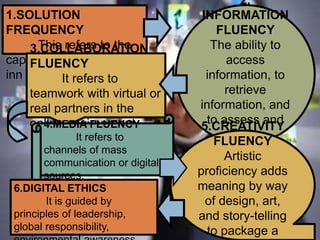
1.SOLUTION
FREQUENCY
This refers to the
capacity and creativity
inn problem solving.
2.
INFORMATION
FLUENCY
The ability to
access
information, to
retrieve
information, and
to assess and
rewrite
information.
3.COLLABORATION
FLUENCY
It refers to
teamwork with virtual or
real partners in the
online environment.4.MEDIA FLUENCY
It refers to
channels of mass
communication or digital
sources.
5.CREATIVITY
FLUENCY
Artistic
proficiency adds
meaning by way
of design, art,
and story-telling
to package a
6.DIGITAL ETHICS
It is guided by
principles of leadership,
global responsibility,
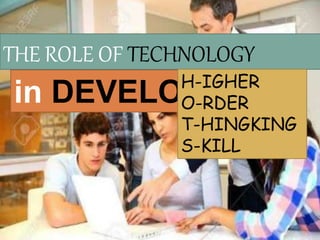
THE ROLE OF TECHNOLOGY
in DEVELOPINGH-IGHER
O-RDER
T-HINGKING
S-KILL
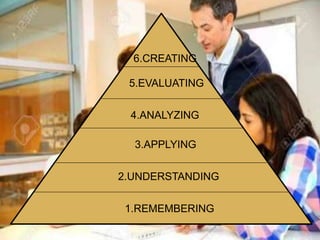
1.REMEMBERING
2.UNDERSTANDING
3.APPLYING
4.ANALYZING
5.EVALUATING
6.CREATING
By developing higher order
thinking skills, the schools today
can inculcate the digital
fluencies, while overcoming
limitations inherent in digital
technology, resulting in
superficial and mediocre
learning skills of new learners.
In the instructional process,
there is also an instructional
COMPUTER AS
INFORMATION
AND COMMUNICATION
TECHNOLOGY
Through computer
technology, educators saw the
amplification of learning along
computer literacy. Much like
reading, the modern students
can now interact with computer
messages, even respond
questions or to computer
THE
C OM P U T E R
As The
TEACHER’S
In this Lesson, we shall
again look at the computer,
but this time from another
perspective the computer
as the teacher’s handy-tool.
It can in fact support the
CONSTRUCTIVISM and
SOCIAL
CONSTRUCTIVI
SM- was introduced by
Piaget (1981) and Bruner
(1990). They gave stress
to KNOWLEDGE
DISCOVERY of new
meaning/concepts/princi
ples in the learning
process.
SOCIAL
CONSTRUCTIVISMVygotsky stressed
that learning is
affected by social
influences. He
therefore, suggested,
the interactive
process in learning.
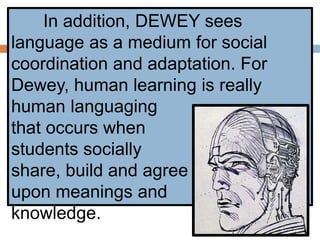
In addition, DEWEY sees
language as a medium for social
coordination and adaptation. For
Dewey, human learning is really
human languaging
that occurs when
students socially
share, build and agree
upon meanings and
knowledge.
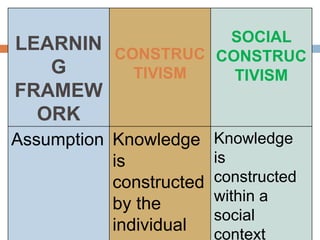
LEARNIN
G
FRAMEW
ORK
CONSTRUC
TIVISM
SOCIAL
CONSTRUC
TIVISM
Assumption Knowledge
is
constructed
by the
individual
Knowledge
is
constructed
within a
social
context
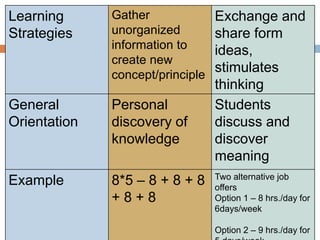
Learning
Strategies
Gather
unorganized
information to
create new
concept/principle
Exchange and
share form
ideas,
stimulates
thinking
General
Orientation
Personal
discovery of
knowledge
Students
discuss and
discover
meaning
Example 8*5 – 8 + 8 + 8
+ 8 + 8
Two alternative job
offers
Option 1 – 8 hrs./day for
6days/week
Option 2 – 9 hrs./day for
INFORMATION
TECHNOLOGY
In Support of
STUDENT-CENTERED
LEARNING
The idea of student-centered learning is
not a recent idea. In fact, as early as the
20th century, educational educators such
as John Dewey argued for a highly
active and individualized pedagogical
methods which place the student at the
center of the teaching-learning process.
THE TRADITIONAL
CLASSROOM
The Traditional Classroom
situation is necessitated by
the need to maintain
classroom discipline and also
to allow the teacher to control
classroom activities through
John Dewey has described
traditional learning as process
in which the teacher pours
information to student
learners, much like pouring
water from a jug into cups.
This is based on the long
accepted belief that the
teacher must perform his/her
THE SCL CLASSROOM
Desiring to gain
effectiveness, efficiency
and economy in
administration and
instruction, schools in
this developed economies
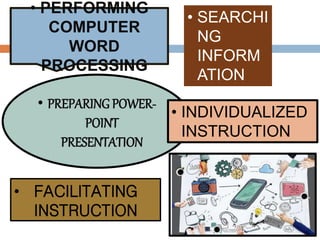
• PERFORMING
COMPUTER
WORD
PROCESSING
• PREPARING POWER-
POINT
PRESENTATION
• SEARCHI
NG
INFORM
ATION
ON THE
INTERNE
T
• FACILITATING
INSTRUCTION
• INDIVIDUALIZED
INSTRUCTION
• ACTIVE not PASSIVE LEARNERS
• INTERACT WITH OTHER
LEARNERS
• INTERACT WITH
OTHER LEARNERS
• DEMONSTRA
TING
INDEPENENC
E
• SELF-
AWARENE
SS IN THE
LEARNING
PROCESS
WHAT I LEARNED IN
EDUCATIONAL TECHNOLOGY II
As a future teacher,
Educational Technology helps
me to become more effective
and efficient for my future
students.
I’ve learned how to
prepare my lesson not just
using the traditional way like
using manila paper as visual
aids but rather using
technology such as power
points.

Bren sendric-a.-laderas

  • 1.
    OO R TFP LIO in EDUCATIONAL TECHNOLOGY II
  • 2.
  • 3.
    EDUCATIONAL TECHNOLOGY II Thecomputer and its multi or hypermedia capabilities must still be used not simply for direct instruction, but for integration into the curricula and its various courses or subjects. Integration is the present challenge.
  • 4.
    At the end,we look forward to further enrichment of the lessons which can be done by the Educational Technology 2 teachers themselves. This serves as a basic manual, and the teacher becomes final fashioner of learning in this course as well
  • 5.
    BRIDGING THE GENERATIONGAP The older generation often feels there is a generation gap between them and the younger generation. This is apparent in simple things like the manner of dressing, socializing, more intimate relationships like friendship and marrying, etc. In the field of education, a huge generation gap also exist and it will
  • 6.
    TEX TS VISUALS Ourparents read book texts, enriched by illustrations and photos. In order to research, they go to the school library, use the card catalogue for needed books, and sign up to borrow books for home reading. The technology or digital generation has greater affinity to visuals (photos and videos) compared with texts. V S.
  • 7.
    LINEAR HYP ERM EDIA The past-30 year old generation has obtained information in a linear, logical and sequential manner. The new generation follows a personal random access to hyperlinked digital information, less superior to elders in focus and reflection. INDEP ENDENT SOCIAL LEARNERS the traditional education system gives priority to independent learning, prior to participative work. New learners are already acquainted with digital tools that adopt to both personal and participative work. V S. V S.
  • 8.
    D E LAYED R E W AR D S I N ST AN T GR AT I F I C AT I O N The traditional reward system in education consists in the grades, honor certificates/medals, and diplomas. Digital learners on their own experience more immediate gratification through immediate scores from games, enjoyable conversation from web-cam calls, excitement from email chats, and inviting comments from their Facebook account. V S. V S.
  • 9.
    ROTE M EMORY FUN LEARNING Teachers feel obliged to delivering content-based courses, the learning of which is measurable by standards tests. Teachers need to connect with digital learners, and not think of them as entering their past-30 years old traditional world. While there are apparent setbacks or limitations to digital learning. Digital learners prefer fun learning which is relevant and instantaneously useful to them. Learning is play to new learners and not surprisingly there is much fun in the digital world outside the school. the new learners’ digital fluency with visual learning with the use of audiovisual, media and multimedia. V S.
  • 10.
  • 11.
    1.SOLUTION FREQUENCY This refers tothe capacity and creativity inn problem solving. 2. INFORMATION FLUENCY The ability to access information, to retrieve information, and to assess and rewrite information. 3.COLLABORATION FLUENCY It refers to teamwork with virtual or real partners in the online environment.4.MEDIA FLUENCY It refers to channels of mass communication or digital sources. 5.CREATIVITY FLUENCY Artistic proficiency adds meaning by way of design, art, and story-telling to package a 6.DIGITAL ETHICS It is guided by principles of leadership, global responsibility,
  • 12.
    THE ROLE OFTECHNOLOGY in DEVELOPINGH-IGHER O-RDER T-HINGKING S-KILL
  • 13.
  • 14.
    By developing higherorder thinking skills, the schools today can inculcate the digital fluencies, while overcoming limitations inherent in digital technology, resulting in superficial and mediocre learning skills of new learners. In the instructional process, there is also an instructional
  • 15.
  • 16.
    Through computer technology, educatorssaw the amplification of learning along computer literacy. Much like reading, the modern students can now interact with computer messages, even respond questions or to computer
  • 17.
    THE C OM PU T E R As The TEACHER’S
  • 19.
    In this Lesson,we shall again look at the computer, but this time from another perspective the computer as the teacher’s handy-tool. It can in fact support the CONSTRUCTIVISM and SOCIAL
  • 20.
    CONSTRUCTIVI SM- was introducedby Piaget (1981) and Bruner (1990). They gave stress to KNOWLEDGE DISCOVERY of new meaning/concepts/princi ples in the learning process.
  • 21.
    SOCIAL CONSTRUCTIVISMVygotsky stressed that learningis affected by social influences. He therefore, suggested, the interactive process in learning.
  • 22.
    In addition, DEWEYsees language as a medium for social coordination and adaptation. For Dewey, human learning is really human languaging that occurs when students socially share, build and agree upon meanings and knowledge.
  • 23.
  • 24.
    Learning Strategies Gather unorganized information to create new concept/principle Exchangeand share form ideas, stimulates thinking General Orientation Personal discovery of knowledge Students discuss and discover meaning Example 8*5 – 8 + 8 + 8 + 8 + 8 Two alternative job offers Option 1 – 8 hrs./day for 6days/week Option 2 – 9 hrs./day for
  • 25.
  • 27.
    The idea ofstudent-centered learning is not a recent idea. In fact, as early as the 20th century, educational educators such as John Dewey argued for a highly active and individualized pedagogical methods which place the student at the center of the teaching-learning process.
  • 28.
    THE TRADITIONAL CLASSROOM The TraditionalClassroom situation is necessitated by the need to maintain classroom discipline and also to allow the teacher to control classroom activities through
  • 29.
    John Dewey hasdescribed traditional learning as process in which the teacher pours information to student learners, much like pouring water from a jug into cups. This is based on the long accepted belief that the teacher must perform his/her
  • 30.
    THE SCL CLASSROOM Desiringto gain effectiveness, efficiency and economy in administration and instruction, schools in this developed economies
  • 31.
    • PERFORMING COMPUTER WORD PROCESSING • PREPARINGPOWER- POINT PRESENTATION • SEARCHI NG INFORM ATION ON THE INTERNE T • FACILITATING INSTRUCTION • INDIVIDUALIZED INSTRUCTION
  • 32.
    • ACTIVE notPASSIVE LEARNERS • INTERACT WITH OTHER LEARNERS • INTERACT WITH OTHER LEARNERS • DEMONSTRA TING INDEPENENC E • SELF- AWARENE SS IN THE LEARNING PROCESS
  • 33.
    WHAT I LEARNEDIN EDUCATIONAL TECHNOLOGY II As a future teacher, Educational Technology helps me to become more effective and efficient for my future students.
  • 34.
    I’ve learned howto prepare my lesson not just using the traditional way like using manila paper as visual aids but rather using technology such as power points.