MY PORTFOLIO IN
EDUCATIONAL
TECHNOLOGY
Educational Technology in a Nut Shell
THE STUDENT
I am Mary Clare C. Crespo,
a third year student taking
up Bachelor of Elementary
Education at Palawan State
University-Brooke’s Point.
What is Educational Technology?
Educational Technology 1 is about presenting
new technology to the learners, Educational
Technology 2 is more on the application of the
different modern educational media presented
from the previous subject. This is wherein
learners can be more aware, appreciate more, and
be fully equipped to use different technology
tools ranging from traditional to modern
educational media.
Technology- Boon or Bane?
In our generation for today, technology is
important in everyday life. Because technology
gives more benefits for us this is attempt to solve
the problem of survival, capturing enough energy
and converting it into human needs and also to
make life easier. That are some benefits of
technology.
BOON
Educators used it for:
 Assignments
 Activities
 We used it to communicate
BOON
The disadvantages of technology is we will
become a lazy person and we will become
dependent.
For example…
BANE
We have a library we have a lot of books, but
most of the students they do not the books for
research they research in the internet.
BANE
Systematic Approach In Teaching
It is a network of elements or parts different
from each other but each one is special in the
sense that each performs a unique function for
the life and effectiveness of the instructional
system.
DEFINITION
The system approach views the entire educational
program as a system of closely interrelated parts. It
is an orchestrated learning pattern with all parts
harmoniously integrated into the whole: the school,
the teacher, the students, the objectives, the media,
the materials, and assessment tools and procedures.
Such an approach integrates the older, more familiar
methods and tools of instruction with the new ones
such as the computer
DEFINITION
Roles of Technology In Learning
 Delivery vehicles for instructional lessons
TRADITIONAL ROLE OF
TECHNOLOGY
 Technology serves as a teacher
TRADITIONAL WAY
 Partners in the learning process
CONSTRUCTIVIST ROLE
 Technology is a learning tool to learn with, not
from.
CONSTRUCTIVIST WAY
From a constructivist perspective, the following
are the roles of technology in learning: Jonassen,
et at 1990
Technology as tools to support knowledge
construction:
 For representing learners’ ideas,
understandings and beliefs
 For producing organized, multimedia
knowledge bases by learners
Technology as information vehicles for
exploring knowledge to support learning-
by-constructing:
 For accessing needed information
 For comparing perspectives, beliefs and
world views.
Technology as context to support learning-
by-doing:
 For representing and stimulating
meaningful real-world problems,
situations and context
 For representing beliefs, perspectives,
arguments and stories of others
Technology as context to support learning-
by-doing:
 For defining a safe, controllable problem
space for student thinking
Technology as a social medium to support
learning by conversing:
 For collaborating with others
 For discussing, arguing, and building
consensus among members of a
communities.
Technology as a social medium to support
learning by conversing:
 For supporting discourse among
knowledge-building communities
Technology as intellectual partner (Jonassen
1996) to support learning-by-reflecting:
 For helping others to articulate and
represent what they know
 For reflecting on what they have learned
and how they came to know it
Technology as intellectual partner (Jonassen
1996) to support learning-by-reflecting:
 For supporting learners internal
negotiations and meaning making
 For constructing personal
representations of meaning for
supporting mindful thinking
Roles of Technology in Education
Learning with technology has become essential in
today’s schools. Worldwide, governments,
education systems, researchers, school leaders,
teachers and parents consider technology to be a
critical part of a child’s education.
The important role that technology plays in
education gives teachers the opportunity to
design meaningful learning experiences that
embed technology.
The “Cone of Experience”
What is Dale’s cone of experience?
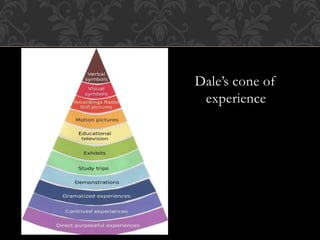
The cone of experience is a pictorial device use
to explain the interrelationships of the various
types of audio-visual media, as well as their
individual “positions” in the learning process.
What is Dale’s cone of experience?
The cone’s utility in selecting instructional
resources and activities is as practical today as
when Dale created it.
Dale’s cone of
experience
Principles on the cone of experience:
 The cone is based on the relationships of
various educational experiences to reality (real
life), and the bottom level of the cone, “direct
purposeful experiences,” represents reality or
the closest things to real, everyday life.
Principles on the cone of experience:
 The opportunity for a learner to use a variety
or several senses (sight, smell, hearing,
touching, movements) is considered in the
cone.
 Direct experience allows us to use all senses.
 Verbal symbols involve only hearing.
Principles on the cone of experience:
 The more sensory channels possible in
interacting with a resource, the better the
chance that many students can learn from it.
 Each level of the cone above its base moves a
learner a step further away from real-life
experiences, so experiences focusing only on
the use of verbal symbols are the furthest
removed from real life.
Principles on the cone of experience:
 Motion pictures (also television) is where it is
on the cone because it is an observational
experience with little or no opportunity to
participate or use senses other seeing and
hearing.
 Contrived experiences are ones that are highly
participatory and stimulate real life situations
or activities.
Principles on the cone of experience:
 Dramatized experiences are defined as
experiences in which the learner acts out a role
or activity.
Verbal Symbols
 Principal medium of communication
 Bear no physical resemblance to the objects or
ideas for which they stand
 May be a word for concretion, idea, scientific
principle, formula or philosophic aphorism
 Disadvantage: highly abstract
Visual Symbols
 Chalkboard/whiteboard, flat maps, diagrams,
charts
 Fits the tempo of presentation of idea, topic
or situation
 Very easy to procure and prepare
 Limitations: lack of ability to use the media
size of visuals simplification of visual
materials leads to misconceptions.
Conceptual Models of Learning
There are a lot of number of models and
theories about learning that is ideal in achieving
instructional goals through preferred application
of EdTech.
These are:
Meaningful Learning
Discovery Learning
Generative Learning
Constructive Learning
If the traditional learning environment gives
stress to rote learning and simple memorization,
meaningful learning gives focus to new
experience that departs from the learning of a
sequence of words but gives attention to
meaning.
MEANINGFUL LEARNING
It assumes that:
 Students already have prior knowledge that is
relevant to new learning.
 Students are willing to perform class work to
find connection between what they already
know and what they can learn.
MEANINGFUL LEARNING
In discovery learning, students perform tasks to
uncover what is to be learned. New ideas and
new decisions are generated in the learning
process, regardless of the need to move on and
depart from the structured lesson previously set.
It is important that the students become
personally engaged and not subjected by the
teacher.
DISCOVERY LEARNING
Here, we have active listeners who attend to learning
events and generate meaning from this experience
and draw inferences thereby creating personal model
of explanation to the new experience in the context
of existing knowledge.
This is viewed as different from the simple process
of storing information. Motivation and responsibility
are crucial to this domain of learning.
GENERATIVE LEARNING
It gives emphasis to what can be done with the
pieces of information not only on access to
them.
GENERATIVE LEARNING
The learner builds a personal understanding through
appropriate learning activities and a good learning
environment. The most accepted constructivism
principles are:
 Learning consist in what a person can actively
assemble for himself and not what he can just ask
from someone else.
 Role of learning is to help the individual live to
his personal world.
CONSTRUCTIVISM
Implications of Constructivism
 The learner is directly responsible for learning.
He creates personal understanding and
transforms it into knowledge.
 The context of meaningful learning consists in
the learner “connecting” his school with real
life.
CONSTRUCTIVISM
Implications of Constructivism
 The purpose of education is the acquiring of
practical and personal knowledge and not the
abstract or trivial truths.
CONSTRUCTIVISM
Learning Through Ed Tech 2
As future teacher Ed Tech 2 is a great help
especially in our world today. We must be willing
to adapt and adjust in our teaching strategy and
we must be willing to learn these new
technologies.
Most of the classrooms today, teachers are using
computers, laptops, projectors in teaching. And
that is why we need to be computer-literate or
computer expert.
LEARNING THROUGH ED TECH 2
The Student After Ed Tech 2
I definitely learn a lot and also enjoy the
Educational Technology 2. I am thankful that we
have this kind of subject that helps and prepares
the future teachers. Truly integrating technology
into teaching and learning is a great help both to
the teachers and students but technology should
never replace the teacher.
THE STUDENT AFTER ED TECH 2

My Portfolio Ed Tech 2

  • 1.
  • 2.
  • 3.
    THE STUDENT I amMary Clare C. Crespo, a third year student taking up Bachelor of Elementary Education at Palawan State University-Brooke’s Point.
  • 4.
  • 5.
    Educational Technology 1is about presenting new technology to the learners, Educational Technology 2 is more on the application of the different modern educational media presented from the previous subject. This is wherein learners can be more aware, appreciate more, and be fully equipped to use different technology tools ranging from traditional to modern educational media.
  • 6.
  • 7.
    In our generationfor today, technology is important in everyday life. Because technology gives more benefits for us this is attempt to solve the problem of survival, capturing enough energy and converting it into human needs and also to make life easier. That are some benefits of technology. BOON
  • 8.
    Educators used itfor:  Assignments  Activities  We used it to communicate BOON
  • 9.
    The disadvantages oftechnology is we will become a lazy person and we will become dependent. For example… BANE
  • 10.
    We have alibrary we have a lot of books, but most of the students they do not the books for research they research in the internet. BANE
  • 11.
  • 12.
    It is anetwork of elements or parts different from each other but each one is special in the sense that each performs a unique function for the life and effectiveness of the instructional system. DEFINITION
  • 13.
    The system approachviews the entire educational program as a system of closely interrelated parts. It is an orchestrated learning pattern with all parts harmoniously integrated into the whole: the school, the teacher, the students, the objectives, the media, the materials, and assessment tools and procedures. Such an approach integrates the older, more familiar methods and tools of instruction with the new ones such as the computer DEFINITION
  • 14.
  • 15.
     Delivery vehiclesfor instructional lessons TRADITIONAL ROLE OF TECHNOLOGY
  • 16.
     Technology servesas a teacher TRADITIONAL WAY
  • 17.
     Partners inthe learning process CONSTRUCTIVIST ROLE
  • 18.
     Technology isa learning tool to learn with, not from. CONSTRUCTIVIST WAY
  • 19.
    From a constructivistperspective, the following are the roles of technology in learning: Jonassen, et at 1990
  • 20.
    Technology as toolsto support knowledge construction:  For representing learners’ ideas, understandings and beliefs  For producing organized, multimedia knowledge bases by learners
  • 21.
    Technology as informationvehicles for exploring knowledge to support learning- by-constructing:  For accessing needed information  For comparing perspectives, beliefs and world views.
  • 22.
    Technology as contextto support learning- by-doing:  For representing and stimulating meaningful real-world problems, situations and context  For representing beliefs, perspectives, arguments and stories of others
  • 23.
    Technology as contextto support learning- by-doing:  For defining a safe, controllable problem space for student thinking
  • 24.
    Technology as asocial medium to support learning by conversing:  For collaborating with others  For discussing, arguing, and building consensus among members of a communities.
  • 25.
    Technology as asocial medium to support learning by conversing:  For supporting discourse among knowledge-building communities
  • 26.
    Technology as intellectualpartner (Jonassen 1996) to support learning-by-reflecting:  For helping others to articulate and represent what they know  For reflecting on what they have learned and how they came to know it
  • 27.
    Technology as intellectualpartner (Jonassen 1996) to support learning-by-reflecting:  For supporting learners internal negotiations and meaning making  For constructing personal representations of meaning for supporting mindful thinking
  • 28.
    Roles of Technologyin Education
  • 29.
    Learning with technologyhas become essential in today’s schools. Worldwide, governments, education systems, researchers, school leaders, teachers and parents consider technology to be a critical part of a child’s education.
  • 30.
    The important rolethat technology plays in education gives teachers the opportunity to design meaningful learning experiences that embed technology.
  • 31.
    The “Cone ofExperience”
  • 32.
    What is Dale’scone of experience? The cone of experience is a pictorial device use to explain the interrelationships of the various types of audio-visual media, as well as their individual “positions” in the learning process.
  • 33.
    What is Dale’scone of experience? The cone’s utility in selecting instructional resources and activities is as practical today as when Dale created it.
  • 34.
  • 35.
    Principles on thecone of experience:  The cone is based on the relationships of various educational experiences to reality (real life), and the bottom level of the cone, “direct purposeful experiences,” represents reality or the closest things to real, everyday life.
  • 36.
    Principles on thecone of experience:  The opportunity for a learner to use a variety or several senses (sight, smell, hearing, touching, movements) is considered in the cone.  Direct experience allows us to use all senses.  Verbal symbols involve only hearing.
  • 37.
    Principles on thecone of experience:  The more sensory channels possible in interacting with a resource, the better the chance that many students can learn from it.  Each level of the cone above its base moves a learner a step further away from real-life experiences, so experiences focusing only on the use of verbal symbols are the furthest removed from real life.
  • 38.
    Principles on thecone of experience:  Motion pictures (also television) is where it is on the cone because it is an observational experience with little or no opportunity to participate or use senses other seeing and hearing.  Contrived experiences are ones that are highly participatory and stimulate real life situations or activities.
  • 39.
    Principles on thecone of experience:  Dramatized experiences are defined as experiences in which the learner acts out a role or activity.
  • 40.
    Verbal Symbols  Principalmedium of communication  Bear no physical resemblance to the objects or ideas for which they stand  May be a word for concretion, idea, scientific principle, formula or philosophic aphorism  Disadvantage: highly abstract
  • 41.
    Visual Symbols  Chalkboard/whiteboard,flat maps, diagrams, charts  Fits the tempo of presentation of idea, topic or situation  Very easy to procure and prepare  Limitations: lack of ability to use the media size of visuals simplification of visual materials leads to misconceptions.
  • 42.
  • 43.
    There are alot of number of models and theories about learning that is ideal in achieving instructional goals through preferred application of EdTech. These are: Meaningful Learning Discovery Learning Generative Learning Constructive Learning
  • 44.
    If the traditionallearning environment gives stress to rote learning and simple memorization, meaningful learning gives focus to new experience that departs from the learning of a sequence of words but gives attention to meaning. MEANINGFUL LEARNING
  • 45.
    It assumes that: Students already have prior knowledge that is relevant to new learning.  Students are willing to perform class work to find connection between what they already know and what they can learn. MEANINGFUL LEARNING
  • 46.
    In discovery learning,students perform tasks to uncover what is to be learned. New ideas and new decisions are generated in the learning process, regardless of the need to move on and depart from the structured lesson previously set. It is important that the students become personally engaged and not subjected by the teacher. DISCOVERY LEARNING
  • 47.
    Here, we haveactive listeners who attend to learning events and generate meaning from this experience and draw inferences thereby creating personal model of explanation to the new experience in the context of existing knowledge. This is viewed as different from the simple process of storing information. Motivation and responsibility are crucial to this domain of learning. GENERATIVE LEARNING
  • 48.
    It gives emphasisto what can be done with the pieces of information not only on access to them. GENERATIVE LEARNING
  • 49.
    The learner buildsa personal understanding through appropriate learning activities and a good learning environment. The most accepted constructivism principles are:  Learning consist in what a person can actively assemble for himself and not what he can just ask from someone else.  Role of learning is to help the individual live to his personal world. CONSTRUCTIVISM
  • 50.
    Implications of Constructivism The learner is directly responsible for learning. He creates personal understanding and transforms it into knowledge.  The context of meaningful learning consists in the learner “connecting” his school with real life. CONSTRUCTIVISM
  • 51.
    Implications of Constructivism The purpose of education is the acquiring of practical and personal knowledge and not the abstract or trivial truths. CONSTRUCTIVISM
  • 52.
  • 53.
    As future teacherEd Tech 2 is a great help especially in our world today. We must be willing to adapt and adjust in our teaching strategy and we must be willing to learn these new technologies. Most of the classrooms today, teachers are using computers, laptops, projectors in teaching. And that is why we need to be computer-literate or computer expert. LEARNING THROUGH ED TECH 2
  • 54.
  • 55.
    I definitely learna lot and also enjoy the Educational Technology 2. I am thankful that we have this kind of subject that helps and prepares the future teachers. Truly integrating technology into teaching and learning is a great help both to the teachers and students but technology should never replace the teacher. THE STUDENT AFTER ED TECH 2