TEACHERS AND STUDENTS IN THE DIGITAL AGE
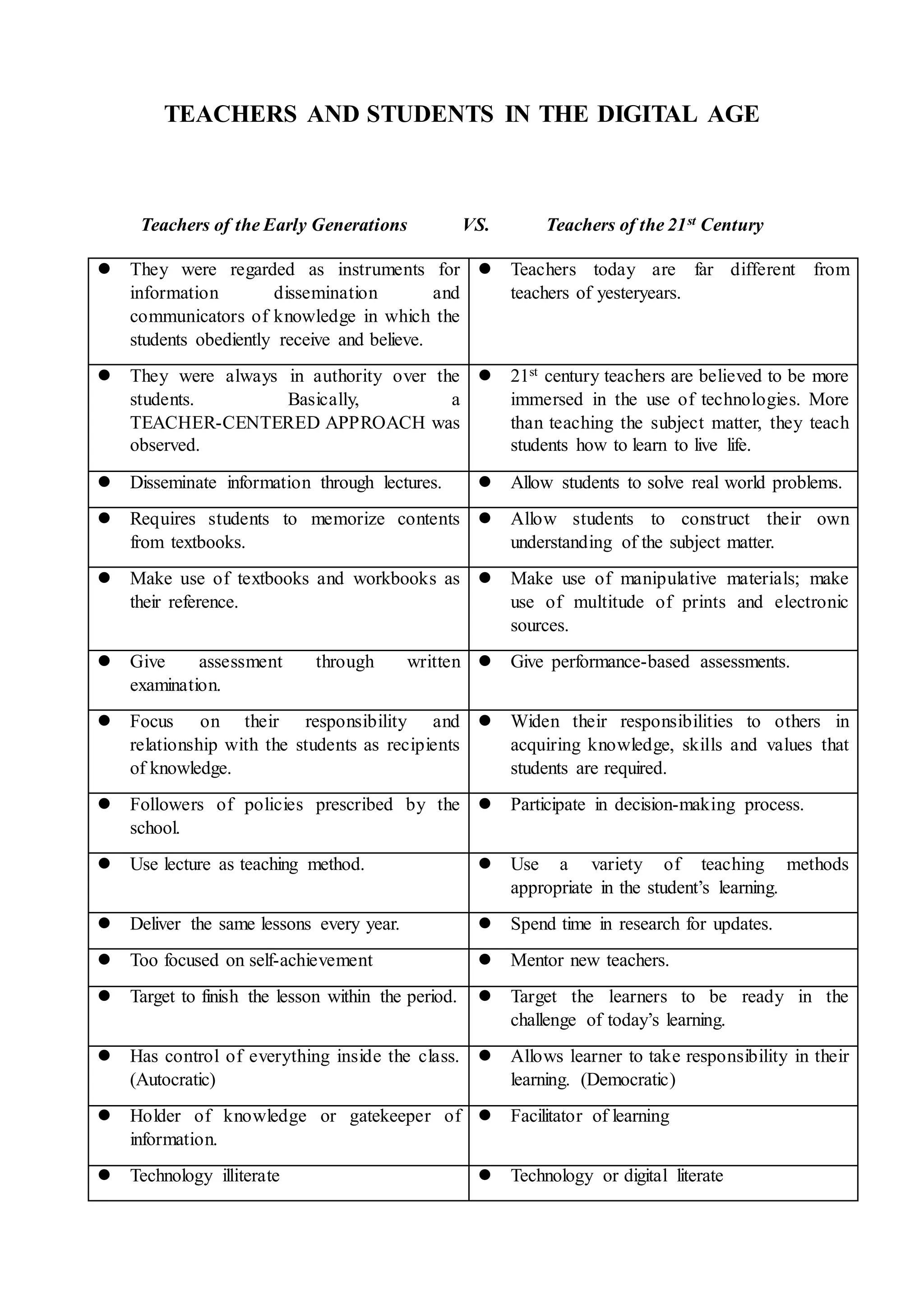
Teachers of the Early Generations VS. Teachers of the 21st Century
 They were regarded as instruments for
information dissemination and
communicators of knowledge in which the
students obediently receive and believe.
 Teachers today are far different from
teachers of yesteryears.
 They were always in authority over the
students. Basically, a
TEACHER-CENTERED APPROACH was
observed.
 21st century teachers are believed to be more
immersed in the use of technologies. More
than teaching the subject matter, they teach
students how to learn to live life.
 Disseminate information through lectures.  Allow students to solve real world problems.
 Requires students to memorize contents
from textbooks.
 Allow students to construct their own
understanding of the subject matter.
 Make use of textbooks and workbooks as
their reference.
 Make use of manipulative materials; make
use of multitude of prints and electronic
sources.
 Give assessment through written
examination.
 Give performance-based assessments.
 Focus on their responsibility and
relationship with the students as recipients
of knowledge.
 Widen their responsibilities to others in
acquiring knowledge, skills and values that
students are required.
 Followers of policies prescribed by the
school.
 Participate in decision-making process.
 Use lecture as teaching method.  Use a variety of teaching methods
appropriate in the student’s learning.
 Deliver the same lessons every year.  Spend time in research for updates.
 Too focused on self-achievement  Mentor new teachers.
 Target to finish the lesson within the period.  Target the learners to be ready in the
challenge of today’s learning.
 Has control of everything inside the class.
(Autocratic)
 Allows learner to take responsibility in their
learning. (Democratic)
 Holder of knowledge or gatekeeper of
information.
 Facilitator of learning
 Technology illiterate  Technology or digital literate
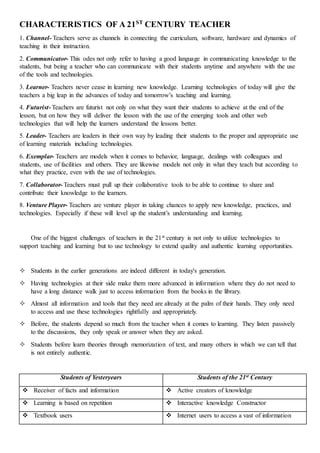
CHARACTERISTICS OF A 21ST
CENTURY TEACHER
1. Channel- Teachers serve as channels in connecting the curriculum, software, hardware and dynamics of
teaching in their instruction.
2. Communicator- This odes not only refer to having a good language in communicating knowledge to the
students, but being a teacher who can communicate with their students anytime and anywhere with the use
of the tools and technologies.
3. Learner- Teachers never cease in learning new knowledge. Learning technologies of today will give the
teachers a big leap in the advances of today and tomorrow’s teaching and learning.
4. Futurist- Teachers are futurist not only on what they want their students to achieve at the end of the
lesson, but on how they will deliver the lesson with the use of the emerging tools and other web
technologies that will help the learners understand the lessons better.
5. Leader- Teachers are leaders in their own way by leading their students to the proper and appropriate use
of learning materials including technologies.
6. Exemplar- Teachers are models when it comes to behavior, language, dealings with colleagues and
students, use of facilities and others. They are likewise models not only in what they teach but according to
what they practice, even with the use of technologies.
7. Collaborator- Teachers must pull up their collaborative tools to be able to continue to share and
contribute their knowledge to the learners.
8. Venture Player- Teachers are venture player in taking chances to apply new knowledge, practices, and
technologies. Especially if these will level up the student’s understanding and learning.
One of the biggest challenges of teachers in the 21st century is not only to utilize technologies to
support teaching and learning but to use technology to extend quality and authentic learning opportunities.
 Students in the earlier generations are indeed different in today's generation.
 Having technologies at their side make them more advanced in information where they do not need to
have a long distance walk just to access information from the books in the library.
 Almost all information and tools that they need are already at the palm of their hands. They only need
to access and use these technologies rightfully and appropriately.
 Before, the students depend so much from the teacher when it comes to learning. They listen passively
to the discussions, they only speak or answer when they are asked.
 Students before learn theories through memorization of text, and many others in which we can tell that
is not entirely authentic.
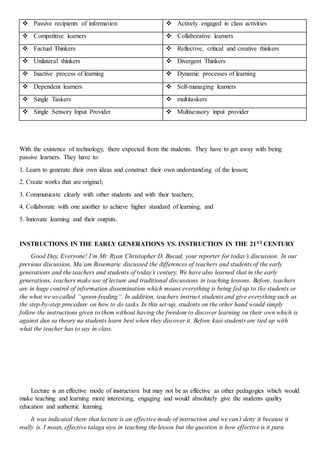
Students of Yesteryears Students of the 21st Century
 Receiver of facts and information  Active creators of knowledge
 Learning is based on repetition  Interactive knowledge Constructor
 Textbook users  Internet users to access a vast of information
 Passive recipients of information  Actively engaged in class activities
 Competitive learners  Collaborative learners
 Factual Thinkers  Reflective, critical and creative thinkers
 Unilateral thinkers  Divergent Thinkers
 Inactive process of learning  Dynamic processes of learning
 Dependent learners  Self-managing learners
 Single Taskers  multitaskers
 Single Sensory Input Provider  Multisensory input provider
With the existence of technology, there expected from the students. They have to get away with being
passive learners. They have to:
1. Learn to generate their own ideas and construct their own understanding of the lesson;
2. Create works that are original;
3. Communicate clearly with other students and with their teachers;
4. Collaborate with one another to achieve higher standard of learning; and
5. Innovate learning and their outputs.
INSTRUCTIONS IN THE EARLY GENERATIONS VS. INSTRUCTION IN THE 21ST CENTURY
Good Day, Everyone! I’m Mr. Ryan Christopher D. Bucad, your reporter for today’s discussion. In our
previous discussion, Ma’am Rosemarie discussed the differences of teachers and students of the early
generations and the teachers and students of today’s century. We have also learned that in the early
generations, teachers make use of lecture and traditional discussions in teaching lessons. Before, teachers
are in huge control of information dissemination which means everything is being fed up to the students or
the what we so-called “spoon-feeding”. In addition, teachers instruct students and give everything such as
the step-by-step procedure on how to do tasks. In this set-up, students on the other hand would simply
follow the instructions given to them without having the freedom to discover learning on their own which is
against dun sa theory na students learn best when they discover it. Before kasi students are tied up with
what the teacher has to say in class.
Lecture is an effective mode of instruction but may not be as effective as other pedagogies which would
make teaching and learning more interesting, engaging and would absolutely give the students quality
education and authentic learning.
It was indicated there that lecture is an effective mode of instruction and we can’t deny it because it
really is. I mean, effective talaga siya in teaching the lesson but the question is how effective is it para
ma-absorb ng estudyante yung information that is being shared. That is why now that we are in the 21st
century, marami ng other pedagogies or yung method and practice of teaching ang naimbento which would
make the teaching and learning process more effective, more interesting and more engaging sa part ng
students. Kasi the fact that students are madaling maboring, kailangan humanap ng ibang ways on how to
get their undivided attention and interests because once the learner is into the lesson proper, learning
becomes more permanent and naeensure yung authentic learning that would result to high students quality
education. With that being said, I will be enumerating some of the useful and effective teaching methods and
strategies.
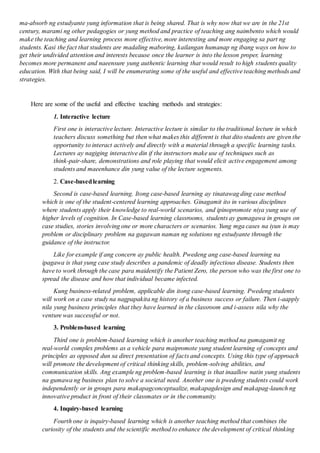
Here are some of the useful and effective teaching methods and strategies:
1. Interactive lecture
First one is interactive lecture. Interactive lecture is similar to the traditional lecture in which
teachers discuss something but then what makes this different is that dito students are given the
opportunity to interact actively and directly with a material through a specific learning tasks.
Lectures ay nagiging interactive din if the instructors make use of techniques such as
think-pair-share, demonstrations and role playing that would elicit active engagement among
students and maeenhance din yung value of the lecture segments.
2. Case-basedlearning
Second is case-based learning. Itong case-based learning ay tinatawag ding case method
which is one of the student-centered learning approaches. Ginagamit ito in various disciplines
where students apply their knowledge to real-world scenarios, and ipinopromote niya yung use of
higher levels of cognition. In Case-based learning classrooms, students ay gumagawa in groups on
case studies, stories involving one or more characters or scenarios. Yung mga cases na iyun is may
problem or disciplinary problem na gagawan naman ng solutions ng estudyante through the
guidance of the instructor.
Like for example if ang concern ay public health. Pwedeng ang case-based learning na
ipagawa is that yung case study describes a pandemic of deadly infectious disease. Students then
have to work through the case para maidentify the Patient Zero, the person who was the first one to
spread the disease and how that individual became infected.
Kung business-related problem, applicable din itong case-based learning. Pwedeng students
will work on a case study na nagpapakita ng history of a business success or failure. Then i-aapply
nila yung business principles that they have learned in the classroom and i-assess nila why the
venture was successful or not.
3. Problem-based learning
Third one is problem-based learning which is another teaching method na gumagamit ng
real-world complex problems as a vehicle para maipromote yung student learning of concepts and
principles as opposed dun sa direct presentation of facts and concepts. Using this type of approach
will promote the development of critical thinking skills, problem-solving abilities, and
communication skills. Ang example ng problem-based learning is that inaallow natin yung students
na gumawa ng business plan to solve a societal need. Another one is pwedeng students could work
independently or in groups para makapagconceptualize, makapagdesign and makapag-launch ng
innovative product in front of their classmates or in the community.
4. Inquiry-based learning
Fourth one is inquiry-based learning which is another teaching method that combines the
curiosity of the students and the scientific method to enhance the development of critical thinking
skills. It promotes engagement, curiosity and experimentation. Dito sa approach na ito, rather than
instructing students, ganito mo gawin yan, mali yan, dito sa approach na ito, students are
empowered na iexplore yung subjects by means of asking questions and finding or creating
solutions. And ang approach na ito is hindi lang nakacenter dun sa asking a student what he or she
wants to know bagkus nakafocus ito dun sa way of teachers in triggering the curiosity and
activating the curiosity. Ito is anchored dun sa sinabi ni Lou Holtz na I never learn anything
talking. I only learn things when I ask questions.
5. Project-based learning
Fifth is project-based learning. It is a teaching method in which students gain knowledge and
skills by means of working for an extended period of time to investigate and respond to an
authentic, engaging and complex question, problem or challenge. This approach is may output sa
huli na mabubuo such as accomplishing a complex task by means of performing a presentation and
producing a project, a craft or an artifact.
Another application of this one ay yung allowing agricultural students na mag-come up ng
organic farm. With this tasks, students can now put their knowledge of science, social studies, math
and economics through planting their own organic farm precisely because they have to researched
well what kind of crops they need to raise, how to take care of these crops, and yung budgeting in
order to purchase the materials that they need. After that, pwede na nilang i-harvest ang crops and
ipagbili sa market.
6. Simulation
Simulations are instructional scenarios where the learner is placed in a “world” defined by
the teacher and it is a form of experiential learning. Ito yung trial and error method na kung saan
gumagamit ng artificial or hypothetical experience is created that engages the learner in an
activity that reflects real life conditions but without taking the risk consequences of an actual
situation. Ginagamit ito mostly sa mga medical field. Kapag nagccpr eh ang ginagamit e yung
replica ng tao. Parang human siya pero artificial. If you can still remember nung Grade 9 tayo
yung volcanic eruption e gumamit tayo ng simulation wherein gumawa tayo ng volcano out of clay
and then yung coke and menthos. Through that, ipinakita ang process of volcanic eruption.
7. Roleplay
It involves the learner in role assumption. The learner takes on a different role (and perhaps
identity) from his or her normal one by playing the part of a different person. Magaact ka depende
sa ibibigay sa iyong role. And it develops speaking and listening skills.
8. Experiential learning
This one naman is about an engaged learning process na kung saan students learn by doing
and by reflecting on the experience. The best example for this one ay ang gagawin nating
internship. Another examples are practicums and undergraduate researches. Ito kasing
experiential learning includes the integration of knowledge yung natutunan natin simula first year
to fourth year first sem ay ipuput natin into the activity- o yung application of knowledge to a
real-world setting and after that magkakaroon tayo ng reflection- o yung analysis and synthesis of
knowledge and activity. Ito yung what have we realized after the internship.
9. Laboratory work
Laboratory work works well in the field of science. Ito yung tayo mismo ang nag-coconduct ng
experiment in order to reveal something. Naniniwala kasi ang educators that yung first-hand
experience in observation and kapag ikaw mismo ang nagseset-up ng materials is madali mong
mauunawaan ang isang phenomenon that can lead to a more holistic understanding.
10. Field work
Fieldwork is the gathering of information about something in a real, natural environment,
rather than in a place of study such as a laboratory or classroom. Karaniwang gumagawa nito is
yung mga geographist, anthropologist, and pati yung survey sa housing number ganun. Field work
tawag dun. Example nito is yung mga tao behind National ID. Yung mga taga-survey.
11. Peer Tutoring
Peer tutoring is a strategy in which learner work in pairs in order to provide explicit teaching
support. Pwede itong same age peer tutoring or magkaedad lang yung nagtuturuan or cross-age
wherein older learner is paired with a younger tutee or tutees. Ang maganda kasi dito is that
learners ay makakapagbigay sila ng feedback about the success of their peers in one particular
subject. (Mary Joy- Grade 3) In addition, we used to this one nung face to face pa. Kapag may quiz,
tanungin mo ako Clabelle, isa lang. Tanungan before exam. And for me mas effective siya kasi mas
nareretain ang information.
12. E-learning
E-learning or electronic learning is the delivery of learning and training through digital
resources. And nung pumasok na ang virus sa ating bansa, karamihan ay ito na ang ginagamit to
address the challenges of learning continuity. This is like learning anytime and anywhere as long
as you have the resources. Ito yung ginagamit natin ngayon. Yung paggamit ng Quipper as LMS,
google meet, zoom and other applications na may kinalaman sa virtual schooling is part of
e-learning.
13. PISER (Peer Instruction and Student Electronic Response)
PISER or peer instruction and student electronic response is a specifically designed classroom
based activity na nag-iintegrates ng two elements. First one is the peer instruction and the second
one is Personal Response System. Peer Instruction is the central thrust of the activity while the
Personal Response System is only a machine na nagcocollect ng responses from remote
transmitters. Here is how it works. May isang tanong na ibibigay ang professor then invidually ay
iaanalyze nila yung tanong tapos isusubmit nila yung responses nila through PRS or personal
response system, then ididisplay ni PRS yung result pattern noong naging sagot ng buong klase.
Then ijujustify ng bawat isa yung answer nila, parang debate siya. Then after that magsasagot ulit
sila, for the second time. Pwedeng magpalit or hindi depende kung may nakaconvince sayo na mali
ang sagot mo. Then after that magkakaroon ng micro lecture dealing with the theories and
principles behind the correct answer. Through this approach kasi, students become more critical
and analytical when they justify their answers and kapag hinahamon nila yung answer ng iba.
When discussing with their peers, they also learn to communicate effectively.
The traditional educational practices have been effective during the old times, but they are no longer
effective in the 21st century. These traditional educational practices would no longer provide the 21st
century skills needed by the students for them to be at par and productive with the learning of the students
globally and for them to be able to live life in the real world to answer the needs of the society and of the
community.
I think effective pa rin naman yung mga traditioanal educational practices before but hindi na nga lang
ganoong kaeffective in today’s century since much has changed. Dahil nga the world is becoming more
advanced and advanced, pati yung mga teaching methods and strategies ay nageevolve na din. Sumasabay
sila sa hamon ng panahon. Kasi yung mga teaching strategies na dapat ginagamit ngayon ay yung mga
techniques na makakapagprovide ng 21st century skills para ang estudyante ay makapagcompete locally
and globally. Hindi na lang limited sa 3R’s ang curriculum ngayon, the curriculum itself together with the
teaching strategies must prepare students to be globally competitive and productive citizens of the society.
Below are the characteristics of the traditional learning environments and new learning environments.
As teachers and students continue to integrate technologies in education, they will find themselves
transitioning from traditional teaching and learning technologically and digitally-enriched teaching and
learning environment.
Ito naman yung mga differences in terms of learning environment. We can say that from traditional
teaching, today’s learning environment is far from before.
TRADITIONAL LEARNING ENVIRONMENT NEW LEARNING ENVIRONMENT
Teacher-centered Instruction Student-centered learning
Single-sense Stimulation Multisensory stimulation
Single-path progression Multipath progression
Single medium Multimedia
Isolated work Collaborative work
Information Delivery Information Exchange
Passive learning Active/Explaratory/Inquiry-based learning
Factual, knowledge-based learning Critical thinking and informed decision making
Reactive response Proactive/Planned action
Isolated, artificial context Authentic, real-world context
Teacher-centered instruction in which the learning situations is that nasa teacher lahat ng authority over
the material na ginagamit ng estudyante and the ways in which they study it. Dito, teacher leads the activity
and supplies all the information. Right now, we are in the student-centered learning approach in which
teachers include the learners in planning, implementation and assessments. From directive, nagiging
consultative ang approach. From “Do as I say to based on your needs, let’s co develop and implement a
plan of action”.
Kung dati, listening and writing skills lang ang nadedevelop kasi nakafocus ang curriculum sa lecture
methods and writing, ngayon sasayaw ka, kakanta ka, dadrawing ka, aarte ka, magrereport ka and halos
lahat ng senses mo ay magagamit mo.
Kapag sinabi kasi nating learning progression, ito yung purposeful sequencing of teaching and learning
expectations ages or grade levels. Before, single-path progression or ang pinupuntahan ng lesson ay
enscimathmakabayan pero ngayon ay multipath progression na which means ang daming discipline na ang
pinag-aaralan ng mga bata. One subject ay halos nasakop na lahat ang discipline. Kasi integrated na ang
curriculum.
Single medium which means dati ay textbooks and workbooks lang ang ginagamit ngayon ay gumagamit na
ng manipulative materials like multitude of prints and electronic resources. Board and chalks, manila paper
before pero ngayon we have pc and laptops, projector and ppt presentation.
Before isolated ang work kasi the students ay kanya kanya, mind ur own business, pero ngayon if
mapapansin mo sa curriculum natin, binibigyang emphasis ang groupings and collaborative work.
Before, information delivery lang or teachers are the primary source of information. They say everything-
the steps on how to do it and how it should be done.
Today, there is an information exchange in which teachers and students converse and exchange ideas.
Teachers ask if the students have previous knowledge about the lesson or if may alam sila about the topic
and the students answer. Kapag may di alam ang estudyante, nagtatanong din sila.
Passive learning which means ang estudyante ay responsible for absorbing the presented information on
their own terms. Dati kasi ay more on lectures and then sasabihin ni teacher ay read and understand page 4.
Dito sa passive learning, student is accountable for paying attention in every word na sasabihin ni teacher.
On the other hand, today’s century promotes active learning which involves students in the instructional
practices through the use of relevant activities and discussions. Dito students are included in the learning
process by means of including them in the instructional practices as opposed dun sa listing of facts and
explaining topics through traditional lecures.
Before nakacenter lamang sa factual knowledge, yung knowledge of terminology and specific facts like ten
biggest cities in the world and factual knowledge is under lamang ng low level knowledge. Today, students
are critical thinker and they have the ability to make an informed-decision making. Today, students are able
to think clearly and rationally about what to do or what to believe.
Before, the response of the students kapag tinanong sila e reactive which means hindi ganoong
kacomprehensive while ngayon, students can be able to answer questions in the most comprehensible way.
Before the students are put in the isolated/artificial context and limited lang sila dun sa quizzes, traditional
assessments like the paper and pencil test pero ngayon the students are put in the authentic real-world
context. The strategies na ginagamit, the assessments and the classroom set-up itself ay mas effective and
engaging.
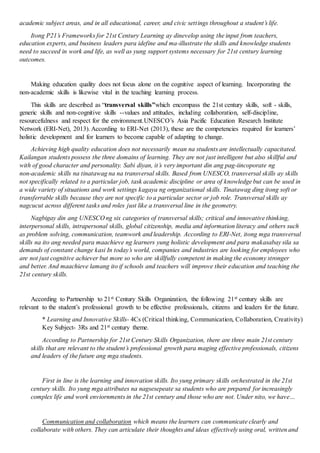
THE 21ST CENTURY SKILLS
The term 21st century skills refers to a broad set of knowledge, skills, work habits, and character traits
that na pinaniniwalaan ng mg educators, school reformers, college professors, employers, na critically
important para maging successful ka in today’s world, particularly in collegiate programs and
contemporary careers and workplaces. Generally speaking, 21st century skills can be applied in all
academic subject areas, and in all educational, career, and civic settings throughout a student’s life.
Itong P21’s Frameworks for 21st Century Learning ay dinevelop using the input from teachers,
education experts, and business leaders para idefine and ma-illustrate the skills and knowledge students
need to succeed in work and life, as well as yung support systems necessary for 21st century learning
outcomes.
Making education quality does not focus alone on the cognitive aspect of learning. Incorporating the
non-academic skills is likewise vital in the teaching learning process.
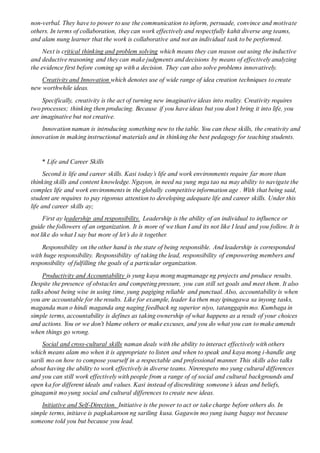
This skills are described as “transversal skills”which encompass the 21st century skills, soft - skills,
generic skills and non-cognitive skills --values and attitudes, including collaboration, self-discipline,
resourcefulness and respect for the environment.UNESCO’s Asia Pacific Education Research Institute
Network (ERI-Net), 2013). According to ERI-Net (2013), these are the competencies required for learners’
holistic development and for learners to become capable of adapting to change.
Achieving high quality education does not necessarily mean na students are intellectually capacitated.
Kailangan students possess the three domains of learning. They are not just intelligent but also skillful and
with of good character and personality. Sabi diyan, it’s very important din ang pag-iincoporate ng
non-academic skills na tinatawag na na transversal skills. Based from UNESCO, transversal skills ay skills
not specifically related to a particular job, task academic discipline or area of knowledge but can be used in
a wide variety of situations and work settings kagaya ng organizational skills. Tinatawag ding itong soft or
transferrable skills because they are not specific to a particular sector or job role. Transversal skills ay
nagcucut across different tasks and roles just like a transversal line in the geometry.
Nagbigay din ang UNESCO ng six categories of transversal skills; critical and innovative thinking,
interpersonal skills, intrapersonal skills, global citizenship, media and information literacy and others such
as problem solving, communication, teamwork and leadership. According to ERI-Net, itong mga transversal
skills na ito ang needed para maachieve ng learners yung holistic development and para makasabay sila sa
demands of constant change kasi In today’s world, companies and industries are looking for employees who
are not just cognitive achiever but more so who are skillfully competent in making the economy stronger
and better. And maachieve lamang ito if schools and teachers will improve their education and teaching the
21st century skills.
According to Partnership to 21st Century Skills Organization, the following 21st century skills are
relevant to the student’s professional growth to be effective professionals, citizens and leaders for the future.
* Learning and Innovative Skills- 4Cs (Critical thinking, Communication, Collaboration, Creativity)
Key Subject- 3Rs and 21st century theme.
According to Partnership for 21st Century Skills Organization, there are three main 21st century
skills that are relevant to the student’s professional growth para maging effective professionals, citizens
and leaders of the future ang mga students.
First in line is the learning and innovation skills. Ito yung primary skills orchestrated in the 21st
century skills. Ito yung mga attributes na nagsesepeate sa students who are prepared for increasingly
complex life and work enviornments in the 21st century and those who are not. Under nito, we have…
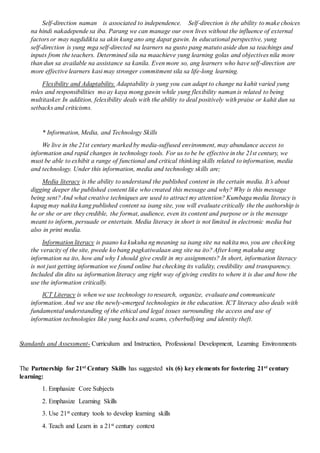
Communication and collaboration which means the learners can communicate clearly and
collaborate with others. They can articulate their thoughts and ideas effectively using oral, written and
non-verbal. They have to power to use the communication to inform, persuade, convince and motivate
others. In terms of collaboration, they can work effectively and respectfully kahit diverse ang teams,
and alam nung learner that the work is collaborative and not an individual task to be performed.
Next is critical thinking and problem solving which means they can reason out using the inductive
and deductive reasoning and they can make judgments and decisions by means of effectively analyzing
the evidence first before coming up with a decision. They can also solve problems innovatively.
Creativity and Innovation which denotes use of wide range of idea creation techniques to create
new worthwhile ideas.
Specifically, creativity is the act of turning new imaginative ideas into reality. Creativity requires
two processes; thinking then producing. Because if you have ideas but you don’t bring it into life, you
are imaginative but not creative.
Innovation naman is introducing something new to the table. You can these skills, the creativity and
innovation in making instructional materials and in thinking the best pedagogy for teaching students.
* Life and Career Skills
Second is life and career skills. Kasi today’s life and work environments require far more than
thinking skills and content knowledge. Ngayon, in need na yung mga tao na may ability to navigate the
complex life and work environments in the globally competitive information age . With that being said,
student are requires to pay rigorous attention to developing adequate life and career skills. Under this
life and career skills ay;
First ay leadership and responsibility. Leadership is the ability of an individual to influence or
guide the followers of an organization. It is more of we than I and its not like I lead and you follow. It is
not like do what I say but more of let’s do it together.
Responsibility on the other hand is the state of being responsible. And leadership is corresponded
with huge responsibility. Responsibility of taking the lead, responsibility of empowering members and
responsibility of fulfilling the goals of a particular organization.
Productivity and Accountability is yung kaya mong magmanage ng projects and produce results.
Despite the presence of obstacles and competing pressure, you can still set goals and meet them. It also
talks about being wise in using time, yung pagiging reliable and punctual. Also, accountability is when
you are accountable for the results. Like for example, leader ka then may ipinagawa sa inyong tasks,
maganda man o hindi maganda ang naging feedback ng superior niyo, tatanggapin mo. Kumbaga in
simple terms, accountability is defines as taking ownership of what happens as a result of your choices
and actions. You or we don't blame others or make excuses, and you do what you can to make amends
when things go wrong.
Social and cross-cultural skills naman deals with the ability to interact effectively with others
which means alam mo when it is appropriate to listen and when to speak and kaya mong i-handle ang
sarili mo on how to compose yourself in a respectable and professional manner. This skills also talks
about having the ability to work effectively in diverse teams. Nirerespeto mo yung cultural differences
and you can still work effectively with people from a range of of social and cultural backgrounds and
open ka for different ideals and values. Kasi instead of discrediting someone’s ideas and beliefs,
ginagamit mo yung social and cultural differences to create new ideas.
Initiative and Self-Direction. Initiative is the power to act or take charge before others do. In
simple terms, initiave is pagkakaroon ng sariling kusa. Gagawin mo yung isang bagay not because
someone told you but because you lead.
Self-direction naman is associated to independence. Self-direction is the ability to make choices
na hindi nakadepende sa iba. Parang we can manage our own lives without the influence of external
factors or may nagdidikta sa akin kung ano ang dapat gawin. In educational perspective, yung
self-direction is yung mga self-directed na learners na gusto pang matuto aside dun sa teachings and
inputs from the teachers. Determined sila na maachieve yung learning golas and objectives nila more
than dun sa available na assistance sa kanila. Even more so, ang learners who have self-direction are
more effective learners kasi may stronger commitment sila sa life-long learning.
Flexibility and Adaptability. Adaptability is yung you can adapt to change na kahit varied yung
roles and responsibilities mo ay kaya mong gawin while yung flexibility naman is related to being
multitasker. In addition, felexibility deals with the ability to deal positively with praise or kahit dun sa
setbacks and criticisms.
* Information, Media, and Technology Skills
We live in the 21st century marked by media-suffused environment, may abundance access to
information and rapid changes in technology tools. For us to be be effective in the 21st century, we
must be able to exhibit a range of functional and critical thinking skills related to information, media
and technology. Under this information, media and technology skills are;
Media literacy is the ability to understand the published content in the certain media. It’s about
digging deeper the published content like who created this message and why? Why is this message
being sent? And what creative techniques are used to attract my attention? Kumbaga media literacy is
kapag may nakita kang published content sa isang site, you will evaluate critically the the authorship is
he or she or are they credible, the format, audience, even its content and purpose or is the message
meant to inform, persuade or entertain. Media literacy in short is not limited in electronic media but
also in print media.
Information literacy is paano ka kukuha ng meaning sa isang site na nakita mo, you are checking
the veracity of the site, pwede ko bang pagkatiwalaan ang site na ito? After kong makuha ang
information na ito, how and why I should give credit in my assignments? In short, information literacy
is not just getting information we found online but checking its validity, credibility and transparency.
Included din dito sa information literacy ang right way of giving credits to where it is due and how the
use the information critically.
ICT Literacy is when we use technology to research, organize, evaluate and communicate
information. And we use the newly-emerged technologies in the education. ICT literacy also deals with
fundamental understanding of the ethical and legal issues surrounding the access and use of
information technologies like yung hacks and scams, cyberbullying and identity theft.
Standards and Assessment- Curriculum and Instruction, Professional Development, Learning Environments
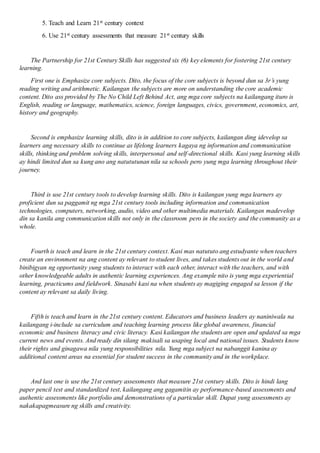
The Partnership for 21st Century Skills has suggested six (6) key elements for fostering 21st century
learning:
1. Emphasize Core Subjects
2. Emphasize Learning Skills
3. Use 21st century tools to develop learning skills
4. Teach and Learn in a 21st century context
5. Teach and Learn 21st century context
6. Use 21st century assessments that measure 21st century skills
The Partnership for 21st Century Skills has suggested six (6) key elements for fostering 21st century
learning.
First one is Emphasize core subjects. Dito, the focus of the core subjects is beyond dun sa 3r’s yung
reading writing and arithmetic. Kailangan the subjects are more on understanding the core academic
content. Dito ass provided by The No Child Left Behind Act, ang mga core subjects na kailangang ituro is
English, reading or language, mathematics, science, foreign languages, civics, government, economics, art,
history and geography.
Second is emphasize learning skills, dito is in addition to core subjects, kailangan ding idevelop sa
learners ang necessary skills to continue as lifelong learners kagaya ng information and communication
skills, thinking and problem solving skills, interpersonal and self-directional skills. Kasi yung learning skills
ay hindi limited dun sa kung ano ang natututunan nila sa schools pero yung mga learning throughout their
journey.
Third is use 21st century tools to develop learning skills. Dito is kailangan yung mga learners ay
proficient dun sa paggamit ng mga 21st century tools including information and communication
technologies, computers, networking, audio, video and other multimedia materials. Kailangan madevelop
din sa kanila ang communication skills not only in the classroom pero in the society and the community as a
whole.
Fourth is teach and learn in the 21st century context. Kasi mas natututo ang estudyante when teachers
create an environment na ang content ay relevant to student lives, and takes students out in the world and
binibigyan ng opportunity yung students to interact with each other, interact with the teachers, and with
other knowledgeable adults in authentic learning experiences. Ang example nito is yung mga experiential
learning, practicums and fieldwork. Sinasabi kasi na when students ay magiging engaged sa lesson if the
content ay relevant sa daily living.
Fifth is teach and learn in the 21st century content. Educators and business leaders ay naniniwala na
kailangang i-include sa curriculum and teaching learning process like global awareness, financial
economic and business literacy and civic literacy. Kasi kailangan the students are open and updated sa mga
current news and events. And ready din silang makisali sa usaping local and national issues. Students know
their rights and ginagawa nila yung responsibilities nila. Yung mga subject na nabanggit kanina ay
additional content areas na essential for student success in the community and in the workplace.
And last one is use the 21st century assessments that measure 21st century skills. Dito is hindi lang
paper pencil test and standardized test, kailangang ang gagamitin ay performance-based assessments and
authentic assessments like portfolio and demonstrations of a particular skill. Dapat yung assessments ay
nakakapagmeasure ng skills and creativity.
CHAPTER 2
INTERNATIONAL SOCIETY FOR TECHNOLOGY IN EDUCATION
Sa lahat ng ating gawain, we specifically design and enumerate our guidelines, criteria or
specifications which meet our standards. We all hold ourselves and the people around us to certains
standards and just like the Golden Rule, our standards determine how to act when we’re by ourselves
as well as how we behave toward others.
Setting standards help us achieve quality output may it be in house, office, and school. This in turn
will give us fulfillment in our activities for our family, friends, staff, heads, people in the society and
the community.
If you’re a teacher and you work well on a task, then your abilities match the standards of your
role and you often produce results that exceed expectations.
In business, standard also plays part because it enables them to track and monitor its
operations. Workers need to ensure acceptable quality standards for the growth and success of the
company. Those people who are good in setting and monitoring standards are those who expect the
best from people.
In Education....
…administrators and teachers with the support of the national educational departments and
organizations define their standards that would guide and help the students in possessing the knowledge
and skills that are required of them to make them successful learners and professionals in the future.
Standards in the field of education focus on the necessary knowledge and skills of students. It is the
reference point in planning programs for teaching and learning and for assessing student progress. If
administrators and teachers set standards, it is an ease to develop programs that can support and
improve student learning. Standards are also the basis of education reform as educators and
administrators respond to the call for desired outcomes.
The use of technology in Education...
…is likewise guided by standards to develop among learners the skills that they need to
possess for the 21st century for them to be able to serve not only themselves but the world. This is
where the International Society for Technology in Education (ISTE) comes in. ISTE is a nonprofit
organization that promotes the use of technology to support and enhance teaching and learning.
Although many technologies emerged, it should be guided by standards when technologies are
incorporated in education.
Appropriate use of technology especially as a tool for learning.
Technology has a complex function but if used appropriately, it can help the students to grow and
learn.
Teachers should focus on setting limits when using technology with children. They should use this
to promote positive interaction instead of allowing it to interfere interactions.
ISTE is a nonprofit organization that helps the global education community in using technology.
They believe that technology has the potential power to transform teaching and learning. They make
substantial resources for teachers, leaders and parents while using technology to keep the learning
going.
There are three standards that have been developed by ISTE for better connection and
empowerment among administrators, teachers, and students:
* Standards for Administrators
* Standards for Teachers
* Standards for Students
ISTE is committed for rethinking education and empowering learners and these three standards are
their vision for the transformation of schools. It means to say that using technology for learning can create
high-impact, sustainable, scalable and equitable learning experiences for all learners.
Different definitions of Standards..
* According to Merriam-Webster’s Learner’s Dictionary, “standard is an idea or thing used as a
measure, norm, or model in comparative evaluations”. It can also be defined as a level of quality,
achievement that is considered acceptable or desirable; something that is very good and that is used to make
judgment about the quality of other things; or something established by authority, custom, or general
consent as a model or example.
* According to Dictionary.com, “standards is a rule or principle that is used as a basis for judgment”.
* According to freedictionary.com, “standard is a degree or level of requirement, excellence, or
attainment.
Standard is used as a measure in a sense that it speaks of perceptible medium that is helpful in
understanding why things are associated with measurement.
Norm is unwritten rule about how to behave. It is the expected idea in a particular social group or
culture with regards to the behavior.
Standard as a level of quality or achievement that is considered acceptable or desirable. In this case,
the word standard is used as basis, requirements, specifications or guidelines to ensure that something like
materials, products, processes and services is fit for their purpose.
Remaining definitions - When we say standard, it usually implies a pattern for guidance, quantity,
excellence or correctness.
“Standards” in incorporating the use of technology in education would mean something that would
serve as a guide to assist the administrators, teachers, and learners in achieving quality and excellence in
teaching and learning.
Standards focus on the ways that technology can be used to amplify and transform learning and
teaching. How will technology empower the learners in a connected world to enhance instruction in digital
citizenship and media literacy.
ISTE STANDARDS
ADMINISTRATORS- This was developed to evaluate the skills and knowledge that school administrators
and leaders should possess to support digital age learning, to implement technology and most importantly,
to transform the education landscape. They believe that in order to meet the goals of the institution, then
everyone must be involved in the educational process.
ISTE STANDARDS FOR ADMINISTRATORS
Administrators are the lead supporters of digital and technology-rich teaching and learning environment.
They lead in the transformation of educational system with the affirmation that these technologies make
teaching and learning more engaging, interesting, inspiring, reflecting, and empowering.
Administrators provide effective training and support tp institution. Progressive administrators are
those who are updated in educational research and emerging trends in utilization of technology. If you are
an administrator who wants to promote effective use of technology in your school, you must provide
valuable and ongoing training about how to use the tools and how to implement them effectively into the
curriculum.
* Visionary leadership- Being visionary leaders, they inspire and engage stakeholders in the
development, communication, and implementation of educational transformation with the use of digital
and technological resources which are aligned with the shared vision.
It requires dedication and commitement to large population. They should consider the crucial goal
of the institution so their school can become a better educational institution. They should also inspire
and implement for comprehensive integration of technology to promote excellence and support
transformation throughout the institution. They also have to take an ongoing role in creating,
implementing and communicating strategic plans.
* Digital Age learning culture- Educational administrators lead in creating, promoting, and
upholding digital age educational environment culture. They ensure the effective use of digital tools
and technological resources in meeting the diverse needs of learners and help them to be more
innovative, creative, and efficient in learning.
Administrators should know how to create, promote and sustain a dynamic and digital age
learning culture that provides a rigorous, relevant and engaging education for all students. They should
provide learning environment that can encourage the students to engage in active learning and
technology has a huge impact so students get consistent exposure to the digital tools that they need to
succeed.
Teachers – Administrators have to provide teachers with learning environment that can adapt to a
diverse range of needs students may have. This may be in the form of implementing technology across
their curriculum to ensure that all teachers have access to resources of school.
* Excellence in professional practice- Educational administrators ensure healthy and professional
growth in technology fluency and integration among education to help enhance students’ learning.
Further, educational administrators keep themselves informed with the changes and updates in
technology that are beneficial in teaching and learning.
To fully adhere to ISTE standards, administrators must exhibit excellent in their professional
practice. It pertains to the amount of time, resources and access that administrators dedicate to their
own growth in technology literacy.
Community has a role for professional excellence as this will allow them to bring modern ideas to
their schools.

* Systematic Improvement- Educational administrators also extend leadership in the
improvement of the department, organization, and school through the promotion and effective use of
information and technology resources which make the daily operations easy and efficient.
Administrators have to affect meaningful change na magkakaroon ng impact sa paggamit ng
technology in their institution. They should establish metrics, data and analaytic standards to improve
education and learning. They have to establish partnerships that assist in an institution’s improvement
and an infrastructure that is conducive to technology-assisted learning and as much as possible, there
should be structural renovations and utility consistency.
* Digital Citizenship- Educational administrators ensure, promote and model ethical use of
information and communication technology following policies and legalities of technology.
As an administrators, you should have a deep understanding on the underlying social, ethical and
legal issues with regards to digital age.
An administrator who wants to meet ISTE standards is the cream of the crop in education. They are
attentive, clever, empathetic, ambitious all at the same time.
ISTE STANDARDS FOR TEACHERS
ISTE standards for teachers state that effective teachers not only support technologies in education, they
design, create, implement, promote, and model the use of technologies to enable them to teach the lessons
and its contents with quality.
When we say standards it is an idea, or rule, principles, mga guidelines na ginagmait para ma measure
ang isang bagay or ito kasi yung magiging basis for judgment. Or kung naattain ba natin yung target or
yung goal natin. Kaya nga sinasabi that setting standard help us achieve quality output. And ISTE they
really make sure na naiincorporate and naeexecute ang paggamit ng technology in education. And ito
kasing ISTE is a global community educators dedicated to leverage the power of technology in the
classroom. Kumbaga naggawa sila ng mga standards for teachers para maincorporate ng bawat educators
ang technology through their teaching process. Hindi lamang sila magsusupport but ofcourse they need to
design, create, implement, promote and kailangan nilang iutilize ng maayos ang technology inside the
classroom to make their lessons more interactive and with quality. So, kumbaga irerequired dito that all
teachers must learn how to utilze technology in their teaching process. So magiging adaptable talaga ang
bawat educators. First standard for teachers is
* Facilitate and inspire student learning and creativity- Teachers inspire ‘students to be creative and
Innovative thinkers, to develop students’ inventive skills, and to enhance their ability in knowledge
construction.
*Design and develop digital age learning experiences and assessments- Teachers design and
develop technology-enriched learning experiences, activities, and assessments to enable students experience
authentic and improved learning.
Take a look with the given description to be creative and innovative Meaning teachers must be a good
facilitator in nourishing every learners to be creative and innovative thinkers. Si teacher yung magmomold
sa students to improve their skills in terms of pagiging creative as well innovative. Innovative in terms of
yung pagprocess and pagtransform ng mga EXISTING IDEAS to generate new ideas, and to generate
information into a realistic one na nakakatulong to make their knowledge more complex. As well as
creativity in a way that yung inventive skills nila yung pagiging creative nila makapagcreate sila ng
kanilang original works. Kailangan mahubog nila ito. Kumbaga isa sa malaking impact dapat ni teacher is
to produce a students who are creative and innovative, a good constructor of knowledge. So dito teachers
need to engage their students in exploring real-world issues and solving authentic problems using digital
tools and resources. So dito si teacher ginagamit nila yung knowledge sa subject matter, teaching and
learning and they use technology to facilitate experiences that advance student learning, creativity and
innovation in both face to face and virtual environments. Kumbaga, they are the one who will mold and
shape students learning, creativity and innovation using or with the help of technology.
We know naman that digital age learning Is aslo known as Information age where the information is
readily available and free. Kumbaga technology driven na tayo and dito teachers design, develop, and
evaluate authentic learning experiences and assessment incorporating digital tools and resources. So
kaakibat na talaga or required na na ang isang teacher kailangan iniincorporate nya ang technology on
their teaching process as well as learning experiences and assessment ng mga students. Sp kailagan ma
hook yung interest ni learners to learn kasi sabi technology enriched learning experiences so dapat bukod
sa naiincorporate ni teachers ang digital tools and resources nagkakaroon din ng willingness si students to
collaborate in the given discussion.Dito rin they provided students with multiple and varied formative and
summative assessments na align sa content and technology standards. Kumbaga they customize also and
personalize ng ibat ibang learning activities to address student’s diverse learning styles, working strategies
and abilities using digital tools and resources. Kumbaga they utilize technology para madevelop ang
students learning at ma asses ang kanilang progress and for them to become active participants.
* Model Digital age work and learning- Teachers demonstrate and exhibit their knowledge and
proficiency in the use of technologies that would support their teaching and students’ learning.
* Promote and model digital citizenship and responsibility- Teachers promote and model the
appropriate and responsible use of technologies which are parallel with the legal and ethical use of digital
and technological information, tools, and systems.
Kumbaga dito naman like what ive said dapat adaptable si teachers na they must know how to use
technology in their work processes. They can transfer knowledge or the lessons to their students using
digital tools and resources. Kailangan they can communicate and collaborate with their students, peers,
parents and community members gamit ang technology para ma support yung student success and
innovation. Kumbaga, they need to model and facilitate effective use of current and emerging digital tools
in their teaching as well as to support students learning.
Meaning as a teacher you should know the do’s and don’t’s, kailangan alam mo yung scope and the
limitations on using different technologies. You as a role model you need to promote and ipakita ang tama
at responsible na pag utilize ng technology hindi lamang to your students but ofcourse within yourself also.
It is a need that you advocate, model, teach safe, legal and ethical use of digital information and technology
for example simply by respecting for copyright yung mga intellectual property to avoid plagiarism. In
conclusion you need to promote and model digital etiquette and responsible social interactions related to
the use of technology and information.
* Engage in professional growth and leadership- Teachers endlessly enhance and improve their
knowledge and skills by participating in seminars, trainings: and workshops on the effective use of digital
and technological Information, tools, and resources, to enable them to contribute to the services that the
school and community may need.
1. We all know that being a teacher doesn’t mean na mag eend na yung pagiging student mo, but rather
you have life-long learning process or continuous pa din ang process of learning natin. Para ma ensure that
we are updated to different information that is related para ma improve ang student learning, definitely
teachers need to undergo in different seminars, trainings and workshops that may lead them para
magkaroon ng growth yung capacity nila as well as their knowledge and skills and for them to be a good
leader in their school. Kapag may bago silang natutunan they will share it to their students, kumbaga ini
exhibit nila yung professional practice and iniaadapt nila yung trends sa isang community to make their
teaching more effective.
ISTE STANDARDS FOR STUDENTS
Dito naman we will explore ano ano ba yung mga guidelines or standards na sinet ng ISTE for Students,
yung mga skills and knowledge that they need to enhance and possess.
Acquisition of knowledge is not the only reason why students go to school. Developing and improving of
skills are likewise the goals of the learners. Teachers facilitate students’ cognitive, affective and
psychomotor learning to enable the students to be life ready and world-ready. With the ISTE Standards,
students are more guided in learning both knowledge and skills that will soon make a big contribution to the
community and society.
Diba when we ask Why do you go to school? Is it you only need to acquired knowledge, to acquired
learning? No, we must go deeper to different reasons why we go school. Para madevelop and 3 domains
which is the cognitive, affective and psychomotor. Or for us to be successful, to change ourlives,to be life
ready and world ready. Whatever reasons you have in your mind, I am given you the assurance that ISTE
standards is so much helpful for students to be well guided as well as yung impact nito to their future. Let
start with the first one
1. Creativity and Innovation- Students exhibit constructive learning by generating new ideas out of the
existing knowledge. They create, explore, develop, and innovate products with the help of technology.
1. Just like what ive said kanina, so kung ang teachers ang facilitators ang students naman ang sa
application or performance based. Kumbaga they need to be creative and innovative. To incorporate their
process of construction, they need to think outside the box, they need to explore the world of learnings. They
need to create, to design to develop ideas, or their own work. And to make it more possible, technology is on
the way. Through the help of technology, or utilizing it mas magiging creative and innovative ang mga
learners.
2. Communication and Collaboration- Students make use of a variety of technological tools and digital
media to effectively converse, Interact, disseminate information, communicate, and collaborate with their
peers to work on their school projects and other tasks.
Dito naman kailangan si students talaga is computer literate, diba we all know naman that one of the
characteristics ng 21st century learners is technologically driven, meaning they are required to learn
utilizing technology and it is part of curriculum as well our life in this world. Kumbaga, technology plays a
vital role in ourlives. And technology, its uses is through having a good communication and collaboration in
students to students relationship as well as teacher to students communication. One of the good example is
nowadays, if there is no technology then ang hirap ng situation natin ngayon, kasi walang online class, we
cannot easily disseminate important informations, we cannot communicate to our students as well as sa
ating mga teachers. Definitely, we cannot imagine what the world is if there is no technology especially now
we are facing this kinf of pandemic, sobrang laking help ng technology not only in terms of doing projects,
assignments, but also to have easy communication and collaboration and many more.
3. Research and Information Fluency- Students utilize digital and technological tools to search and select
for data and information, organize, process, analyze, synthesize, and evaluate information. Students
likewise produce the processed reports with the aid of the digital and technological tools.
It simply means that students apply digital tools to gather, evaluate and use information. Kumbaga,
katuwang mo ang technological tools for you to be knowledgeable students but ofcourse reminder not all
informations na makikita mo are valid and reliable, so you need to make sure that you plan strategies to
guide inquiry,kumbaga kung may mga queries ka then definitely you need to analyze, evaluate or validate
the fluency of that information. Para makapagprocess ka ng informative data and reports.
4. Critical thinking, problem solving, and decision making- Students use appropriate digital and
technological tools in practicing their creative and critical thinking skills to identify problems, plan,
investigate, collect, process, analyze information in developing solutions to help in decision making.
Yes, as a students diba andaming curiosity na gusto natin masagot and ma explore, yung mga decisions
natin in life is it right or wrong. So students should use critical thinking skills to plan and conduct research,
manage projects, solve problems and make informed decisions using appropriate digital tools and resources.
Kumbaga kaya mong iidentify yung mga authentic problems and significant questions that you have then
using digital tools and resources you can come up with possible solutions and better decisions that you need
to do. For example if you have problems, pede kang mag collect ng datas related to it, pede kang manood
ng mga informative videos, magbasa ng mga articles for you to come up with solutions.
5. Digital Citizenship- Students practice ethical, legal, and responsible use of information, communication,
and technology in learning and production of outputs.
Dito naman as a student or an individual we need to be a digital citizenship which is you need to
informed yourself into the guidelines the ethical, legal and responsible use of ICT learning. You know ano
ba yung dapat at hindi dapat gawin while using digital tools and resources. Simply you should know your
scope and limitations in utilizing it. So dapat you should exhibit a positive attitude toward using technology,
the proper etiquette and proper behavior.
6. Technology operations and concepts- Students exhibit awareness and knowledge in the effective
selection and usage of technology which allow them to learn, improve, and innovate
Somehow connected to digital citizenship kung saan dito si students kailagnan aware sya sa kung
paano iniooperate ang different digital tools, they understand the use of technology systems, it concepts.
Yung importance of having technology lalong lalo na sa ating mga students to improve learning capability
and makapili at magamit yung different applications effectively and productively. Kasi dito aware din dapat
sila sa possible error or problems na maari nating makaharap kapag gumagamit tayo nang technology.
THE SIGNIFICANCE OF STANDARDS
ADMINISTRATORS - How to lead teachers and learners in the effective use of technology in teaching
and learning; how to create a culture of innovation to achieve excellence in education; how to promote the
positive integration of technology into teaching and learning.
TEACHERS - Content to teach; meeting the requirements of the curriculum; how to teach the lessons;
how to assess' the learners; how to integrate technologies into teaching.
LEARNERS- How learners learn; how learners acquire knowledge and skills; how well learners
perform; how learners create, innovate, collaborate and communicate with the use of technologies; how to
integrate technologies into learning.
Diba nadiscuss naman natin yung 3 standards given by ISTE or International Society for Technology In
Education which is for the administrators, teachers and learners. Sobrang important kasi of setting
standards kasi just like what we discuss Standards are criteria that define what is expected from the
administrators, teachers and learners. Standards is significant to administrators because it tell them…….
Standards is significant to teachers because it tell them…..and it is significant also to learners in a sense
that it tells …… kumbaga those standards help them to execute well their roles in the institutions. Diba they
are guided, they are bounded by those criteria para maialign nila yung mga steps and roles na dapat nilang
gampanan. So it may help them to prevent commit mistakes, para hindi sila magkamali kasi nga may
sinusunod silang guidelines. So very clear na naman yung mga standards na dapat maposses ng
administrators, teachers and learners para magkaroon ng appropriate utilization of digital tools and
resources at maincorporate ito sa teaching and learning process.
The set standards would be futile if these are not demonstrated by the people involved in the
implementation. The administrators, teachers and learners must be compliant with the standards to achieve
high quality service, teaching, and learning. Moreover, being compliant or noncompliant is associated with
consequences. This is the question of what will be done to those who have complied and failed to comply
with the standards - (compliant) giving of incentives and positive remarks; and (noncompliant) giving of
remedial instructions and delays or limited opportunities.
Yes it is right, kaya nga diba if may standards, or may mga rules na dapat sundin so definetly kailangan
magkaroon ng compliant. Kasi if the administrators, teachers and students will do their part then it may
lead to a successful results or outcome. Kasi nameet yung given standards. So very familiar naman tayo na
in every action there is a consequences, parang sa work if nag complied ka sa rules definitely may reward
ka it may be in a form of incentives or positive remarks. Yung mga teachers napopromte, yung mga students
nagkakaroon ng mataas na grades mga positive feedbacks. And vice versa. Na kapag nag failed ka may
consequences din yan.
It is just enough to remember that having standards like that of the technology standards of ISTE, provide
expectations from the administrators, teachers and learners regarding the knowledge and skills that each one
should acquire while forming competency in technology integration within the teaching and learning
process.
The most important is to look forward and follow the given standards set by ISTE because it was
formulated for having a better teaching and learning process which also incorporated the integration of
technology.
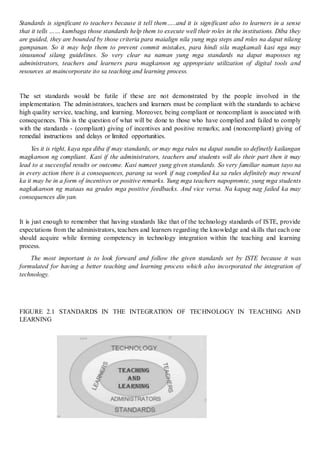
FIGURE 2.1 STANDARDS IN THE INTEGRATION OF TECHNOLOGY IN TEACHING AND
LEARNING
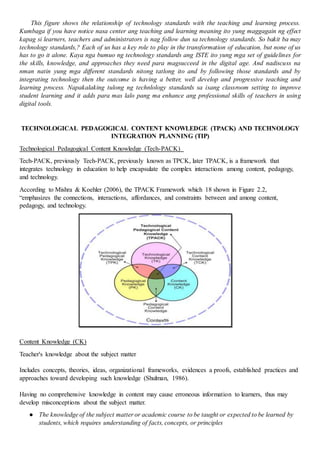
This figure shows the relationship of technology standards with the teaching and learning process.
Kumbaga if you have notice nasa center ang teaching and learning meaning ito yung maggagain ng effect
kapag si learners, teachers and administrators is nag follow dun sa technology standards. So bakit ba may
technology standards,? Each of us has a key role to play in the transformation of education, but none of us
has to go it alone. Kaya nga bumuo ng technology standards ang ISTE ito yung mga set of guidelines for
the skills, knowledge, and approaches they need para magsucceed in the digital age. And nadiscuss na
nman natin yung mga different standards nitong tatlong ito and by following those standards and by
integrating technology then the outcome is having a better, well develop and progressive teaching and
learning process. Napakalaking tulong ng technlology standards sa isang classroom setting to improve
student learning and it adds para mas lalo pang ma enhance ang professional skills of teachers in using
digital tools.
TECHNOLOGICAL PEDAGOGICAL CONTENT KNOWLEDGE (TPACK) AND TECHNOLOGY
INTEGRATION PLANNING (TIP)
Technological Pedagogical Content Knowledge (Tech-PACK)
Tech-PACK, previously Tech-PACK, previously known as TPCK, later TPACK, is a framework that
integrates technology in education to help encapsulate the complex interactions among content, pedagogy,
and technology.
According to Mishra & Koehler (2006), the TPACK Framework which 18 shown in Figure 2.2,
“emphasizes the connections, interactions, affordances, and constraints between and among content,
pedagogy, and technology.
Content Knowledge (CK)
Teacher's knowledge about the subject matter
Includes concepts, theories, ideas, organizational frameworks, evidences a proofs, established practices and
approaches toward developing such knowledge (Shulman, 1986).
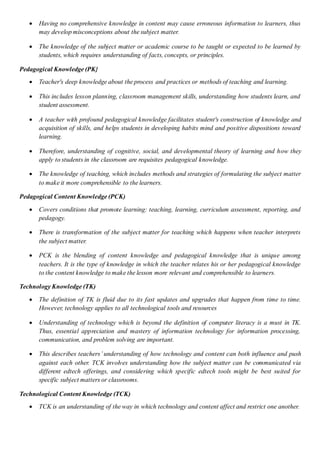
Having no comprehensive knowledge in content may cause erroneous information to learners, thus may
develop misconceptions about the subject matter.
● The knowledge of the subject matter or academic course to be taught or expected to be learned by
students, which requires understanding of facts, concepts, or principles
Pedagogical Knowledge (PK)
Teacher's deep knowledge about the process and practices or methods of teaching and learning.
This includes lesson planning, classroom management skills, understanding how students learn, and student
assessment.
● The knowledge of teaching, which includes methods and strategies of formulating the subject matter
to make it more comprehensible to the learners.
A teacher with profound pedagogical knowledge facilitates student's construction of knowledge and
acquisition of skills, and helps students in developing habits mind and positive dispositions toward learning.
Therefore, understanding of cognitive, social, and developmental theory of learning and how they apply to
students in the classroom are requisites pedagogical knowledge.
Pedagogical Content Knowledge (PCK)
Covers conditions that promote learning: teaching, learning, curriculum assessment, reporting, and
pedagogy.
There is transformation of the subject matter for teaching which happens when teacher interprets the subject
matter.
● PCK is the blending of content knowledge and pedagogical knowledge that is unique among
teachers. It is the type of knowledge in which the teacher relates his or her pedagogical knowledge
to the content knowledge to make the lesson more relevant and comprehensible to learners.
Technology Knowledge (TK)
The definition of TK is fluid due to its fast updates and upgrades that happen from time to time. However,
technology applies to all technological tools and resources
Understanding of technology which is beyond the definition of computer literacy is a must in TK. Thus,
essential appreciation and mastery of information technology for information processing, communication,
and problem solving are important.
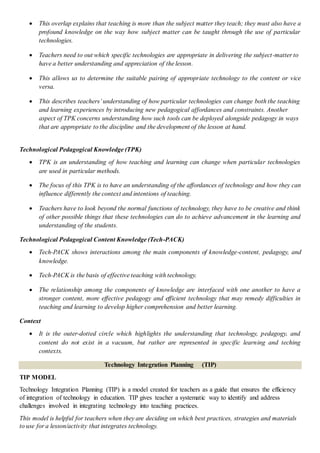
Technological Content Knowledge (TCK)
TCK is an understanding of the way in which technology and content affect and restrict one another.
• This overlap explains that teaching is more than the subject matter they teach; they must also have a
profound knowledge on the way how subject matter can be taught through the use of particular
technologies.
• Teachers need to figure out which specific technologies are appropriate in delivering the
subject-matter to have a better understanding and appreciation of the lesson.
• This allows us to determine the suitable pairing of appropriate technology to the content or vice
versa.
• Knowledge of how to use technology within a specific content area. Knowing how to use a
spreadsheet provides an example of how to analyze a set of data for patterns or knowing how to use
Fraction Bars to show a proportional relationship.
• Knowledge about how technology can be used to provide new ways of teaching content.
• This describes teachers’ understanding of how technology and content can both influence and push
against each other. TCK involves understanding how the subject matter can be communicated via
different edtech offerings, and considering which specific edtech tools might be best suited for
specific subject matters or classrooms.
Technological Pedagogical Knowledge (TPK)
• TPK is an understanding of how teaching and learning can change when particular technologies are
used in particular methods.
• The focus of this TPK is to have an understanding of the affordances of technology and how they
can influence differently the context and intentions of teaching.
Technological skills required for effective teaching with technology.
Knowledge of how to teach students to use technology in learning situations.
A teacher’s understanding of how technology can influence instructional decisions to best support student
learning.
This describes teachers’ understanding of how particular technologies can change both the teaching and
learning experiences by introducing new pedagogical affordances and constraints. Another aspect of TPK
concerns understanding how such tools can be deployed alongside pedagogy in ways that are appropriate
to the discipline and the development of the lesson at hand.
Technological Pedagogical Content Knowledge (Tech-PACK)
● Tech-PACK shows interactions among the main components of knowledge-content, pedagogy, and
knowledge.
● Tech-PACK is the basis of effective teaching with technology.
CONTEXT
It is the outer-dotted circle which highlights the understanding that technology, pedagogy, and content do
not exist in a vacuum, but rather are represented in specific learning and teaching contexts.
TECHNOLOGICAL PEDAGOGICAL CONTENT KNOWLEDGE (TPACK) AND TECHNOLOGY
INTEGRATION PLANNING (TIP)
Teaching can be associated with soldiers who go to war. Soldiers are being trained and they make a lot of
preparations. Before going to war, they plan for the tactics and strategies to be done; they make sure that
they are complete with their stockpile of ammunition and protection. No soldier will go to a war without
enough bullets in his pockets. Same with teaching, teachers are trained on how to teach and manage a class.
Before stepping inside the classroom, they have made their lesson plans on what to teach and how to teach,
they make sure that they have all the materials needed for the lesson. The use of technology is one of the
materials that teachers make use to deliver the lesson successfully to their learners. However, sometimes the
use of technology becomes ineffective because of insufficient knowledge on the true purpose and proper use
of such technology. This is why the Technological Pedagogical Content Knowledge (TPACK) by Mishra, P.
& Koehler, M. and Technology Integration Planning (TIP) by Roblyer, M.D, & Doeririg, A.H. came into
existence, to guide teachers on how to integrate technology into teaching.
Technological Pedagogical Content Knowledge (Tech-PACK)
 Tech-PACK, previously Tech-PACK, previously known as TPCK, later TPACK, is a framework that
integrates technology in education to help encapsulate the complex interactions among content,
pedagogy, and technology. Tech-PACK provides a picture of the entire process of technology
integration that helps identify what is essential and what is not in any discussions of teacher using
technology for teaching subject matter.
 Mishra and Koehler, researchers from Michigan State University, developed TPACK in the absence
of other sufficient theory to explain or guide effective edtech integration. Since its publication in
2006, TPACK has become one of the leading theories regarding edtech and edtech integration:
research and professional development activities both draw from it heavily.
 According to Mishra & Koehler (2006), the TPACK Framework which 18 shown in Figure 2.2,
“emphasizes the connections, interactions, affordances, and constraints between and among content,
pedagogy, and technology. In this model, it shows that content (C), pedagogy (P), and technology
are the main components of teacher’s knowledge. Looking at the model closely, it shows the
interactions between and among the bodies of knowledge: the PCK (PEDAGOCICAL CONTENT
KNOWLEDGE), TCK (TECHNOLOGICAL CONTENT KNOWLEDGE), TPK
(TECHNOLOGICAL PEDAGOGICAL KNOWLEDGE), and TPACK (TECHNOLOGICAL
PEDAGOGICAL CONTENT KNOWLEDGE) which are significant in making teaching and learning
with the use of technology a success.
 Punya Mishra and Matthew J. Koehler’s 2006 TPACK framework, which focuses on technological
knowledge (TK), pedagogical knowledge (PK), and content knowledge (CK), offers a productive
approach to many of the dilemmas that teachers face in implementing educational
technology (edtech) in their classrooms. By differentiating among these three types of knowledge,
the TPACK framework outlines how content (what is being taught) and pedagogy (how the teacher
imparts that content) must form the foundation for any effective edtech integration. This order is
important because the technology being implemented must communicate the content and support the
pedagogy in order to enhance students’learning experience.
 In this model, it shows that content (C), pedagogy (P), and technology are the main components of
teacher’s knowledge. Looking at the model closely, it shows the interactions between and among the
bodies of knowledge: the PCK (PEDAGOCICAL CONTENT KNOWLEDGE), TCK
(TECHNOLOGICAL CONTENT KNOWLEDGE), TPK (TECHNOLOGICAL PEDAGOGICAL
KNOWLEDGE), and TPACK (TECHNOLOGICAL PEDAGOGICAL CONTENT KNOWLEDGE)
which are significant in making teaching and learning with the use of technology a success.
 According to the TPACK framework, specific technological tools (hardware, software, applications,
associated information literacy practices, etc.) are best used to instruct and guide students toward a
better, more robust understanding of the subject matter. The three types of knowledge – TK, PK, and
CK – are thus combined and recombined in various ways within the TPACK framework.
Technological pedagogical knowledge (TPK) describes relationships and interactions between
technological tools and specific pedagogical practices, while pedagogical content knowledge (PCK)
describes the same between pedagogical practices and specific learning objectives; finally,
technological content knowledge (TCK) describes relationships and intersections among
technologies and learning objectives. These triangulated areas then constitute TPACK, which
considers the relationships among all three areas and acknowledges that educators are acting
within this complex space.
Content Knowledge (CK)
 Teacher's knowledge about the subject matter
 Includes concepts, theories, ideas, organizational frameworks, evidences a proofs, established
practices and approaches toward developing such knowledge (Shulman, 1986).
 Having no comprehensive knowledge in content may cause erroneous information to learners, thus
may develop misconceptions about the subject matter.
 The knowledge of the subject matter or academic course to be taught or expected to be learned by
students, which requires understanding of facts, concepts, or principles.
Pedagogical Knowledge (PK}
 Teacher's deep knowledge about the process and practices or methods of teaching and learning.
 This includes lesson planning, classroom management skills, understanding how students learn, and
student assessment.
 A teacher with profound pedagogical knowledge facilitates student's construction of knowledge and
acquisition of skills, and helps students in developing habits mind and positive dispositions toward
learning.
 Therefore, understanding of cognitive, social, and developmental theory of learning and how they
apply to students in the classroom are requisites pedagogical knowledge.
 The knowledge of teaching, which includes methods and strategies of formulating the subject matter
to make it more comprehensible to the learners.
Pedagogical Content Knowledge (PCK)
 Covers conditions that promote learning: teaching, learning, curriculum assessment, reporting, and
pedagogy.
 There is transformation of the subject matter for teaching which happens when teacher interprets
the subject matter.
 PCK is the blending of content knowledge and pedagogical knowledge that is unique among
teachers. It is the type of knowledge in which the teacher relates his or her pedagogical knowledge
to the content knowledge to make the lesson more relevant and comprehensible to learners.
Technology Knowledge (TK)
 The definition of TK is fluid due to its fast updates and upgrades that happen from time to time.
However, technology applies to all technological tools and resources
 Understanding of technology which is beyond the definition of computer literacy is a must in TK.
Thus, essential appreciation and mastery of information technology for information processing,
communication, and problem solving are important.
 This describes teachers’ understanding of how technology and content can both influence and push
against each other. TCK involves understanding how the subject matter can be communicated via
different edtech offerings, and considering which specific edtech tools might be best suited for
specific subject matters or classrooms.
Technological Content Knowledge (TCK)
 TCK is an understanding of the way in which technology and content affect and restrict one another.
 This overlap explains that teaching is more than the subject matter they teach; they must also have a
profound knowledge on the way how subject matter can be taught through the use of particular
technologies.
 Teachers need to out which specific technologies are appropriate in delivering the subject-matter to
have a better understanding and appreciation of the lesson.
 This allows us to determine the suitable pairing of appropriate technology to the content or vice
versa.
 This describes teachers’ understanding of how particular technologies can change both the teaching
and learning experiences by introducing new pedagogical affordances and constraints. Another
aspect of TPK concerns understanding how such tools can be deployed alongside pedagogy in ways
that are appropriate to the discipline and the development of the lesson at hand.
Technological Pedagogical Knowledge (TPK)
 TPK is an understanding of how teaching and learning can change when particular technologies
are used in particular methods.
 The focus of this TPK is to have an understanding of the affordances of technology and how they can
influence differently the context and intentions of teaching.
 Teachers have to look beyond the normal functions of technology, they have to be creative and think
of other possible things that these technologies can do to achieve advancement in the learning and
understanding of the students.
Technological Pedagogical Content Knowledge (Tech-PACK)
 Tech-PACK shows interactions among the main components of knowledge-content, pedagogy, and
knowledge.
 Tech-PACK is the basis of effective teaching with technology.
 The relationship among the components of knowledge are interfaced with one another to have a
stronger content, more effective pedagogy and efficient technology that may remedy difficulties in
teaching and learning to develop higher comprehension and better learning.
Context
 It is the outer-dotted circle which highlights the understanding that technology, pedagogy, and
content do not exist in a vacuum, but rather are represented in specific learning and teching
contexts.
Technology Integration Planning (TIP)
TIP MODEL
Technology Integration Planning (TIP) is a model created for teachers as a guide that ensures the efficiency
of integration of technology in education. TIP gives teacher a systematic way to identify and address
challenges involved in integrating technology into teaching practices.
This model is helpful for teachers when they are deciding on which best practices, strategies and materials
to use for a lesson/activity that integrates technology.
It is very basic naman at sobrang daling intindihin, so sa papamagitan nitong TIP, nakaka pag decide ang
teachers or nakakahanap sila ng magandang way or strategies to make learning more interesting, more fun,
more motivating, easily accessible, upgraded at madami pang iba, and it is through the help of technology.
The Technology Integration Planning Cycle is a flexible and reflective model that assists educators in
creating lessons that integrate digital technology into literacy instruction while supporting the Common
Core State Standards (Hutchison, 2014). We are all aware naman kung gaano ka importante ang integration
ng tehcnology sa education natin ngayon, and itong TIP is a helpful planner kung paano nga ba ang right
and best ways to integrate technology sa learning process, considering the challenges, weaknesses,
strengths and evaluations.
Technology not only brings greater learning access to the classroom, but also lets teachers adapt to
individual students’learning styles, customizing lessons and homework to fit their unique approaches and
optimize the results. Students who are more visual can enjoy video presentations, while audio learners can
access podcasts related to the lesson. Student progress can be tracked more accurately, with advanced
students getting access to different homework or projects than those who might be struggling with a topic.
Further, TIP Model shows teachers how to establish a milieu in which technology can effectually enrich
learning.
Technology provides convenience for everyone, and even in education is malaki ang factor na naiaambag
ng technology sa sistema neto. To be honest, mas malawak ang nagiging learning environment ng mga
learners through the use of technology. But given na madami itong advantages, ofcourse, madami ding
challenges and consequences ang pag gamit nito. That's why, etong TIP model ang mag gui-guide for
teachers to integrate technology in the most ethical, moral and right way kung saan pati students and
parents is identified as an important factor when considering and implementing activities and performances
online.
However, technology in the classroom offers many benefits that outweigh potential disadvantages –
especially if school faculty is prepared to handle the influx and usage of devices during class periods.
Rather than fight widespread tech adoption among younger generations, it can instead be embraced as a
powerful teaching tool that prepares students for tech-integrated careers.
In the earlier editions of TIP Model, there were five to six phases to enable the teachers successfully
integrate technology in instruction. In the recent edition (6th), it boils down into three phases with sub steps
in each phase.
The TIP model gives teachers a general approach to addressing challenges involved in integrating
technology into teaching.
•The TIP model serves as a helpful guide on procedures and to address issues for new teachers and those
just beginning to integrate technology into their classroom.
•The TIP has five phases. Determining relative advantage, Decide on objectives and assessments, Design
integration strategies, Prepare the instructional environment, and Evaluate and revise integration
strategies.
Pero ngayon naman is from five phases, nag down into three phases ang TIP Model and each phases is
merong mga steps that help guide teachers kung ano ba ang tama at kung alin ang dapat nilang pag
focusan when integrating technology in the classroom.
PHASE 1: ANALYSIS OF LEARNING AND TEACHING NEEDS
During Phase 1, teachers look at the learning needs of their students to determine which
strategy/method/practice they will implement. This phase includes 2 analysis steps.
self-explanatory naman ito, dito daw i aassess ng teachers/faculty kung ano ba ang needs ng students at ng
teachers/learning environment.
STEP 1: Determine the relative advantage
Focus: Will a technology-based method offer relative advantage?
Heraclitus once said that nothing is permanent in this world except change. But, some people resist to
change things that they are used to doing because according to them they still able to deliver well using the
old method even if there are new better approaches to achieve the task. However, change may be acceptable
if they would understand the advantages of the new method over the old one. This is seeing a "relative
advantage" as mentioned by Everett Rogers.
Step 1: Relative Advantage
This step helps teachers pick a strategy or method once they can see clear and beneficial impacts, or
relative advantages.
Eventhough mahirap baguhin ang traditional method sa classroom but if we can observe na hindi na ito
effective, we need to adapt to the modern world. As long as itong ipapalit natin is malaki ang impact or
advantage not just for the learners, but also for the school, faculty and future generations.
For example: If ang way ng ating pagprepresent ng information noon is through presenting reports in
manila papers, the best possible way to upgrade ito is through powerpoint presentations. And andaming
advantage nito, it can catch learners interest lalo if may mga pictures or video presentations. And it can
also motivate learners, and help them be active in the teaching and learning process.
when we say relative advantage- the belief that a new system has benefits above and beyond the current
system. kumbaga mas mataas ang kalidad ng bago kesa sa luma.
Below are the measures to see relative advantage easier:
1. COMPATIBILITY- Methods consistent with their cultural values and beliefs and others adopted in the
past. For example, teachers see using technology as compatible with their views of being an updated
teacher.
2. COMPLEXITY- Easy enough for them to learn and to carry out on a frequent basis. Teachers who use
technology-based methods feel no fear and find no difficulties in understanding and learning something
new.
1. From the word compatible, dito is being able to connect yung old tradition sa new methods.
Characteristics kasi ng teacher na dapat laging nasa kanila is dapat they are flexible and adaptive,
kailangan marunong silang magblend sa kung ano yung bago. Even if iba yung nakasanayan, they should
always feel compatible and comfortable sa mga bagong methods. Kung kaya dapat is lagi silang updated.
2. Dito naman sa complexity is being able to adapt to changes without fearing the consequences and
possible problems. Imagine from traditional na biglang magshishift sat technology-based methods, na
eventhough they are yet aware with it, they don't fear and find difficulties with it. kasi teachers should be
flexible and adaptive.
Below are the measures to see relative advantage easier:
3. TRIABILITY- Being able to try out a little before making a final decision. Teachers have the courage to
try using and applying technology-based methods than saying no to it outright.
4. OBSERVABILITY- Seeing others they respect or emulate using the new method successfully.
Observation is one of the many ways to help teachers decide wheter technology-based method will be
helpful or not or if it is effective or not.
3. This is being courageous not knowing the results but still try out something new. Sabi nga lagi diba,
experience is the best teacher. Hindi mo malalaman or maiidentify and importance ng isang bagay unless
you try it out. For example, still finding out how to compute grades using excel. kasi you are trying to
compute grades despite having no knowledge kung paano magcompute. And through trials and errors,
you'll still be able to identify the correct way. And after finding out, you'll assess kung helpful ba itong
nadiscover mo compared sa dati mong way ng pagcocompute.
4. Observation is also one of the biggest advantage natin as an individual, we can learn simply by
observing. And as time passed by, we can definitely judge and guarantee kung ang isang method ba is
effective enough or not, simply by observing.
At this phase, teachers do curriculum review and assessment of teaching methods, then, they determine
problems in instruction and find out which technology may be helpful to remedy the problem.
Summary of issues to address in Step 1:
1. Are there any topics or curriculum objectives I have difficulty teaching?
2. Do any of these instructional problem areas have tehcnology-based solution?
3. What is the relative advantage of the technology-based solutions?
4. Is the relative advantage sufficient to justify the effort involved?
Teachers look at their current teaching problems and identify technology-based methods that may offer
good solutions.
•Technology–based strategies offer new resources for teachers.
to identify specifically ang mga issues na need ma addressed dito sa step nito, here are some guide
questions to easily identify problems and provide accurate solutions.
1. identify kung may nahihirapan ka bang ituro na topic so you can give better solutions to address it.
specially through the help of technology.
2. ayun, so kailangan every inch of problems is kailangang salain maigi, lalo na when deciding to use
technology, na before using it, dapat is may back-up plan in case nagka problem sa area na yun.
3. identify and compare traditional and modern techniques and strategies lalo na yung mga solutions, if sila
ba ay short-timed solutions or mas longer ang validity nito.
4. is it worth the effort? hindi ba ito time consuming or 100% accurate ba ang mga nahanap na relative
advantage ?
STEP 2: Assess Tech-PACK
Focus: What is my technological pedagogical content knowledge (tech-PACK)?
Teachers have to be proficient in content, pedagogy and tehcnology before the day of instruction comes.
The teacher has to spend time in understanding all the components of knowledge to have a better and
successful delivery of the lesson. Being knowledgeable of the content, pedagogy and technology will make
the teacher confident in the entire process of teaching and learning. This tech-PACK helps to emphasize
technology contribution to teaching.
Step 2: Tech-PACK
Tech-PACK stands for technological pedagogical content knowledge. This is how much teachers know
about what they're teaching, how they're going to teach it, and what tools/resources they use to get the job
well done.
eto na yung process of execution, if ready na ba lahat or hindi pa. dito i assess kung alam na ba ng teachers
or prepared na ba sila for the instruction.
Technological, Pedagogical, Content Knowledge (TPACK) is a conceptual framework that teachers can
effectively incentivize as technology is ubiquitous. Technology infusion in a specific educational context is
beneficial if pedagogy and content are effectively aligned it.
importante na before teachers conduct their instruction, dapat is ready na sila and prepared enough to
utilize technology in their teaching process. kagaya na lamang ng mga ctrl keys dapat is mastered na nila
ito so if sila ay nagprepresent ng information, alam nila kung ano ang mga shortcut keys para mas mabilis
macontrol ang computer at ang presentation.
Summary of issues to address in Step 2:
1. Do I have the mastery of subject matter, both the content and its context?
2. Is the pedagogy I am planning to employ appropriate for the subject matter, my learners, and technology?
3. Is the technology I am planning to use appropriate for the subject matter, pedagogy and my learners?
4. Have I reviewed my TPACK?
1. kagaya nga ng sabi ko, dapat is ready and confident enough sila sa kanilang knowledge and strategies na
gagamitin.
2. identify the right pedagogy, ito bang strategies na gagamitin ko is align para sa lahat? akma ba ang
activity na aking ipapagawa para sa subject at para sa students?
3. same as number 2, dito naman i aanalyze mo if capable ba lahat ng students mo na maka adapt sa
gagamitin mong technology
4. as always, be ready.
PHASE 2: PLANNING FOR INTEGRATION
During Phase 2, teachers create their plans for instruction delivery, ways to assess their students, and an
environment supportive of technology integration. (3 steps)
dito na ipla plan ang pag iintegrate ng technology sa classroom, considering the advantages and
disadvantages.
STEP 3: Decide on objectives, assessments
Focus: How will I know students have learned?
Teachers define the skills they want their students to possess upon learning the lesson and create ways to
measure the authenticity of students' learning and how successful the activities have been carried out by
them.
The problem that have been identified in phase 1 must be addressed successfully by defining
observable and measurable outcomes. Then, teachers design activities or performance task to measure the
outcomes. Teachers must remember that having more than the multiple choice activities is better to
effectively see authentic learning among learners.
Objectives and assessments are vital components because teachers must lay out the skills and concepts they
want their students to learn, and design ways to determine if the students learned the content or not.
ofcourse, hindi naman masusukat ang learning ng mga bata if there is no objective and assessments. It is
important na before mag start ang instruction is may desired objectives na ang teacher na inaasahan
niyang ma achieve ng mga students.
Mostly, we can accurately measure student's progress and learning through performance.
Before integrating technology, teachers must create objectives na sa tingin nila is mas mag eexcel ang
students. kagaya na lamang ng expecting them to learn to compute grades sa pamamagitan ng pagtuturo
through computers.
and we can assess them naman by observing their performances in computing, kung gaano sila kabilis
natapos and if ang sagot nila is tama.
Summary of issues to address in Step 3:
1. What kind of performances do I expect from students to show they learned?
2. What is the best way for me to assess students' learning progress and products?
3. Do the desired instruments exist or do I have to develop them?
4. What other methods could gauge success?
1. you can expect naman from students since you have given goals for them to achieve. ang best thing to do
dito is to analyze kung ano ba ang pinakabest type ng performance activities na dapat ipagawa sa students
to assess their learning. for example: subject is ict, expect them to be able to create their own websites.
2. dito is hahanap ka ng way na hindi ka magiging bias and magiging fair ka sa lahat students, ano nga ba
ang best way para ma measure ang kanilang learning? may progress ba or wala? ano ang naicontribute
nila? well, this can happen through recitations, timed activities, etc.
3. dito naman is identifying progress and developing new ideas.
4. ayun, syempre hahanap ka ng ibang way to lead your students to excel and succeed.
STEP 4: Design Integration Strategies
Focus:What teaching strategies and activities will work best?
Teachers decide on pedagogies and study its execution. In deciding on the instructional course of action, the
characteristics of the topic and the needs of the students are being taken into consideration whenever
teachers create an instructional design for technology integration. With these, teachers make decision on:
1.Instructional Approaches- traditional or constructivist approach
2. Curriculum Approaches- single subject approach or interdisciplinary approach
3. Grouping- from individual to pair or group learning
4. Sequence- must have acquired technology prerequisite skills to successfully learn from the resources.
Step 4: Integration Strategies
Teachers pick strategies that will help them carry out their lesson or activity. They are chosen based on the
learning situation.
In here, teachers will plan and design the integration process. I coconsider nila ang best action or
strategies na dapat nilang gawin na nakabased sa topic or sa subject.
For example, they'll find a way on how to present historical events easily and effectively, ofcourse they'll
think different strategies kung paano ba ito maiprepresent ng maganda? is it through a video presentation?
a game? flashcards? and after deciding kung alin ang akma, they'll also need to consider kung makaka
relate ba ang students sa strategy na ito, capable ba lahat ng students? That is why kelangang magkaroon
ng masinsinang analysis kung pano mag integrate ng technology sa education.
1. Dito the teachers will decide kung ano ang best para sa teaching and learning process, kung alin ang
most beneficial between the two. Ano nga bang instructional approach ang best na mag susuit sa topic or sa
subject na tatalakayin, is it through traditional na teacher-centered? or it can be constructivist na students
will explore and identify new knowledge and relate it to real world context.
2. Dito naman is nag dedecide ang teachers based sa curriculum, the strategies na gagamitin is pwedeng
nakafocus lang sa mismong subject or it can be related to other disciplines.
3. Teachers have to consider everyone, from individual to pair or groupings, dapat is lahat is nagcliclick or
naka align.
4. Sequence is important so teachers will know kung paano ba ang series of information, and kung ano ang
tamang order na gagawin to make learning successful and effective.
Summary of issues to address in Step 4:
1. Should instruction be directed, constructivist, or a combination of both?
2. Will the instruction be single subject or interdisciplinary?
3. Should activities be individual, paired, small group, large group, or whole class?
4. What strategies should I use to encourage females and minority students to be integrally involved with
the technologies?
5. What sequence of activities should I teach?
6. Have I built in demonstrations of the skills students will need to use both equipment and the specific
software?
7. Have I allowed students enough time to get used to materials before beggining a graded activity?
1. alamin kung ano bang type ng instructional approaches ang magtatama sa topic na ididiscuss, does it
have to be within the subject only or can it be related to real world context?
2. like number 1, gaano ba kalawak ang dapat na matutunan ng students.
3. Consider the number of individuals based on the topic na ididiscuss, kung ang strategy ba dapat is by
group, by pair or individual.
4. it is important na makuha mo ang interest ng iyong learners, and through technology, it can easily caught
the learner's interest and motivation, through these nagiging active ang mga learners and namumulat and
narerelate nila ang subject from school to real world context.
5. the order of activities is based sa topic na ididiscuss mo. mas maganda na merong lesson plan para mas
maganda and mas madaling i identify ang series of events/informstion.
6. dapat is before ka magstart to discuss, you have to know if ang mga students mo is maalam or master na
kung paano gumamit ng technological tools.
7. this is basic naman, ofcourse you have to design and plan the time para makapa and ma-master ng
students ang mga materials na possible gamitin through discussing the topic.
STEP 5: Prepare Instructional Environment
Focus: Are essential conditions in place to support teaching and learning?
Teachers establish the educational environment to carry out effectively the plan of using technology in
teaching and learning.
With the support of International Society for Technology in Education (ISTE) the teachers will be
guided in setting the essential standards to unleash at its level best the potentials of technology tools and
methods when used in teaching and learning. Teachers have to remember that integration of technology in
education would only be successful if there is an adequate hardware, and technical support available.
Step 5: Instructional Environment
Does the teachers environment support the integration of technology? This includes software, devices, etc.
for all types of learners.
Super easy naman nito, syempre we are talking about integration of technology. So, ang problem and
question dito is ready ba or well equipped ba and school or learning environment ng mga bata? Dito natin
makikita if ready ba ang instructional environment ng mga learners, meron bang mga devices na
makakapag suporta sa integration of technology sa learning process ng mga bata? If ever na meron, is it
enough to support all students? or handa ba ang school sa pag iintegrate ng technology sa curriculum?
Kaya dito, kailangang ma iprepare or makapag provide ang school ng mga essential tools na
gagamitin in integrating technology in the learning process. Andito yung mga tv for presentations, speakers
for meetings, devices such as computers na nagfufunction ng maayos, softwares na naka install in each
devices na gagamitin din ng mga learners and many more.
Sabi nga dito, magiging successful lamang ang integration of tehcnology if merong adequate na support for
the integration. And iyon nga yung sinasabi ko, yung mga main . materials na kelangan. Kasi hindi naman
tayo makakapag integrate kung walang tools na gagamitin diba? and that's why these tools are the
essential elements to make the integration of technology possible and effective.
Summary of issues to address in Step 5:
1. What are the technological needs necessary to carry out the activities?
2. Is the supply of computers and copies of software enough to carry out the activities?
3. When and how long will the technology resources be needed?
4. Do I need to set the schedule for occupancy of laboratory or media center?
5. Will projection devices or large screens be needed for demonstrations?
6. Have I checked out the legalities of the uses of technology I want to make?
7. Have I looked into students' privacy and safety in carrying out the activities?
8. Have I considered the necessary provisions for students with physical disabilities in carrying out the
activities?
9. Am I knowledgeable in troubleshooting if ever problems arise during the activity?
10. Have I set and tested everything that is needed before the students do the activity ?
11. Do students already have the knowledge in suing the technologies that they will be using for the activity?
12. Am I ready with a backup plan whenever the planned resources fail to work?
eto naman is mga basic na tanong, and we're all aware of it. nabanggit nga dito yung mga materials na
kailangang gamitin, no. of stocks of tools, and ofcourse kelangan din natin in preparing the environment
ang knowledge ng mga teachers about technology. Importante kasi na knowledgeable enough ang teachers
about these, para in case any problem occurs alam nila kung ano ang right way to handle it and they can
also have back up plans in case hindi nsg work out yung unang plan.
Dapat is trained and master ng teachers ang paggamit ng mga devices na ito so they'll be able to
execute perfectly yung mga lessons, lalo na if hindi masyadong aware or hindi familiar ang students sa mga
tools na ginagamit, teachers will provide information kung paano ba ito ginagamit and ano ang sense nito.
PHASE 3: POST INSTRUCTION ANALYSIS AND REVISIONS
During Phase 3, the teachers continue to plan by analyzing and reviewing lessons and activities that have
been delivered.
analysis is important because it organizes and interprets data, then structures that data into presentable
information useful for real-world applications.
dapat is meron talagang analysis so maidentify if alin ba ang mga problems or challenges na pwedeng
mangyari, and kung anong solution ang maganda to solve it. Through analysis, nagkakaroon ng
masinsinang pagpili or pagdedesisyon. Halimbawa, ito bang software na ito ay makakatulong para
mapaunlad ang idea ng mga bata? ano ang mga possible consequences if i let them use it? Ano ang mga
advantages nito? is it helpful for students to connect in real life?
Kumbaga through this phase, hinihimay himay ang bawat detalye na gagamitin before finally deciding. And
this process takes a lot of time before mafinalize kasi you have to consider the positive and negative sides.
STEP 6: Analyze Results
Focus: What worked well? What could be improved?
Teachers have to spend time reflecting and assessing themselves to determine wheter the integration of
technology and if all processess in teaching and learning went on smoothly and have been successful in the
delivery.
Step 6: Analyze
Teachers must look at what worked in a lesson and plan, design and create ways that improve the lesson.
so yun nga, this is time consuming because madaming factor ang kailangan iconsider ng teachers. Kagaya
na lamang ng in case na magkaroon ng problems, ano ba ang dapat gawin? And from the instruction, ano
ang nagwork ng mas madali sa learners para matuto sila? ano ba ang mga dapat iimprove, is it the type of
presentation, the background, the setting, etc.
Summary of issues to address in Step 6:
1. Was there a change in the behavior of the students upon learning the subject matter?
2. Were the students engaged in the instruction and tasks given?
3. Did the technological resources work well as expected?
4. Did the students work deeply and thoroughly in the teaching and learning environment?
5. Is the integration of technology in education, instruction, strategies, activities, assessments work well in
the entire teaching and learning process?
1. you can notice naman in student's behavior if they are enjoying or if they are learning, you can see them
actively participating, and isa yun sa goal na dapat maachieve ng mga teacher after discussion.
2. yun nga, catch their attentions, it can be in the form of warm up dances, funny games, etc.
3. does the devices being used worked perfectly during the discussion? ano ang mga problems na
naencounter? through that, alam na sa next ang gagawin.
4. Na engage ba ang mga students sa subject?
5. is there any problem na nag occur during the process of learning?
STEP 7: Make Revisions
Focus: Should I make the revisions?
After analyzing the results, it is important to determine the necessary areas which need improvement for
better execution of instruction with technology integration in the next time around.
Step 7: Revisions
The final step is actually carrying out the plans made during step 6.
Now, after ma analyze ang mga good thing na dapat i keep, it's also time para i address naman ang mga
issues na dapat iconsider at masolve.
alin bang part or strategy ang dapat iimprove, is it the approach or the activities?
para maging perfect and smooth ang discussion, teachers have to adress the issues and make revisions para
there'll be no more problems na maeencounter.
Summary of issues to address in Step 7:
1. What pedagogy should I do to make the instruction more interesting and engaging?
2. What technology resources should i use next time for better understanding of the lesson?
1. is it the change of strategies?
2. is it video presentation? online games? etc.
So, that concludes our discussion for today. Basically, sobrang easy naman maintindihan nito, this model
helps the teachers to perfectly present and discuss their topic with the use of technology by considering
every factor and challenges na maaring maging hindrance. And by having this model, teachers can
confidently teach their lessons kasi they undergo the process of planning the integration, andun na nga
yung pagibibigay solution sa mga problems.
We all know naman how important technology is lalo na sa education and we have to adapt to these
changes but with limitations, lagi dapat nating incoconsider ang mga barriers and possible problems na
makakaapekto sa teaching and learning process.
STAGES OF TECHNOLOGY INTEGRATION IN TEACHING AND LEARNING
In every cycle, anything and everything begins with first stage. Before a butterfly begins to spread its
wings to fly, it passes through different stages from tiny egg to a beautiful insect with wings. A teacher
likewise passes through different stages of teaching from novice to proficient, to highly proficient, to
distinguished or expert teacher. A teacher moves on from one stage to another based on his experiences,
achievements, increased knowledge and skills, and developing characteristics. Same is true when it comes
to technology integration, a teacher who is beginning to learn about technology may experiment on how
technology can be integrated in instruction until he understands fully the appropriate use of technology in
instruction.
The following are the different stages of technology integration:
BEGINNING
ST
AGE
DEVELOPING
ST
AGE
PROFICIENT
ST
AGE
TRANSFORMATIVEST
AGE
Teachers still make use
chalkboards, textbooks,
workbooks, hand-outs,
worksheets in theirinstructions
andactivities despitethe presence
of the selectedtechnologies and
other resources that support
student learningexperience.
Teachers plan,manage, and
facilitatestudent understanding
of technologies andother
resources best suitedto support
specific learningexperiences.
Teachers demonstrate andmodel
effective use of a varietyof
existingandemerging
technology-basedresources to
encourage students toengage in a
range of learningexperiences.
Teachers engage withstudents to
explore anddetermine
appropriate uses of existingand
emergingtechnology-based
resources so that students may
effectivelyplan, manage, and
evaluate their learning
experiences.
Teachers researchanddiscuss
strategies students canuse to
promote knowledge construction
anddemonstrate creativity.They
monitor safe,ethical, legal and
healthyuse of technology and
informationresources.
Teachers facilitate andguide
students as they employstrategies
to construct knowledge and
promote creative thought; they
model safe, ethical, legal, and
healthyuse of technology and
informationresources andhelp
students address threats to
security of technologies, data and
information.
Teachers model creativityand
knowledge constructionand
enable students todemonstrate
creativityandinnovation.
Teachers advocateforand
effectivelyinstruct students in the
safe, ethical, legal, andhealthy
use of technology and
informationresources including
emergingpolicies andpractise
Teachers collaborate withand
involve students as leadlearners
to engage in activities topromote
creativityandinnovation and
explore complexissues. They
engage students as active
participants in thesafe, ethical,
legal, andhealthy use of
technologyandinformation
resources by encouragingthemto
relatedto issues such as security,
intellectual property,andpersonal
rights.
establish policies andprocedures
for its use anddetermining
methods toaddress its misuse.
Teachers use andmodifythe
existinglearningresources to
redesign instructional and
learningactivities forstudent
learning.
Teachers adapt orcreate
instructional activities that allow
students to collect andreport
informationthrough a varietyof
products andformats. Teachers
develop andconduct formative
andsummative assessments to
inform teachingandlearning.
Teachers design andcustomize
instructional activities in
response tostudents’learning
styles, preferences,and abilities,
so that students develop
questions, proposesolutions, and
elicit feedback on theirlearning.
Teachers provide students with
various opportunities to
demonstrate skills andknowledge
to adapt future teachingand
learningopportunities.
Teachers collaborate with
students to identify anddevelop
personalizedinstructional
activities that allowstudents to
formulate, evaluate, andtest
hypotheses toaddress complex
problems that address real-world
local andglobal issues with their
teachers, otherstudents, and
outside experts andshare their
informationforreal-world
application.
Teachers engage students in the
development andanalysis of
various opportunities to
demonstrate skills andknowledge
to orient future teachingand
learningopportunities toward
areas necessary forgreatest
student success.
Students use technology tools to
research andcollect information.
Students use technology tools to
collect information, synthesize,
andcreate newinformationin
projects guidedby their teachers.
They explore issues of individual
interest relatedtotheirlearning.
Students use technology support
of collectingandsynthesizing
information, developingand
demonstratingcritical thinking,
andsolvingauthenticproblems
through the creationofprojects
they propose.Students use
technologytoplan, manage, and
reflect on their own learning.
Students collaborate and
communicatewith theirteachers,
other students, andexperts to
select anduse technologytools
that align with learning
preferences, styles,andcontent
requirements in order to address
real-world, complex problems
with multiple answers or
solutions. Students routinely
monitor, evaluate, andadjust
their own learningstrategies and
thinking.
BEGINNING STAGE- first phase, first stage, first step
DEVELOPING STAGE – where growth happens
PROFICIENT STAGE- also called as the “skilled stage”
TRANSFORMATIVE STAGE - causing a marked change in someone or something
Ttl 2-transcript-prelims

Ttl 2-transcript-prelims

  • 1.
    TEACHERS AND STUDENTSIN THE DIGITAL AGE Teachers of the Early Generations VS. Teachers of the 21st Century  They were regarded as instruments for information dissemination and communicators of knowledge in which the students obediently receive and believe.  Teachers today are far different from teachers of yesteryears.  They were always in authority over the students. Basically, a TEACHER-CENTERED APPROACH was observed.  21st century teachers are believed to be more immersed in the use of technologies. More than teaching the subject matter, they teach students how to learn to live life.  Disseminate information through lectures.  Allow students to solve real world problems.  Requires students to memorize contents from textbooks.  Allow students to construct their own understanding of the subject matter.  Make use of textbooks and workbooks as their reference.  Make use of manipulative materials; make use of multitude of prints and electronic sources.  Give assessment through written examination.  Give performance-based assessments.  Focus on their responsibility and relationship with the students as recipients of knowledge.  Widen their responsibilities to others in acquiring knowledge, skills and values that students are required.  Followers of policies prescribed by the school.  Participate in decision-making process.  Use lecture as teaching method.  Use a variety of teaching methods appropriate in the student’s learning.  Deliver the same lessons every year.  Spend time in research for updates.  Too focused on self-achievement  Mentor new teachers.  Target to finish the lesson within the period.  Target the learners to be ready in the challenge of today’s learning.  Has control of everything inside the class. (Autocratic)  Allows learner to take responsibility in their learning. (Democratic)  Holder of knowledge or gatekeeper of information.  Facilitator of learning  Technology illiterate  Technology or digital literate
  • 2.
    CHARACTERISTICS OF A21ST CENTURY TEACHER 1. Channel- Teachers serve as channels in connecting the curriculum, software, hardware and dynamics of teaching in their instruction. 2. Communicator- This odes not only refer to having a good language in communicating knowledge to the students, but being a teacher who can communicate with their students anytime and anywhere with the use of the tools and technologies. 3. Learner- Teachers never cease in learning new knowledge. Learning technologies of today will give the teachers a big leap in the advances of today and tomorrow’s teaching and learning. 4. Futurist- Teachers are futurist not only on what they want their students to achieve at the end of the lesson, but on how they will deliver the lesson with the use of the emerging tools and other web technologies that will help the learners understand the lessons better. 5. Leader- Teachers are leaders in their own way by leading their students to the proper and appropriate use of learning materials including technologies. 6. Exemplar- Teachers are models when it comes to behavior, language, dealings with colleagues and students, use of facilities and others. They are likewise models not only in what they teach but according to what they practice, even with the use of technologies. 7. Collaborator- Teachers must pull up their collaborative tools to be able to continue to share and contribute their knowledge to the learners. 8. Venture Player- Teachers are venture player in taking chances to apply new knowledge, practices, and technologies. Especially if these will level up the student’s understanding and learning. One of the biggest challenges of teachers in the 21st century is not only to utilize technologies to support teaching and learning but to use technology to extend quality and authentic learning opportunities.  Students in the earlier generations are indeed different in today's generation.  Having technologies at their side make them more advanced in information where they do not need to have a long distance walk just to access information from the books in the library.  Almost all information and tools that they need are already at the palm of their hands. They only need to access and use these technologies rightfully and appropriately.  Before, the students depend so much from the teacher when it comes to learning. They listen passively to the discussions, they only speak or answer when they are asked.  Students before learn theories through memorization of text, and many others in which we can tell that is not entirely authentic. Students of Yesteryears Students of the 21st Century  Receiver of facts and information  Active creators of knowledge  Learning is based on repetition  Interactive knowledge Constructor  Textbook users  Internet users to access a vast of information
  • 3.
     Passive recipientsof information  Actively engaged in class activities  Competitive learners  Collaborative learners  Factual Thinkers  Reflective, critical and creative thinkers  Unilateral thinkers  Divergent Thinkers  Inactive process of learning  Dynamic processes of learning  Dependent learners  Self-managing learners  Single Taskers  multitaskers  Single Sensory Input Provider  Multisensory input provider With the existence of technology, there expected from the students. They have to get away with being passive learners. They have to: 1. Learn to generate their own ideas and construct their own understanding of the lesson; 2. Create works that are original; 3. Communicate clearly with other students and with their teachers; 4. Collaborate with one another to achieve higher standard of learning; and 5. Innovate learning and their outputs. INSTRUCTIONS IN THE EARLY GENERATIONS VS. INSTRUCTION IN THE 21ST CENTURY Good Day, Everyone! I’m Mr. Ryan Christopher D. Bucad, your reporter for today’s discussion. In our previous discussion, Ma’am Rosemarie discussed the differences of teachers and students of the early generations and the teachers and students of today’s century. We have also learned that in the early generations, teachers make use of lecture and traditional discussions in teaching lessons. Before, teachers are in huge control of information dissemination which means everything is being fed up to the students or the what we so-called “spoon-feeding”. In addition, teachers instruct students and give everything such as the step-by-step procedure on how to do tasks. In this set-up, students on the other hand would simply follow the instructions given to them without having the freedom to discover learning on their own which is against dun sa theory na students learn best when they discover it. Before kasi students are tied up with what the teacher has to say in class. Lecture is an effective mode of instruction but may not be as effective as other pedagogies which would make teaching and learning more interesting, engaging and would absolutely give the students quality education and authentic learning. It was indicated there that lecture is an effective mode of instruction and we can’t deny it because it really is. I mean, effective talaga siya in teaching the lesson but the question is how effective is it para
  • 4.
    ma-absorb ng estudyanteyung information that is being shared. That is why now that we are in the 21st century, marami ng other pedagogies or yung method and practice of teaching ang naimbento which would make the teaching and learning process more effective, more interesting and more engaging sa part ng students. Kasi the fact that students are madaling maboring, kailangan humanap ng ibang ways on how to get their undivided attention and interests because once the learner is into the lesson proper, learning becomes more permanent and naeensure yung authentic learning that would result to high students quality education. With that being said, I will be enumerating some of the useful and effective teaching methods and strategies. Here are some of the useful and effective teaching methods and strategies: 1. Interactive lecture First one is interactive lecture. Interactive lecture is similar to the traditional lecture in which teachers discuss something but then what makes this different is that dito students are given the opportunity to interact actively and directly with a material through a specific learning tasks. Lectures ay nagiging interactive din if the instructors make use of techniques such as think-pair-share, demonstrations and role playing that would elicit active engagement among students and maeenhance din yung value of the lecture segments. 2. Case-basedlearning Second is case-based learning. Itong case-based learning ay tinatawag ding case method which is one of the student-centered learning approaches. Ginagamit ito in various disciplines where students apply their knowledge to real-world scenarios, and ipinopromote niya yung use of higher levels of cognition. In Case-based learning classrooms, students ay gumagawa in groups on case studies, stories involving one or more characters or scenarios. Yung mga cases na iyun is may problem or disciplinary problem na gagawan naman ng solutions ng estudyante through the guidance of the instructor. Like for example if ang concern ay public health. Pwedeng ang case-based learning na ipagawa is that yung case study describes a pandemic of deadly infectious disease. Students then have to work through the case para maidentify the Patient Zero, the person who was the first one to spread the disease and how that individual became infected. Kung business-related problem, applicable din itong case-based learning. Pwedeng students will work on a case study na nagpapakita ng history of a business success or failure. Then i-aapply nila yung business principles that they have learned in the classroom and i-assess nila why the venture was successful or not. 3. Problem-based learning Third one is problem-based learning which is another teaching method na gumagamit ng real-world complex problems as a vehicle para maipromote yung student learning of concepts and principles as opposed dun sa direct presentation of facts and concepts. Using this type of approach will promote the development of critical thinking skills, problem-solving abilities, and communication skills. Ang example ng problem-based learning is that inaallow natin yung students na gumawa ng business plan to solve a societal need. Another one is pwedeng students could work independently or in groups para makapagconceptualize, makapagdesign and makapag-launch ng innovative product in front of their classmates or in the community. 4. Inquiry-based learning Fourth one is inquiry-based learning which is another teaching method that combines the curiosity of the students and the scientific method to enhance the development of critical thinking
  • 5.
    skills. It promotesengagement, curiosity and experimentation. Dito sa approach na ito, rather than instructing students, ganito mo gawin yan, mali yan, dito sa approach na ito, students are empowered na iexplore yung subjects by means of asking questions and finding or creating solutions. And ang approach na ito is hindi lang nakacenter dun sa asking a student what he or she wants to know bagkus nakafocus ito dun sa way of teachers in triggering the curiosity and activating the curiosity. Ito is anchored dun sa sinabi ni Lou Holtz na I never learn anything talking. I only learn things when I ask questions. 5. Project-based learning Fifth is project-based learning. It is a teaching method in which students gain knowledge and skills by means of working for an extended period of time to investigate and respond to an authentic, engaging and complex question, problem or challenge. This approach is may output sa huli na mabubuo such as accomplishing a complex task by means of performing a presentation and producing a project, a craft or an artifact. Another application of this one ay yung allowing agricultural students na mag-come up ng organic farm. With this tasks, students can now put their knowledge of science, social studies, math and economics through planting their own organic farm precisely because they have to researched well what kind of crops they need to raise, how to take care of these crops, and yung budgeting in order to purchase the materials that they need. After that, pwede na nilang i-harvest ang crops and ipagbili sa market. 6. Simulation Simulations are instructional scenarios where the learner is placed in a “world” defined by the teacher and it is a form of experiential learning. Ito yung trial and error method na kung saan gumagamit ng artificial or hypothetical experience is created that engages the learner in an activity that reflects real life conditions but without taking the risk consequences of an actual situation. Ginagamit ito mostly sa mga medical field. Kapag nagccpr eh ang ginagamit e yung replica ng tao. Parang human siya pero artificial. If you can still remember nung Grade 9 tayo yung volcanic eruption e gumamit tayo ng simulation wherein gumawa tayo ng volcano out of clay and then yung coke and menthos. Through that, ipinakita ang process of volcanic eruption. 7. Roleplay It involves the learner in role assumption. The learner takes on a different role (and perhaps identity) from his or her normal one by playing the part of a different person. Magaact ka depende sa ibibigay sa iyong role. And it develops speaking and listening skills. 8. Experiential learning This one naman is about an engaged learning process na kung saan students learn by doing and by reflecting on the experience. The best example for this one ay ang gagawin nating internship. Another examples are practicums and undergraduate researches. Ito kasing experiential learning includes the integration of knowledge yung natutunan natin simula first year to fourth year first sem ay ipuput natin into the activity- o yung application of knowledge to a real-world setting and after that magkakaroon tayo ng reflection- o yung analysis and synthesis of knowledge and activity. Ito yung what have we realized after the internship. 9. Laboratory work Laboratory work works well in the field of science. Ito yung tayo mismo ang nag-coconduct ng experiment in order to reveal something. Naniniwala kasi ang educators that yung first-hand experience in observation and kapag ikaw mismo ang nagseset-up ng materials is madali mong
  • 6.
    mauunawaan ang isangphenomenon that can lead to a more holistic understanding. 10. Field work Fieldwork is the gathering of information about something in a real, natural environment, rather than in a place of study such as a laboratory or classroom. Karaniwang gumagawa nito is yung mga geographist, anthropologist, and pati yung survey sa housing number ganun. Field work tawag dun. Example nito is yung mga tao behind National ID. Yung mga taga-survey. 11. Peer Tutoring Peer tutoring is a strategy in which learner work in pairs in order to provide explicit teaching support. Pwede itong same age peer tutoring or magkaedad lang yung nagtuturuan or cross-age wherein older learner is paired with a younger tutee or tutees. Ang maganda kasi dito is that learners ay makakapagbigay sila ng feedback about the success of their peers in one particular subject. (Mary Joy- Grade 3) In addition, we used to this one nung face to face pa. Kapag may quiz, tanungin mo ako Clabelle, isa lang. Tanungan before exam. And for me mas effective siya kasi mas nareretain ang information. 12. E-learning E-learning or electronic learning is the delivery of learning and training through digital resources. And nung pumasok na ang virus sa ating bansa, karamihan ay ito na ang ginagamit to address the challenges of learning continuity. This is like learning anytime and anywhere as long as you have the resources. Ito yung ginagamit natin ngayon. Yung paggamit ng Quipper as LMS, google meet, zoom and other applications na may kinalaman sa virtual schooling is part of e-learning. 13. PISER (Peer Instruction and Student Electronic Response) PISER or peer instruction and student electronic response is a specifically designed classroom based activity na nag-iintegrates ng two elements. First one is the peer instruction and the second one is Personal Response System. Peer Instruction is the central thrust of the activity while the Personal Response System is only a machine na nagcocollect ng responses from remote transmitters. Here is how it works. May isang tanong na ibibigay ang professor then invidually ay iaanalyze nila yung tanong tapos isusubmit nila yung responses nila through PRS or personal response system, then ididisplay ni PRS yung result pattern noong naging sagot ng buong klase. Then ijujustify ng bawat isa yung answer nila, parang debate siya. Then after that magsasagot ulit sila, for the second time. Pwedeng magpalit or hindi depende kung may nakaconvince sayo na mali ang sagot mo. Then after that magkakaroon ng micro lecture dealing with the theories and principles behind the correct answer. Through this approach kasi, students become more critical and analytical when they justify their answers and kapag hinahamon nila yung answer ng iba. When discussing with their peers, they also learn to communicate effectively. The traditional educational practices have been effective during the old times, but they are no longer effective in the 21st century. These traditional educational practices would no longer provide the 21st century skills needed by the students for them to be at par and productive with the learning of the students globally and for them to be able to live life in the real world to answer the needs of the society and of the community. I think effective pa rin naman yung mga traditioanal educational practices before but hindi na nga lang ganoong kaeffective in today’s century since much has changed. Dahil nga the world is becoming more advanced and advanced, pati yung mga teaching methods and strategies ay nageevolve na din. Sumasabay sila sa hamon ng panahon. Kasi yung mga teaching strategies na dapat ginagamit ngayon ay yung mga
  • 7.
    techniques na makakapagprovideng 21st century skills para ang estudyante ay makapagcompete locally and globally. Hindi na lang limited sa 3R’s ang curriculum ngayon, the curriculum itself together with the teaching strategies must prepare students to be globally competitive and productive citizens of the society. Below are the characteristics of the traditional learning environments and new learning environments. As teachers and students continue to integrate technologies in education, they will find themselves transitioning from traditional teaching and learning technologically and digitally-enriched teaching and learning environment. Ito naman yung mga differences in terms of learning environment. We can say that from traditional teaching, today’s learning environment is far from before. TRADITIONAL LEARNING ENVIRONMENT NEW LEARNING ENVIRONMENT Teacher-centered Instruction Student-centered learning Single-sense Stimulation Multisensory stimulation Single-path progression Multipath progression Single medium Multimedia Isolated work Collaborative work Information Delivery Information Exchange Passive learning Active/Explaratory/Inquiry-based learning Factual, knowledge-based learning Critical thinking and informed decision making Reactive response Proactive/Planned action Isolated, artificial context Authentic, real-world context Teacher-centered instruction in which the learning situations is that nasa teacher lahat ng authority over the material na ginagamit ng estudyante and the ways in which they study it. Dito, teacher leads the activity and supplies all the information. Right now, we are in the student-centered learning approach in which teachers include the learners in planning, implementation and assessments. From directive, nagiging consultative ang approach. From “Do as I say to based on your needs, let’s co develop and implement a plan of action”. Kung dati, listening and writing skills lang ang nadedevelop kasi nakafocus ang curriculum sa lecture methods and writing, ngayon sasayaw ka, kakanta ka, dadrawing ka, aarte ka, magrereport ka and halos lahat ng senses mo ay magagamit mo. Kapag sinabi kasi nating learning progression, ito yung purposeful sequencing of teaching and learning expectations ages or grade levels. Before, single-path progression or ang pinupuntahan ng lesson ay enscimathmakabayan pero ngayon ay multipath progression na which means ang daming discipline na ang pinag-aaralan ng mga bata. One subject ay halos nasakop na lahat ang discipline. Kasi integrated na ang
  • 8.
    curriculum. Single medium whichmeans dati ay textbooks and workbooks lang ang ginagamit ngayon ay gumagamit na ng manipulative materials like multitude of prints and electronic resources. Board and chalks, manila paper before pero ngayon we have pc and laptops, projector and ppt presentation. Before isolated ang work kasi the students ay kanya kanya, mind ur own business, pero ngayon if mapapansin mo sa curriculum natin, binibigyang emphasis ang groupings and collaborative work. Before, information delivery lang or teachers are the primary source of information. They say everything- the steps on how to do it and how it should be done. Today, there is an information exchange in which teachers and students converse and exchange ideas. Teachers ask if the students have previous knowledge about the lesson or if may alam sila about the topic and the students answer. Kapag may di alam ang estudyante, nagtatanong din sila. Passive learning which means ang estudyante ay responsible for absorbing the presented information on their own terms. Dati kasi ay more on lectures and then sasabihin ni teacher ay read and understand page 4. Dito sa passive learning, student is accountable for paying attention in every word na sasabihin ni teacher. On the other hand, today’s century promotes active learning which involves students in the instructional practices through the use of relevant activities and discussions. Dito students are included in the learning process by means of including them in the instructional practices as opposed dun sa listing of facts and explaining topics through traditional lecures. Before nakacenter lamang sa factual knowledge, yung knowledge of terminology and specific facts like ten biggest cities in the world and factual knowledge is under lamang ng low level knowledge. Today, students are critical thinker and they have the ability to make an informed-decision making. Today, students are able to think clearly and rationally about what to do or what to believe. Before, the response of the students kapag tinanong sila e reactive which means hindi ganoong kacomprehensive while ngayon, students can be able to answer questions in the most comprehensible way. Before the students are put in the isolated/artificial context and limited lang sila dun sa quizzes, traditional assessments like the paper and pencil test pero ngayon the students are put in the authentic real-world context. The strategies na ginagamit, the assessments and the classroom set-up itself ay mas effective and engaging. THE 21ST CENTURY SKILLS The term 21st century skills refers to a broad set of knowledge, skills, work habits, and character traits that na pinaniniwalaan ng mg educators, school reformers, college professors, employers, na critically important para maging successful ka in today’s world, particularly in collegiate programs and contemporary careers and workplaces. Generally speaking, 21st century skills can be applied in all
  • 9.
    academic subject areas,and in all educational, career, and civic settings throughout a student’s life. Itong P21’s Frameworks for 21st Century Learning ay dinevelop using the input from teachers, education experts, and business leaders para idefine and ma-illustrate the skills and knowledge students need to succeed in work and life, as well as yung support systems necessary for 21st century learning outcomes. Making education quality does not focus alone on the cognitive aspect of learning. Incorporating the non-academic skills is likewise vital in the teaching learning process. This skills are described as “transversal skills”which encompass the 21st century skills, soft - skills, generic skills and non-cognitive skills --values and attitudes, including collaboration, self-discipline, resourcefulness and respect for the environment.UNESCO’s Asia Pacific Education Research Institute Network (ERI-Net), 2013). According to ERI-Net (2013), these are the competencies required for learners’ holistic development and for learners to become capable of adapting to change. Achieving high quality education does not necessarily mean na students are intellectually capacitated. Kailangan students possess the three domains of learning. They are not just intelligent but also skillful and with of good character and personality. Sabi diyan, it’s very important din ang pag-iincoporate ng non-academic skills na tinatawag na na transversal skills. Based from UNESCO, transversal skills ay skills not specifically related to a particular job, task academic discipline or area of knowledge but can be used in a wide variety of situations and work settings kagaya ng organizational skills. Tinatawag ding itong soft or transferrable skills because they are not specific to a particular sector or job role. Transversal skills ay nagcucut across different tasks and roles just like a transversal line in the geometry. Nagbigay din ang UNESCO ng six categories of transversal skills; critical and innovative thinking, interpersonal skills, intrapersonal skills, global citizenship, media and information literacy and others such as problem solving, communication, teamwork and leadership. According to ERI-Net, itong mga transversal skills na ito ang needed para maachieve ng learners yung holistic development and para makasabay sila sa demands of constant change kasi In today’s world, companies and industries are looking for employees who are not just cognitive achiever but more so who are skillfully competent in making the economy stronger and better. And maachieve lamang ito if schools and teachers will improve their education and teaching the 21st century skills. According to Partnership to 21st Century Skills Organization, the following 21st century skills are relevant to the student’s professional growth to be effective professionals, citizens and leaders for the future. * Learning and Innovative Skills- 4Cs (Critical thinking, Communication, Collaboration, Creativity) Key Subject- 3Rs and 21st century theme. According to Partnership for 21st Century Skills Organization, there are three main 21st century skills that are relevant to the student’s professional growth para maging effective professionals, citizens and leaders of the future ang mga students. First in line is the learning and innovation skills. Ito yung primary skills orchestrated in the 21st century skills. Ito yung mga attributes na nagsesepeate sa students who are prepared for increasingly complex life and work enviornments in the 21st century and those who are not. Under nito, we have… Communication and collaboration which means the learners can communicate clearly and collaborate with others. They can articulate their thoughts and ideas effectively using oral, written and
  • 10.
    non-verbal. They haveto power to use the communication to inform, persuade, convince and motivate others. In terms of collaboration, they can work effectively and respectfully kahit diverse ang teams, and alam nung learner that the work is collaborative and not an individual task to be performed. Next is critical thinking and problem solving which means they can reason out using the inductive and deductive reasoning and they can make judgments and decisions by means of effectively analyzing the evidence first before coming up with a decision. They can also solve problems innovatively. Creativity and Innovation which denotes use of wide range of idea creation techniques to create new worthwhile ideas. Specifically, creativity is the act of turning new imaginative ideas into reality. Creativity requires two processes; thinking then producing. Because if you have ideas but you don’t bring it into life, you are imaginative but not creative. Innovation naman is introducing something new to the table. You can these skills, the creativity and innovation in making instructional materials and in thinking the best pedagogy for teaching students. * Life and Career Skills Second is life and career skills. Kasi today’s life and work environments require far more than thinking skills and content knowledge. Ngayon, in need na yung mga tao na may ability to navigate the complex life and work environments in the globally competitive information age . With that being said, student are requires to pay rigorous attention to developing adequate life and career skills. Under this life and career skills ay; First ay leadership and responsibility. Leadership is the ability of an individual to influence or guide the followers of an organization. It is more of we than I and its not like I lead and you follow. It is not like do what I say but more of let’s do it together. Responsibility on the other hand is the state of being responsible. And leadership is corresponded with huge responsibility. Responsibility of taking the lead, responsibility of empowering members and responsibility of fulfilling the goals of a particular organization. Productivity and Accountability is yung kaya mong magmanage ng projects and produce results. Despite the presence of obstacles and competing pressure, you can still set goals and meet them. It also talks about being wise in using time, yung pagiging reliable and punctual. Also, accountability is when you are accountable for the results. Like for example, leader ka then may ipinagawa sa inyong tasks, maganda man o hindi maganda ang naging feedback ng superior niyo, tatanggapin mo. Kumbaga in simple terms, accountability is defines as taking ownership of what happens as a result of your choices and actions. You or we don't blame others or make excuses, and you do what you can to make amends when things go wrong. Social and cross-cultural skills naman deals with the ability to interact effectively with others which means alam mo when it is appropriate to listen and when to speak and kaya mong i-handle ang sarili mo on how to compose yourself in a respectable and professional manner. This skills also talks about having the ability to work effectively in diverse teams. Nirerespeto mo yung cultural differences and you can still work effectively with people from a range of of social and cultural backgrounds and open ka for different ideals and values. Kasi instead of discrediting someone’s ideas and beliefs, ginagamit mo yung social and cultural differences to create new ideas. Initiative and Self-Direction. Initiative is the power to act or take charge before others do. In simple terms, initiave is pagkakaroon ng sariling kusa. Gagawin mo yung isang bagay not because someone told you but because you lead.
  • 11.
    Self-direction naman isassociated to independence. Self-direction is the ability to make choices na hindi nakadepende sa iba. Parang we can manage our own lives without the influence of external factors or may nagdidikta sa akin kung ano ang dapat gawin. In educational perspective, yung self-direction is yung mga self-directed na learners na gusto pang matuto aside dun sa teachings and inputs from the teachers. Determined sila na maachieve yung learning golas and objectives nila more than dun sa available na assistance sa kanila. Even more so, ang learners who have self-direction are more effective learners kasi may stronger commitment sila sa life-long learning. Flexibility and Adaptability. Adaptability is yung you can adapt to change na kahit varied yung roles and responsibilities mo ay kaya mong gawin while yung flexibility naman is related to being multitasker. In addition, felexibility deals with the ability to deal positively with praise or kahit dun sa setbacks and criticisms. * Information, Media, and Technology Skills We live in the 21st century marked by media-suffused environment, may abundance access to information and rapid changes in technology tools. For us to be be effective in the 21st century, we must be able to exhibit a range of functional and critical thinking skills related to information, media and technology. Under this information, media and technology skills are; Media literacy is the ability to understand the published content in the certain media. It’s about digging deeper the published content like who created this message and why? Why is this message being sent? And what creative techniques are used to attract my attention? Kumbaga media literacy is kapag may nakita kang published content sa isang site, you will evaluate critically the the authorship is he or she or are they credible, the format, audience, even its content and purpose or is the message meant to inform, persuade or entertain. Media literacy in short is not limited in electronic media but also in print media. Information literacy is paano ka kukuha ng meaning sa isang site na nakita mo, you are checking the veracity of the site, pwede ko bang pagkatiwalaan ang site na ito? After kong makuha ang information na ito, how and why I should give credit in my assignments? In short, information literacy is not just getting information we found online but checking its validity, credibility and transparency. Included din dito sa information literacy ang right way of giving credits to where it is due and how the use the information critically. ICT Literacy is when we use technology to research, organize, evaluate and communicate information. And we use the newly-emerged technologies in the education. ICT literacy also deals with fundamental understanding of the ethical and legal issues surrounding the access and use of information technologies like yung hacks and scams, cyberbullying and identity theft. Standards and Assessment- Curriculum and Instruction, Professional Development, Learning Environments The Partnership for 21st Century Skills has suggested six (6) key elements for fostering 21st century learning: 1. Emphasize Core Subjects 2. Emphasize Learning Skills 3. Use 21st century tools to develop learning skills 4. Teach and Learn in a 21st century context
  • 12.
    5. Teach andLearn 21st century context 6. Use 21st century assessments that measure 21st century skills The Partnership for 21st Century Skills has suggested six (6) key elements for fostering 21st century learning. First one is Emphasize core subjects. Dito, the focus of the core subjects is beyond dun sa 3r’s yung reading writing and arithmetic. Kailangan the subjects are more on understanding the core academic content. Dito ass provided by The No Child Left Behind Act, ang mga core subjects na kailangang ituro is English, reading or language, mathematics, science, foreign languages, civics, government, economics, art, history and geography. Second is emphasize learning skills, dito is in addition to core subjects, kailangan ding idevelop sa learners ang necessary skills to continue as lifelong learners kagaya ng information and communication skills, thinking and problem solving skills, interpersonal and self-directional skills. Kasi yung learning skills ay hindi limited dun sa kung ano ang natututunan nila sa schools pero yung mga learning throughout their journey. Third is use 21st century tools to develop learning skills. Dito is kailangan yung mga learners ay proficient dun sa paggamit ng mga 21st century tools including information and communication technologies, computers, networking, audio, video and other multimedia materials. Kailangan madevelop din sa kanila ang communication skills not only in the classroom pero in the society and the community as a whole. Fourth is teach and learn in the 21st century context. Kasi mas natututo ang estudyante when teachers create an environment na ang content ay relevant to student lives, and takes students out in the world and binibigyan ng opportunity yung students to interact with each other, interact with the teachers, and with other knowledgeable adults in authentic learning experiences. Ang example nito is yung mga experiential learning, practicums and fieldwork. Sinasabi kasi na when students ay magiging engaged sa lesson if the content ay relevant sa daily living. Fifth is teach and learn in the 21st century content. Educators and business leaders ay naniniwala na kailangang i-include sa curriculum and teaching learning process like global awareness, financial economic and business literacy and civic literacy. Kasi kailangan the students are open and updated sa mga current news and events. And ready din silang makisali sa usaping local and national issues. Students know their rights and ginagawa nila yung responsibilities nila. Yung mga subject na nabanggit kanina ay additional content areas na essential for student success in the community and in the workplace. And last one is use the 21st century assessments that measure 21st century skills. Dito is hindi lang paper pencil test and standardized test, kailangang ang gagamitin ay performance-based assessments and authentic assessments like portfolio and demonstrations of a particular skill. Dapat yung assessments ay nakakapagmeasure ng skills and creativity.
  • 13.
    CHAPTER 2 INTERNATIONAL SOCIETYFOR TECHNOLOGY IN EDUCATION Sa lahat ng ating gawain, we specifically design and enumerate our guidelines, criteria or specifications which meet our standards. We all hold ourselves and the people around us to certains standards and just like the Golden Rule, our standards determine how to act when we’re by ourselves as well as how we behave toward others. Setting standards help us achieve quality output may it be in house, office, and school. This in turn will give us fulfillment in our activities for our family, friends, staff, heads, people in the society and the community. If you’re a teacher and you work well on a task, then your abilities match the standards of your role and you often produce results that exceed expectations. In business, standard also plays part because it enables them to track and monitor its operations. Workers need to ensure acceptable quality standards for the growth and success of the company. Those people who are good in setting and monitoring standards are those who expect the best from people. In Education.... …administrators and teachers with the support of the national educational departments and organizations define their standards that would guide and help the students in possessing the knowledge and skills that are required of them to make them successful learners and professionals in the future. Standards in the field of education focus on the necessary knowledge and skills of students. It is the reference point in planning programs for teaching and learning and for assessing student progress. If administrators and teachers set standards, it is an ease to develop programs that can support and improve student learning. Standards are also the basis of education reform as educators and administrators respond to the call for desired outcomes. The use of technology in Education... …is likewise guided by standards to develop among learners the skills that they need to possess for the 21st century for them to be able to serve not only themselves but the world. This is where the International Society for Technology in Education (ISTE) comes in. ISTE is a nonprofit organization that promotes the use of technology to support and enhance teaching and learning. Although many technologies emerged, it should be guided by standards when technologies are incorporated in education. Appropriate use of technology especially as a tool for learning. Technology has a complex function but if used appropriately, it can help the students to grow and learn. Teachers should focus on setting limits when using technology with children. They should use this to promote positive interaction instead of allowing it to interfere interactions.
  • 14.
    ISTE is anonprofit organization that helps the global education community in using technology. They believe that technology has the potential power to transform teaching and learning. They make substantial resources for teachers, leaders and parents while using technology to keep the learning going. There are three standards that have been developed by ISTE for better connection and empowerment among administrators, teachers, and students: * Standards for Administrators * Standards for Teachers * Standards for Students ISTE is committed for rethinking education and empowering learners and these three standards are their vision for the transformation of schools. It means to say that using technology for learning can create high-impact, sustainable, scalable and equitable learning experiences for all learners. Different definitions of Standards.. * According to Merriam-Webster’s Learner’s Dictionary, “standard is an idea or thing used as a measure, norm, or model in comparative evaluations”. It can also be defined as a level of quality, achievement that is considered acceptable or desirable; something that is very good and that is used to make judgment about the quality of other things; or something established by authority, custom, or general consent as a model or example. * According to Dictionary.com, “standards is a rule or principle that is used as a basis for judgment”. * According to freedictionary.com, “standard is a degree or level of requirement, excellence, or attainment. Standard is used as a measure in a sense that it speaks of perceptible medium that is helpful in understanding why things are associated with measurement. Norm is unwritten rule about how to behave. It is the expected idea in a particular social group or culture with regards to the behavior. Standard as a level of quality or achievement that is considered acceptable or desirable. In this case, the word standard is used as basis, requirements, specifications or guidelines to ensure that something like materials, products, processes and services is fit for their purpose. Remaining definitions - When we say standard, it usually implies a pattern for guidance, quantity, excellence or correctness. “Standards” in incorporating the use of technology in education would mean something that would serve as a guide to assist the administrators, teachers, and learners in achieving quality and excellence in teaching and learning. Standards focus on the ways that technology can be used to amplify and transform learning and teaching. How will technology empower the learners in a connected world to enhance instruction in digital citizenship and media literacy.
  • 15.
    ISTE STANDARDS ADMINISTRATORS- Thiswas developed to evaluate the skills and knowledge that school administrators and leaders should possess to support digital age learning, to implement technology and most importantly, to transform the education landscape. They believe that in order to meet the goals of the institution, then everyone must be involved in the educational process. ISTE STANDARDS FOR ADMINISTRATORS Administrators are the lead supporters of digital and technology-rich teaching and learning environment. They lead in the transformation of educational system with the affirmation that these technologies make teaching and learning more engaging, interesting, inspiring, reflecting, and empowering. Administrators provide effective training and support tp institution. Progressive administrators are those who are updated in educational research and emerging trends in utilization of technology. If you are an administrator who wants to promote effective use of technology in your school, you must provide valuable and ongoing training about how to use the tools and how to implement them effectively into the curriculum. * Visionary leadership- Being visionary leaders, they inspire and engage stakeholders in the development, communication, and implementation of educational transformation with the use of digital and technological resources which are aligned with the shared vision. It requires dedication and commitement to large population. They should consider the crucial goal of the institution so their school can become a better educational institution. They should also inspire and implement for comprehensive integration of technology to promote excellence and support transformation throughout the institution. They also have to take an ongoing role in creating, implementing and communicating strategic plans. * Digital Age learning culture- Educational administrators lead in creating, promoting, and upholding digital age educational environment culture. They ensure the effective use of digital tools and technological resources in meeting the diverse needs of learners and help them to be more innovative, creative, and efficient in learning. Administrators should know how to create, promote and sustain a dynamic and digital age learning culture that provides a rigorous, relevant and engaging education for all students. They should provide learning environment that can encourage the students to engage in active learning and technology has a huge impact so students get consistent exposure to the digital tools that they need to succeed. Teachers – Administrators have to provide teachers with learning environment that can adapt to a diverse range of needs students may have. This may be in the form of implementing technology across their curriculum to ensure that all teachers have access to resources of school. * Excellence in professional practice- Educational administrators ensure healthy and professional growth in technology fluency and integration among education to help enhance students’ learning. Further, educational administrators keep themselves informed with the changes and updates in technology that are beneficial in teaching and learning. To fully adhere to ISTE standards, administrators must exhibit excellent in their professional practice. It pertains to the amount of time, resources and access that administrators dedicate to their own growth in technology literacy. Community has a role for professional excellence as this will allow them to bring modern ideas to their schools.
  • 16.
    * Systematic Improvement-Educational administrators also extend leadership in the improvement of the department, organization, and school through the promotion and effective use of information and technology resources which make the daily operations easy and efficient. Administrators have to affect meaningful change na magkakaroon ng impact sa paggamit ng technology in their institution. They should establish metrics, data and analaytic standards to improve education and learning. They have to establish partnerships that assist in an institution’s improvement and an infrastructure that is conducive to technology-assisted learning and as much as possible, there should be structural renovations and utility consistency. * Digital Citizenship- Educational administrators ensure, promote and model ethical use of information and communication technology following policies and legalities of technology. As an administrators, you should have a deep understanding on the underlying social, ethical and legal issues with regards to digital age. An administrator who wants to meet ISTE standards is the cream of the crop in education. They are attentive, clever, empathetic, ambitious all at the same time. ISTE STANDARDS FOR TEACHERS ISTE standards for teachers state that effective teachers not only support technologies in education, they design, create, implement, promote, and model the use of technologies to enable them to teach the lessons and its contents with quality. When we say standards it is an idea, or rule, principles, mga guidelines na ginagmait para ma measure ang isang bagay or ito kasi yung magiging basis for judgment. Or kung naattain ba natin yung target or yung goal natin. Kaya nga sinasabi that setting standard help us achieve quality output. And ISTE they really make sure na naiincorporate and naeexecute ang paggamit ng technology in education. And ito kasing ISTE is a global community educators dedicated to leverage the power of technology in the classroom. Kumbaga naggawa sila ng mga standards for teachers para maincorporate ng bawat educators ang technology through their teaching process. Hindi lamang sila magsusupport but ofcourse they need to design, create, implement, promote and kailangan nilang iutilize ng maayos ang technology inside the classroom to make their lessons more interactive and with quality. So, kumbaga irerequired dito that all teachers must learn how to utilze technology in their teaching process. So magiging adaptable talaga ang bawat educators. First standard for teachers is * Facilitate and inspire student learning and creativity- Teachers inspire ‘students to be creative and Innovative thinkers, to develop students’ inventive skills, and to enhance their ability in knowledge construction. *Design and develop digital age learning experiences and assessments- Teachers design and develop technology-enriched learning experiences, activities, and assessments to enable students experience authentic and improved learning. Take a look with the given description to be creative and innovative Meaning teachers must be a good facilitator in nourishing every learners to be creative and innovative thinkers. Si teacher yung magmomold sa students to improve their skills in terms of pagiging creative as well innovative. Innovative in terms of yung pagprocess and pagtransform ng mga EXISTING IDEAS to generate new ideas, and to generate information into a realistic one na nakakatulong to make their knowledge more complex. As well as creativity in a way that yung inventive skills nila yung pagiging creative nila makapagcreate sila ng
  • 17.
    kanilang original works.Kailangan mahubog nila ito. Kumbaga isa sa malaking impact dapat ni teacher is to produce a students who are creative and innovative, a good constructor of knowledge. So dito teachers need to engage their students in exploring real-world issues and solving authentic problems using digital tools and resources. So dito si teacher ginagamit nila yung knowledge sa subject matter, teaching and learning and they use technology to facilitate experiences that advance student learning, creativity and innovation in both face to face and virtual environments. Kumbaga, they are the one who will mold and shape students learning, creativity and innovation using or with the help of technology. We know naman that digital age learning Is aslo known as Information age where the information is readily available and free. Kumbaga technology driven na tayo and dito teachers design, develop, and evaluate authentic learning experiences and assessment incorporating digital tools and resources. So kaakibat na talaga or required na na ang isang teacher kailangan iniincorporate nya ang technology on their teaching process as well as learning experiences and assessment ng mga students. Sp kailagan ma hook yung interest ni learners to learn kasi sabi technology enriched learning experiences so dapat bukod sa naiincorporate ni teachers ang digital tools and resources nagkakaroon din ng willingness si students to collaborate in the given discussion.Dito rin they provided students with multiple and varied formative and summative assessments na align sa content and technology standards. Kumbaga they customize also and personalize ng ibat ibang learning activities to address student’s diverse learning styles, working strategies and abilities using digital tools and resources. Kumbaga they utilize technology para madevelop ang students learning at ma asses ang kanilang progress and for them to become active participants. * Model Digital age work and learning- Teachers demonstrate and exhibit their knowledge and proficiency in the use of technologies that would support their teaching and students’ learning. * Promote and model digital citizenship and responsibility- Teachers promote and model the appropriate and responsible use of technologies which are parallel with the legal and ethical use of digital and technological information, tools, and systems. Kumbaga dito naman like what ive said dapat adaptable si teachers na they must know how to use technology in their work processes. They can transfer knowledge or the lessons to their students using digital tools and resources. Kailangan they can communicate and collaborate with their students, peers, parents and community members gamit ang technology para ma support yung student success and innovation. Kumbaga, they need to model and facilitate effective use of current and emerging digital tools in their teaching as well as to support students learning. Meaning as a teacher you should know the do’s and don’t’s, kailangan alam mo yung scope and the limitations on using different technologies. You as a role model you need to promote and ipakita ang tama at responsible na pag utilize ng technology hindi lamang to your students but ofcourse within yourself also. It is a need that you advocate, model, teach safe, legal and ethical use of digital information and technology for example simply by respecting for copyright yung mga intellectual property to avoid plagiarism. In conclusion you need to promote and model digital etiquette and responsible social interactions related to the use of technology and information. * Engage in professional growth and leadership- Teachers endlessly enhance and improve their knowledge and skills by participating in seminars, trainings: and workshops on the effective use of digital and technological Information, tools, and resources, to enable them to contribute to the services that the school and community may need. 1. We all know that being a teacher doesn’t mean na mag eend na yung pagiging student mo, but rather you have life-long learning process or continuous pa din ang process of learning natin. Para ma ensure that we are updated to different information that is related para ma improve ang student learning, definitely
  • 18.
    teachers need toundergo in different seminars, trainings and workshops that may lead them para magkaroon ng growth yung capacity nila as well as their knowledge and skills and for them to be a good leader in their school. Kapag may bago silang natutunan they will share it to their students, kumbaga ini exhibit nila yung professional practice and iniaadapt nila yung trends sa isang community to make their teaching more effective. ISTE STANDARDS FOR STUDENTS Dito naman we will explore ano ano ba yung mga guidelines or standards na sinet ng ISTE for Students, yung mga skills and knowledge that they need to enhance and possess. Acquisition of knowledge is not the only reason why students go to school. Developing and improving of skills are likewise the goals of the learners. Teachers facilitate students’ cognitive, affective and psychomotor learning to enable the students to be life ready and world-ready. With the ISTE Standards, students are more guided in learning both knowledge and skills that will soon make a big contribution to the community and society. Diba when we ask Why do you go to school? Is it you only need to acquired knowledge, to acquired learning? No, we must go deeper to different reasons why we go school. Para madevelop and 3 domains which is the cognitive, affective and psychomotor. Or for us to be successful, to change ourlives,to be life ready and world ready. Whatever reasons you have in your mind, I am given you the assurance that ISTE standards is so much helpful for students to be well guided as well as yung impact nito to their future. Let start with the first one 1. Creativity and Innovation- Students exhibit constructive learning by generating new ideas out of the existing knowledge. They create, explore, develop, and innovate products with the help of technology. 1. Just like what ive said kanina, so kung ang teachers ang facilitators ang students naman ang sa application or performance based. Kumbaga they need to be creative and innovative. To incorporate their process of construction, they need to think outside the box, they need to explore the world of learnings. They need to create, to design to develop ideas, or their own work. And to make it more possible, technology is on the way. Through the help of technology, or utilizing it mas magiging creative and innovative ang mga learners. 2. Communication and Collaboration- Students make use of a variety of technological tools and digital media to effectively converse, Interact, disseminate information, communicate, and collaborate with their peers to work on their school projects and other tasks. Dito naman kailangan si students talaga is computer literate, diba we all know naman that one of the characteristics ng 21st century learners is technologically driven, meaning they are required to learn utilizing technology and it is part of curriculum as well our life in this world. Kumbaga, technology plays a vital role in ourlives. And technology, its uses is through having a good communication and collaboration in students to students relationship as well as teacher to students communication. One of the good example is nowadays, if there is no technology then ang hirap ng situation natin ngayon, kasi walang online class, we cannot easily disseminate important informations, we cannot communicate to our students as well as sa ating mga teachers. Definitely, we cannot imagine what the world is if there is no technology especially now we are facing this kinf of pandemic, sobrang laking help ng technology not only in terms of doing projects, assignments, but also to have easy communication and collaboration and many more. 3. Research and Information Fluency- Students utilize digital and technological tools to search and select for data and information, organize, process, analyze, synthesize, and evaluate information. Students
  • 19.
    likewise produce theprocessed reports with the aid of the digital and technological tools. It simply means that students apply digital tools to gather, evaluate and use information. Kumbaga, katuwang mo ang technological tools for you to be knowledgeable students but ofcourse reminder not all informations na makikita mo are valid and reliable, so you need to make sure that you plan strategies to guide inquiry,kumbaga kung may mga queries ka then definitely you need to analyze, evaluate or validate the fluency of that information. Para makapagprocess ka ng informative data and reports. 4. Critical thinking, problem solving, and decision making- Students use appropriate digital and technological tools in practicing their creative and critical thinking skills to identify problems, plan, investigate, collect, process, analyze information in developing solutions to help in decision making. Yes, as a students diba andaming curiosity na gusto natin masagot and ma explore, yung mga decisions natin in life is it right or wrong. So students should use critical thinking skills to plan and conduct research, manage projects, solve problems and make informed decisions using appropriate digital tools and resources. Kumbaga kaya mong iidentify yung mga authentic problems and significant questions that you have then using digital tools and resources you can come up with possible solutions and better decisions that you need to do. For example if you have problems, pede kang mag collect ng datas related to it, pede kang manood ng mga informative videos, magbasa ng mga articles for you to come up with solutions. 5. Digital Citizenship- Students practice ethical, legal, and responsible use of information, communication, and technology in learning and production of outputs. Dito naman as a student or an individual we need to be a digital citizenship which is you need to informed yourself into the guidelines the ethical, legal and responsible use of ICT learning. You know ano ba yung dapat at hindi dapat gawin while using digital tools and resources. Simply you should know your scope and limitations in utilizing it. So dapat you should exhibit a positive attitude toward using technology, the proper etiquette and proper behavior. 6. Technology operations and concepts- Students exhibit awareness and knowledge in the effective selection and usage of technology which allow them to learn, improve, and innovate Somehow connected to digital citizenship kung saan dito si students kailagnan aware sya sa kung paano iniooperate ang different digital tools, they understand the use of technology systems, it concepts. Yung importance of having technology lalong lalo na sa ating mga students to improve learning capability and makapili at magamit yung different applications effectively and productively. Kasi dito aware din dapat sila sa possible error or problems na maari nating makaharap kapag gumagamit tayo nang technology. THE SIGNIFICANCE OF STANDARDS ADMINISTRATORS - How to lead teachers and learners in the effective use of technology in teaching and learning; how to create a culture of innovation to achieve excellence in education; how to promote the positive integration of technology into teaching and learning. TEACHERS - Content to teach; meeting the requirements of the curriculum; how to teach the lessons; how to assess' the learners; how to integrate technologies into teaching. LEARNERS- How learners learn; how learners acquire knowledge and skills; how well learners perform; how learners create, innovate, collaborate and communicate with the use of technologies; how to integrate technologies into learning. Diba nadiscuss naman natin yung 3 standards given by ISTE or International Society for Technology In Education which is for the administrators, teachers and learners. Sobrang important kasi of setting standards kasi just like what we discuss Standards are criteria that define what is expected from the administrators, teachers and learners. Standards is significant to administrators because it tell them…….
  • 20.
    Standards is significantto teachers because it tell them…..and it is significant also to learners in a sense that it tells …… kumbaga those standards help them to execute well their roles in the institutions. Diba they are guided, they are bounded by those criteria para maialign nila yung mga steps and roles na dapat nilang gampanan. So it may help them to prevent commit mistakes, para hindi sila magkamali kasi nga may sinusunod silang guidelines. So very clear na naman yung mga standards na dapat maposses ng administrators, teachers and learners para magkaroon ng appropriate utilization of digital tools and resources at maincorporate ito sa teaching and learning process. The set standards would be futile if these are not demonstrated by the people involved in the implementation. The administrators, teachers and learners must be compliant with the standards to achieve high quality service, teaching, and learning. Moreover, being compliant or noncompliant is associated with consequences. This is the question of what will be done to those who have complied and failed to comply with the standards - (compliant) giving of incentives and positive remarks; and (noncompliant) giving of remedial instructions and delays or limited opportunities. Yes it is right, kaya nga diba if may standards, or may mga rules na dapat sundin so definetly kailangan magkaroon ng compliant. Kasi if the administrators, teachers and students will do their part then it may lead to a successful results or outcome. Kasi nameet yung given standards. So very familiar naman tayo na in every action there is a consequences, parang sa work if nag complied ka sa rules definitely may reward ka it may be in a form of incentives or positive remarks. Yung mga teachers napopromte, yung mga students nagkakaroon ng mataas na grades mga positive feedbacks. And vice versa. Na kapag nag failed ka may consequences din yan. It is just enough to remember that having standards like that of the technology standards of ISTE, provide expectations from the administrators, teachers and learners regarding the knowledge and skills that each one should acquire while forming competency in technology integration within the teaching and learning process. The most important is to look forward and follow the given standards set by ISTE because it was formulated for having a better teaching and learning process which also incorporated the integration of technology. FIGURE 2.1 STANDARDS IN THE INTEGRATION OF TECHNOLOGY IN TEACHING AND LEARNING
  • 21.
    This figure showsthe relationship of technology standards with the teaching and learning process. Kumbaga if you have notice nasa center ang teaching and learning meaning ito yung maggagain ng effect kapag si learners, teachers and administrators is nag follow dun sa technology standards. So bakit ba may technology standards,? Each of us has a key role to play in the transformation of education, but none of us has to go it alone. Kaya nga bumuo ng technology standards ang ISTE ito yung mga set of guidelines for the skills, knowledge, and approaches they need para magsucceed in the digital age. And nadiscuss na nman natin yung mga different standards nitong tatlong ito and by following those standards and by integrating technology then the outcome is having a better, well develop and progressive teaching and learning process. Napakalaking tulong ng technlology standards sa isang classroom setting to improve student learning and it adds para mas lalo pang ma enhance ang professional skills of teachers in using digital tools. TECHNOLOGICAL PEDAGOGICAL CONTENT KNOWLEDGE (TPACK) AND TECHNOLOGY INTEGRATION PLANNING (TIP) Technological Pedagogical Content Knowledge (Tech-PACK) Tech-PACK, previously Tech-PACK, previously known as TPCK, later TPACK, is a framework that integrates technology in education to help encapsulate the complex interactions among content, pedagogy, and technology. According to Mishra & Koehler (2006), the TPACK Framework which 18 shown in Figure 2.2, “emphasizes the connections, interactions, affordances, and constraints between and among content, pedagogy, and technology. Content Knowledge (CK) Teacher's knowledge about the subject matter Includes concepts, theories, ideas, organizational frameworks, evidences a proofs, established practices and approaches toward developing such knowledge (Shulman, 1986). Having no comprehensive knowledge in content may cause erroneous information to learners, thus may develop misconceptions about the subject matter. ● The knowledge of the subject matter or academic course to be taught or expected to be learned by students, which requires understanding of facts, concepts, or principles
  • 22.
    Pedagogical Knowledge (PK) Teacher'sdeep knowledge about the process and practices or methods of teaching and learning. This includes lesson planning, classroom management skills, understanding how students learn, and student assessment. ● The knowledge of teaching, which includes methods and strategies of formulating the subject matter to make it more comprehensible to the learners. A teacher with profound pedagogical knowledge facilitates student's construction of knowledge and acquisition of skills, and helps students in developing habits mind and positive dispositions toward learning. Therefore, understanding of cognitive, social, and developmental theory of learning and how they apply to students in the classroom are requisites pedagogical knowledge. Pedagogical Content Knowledge (PCK) Covers conditions that promote learning: teaching, learning, curriculum assessment, reporting, and pedagogy. There is transformation of the subject matter for teaching which happens when teacher interprets the subject matter. ● PCK is the blending of content knowledge and pedagogical knowledge that is unique among teachers. It is the type of knowledge in which the teacher relates his or her pedagogical knowledge to the content knowledge to make the lesson more relevant and comprehensible to learners. Technology Knowledge (TK) The definition of TK is fluid due to its fast updates and upgrades that happen from time to time. However, technology applies to all technological tools and resources Understanding of technology which is beyond the definition of computer literacy is a must in TK. Thus, essential appreciation and mastery of information technology for information processing, communication, and problem solving are important. Technological Content Knowledge (TCK) TCK is an understanding of the way in which technology and content affect and restrict one another. • This overlap explains that teaching is more than the subject matter they teach; they must also have a profound knowledge on the way how subject matter can be taught through the use of particular technologies. • Teachers need to figure out which specific technologies are appropriate in delivering the subject-matter to have a better understanding and appreciation of the lesson. • This allows us to determine the suitable pairing of appropriate technology to the content or vice versa. • Knowledge of how to use technology within a specific content area. Knowing how to use a spreadsheet provides an example of how to analyze a set of data for patterns or knowing how to use Fraction Bars to show a proportional relationship. • Knowledge about how technology can be used to provide new ways of teaching content. • This describes teachers’ understanding of how technology and content can both influence and push against each other. TCK involves understanding how the subject matter can be communicated via
  • 23.
    different edtech offerings,and considering which specific edtech tools might be best suited for specific subject matters or classrooms. Technological Pedagogical Knowledge (TPK) • TPK is an understanding of how teaching and learning can change when particular technologies are used in particular methods. • The focus of this TPK is to have an understanding of the affordances of technology and how they can influence differently the context and intentions of teaching. Technological skills required for effective teaching with technology. Knowledge of how to teach students to use technology in learning situations. A teacher’s understanding of how technology can influence instructional decisions to best support student learning. This describes teachers’ understanding of how particular technologies can change both the teaching and learning experiences by introducing new pedagogical affordances and constraints. Another aspect of TPK concerns understanding how such tools can be deployed alongside pedagogy in ways that are appropriate to the discipline and the development of the lesson at hand. Technological Pedagogical Content Knowledge (Tech-PACK) ● Tech-PACK shows interactions among the main components of knowledge-content, pedagogy, and knowledge. ● Tech-PACK is the basis of effective teaching with technology. CONTEXT It is the outer-dotted circle which highlights the understanding that technology, pedagogy, and content do not exist in a vacuum, but rather are represented in specific learning and teaching contexts. TECHNOLOGICAL PEDAGOGICAL CONTENT KNOWLEDGE (TPACK) AND TECHNOLOGY INTEGRATION PLANNING (TIP) Teaching can be associated with soldiers who go to war. Soldiers are being trained and they make a lot of preparations. Before going to war, they plan for the tactics and strategies to be done; they make sure that they are complete with their stockpile of ammunition and protection. No soldier will go to a war without enough bullets in his pockets. Same with teaching, teachers are trained on how to teach and manage a class. Before stepping inside the classroom, they have made their lesson plans on what to teach and how to teach, they make sure that they have all the materials needed for the lesson. The use of technology is one of the materials that teachers make use to deliver the lesson successfully to their learners. However, sometimes the use of technology becomes ineffective because of insufficient knowledge on the true purpose and proper use of such technology. This is why the Technological Pedagogical Content Knowledge (TPACK) by Mishra, P. & Koehler, M. and Technology Integration Planning (TIP) by Roblyer, M.D, & Doeririg, A.H. came into existence, to guide teachers on how to integrate technology into teaching. Technological Pedagogical Content Knowledge (Tech-PACK)  Tech-PACK, previously Tech-PACK, previously known as TPCK, later TPACK, is a framework that integrates technology in education to help encapsulate the complex interactions among content, pedagogy, and technology. Tech-PACK provides a picture of the entire process of technology integration that helps identify what is essential and what is not in any discussions of teacher using technology for teaching subject matter.
  • 24.
     Mishra andKoehler, researchers from Michigan State University, developed TPACK in the absence of other sufficient theory to explain or guide effective edtech integration. Since its publication in 2006, TPACK has become one of the leading theories regarding edtech and edtech integration: research and professional development activities both draw from it heavily.  According to Mishra & Koehler (2006), the TPACK Framework which 18 shown in Figure 2.2, “emphasizes the connections, interactions, affordances, and constraints between and among content, pedagogy, and technology. In this model, it shows that content (C), pedagogy (P), and technology are the main components of teacher’s knowledge. Looking at the model closely, it shows the interactions between and among the bodies of knowledge: the PCK (PEDAGOCICAL CONTENT KNOWLEDGE), TCK (TECHNOLOGICAL CONTENT KNOWLEDGE), TPK (TECHNOLOGICAL PEDAGOGICAL KNOWLEDGE), and TPACK (TECHNOLOGICAL PEDAGOGICAL CONTENT KNOWLEDGE) which are significant in making teaching and learning with the use of technology a success.  Punya Mishra and Matthew J. Koehler’s 2006 TPACK framework, which focuses on technological knowledge (TK), pedagogical knowledge (PK), and content knowledge (CK), offers a productive approach to many of the dilemmas that teachers face in implementing educational technology (edtech) in their classrooms. By differentiating among these three types of knowledge, the TPACK framework outlines how content (what is being taught) and pedagogy (how the teacher imparts that content) must form the foundation for any effective edtech integration. This order is important because the technology being implemented must communicate the content and support the pedagogy in order to enhance students’learning experience.  In this model, it shows that content (C), pedagogy (P), and technology are the main components of teacher’s knowledge. Looking at the model closely, it shows the interactions between and among the bodies of knowledge: the PCK (PEDAGOCICAL CONTENT KNOWLEDGE), TCK (TECHNOLOGICAL CONTENT KNOWLEDGE), TPK (TECHNOLOGICAL PEDAGOGICAL KNOWLEDGE), and TPACK (TECHNOLOGICAL PEDAGOGICAL CONTENT KNOWLEDGE) which are significant in making teaching and learning with the use of technology a success.  According to the TPACK framework, specific technological tools (hardware, software, applications, associated information literacy practices, etc.) are best used to instruct and guide students toward a better, more robust understanding of the subject matter. The three types of knowledge – TK, PK, and CK – are thus combined and recombined in various ways within the TPACK framework. Technological pedagogical knowledge (TPK) describes relationships and interactions between technological tools and specific pedagogical practices, while pedagogical content knowledge (PCK) describes the same between pedagogical practices and specific learning objectives; finally, technological content knowledge (TCK) describes relationships and intersections among technologies and learning objectives. These triangulated areas then constitute TPACK, which considers the relationships among all three areas and acknowledges that educators are acting within this complex space. Content Knowledge (CK)  Teacher's knowledge about the subject matter  Includes concepts, theories, ideas, organizational frameworks, evidences a proofs, established practices and approaches toward developing such knowledge (Shulman, 1986).
  • 25.
     Having nocomprehensive knowledge in content may cause erroneous information to learners, thus may develop misconceptions about the subject matter.  The knowledge of the subject matter or academic course to be taught or expected to be learned by students, which requires understanding of facts, concepts, or principles. Pedagogical Knowledge (PK}  Teacher's deep knowledge about the process and practices or methods of teaching and learning.  This includes lesson planning, classroom management skills, understanding how students learn, and student assessment.  A teacher with profound pedagogical knowledge facilitates student's construction of knowledge and acquisition of skills, and helps students in developing habits mind and positive dispositions toward learning.  Therefore, understanding of cognitive, social, and developmental theory of learning and how they apply to students in the classroom are requisites pedagogical knowledge.  The knowledge of teaching, which includes methods and strategies of formulating the subject matter to make it more comprehensible to the learners. Pedagogical Content Knowledge (PCK)  Covers conditions that promote learning: teaching, learning, curriculum assessment, reporting, and pedagogy.  There is transformation of the subject matter for teaching which happens when teacher interprets the subject matter.  PCK is the blending of content knowledge and pedagogical knowledge that is unique among teachers. It is the type of knowledge in which the teacher relates his or her pedagogical knowledge to the content knowledge to make the lesson more relevant and comprehensible to learners. Technology Knowledge (TK)  The definition of TK is fluid due to its fast updates and upgrades that happen from time to time. However, technology applies to all technological tools and resources  Understanding of technology which is beyond the definition of computer literacy is a must in TK. Thus, essential appreciation and mastery of information technology for information processing, communication, and problem solving are important.  This describes teachers’ understanding of how technology and content can both influence and push against each other. TCK involves understanding how the subject matter can be communicated via different edtech offerings, and considering which specific edtech tools might be best suited for specific subject matters or classrooms. Technological Content Knowledge (TCK)  TCK is an understanding of the way in which technology and content affect and restrict one another.
  • 26.
     This overlapexplains that teaching is more than the subject matter they teach; they must also have a profound knowledge on the way how subject matter can be taught through the use of particular technologies.  Teachers need to out which specific technologies are appropriate in delivering the subject-matter to have a better understanding and appreciation of the lesson.  This allows us to determine the suitable pairing of appropriate technology to the content or vice versa.  This describes teachers’ understanding of how particular technologies can change both the teaching and learning experiences by introducing new pedagogical affordances and constraints. Another aspect of TPK concerns understanding how such tools can be deployed alongside pedagogy in ways that are appropriate to the discipline and the development of the lesson at hand. Technological Pedagogical Knowledge (TPK)  TPK is an understanding of how teaching and learning can change when particular technologies are used in particular methods.  The focus of this TPK is to have an understanding of the affordances of technology and how they can influence differently the context and intentions of teaching.  Teachers have to look beyond the normal functions of technology, they have to be creative and think of other possible things that these technologies can do to achieve advancement in the learning and understanding of the students. Technological Pedagogical Content Knowledge (Tech-PACK)  Tech-PACK shows interactions among the main components of knowledge-content, pedagogy, and knowledge.  Tech-PACK is the basis of effective teaching with technology.  The relationship among the components of knowledge are interfaced with one another to have a stronger content, more effective pedagogy and efficient technology that may remedy difficulties in teaching and learning to develop higher comprehension and better learning. Context  It is the outer-dotted circle which highlights the understanding that technology, pedagogy, and content do not exist in a vacuum, but rather are represented in specific learning and teching contexts. Technology Integration Planning (TIP) TIP MODEL Technology Integration Planning (TIP) is a model created for teachers as a guide that ensures the efficiency of integration of technology in education. TIP gives teacher a systematic way to identify and address challenges involved in integrating technology into teaching practices. This model is helpful for teachers when they are deciding on which best practices, strategies and materials to use for a lesson/activity that integrates technology.
  • 27.
    It is verybasic naman at sobrang daling intindihin, so sa papamagitan nitong TIP, nakaka pag decide ang teachers or nakakahanap sila ng magandang way or strategies to make learning more interesting, more fun, more motivating, easily accessible, upgraded at madami pang iba, and it is through the help of technology. The Technology Integration Planning Cycle is a flexible and reflective model that assists educators in creating lessons that integrate digital technology into literacy instruction while supporting the Common Core State Standards (Hutchison, 2014). We are all aware naman kung gaano ka importante ang integration ng tehcnology sa education natin ngayon, and itong TIP is a helpful planner kung paano nga ba ang right and best ways to integrate technology sa learning process, considering the challenges, weaknesses, strengths and evaluations. Technology not only brings greater learning access to the classroom, but also lets teachers adapt to individual students’learning styles, customizing lessons and homework to fit their unique approaches and optimize the results. Students who are more visual can enjoy video presentations, while audio learners can access podcasts related to the lesson. Student progress can be tracked more accurately, with advanced students getting access to different homework or projects than those who might be struggling with a topic. Further, TIP Model shows teachers how to establish a milieu in which technology can effectually enrich learning. Technology provides convenience for everyone, and even in education is malaki ang factor na naiaambag ng technology sa sistema neto. To be honest, mas malawak ang nagiging learning environment ng mga learners through the use of technology. But given na madami itong advantages, ofcourse, madami ding challenges and consequences ang pag gamit nito. That's why, etong TIP model ang mag gui-guide for teachers to integrate technology in the most ethical, moral and right way kung saan pati students and parents is identified as an important factor when considering and implementing activities and performances online. However, technology in the classroom offers many benefits that outweigh potential disadvantages – especially if school faculty is prepared to handle the influx and usage of devices during class periods. Rather than fight widespread tech adoption among younger generations, it can instead be embraced as a powerful teaching tool that prepares students for tech-integrated careers. In the earlier editions of TIP Model, there were five to six phases to enable the teachers successfully integrate technology in instruction. In the recent edition (6th), it boils down into three phases with sub steps in each phase. The TIP model gives teachers a general approach to addressing challenges involved in integrating technology into teaching. •The TIP model serves as a helpful guide on procedures and to address issues for new teachers and those just beginning to integrate technology into their classroom. •The TIP has five phases. Determining relative advantage, Decide on objectives and assessments, Design integration strategies, Prepare the instructional environment, and Evaluate and revise integration strategies. Pero ngayon naman is from five phases, nag down into three phases ang TIP Model and each phases is merong mga steps that help guide teachers kung ano ba ang tama at kung alin ang dapat nilang pag focusan when integrating technology in the classroom.
  • 28.
    PHASE 1: ANALYSISOF LEARNING AND TEACHING NEEDS During Phase 1, teachers look at the learning needs of their students to determine which strategy/method/practice they will implement. This phase includes 2 analysis steps. self-explanatory naman ito, dito daw i aassess ng teachers/faculty kung ano ba ang needs ng students at ng teachers/learning environment. STEP 1: Determine the relative advantage Focus: Will a technology-based method offer relative advantage? Heraclitus once said that nothing is permanent in this world except change. But, some people resist to change things that they are used to doing because according to them they still able to deliver well using the old method even if there are new better approaches to achieve the task. However, change may be acceptable if they would understand the advantages of the new method over the old one. This is seeing a "relative advantage" as mentioned by Everett Rogers. Step 1: Relative Advantage This step helps teachers pick a strategy or method once they can see clear and beneficial impacts, or relative advantages. Eventhough mahirap baguhin ang traditional method sa classroom but if we can observe na hindi na ito effective, we need to adapt to the modern world. As long as itong ipapalit natin is malaki ang impact or advantage not just for the learners, but also for the school, faculty and future generations. For example: If ang way ng ating pagprepresent ng information noon is through presenting reports in manila papers, the best possible way to upgrade ito is through powerpoint presentations. And andaming advantage nito, it can catch learners interest lalo if may mga pictures or video presentations. And it can also motivate learners, and help them be active in the teaching and learning process. when we say relative advantage- the belief that a new system has benefits above and beyond the current system. kumbaga mas mataas ang kalidad ng bago kesa sa luma. Below are the measures to see relative advantage easier: 1. COMPATIBILITY- Methods consistent with their cultural values and beliefs and others adopted in the past. For example, teachers see using technology as compatible with their views of being an updated teacher. 2. COMPLEXITY- Easy enough for them to learn and to carry out on a frequent basis. Teachers who use technology-based methods feel no fear and find no difficulties in understanding and learning something new. 1. From the word compatible, dito is being able to connect yung old tradition sa new methods. Characteristics kasi ng teacher na dapat laging nasa kanila is dapat they are flexible and adaptive, kailangan marunong silang magblend sa kung ano yung bago. Even if iba yung nakasanayan, they should always feel compatible and comfortable sa mga bagong methods. Kung kaya dapat is lagi silang updated. 2. Dito naman sa complexity is being able to adapt to changes without fearing the consequences and possible problems. Imagine from traditional na biglang magshishift sat technology-based methods, na eventhough they are yet aware with it, they don't fear and find difficulties with it. kasi teachers should be flexible and adaptive. Below are the measures to see relative advantage easier: 3. TRIABILITY- Being able to try out a little before making a final decision. Teachers have the courage to try using and applying technology-based methods than saying no to it outright.
  • 29.
    4. OBSERVABILITY- Seeingothers they respect or emulate using the new method successfully. Observation is one of the many ways to help teachers decide wheter technology-based method will be helpful or not or if it is effective or not. 3. This is being courageous not knowing the results but still try out something new. Sabi nga lagi diba, experience is the best teacher. Hindi mo malalaman or maiidentify and importance ng isang bagay unless you try it out. For example, still finding out how to compute grades using excel. kasi you are trying to compute grades despite having no knowledge kung paano magcompute. And through trials and errors, you'll still be able to identify the correct way. And after finding out, you'll assess kung helpful ba itong nadiscover mo compared sa dati mong way ng pagcocompute. 4. Observation is also one of the biggest advantage natin as an individual, we can learn simply by observing. And as time passed by, we can definitely judge and guarantee kung ang isang method ba is effective enough or not, simply by observing. At this phase, teachers do curriculum review and assessment of teaching methods, then, they determine problems in instruction and find out which technology may be helpful to remedy the problem. Summary of issues to address in Step 1: 1. Are there any topics or curriculum objectives I have difficulty teaching? 2. Do any of these instructional problem areas have tehcnology-based solution? 3. What is the relative advantage of the technology-based solutions? 4. Is the relative advantage sufficient to justify the effort involved? Teachers look at their current teaching problems and identify technology-based methods that may offer good solutions. •Technology–based strategies offer new resources for teachers. to identify specifically ang mga issues na need ma addressed dito sa step nito, here are some guide questions to easily identify problems and provide accurate solutions. 1. identify kung may nahihirapan ka bang ituro na topic so you can give better solutions to address it. specially through the help of technology. 2. ayun, so kailangan every inch of problems is kailangang salain maigi, lalo na when deciding to use technology, na before using it, dapat is may back-up plan in case nagka problem sa area na yun. 3. identify and compare traditional and modern techniques and strategies lalo na yung mga solutions, if sila ba ay short-timed solutions or mas longer ang validity nito. 4. is it worth the effort? hindi ba ito time consuming or 100% accurate ba ang mga nahanap na relative advantage ? STEP 2: Assess Tech-PACK Focus: What is my technological pedagogical content knowledge (tech-PACK)? Teachers have to be proficient in content, pedagogy and tehcnology before the day of instruction comes. The teacher has to spend time in understanding all the components of knowledge to have a better and successful delivery of the lesson. Being knowledgeable of the content, pedagogy and technology will make the teacher confident in the entire process of teaching and learning. This tech-PACK helps to emphasize technology contribution to teaching. Step 2: Tech-PACK Tech-PACK stands for technological pedagogical content knowledge. This is how much teachers know about what they're teaching, how they're going to teach it, and what tools/resources they use to get the job well done.
  • 30.
    eto na yungprocess of execution, if ready na ba lahat or hindi pa. dito i assess kung alam na ba ng teachers or prepared na ba sila for the instruction. Technological, Pedagogical, Content Knowledge (TPACK) is a conceptual framework that teachers can effectively incentivize as technology is ubiquitous. Technology infusion in a specific educational context is beneficial if pedagogy and content are effectively aligned it. importante na before teachers conduct their instruction, dapat is ready na sila and prepared enough to utilize technology in their teaching process. kagaya na lamang ng mga ctrl keys dapat is mastered na nila ito so if sila ay nagprepresent ng information, alam nila kung ano ang mga shortcut keys para mas mabilis macontrol ang computer at ang presentation. Summary of issues to address in Step 2: 1. Do I have the mastery of subject matter, both the content and its context? 2. Is the pedagogy I am planning to employ appropriate for the subject matter, my learners, and technology? 3. Is the technology I am planning to use appropriate for the subject matter, pedagogy and my learners? 4. Have I reviewed my TPACK? 1. kagaya nga ng sabi ko, dapat is ready and confident enough sila sa kanilang knowledge and strategies na gagamitin. 2. identify the right pedagogy, ito bang strategies na gagamitin ko is align para sa lahat? akma ba ang activity na aking ipapagawa para sa subject at para sa students? 3. same as number 2, dito naman i aanalyze mo if capable ba lahat ng students mo na maka adapt sa gagamitin mong technology 4. as always, be ready. PHASE 2: PLANNING FOR INTEGRATION During Phase 2, teachers create their plans for instruction delivery, ways to assess their students, and an environment supportive of technology integration. (3 steps) dito na ipla plan ang pag iintegrate ng technology sa classroom, considering the advantages and disadvantages. STEP 3: Decide on objectives, assessments Focus: How will I know students have learned? Teachers define the skills they want their students to possess upon learning the lesson and create ways to measure the authenticity of students' learning and how successful the activities have been carried out by them. The problem that have been identified in phase 1 must be addressed successfully by defining observable and measurable outcomes. Then, teachers design activities or performance task to measure the outcomes. Teachers must remember that having more than the multiple choice activities is better to effectively see authentic learning among learners. Objectives and assessments are vital components because teachers must lay out the skills and concepts they want their students to learn, and design ways to determine if the students learned the content or not. ofcourse, hindi naman masusukat ang learning ng mga bata if there is no objective and assessments. It is important na before mag start ang instruction is may desired objectives na ang teacher na inaasahan niyang ma achieve ng mga students. Mostly, we can accurately measure student's progress and learning through performance.
  • 31.
    Before integrating technology,teachers must create objectives na sa tingin nila is mas mag eexcel ang students. kagaya na lamang ng expecting them to learn to compute grades sa pamamagitan ng pagtuturo through computers. and we can assess them naman by observing their performances in computing, kung gaano sila kabilis natapos and if ang sagot nila is tama. Summary of issues to address in Step 3: 1. What kind of performances do I expect from students to show they learned? 2. What is the best way for me to assess students' learning progress and products? 3. Do the desired instruments exist or do I have to develop them? 4. What other methods could gauge success? 1. you can expect naman from students since you have given goals for them to achieve. ang best thing to do dito is to analyze kung ano ba ang pinakabest type ng performance activities na dapat ipagawa sa students to assess their learning. for example: subject is ict, expect them to be able to create their own websites. 2. dito is hahanap ka ng way na hindi ka magiging bias and magiging fair ka sa lahat students, ano nga ba ang best way para ma measure ang kanilang learning? may progress ba or wala? ano ang naicontribute nila? well, this can happen through recitations, timed activities, etc. 3. dito naman is identifying progress and developing new ideas. 4. ayun, syempre hahanap ka ng ibang way to lead your students to excel and succeed. STEP 4: Design Integration Strategies Focus:What teaching strategies and activities will work best? Teachers decide on pedagogies and study its execution. In deciding on the instructional course of action, the characteristics of the topic and the needs of the students are being taken into consideration whenever teachers create an instructional design for technology integration. With these, teachers make decision on: 1.Instructional Approaches- traditional or constructivist approach 2. Curriculum Approaches- single subject approach or interdisciplinary approach 3. Grouping- from individual to pair or group learning 4. Sequence- must have acquired technology prerequisite skills to successfully learn from the resources. Step 4: Integration Strategies Teachers pick strategies that will help them carry out their lesson or activity. They are chosen based on the learning situation. In here, teachers will plan and design the integration process. I coconsider nila ang best action or strategies na dapat nilang gawin na nakabased sa topic or sa subject. For example, they'll find a way on how to present historical events easily and effectively, ofcourse they'll think different strategies kung paano ba ito maiprepresent ng maganda? is it through a video presentation? a game? flashcards? and after deciding kung alin ang akma, they'll also need to consider kung makaka relate ba ang students sa strategy na ito, capable ba lahat ng students? That is why kelangang magkaroon ng masinsinang analysis kung pano mag integrate ng technology sa education. 1. Dito the teachers will decide kung ano ang best para sa teaching and learning process, kung alin ang most beneficial between the two. Ano nga bang instructional approach ang best na mag susuit sa topic or sa subject na tatalakayin, is it through traditional na teacher-centered? or it can be constructivist na students will explore and identify new knowledge and relate it to real world context.
  • 32.
    2. Dito namanis nag dedecide ang teachers based sa curriculum, the strategies na gagamitin is pwedeng nakafocus lang sa mismong subject or it can be related to other disciplines. 3. Teachers have to consider everyone, from individual to pair or groupings, dapat is lahat is nagcliclick or naka align. 4. Sequence is important so teachers will know kung paano ba ang series of information, and kung ano ang tamang order na gagawin to make learning successful and effective. Summary of issues to address in Step 4: 1. Should instruction be directed, constructivist, or a combination of both? 2. Will the instruction be single subject or interdisciplinary? 3. Should activities be individual, paired, small group, large group, or whole class? 4. What strategies should I use to encourage females and minority students to be integrally involved with the technologies? 5. What sequence of activities should I teach? 6. Have I built in demonstrations of the skills students will need to use both equipment and the specific software? 7. Have I allowed students enough time to get used to materials before beggining a graded activity? 1. alamin kung ano bang type ng instructional approaches ang magtatama sa topic na ididiscuss, does it have to be within the subject only or can it be related to real world context? 2. like number 1, gaano ba kalawak ang dapat na matutunan ng students. 3. Consider the number of individuals based on the topic na ididiscuss, kung ang strategy ba dapat is by group, by pair or individual. 4. it is important na makuha mo ang interest ng iyong learners, and through technology, it can easily caught the learner's interest and motivation, through these nagiging active ang mga learners and namumulat and narerelate nila ang subject from school to real world context. 5. the order of activities is based sa topic na ididiscuss mo. mas maganda na merong lesson plan para mas maganda and mas madaling i identify ang series of events/informstion. 6. dapat is before ka magstart to discuss, you have to know if ang mga students mo is maalam or master na kung paano gumamit ng technological tools. 7. this is basic naman, ofcourse you have to design and plan the time para makapa and ma-master ng students ang mga materials na possible gamitin through discussing the topic. STEP 5: Prepare Instructional Environment Focus: Are essential conditions in place to support teaching and learning? Teachers establish the educational environment to carry out effectively the plan of using technology in teaching and learning. With the support of International Society for Technology in Education (ISTE) the teachers will be guided in setting the essential standards to unleash at its level best the potentials of technology tools and methods when used in teaching and learning. Teachers have to remember that integration of technology in education would only be successful if there is an adequate hardware, and technical support available. Step 5: Instructional Environment Does the teachers environment support the integration of technology? This includes software, devices, etc. for all types of learners.
  • 33.
    Super easy namannito, syempre we are talking about integration of technology. So, ang problem and question dito is ready ba or well equipped ba and school or learning environment ng mga bata? Dito natin makikita if ready ba ang instructional environment ng mga learners, meron bang mga devices na makakapag suporta sa integration of technology sa learning process ng mga bata? If ever na meron, is it enough to support all students? or handa ba ang school sa pag iintegrate ng technology sa curriculum? Kaya dito, kailangang ma iprepare or makapag provide ang school ng mga essential tools na gagamitin in integrating technology in the learning process. Andito yung mga tv for presentations, speakers for meetings, devices such as computers na nagfufunction ng maayos, softwares na naka install in each devices na gagamitin din ng mga learners and many more. Sabi nga dito, magiging successful lamang ang integration of tehcnology if merong adequate na support for the integration. And iyon nga yung sinasabi ko, yung mga main . materials na kelangan. Kasi hindi naman tayo makakapag integrate kung walang tools na gagamitin diba? and that's why these tools are the essential elements to make the integration of technology possible and effective. Summary of issues to address in Step 5: 1. What are the technological needs necessary to carry out the activities? 2. Is the supply of computers and copies of software enough to carry out the activities? 3. When and how long will the technology resources be needed? 4. Do I need to set the schedule for occupancy of laboratory or media center? 5. Will projection devices or large screens be needed for demonstrations? 6. Have I checked out the legalities of the uses of technology I want to make? 7. Have I looked into students' privacy and safety in carrying out the activities? 8. Have I considered the necessary provisions for students with physical disabilities in carrying out the activities? 9. Am I knowledgeable in troubleshooting if ever problems arise during the activity? 10. Have I set and tested everything that is needed before the students do the activity ? 11. Do students already have the knowledge in suing the technologies that they will be using for the activity? 12. Am I ready with a backup plan whenever the planned resources fail to work? eto naman is mga basic na tanong, and we're all aware of it. nabanggit nga dito yung mga materials na kailangang gamitin, no. of stocks of tools, and ofcourse kelangan din natin in preparing the environment ang knowledge ng mga teachers about technology. Importante kasi na knowledgeable enough ang teachers about these, para in case any problem occurs alam nila kung ano ang right way to handle it and they can also have back up plans in case hindi nsg work out yung unang plan. Dapat is trained and master ng teachers ang paggamit ng mga devices na ito so they'll be able to execute perfectly yung mga lessons, lalo na if hindi masyadong aware or hindi familiar ang students sa mga tools na ginagamit, teachers will provide information kung paano ba ito ginagamit and ano ang sense nito. PHASE 3: POST INSTRUCTION ANALYSIS AND REVISIONS During Phase 3, the teachers continue to plan by analyzing and reviewing lessons and activities that have been delivered. analysis is important because it organizes and interprets data, then structures that data into presentable information useful for real-world applications. dapat is meron talagang analysis so maidentify if alin ba ang mga problems or challenges na pwedeng mangyari, and kung anong solution ang maganda to solve it. Through analysis, nagkakaroon ng masinsinang pagpili or pagdedesisyon. Halimbawa, ito bang software na ito ay makakatulong para mapaunlad ang idea ng mga bata? ano ang mga possible consequences if i let them use it? Ano ang mga advantages nito? is it helpful for students to connect in real life?
  • 34.
    Kumbaga through thisphase, hinihimay himay ang bawat detalye na gagamitin before finally deciding. And this process takes a lot of time before mafinalize kasi you have to consider the positive and negative sides. STEP 6: Analyze Results Focus: What worked well? What could be improved? Teachers have to spend time reflecting and assessing themselves to determine wheter the integration of technology and if all processess in teaching and learning went on smoothly and have been successful in the delivery. Step 6: Analyze Teachers must look at what worked in a lesson and plan, design and create ways that improve the lesson. so yun nga, this is time consuming because madaming factor ang kailangan iconsider ng teachers. Kagaya na lamang ng in case na magkaroon ng problems, ano ba ang dapat gawin? And from the instruction, ano ang nagwork ng mas madali sa learners para matuto sila? ano ba ang mga dapat iimprove, is it the type of presentation, the background, the setting, etc. Summary of issues to address in Step 6: 1. Was there a change in the behavior of the students upon learning the subject matter? 2. Were the students engaged in the instruction and tasks given? 3. Did the technological resources work well as expected? 4. Did the students work deeply and thoroughly in the teaching and learning environment? 5. Is the integration of technology in education, instruction, strategies, activities, assessments work well in the entire teaching and learning process? 1. you can notice naman in student's behavior if they are enjoying or if they are learning, you can see them actively participating, and isa yun sa goal na dapat maachieve ng mga teacher after discussion. 2. yun nga, catch their attentions, it can be in the form of warm up dances, funny games, etc. 3. does the devices being used worked perfectly during the discussion? ano ang mga problems na naencounter? through that, alam na sa next ang gagawin. 4. Na engage ba ang mga students sa subject? 5. is there any problem na nag occur during the process of learning? STEP 7: Make Revisions Focus: Should I make the revisions? After analyzing the results, it is important to determine the necessary areas which need improvement for better execution of instruction with technology integration in the next time around. Step 7: Revisions The final step is actually carrying out the plans made during step 6. Now, after ma analyze ang mga good thing na dapat i keep, it's also time para i address naman ang mga issues na dapat iconsider at masolve. alin bang part or strategy ang dapat iimprove, is it the approach or the activities? para maging perfect and smooth ang discussion, teachers have to adress the issues and make revisions para there'll be no more problems na maeencounter. Summary of issues to address in Step 7:
  • 35.
    1. What pedagogyshould I do to make the instruction more interesting and engaging? 2. What technology resources should i use next time for better understanding of the lesson? 1. is it the change of strategies? 2. is it video presentation? online games? etc. So, that concludes our discussion for today. Basically, sobrang easy naman maintindihan nito, this model helps the teachers to perfectly present and discuss their topic with the use of technology by considering every factor and challenges na maaring maging hindrance. And by having this model, teachers can confidently teach their lessons kasi they undergo the process of planning the integration, andun na nga yung pagibibigay solution sa mga problems. We all know naman how important technology is lalo na sa education and we have to adapt to these changes but with limitations, lagi dapat nating incoconsider ang mga barriers and possible problems na makakaapekto sa teaching and learning process. STAGES OF TECHNOLOGY INTEGRATION IN TEACHING AND LEARNING In every cycle, anything and everything begins with first stage. Before a butterfly begins to spread its wings to fly, it passes through different stages from tiny egg to a beautiful insect with wings. A teacher likewise passes through different stages of teaching from novice to proficient, to highly proficient, to distinguished or expert teacher. A teacher moves on from one stage to another based on his experiences, achievements, increased knowledge and skills, and developing characteristics. Same is true when it comes to technology integration, a teacher who is beginning to learn about technology may experiment on how technology can be integrated in instruction until he understands fully the appropriate use of technology in instruction. The following are the different stages of technology integration: BEGINNING ST AGE DEVELOPING ST AGE PROFICIENT ST AGE TRANSFORMATIVEST AGE Teachers still make use chalkboards, textbooks, workbooks, hand-outs, worksheets in theirinstructions andactivities despitethe presence of the selectedtechnologies and other resources that support student learningexperience. Teachers plan,manage, and facilitatestudent understanding of technologies andother resources best suitedto support specific learningexperiences. Teachers demonstrate andmodel effective use of a varietyof existingandemerging technology-basedresources to encourage students toengage in a range of learningexperiences. Teachers engage withstudents to explore anddetermine appropriate uses of existingand emergingtechnology-based resources so that students may effectivelyplan, manage, and evaluate their learning experiences. Teachers researchanddiscuss strategies students canuse to promote knowledge construction anddemonstrate creativity.They monitor safe,ethical, legal and healthyuse of technology and informationresources. Teachers facilitate andguide students as they employstrategies to construct knowledge and promote creative thought; they model safe, ethical, legal, and healthyuse of technology and informationresources andhelp students address threats to security of technologies, data and information. Teachers model creativityand knowledge constructionand enable students todemonstrate creativityandinnovation. Teachers advocateforand effectivelyinstruct students in the safe, ethical, legal, andhealthy use of technology and informationresources including emergingpolicies andpractise Teachers collaborate withand involve students as leadlearners to engage in activities topromote creativityandinnovation and explore complexissues. They engage students as active participants in thesafe, ethical, legal, andhealthy use of technologyandinformation resources by encouragingthemto
  • 36.
    relatedto issues suchas security, intellectual property,andpersonal rights. establish policies andprocedures for its use anddetermining methods toaddress its misuse. Teachers use andmodifythe existinglearningresources to redesign instructional and learningactivities forstudent learning. Teachers adapt orcreate instructional activities that allow students to collect andreport informationthrough a varietyof products andformats. Teachers develop andconduct formative andsummative assessments to inform teachingandlearning. Teachers design andcustomize instructional activities in response tostudents’learning styles, preferences,and abilities, so that students develop questions, proposesolutions, and elicit feedback on theirlearning. Teachers provide students with various opportunities to demonstrate skills andknowledge to adapt future teachingand learningopportunities. Teachers collaborate with students to identify anddevelop personalizedinstructional activities that allowstudents to formulate, evaluate, andtest hypotheses toaddress complex problems that address real-world local andglobal issues with their teachers, otherstudents, and outside experts andshare their informationforreal-world application. Teachers engage students in the development andanalysis of various opportunities to demonstrate skills andknowledge to orient future teachingand learningopportunities toward areas necessary forgreatest student success. Students use technology tools to research andcollect information. Students use technology tools to collect information, synthesize, andcreate newinformationin projects guidedby their teachers. They explore issues of individual interest relatedtotheirlearning. Students use technology support of collectingandsynthesizing information, developingand demonstratingcritical thinking, andsolvingauthenticproblems through the creationofprojects they propose.Students use technologytoplan, manage, and reflect on their own learning. Students collaborate and communicatewith theirteachers, other students, andexperts to select anduse technologytools that align with learning preferences, styles,andcontent requirements in order to address real-world, complex problems with multiple answers or solutions. Students routinely monitor, evaluate, andadjust their own learningstrategies and thinking. BEGINNING STAGE- first phase, first stage, first step DEVELOPING STAGE – where growth happens PROFICIENT STAGE- also called as the “skilled stage” TRANSFORMATIVE STAGE - causing a marked change in someone or something