INTRODUCTION
MA. JOY O. JOCOSOL
Faculty
I. Understanding Technology Learners
I. Bridging the Generation Gap
I. Preferences of the Technology Generation
I. Developing Basic Digital Skills
I. Evaluation of Technology Learning
I. Higher Thinking Skills Through IT-based Projects
I. Communications as Information and Technology
I. The Computer as a Tutor
I. The Computer as the Teacher’s Tool
I. Information Technology in Support of Student- Centered Learning
I. Cooperative Learning with the Computer
I. The Software as an Educational Resource
I. Understanding Hypermedia
UNDERSTANDING
TECHNOLOGY LEARNERS
MA. JOY O. JOCOSOL
Faculty
•
•
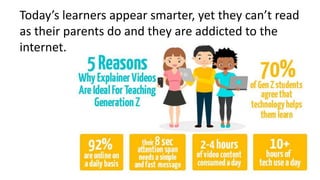
Today’s learners appear smarter, yet they can’t read
as their parents do and they are addicted to the
internet.
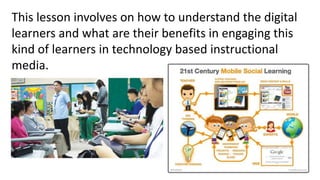
This lesson involves on how to understand the digital
learners and what are their benefits in engaging this
kind of learners in technology based instructional
media.
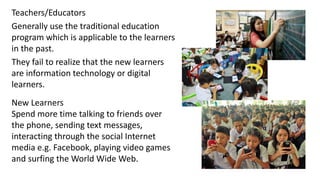
Teachers/Educators
Generally use the traditional education
program which is applicable to the learners
in the past.
They fail to realize that the new learners
are information technology or digital
learners.
New Learners
Spend more time talking to friends over
the phone, sending text messages,
interacting through the social Internet
media e.g. Facebook, playing video games
and surfing the World Wide Web.
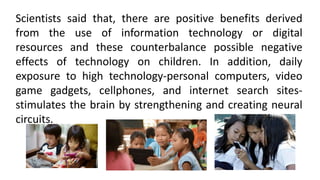
Scientists said that, there are positive benefits derived
from the use of information technology or digital
resources and these counterbalance possible negative
effects of technology on children. In addition, daily
exposure to high technology-personal computers, video
game gadgets, cellphones, and internet search sites-
stimulates the brain by strengthening and creating neural
circuits.
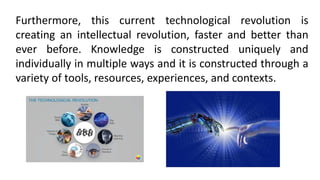
Furthermore, this current technological revolution is
creating an intellectual revolution, faster and better than
ever before. Knowledge is constructed uniquely and
individually in multiple ways and it is constructed through a
variety of tools, resources, experiences, and contexts.
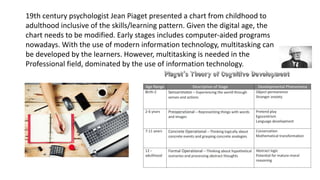
19th century psychologist Jean Piaget presented a chart from childhood to
adulthood inclusive of the skills/learning pattern. Given the digital age, the
chart needs to be modified. Early stages includes computer-aided programs
nowadays. With the use of modern information technology, multitasking can
be developed by the learners. However, multitasking is needed in the
Professional field, dominated by the use of information technology.
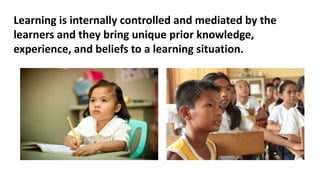
Learning is internally controlled and mediated by the
learners and they bring unique prior knowledge,
experience, and beliefs to a learning situation.
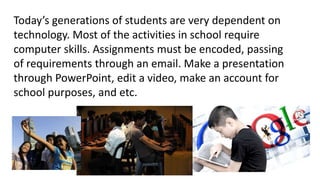
Today’s generations of students are very dependent on
technology. Most of the activities in school require
computer skills. Assignments must be encoded, passing
of requirements through an email. Make a presentation
through PowerPoint, edit a video, make an account for
school purposes, and etc.
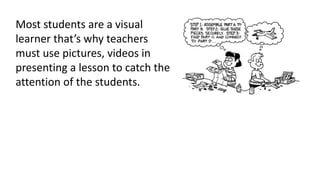
Most students are a visual
learner that’s why teachers
must use pictures, videos in
presenting a lesson to catch the
attention of the students.
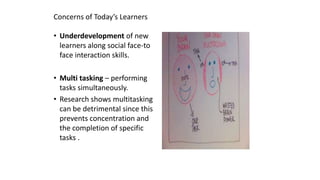
Concerns of Today’s Learners
• Underdevelopment of new
learners along social face-to
face interaction skills.
• Multi tasking – performing
tasks simultaneously.
• Research shows multitasking
can be detrimental since this
prevents concentration and
the completion of specific
tasks .
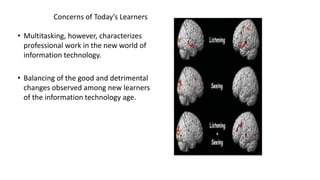
Concerns of Today’s Learners
• Multitasking, however, characterizes
professional work in the new world of
information technology.
• Balancing of the good and detrimental
changes observed among new learners
of the information technology age.
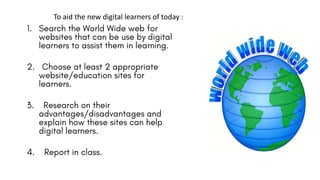
To aid the new digital learners of today :
EdTech Lesson Bridging Generaion ga in h edcaion

EdTech Lesson Bridging Generaion ga in h edcaion

  • 1.
    INTRODUCTION MA. JOY O.JOCOSOL Faculty
  • 9.
    I. Understanding TechnologyLearners I. Bridging the Generation Gap I. Preferences of the Technology Generation I. Developing Basic Digital Skills I. Evaluation of Technology Learning I. Higher Thinking Skills Through IT-based Projects I. Communications as Information and Technology I. The Computer as a Tutor I. The Computer as the Teacher’s Tool I. Information Technology in Support of Student- Centered Learning I. Cooperative Learning with the Computer I. The Software as an Educational Resource I. Understanding Hypermedia
  • 10.
  • 11.
  • 15.
    Today’s learners appearsmarter, yet they can’t read as their parents do and they are addicted to the internet.
  • 16.
    This lesson involveson how to understand the digital learners and what are their benefits in engaging this kind of learners in technology based instructional media.
  • 17.
    Teachers/Educators Generally use thetraditional education program which is applicable to the learners in the past. They fail to realize that the new learners are information technology or digital learners. New Learners Spend more time talking to friends over the phone, sending text messages, interacting through the social Internet media e.g. Facebook, playing video games and surfing the World Wide Web.
  • 18.
    Scientists said that,there are positive benefits derived from the use of information technology or digital resources and these counterbalance possible negative effects of technology on children. In addition, daily exposure to high technology-personal computers, video game gadgets, cellphones, and internet search sites- stimulates the brain by strengthening and creating neural circuits.
  • 19.
    Furthermore, this currenttechnological revolution is creating an intellectual revolution, faster and better than ever before. Knowledge is constructed uniquely and individually in multiple ways and it is constructed through a variety of tools, resources, experiences, and contexts.
  • 20.
    19th century psychologistJean Piaget presented a chart from childhood to adulthood inclusive of the skills/learning pattern. Given the digital age, the chart needs to be modified. Early stages includes computer-aided programs nowadays. With the use of modern information technology, multitasking can be developed by the learners. However, multitasking is needed in the Professional field, dominated by the use of information technology.
  • 21.
    Learning is internallycontrolled and mediated by the learners and they bring unique prior knowledge, experience, and beliefs to a learning situation.
  • 22.
    Today’s generations ofstudents are very dependent on technology. Most of the activities in school require computer skills. Assignments must be encoded, passing of requirements through an email. Make a presentation through PowerPoint, edit a video, make an account for school purposes, and etc.
  • 23.
    Most students area visual learner that’s why teachers must use pictures, videos in presenting a lesson to catch the attention of the students.
  • 27.
    Concerns of Today’sLearners • Underdevelopment of new learners along social face-to face interaction skills. • Multi tasking – performing tasks simultaneously. • Research shows multitasking can be detrimental since this prevents concentration and the completion of specific tasks .
  • 28.
    Concerns of Today’sLearners • Multitasking, however, characterizes professional work in the new world of information technology. • Balancing of the good and detrimental changes observed among new learners of the information technology age.
  • 29.
    To aid thenew digital learners of today :