outline


•  introduction

• rationale

• guidelines

• the   m-project
rationale

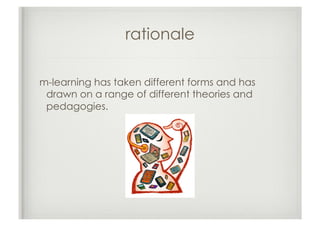
m-learning has taken different forms and has
 drawn on a range of different theories and
 pedagogies.
rationale

content delivery (Bradley et al., 2009; Muyinda,
                        Lubega & Lynch 2010),

     interactive logbooks (Corlett et al., 2005),

 mobile GBL (Mitchell, Millwood &Fallenboeck,
                                        2006),

 mobile Web 2.0 (Cochrane & Bateman, 2010;
                        Safran et al., 2010).
mlearning


•  enablesspontaneous, personalised and situated
 learning, promoting collaboration and
 encouraging autonomous, lifelong learning
 (Naismith et al.,2004; Dyson et al., 2008; Traxler,
 2009).

•  need to embed m-learning into mainstream higher
 educational practice (Traxler, 2005; Dyson, Raban,
 Litchfield & Lawrence, 2008).
ml & social constructivism


•    social interaction for co-construction of knowledge and
     meaning.

•    Learners are encouraged to take control of their learning
     (by shaping learning goals and processes), collaborate with
     peers to produce content and to use mobile tools for
     investigation and exploration (Loke et al., 2010).

•    Instructors as facilitators design the learning environment
     and structure learning processes (Jonassen, 1991)
AR
•    Engages users as co-researchers in a reflective process of
     progressive problem solving.

•    Learning takes place in real-world situations and aims at
     solving problems in teams.

•    Collection of feedback prior, during and after learning
     activities

•    Allows co-/researchers to develop their own learning projects
     and acting upon received feedback

•    Provides an opportunity to explore and develop new
     strategies for mobile learning.
key principles of AR

•    Reflective critique

•    Dialectical critique

•    Collaborative resource

•    Risk

•    plural structure

•    theory, practice, transformation

                                        Winter, 1989
10 guidelines to designing a
mlearning course in HE


•    1.Engage students as co-designers of mobile learning

•    2.Involve other stakeholders to enable the uptake of mlearning

•    3.Enable a socializing context for mlearning

•    4.Facilitate communication and cooperation between and within teams

•    5.Facilitate co-construction of mlearning content
10 guidelines to designing a
mlearning course in HE


•    6.Find the optimal level of control by scaffoliding

•    7.Encourage the deveopment of higher-order thinking skills

•    8.Facilitate bridging different contexts

•    9.Engage students in evaluation

•    10.Find ways to increase sustainability
the mproject


•    Launched in 2010 to be deployed in 2011
•    Pilot mobile learning course connecting university students in Germany
     and Spain
•    Aim  to engage students in collaborative exploration of applications
     of mobile technologies for study and work, and in creating personal
     mobile learning environments to support own learning projects.
•    Focuses on the use of mobile Web 2.0 and social media for bridging
     contexts.
the mproject

•    Launched in 2010 to be deployed in 2011

•    Guided by action research, social constructivism and problem-based
     learning,

•    The focus is on collaborative application of mobile technologies for
     knowledge sharing and co-construction of content.

•    The m-course aims at bridging in-university and out-of-university contexts
     through engagement in social activities with peers, practitioners and the
     wider community.
the mproject


•    Next steps ….

•    Questionnaire

•    Blog: http://ourmproject.wordpress.com
thanks!
buchem@beuth-hochschule.de   mar.camacho@urv.cat

Bremen1

  • 2.
  • 3.
    rationale m-learning has takendifferent forms and has drawn on a range of different theories and pedagogies.
  • 4.
    rationale content delivery (Bradleyet al., 2009; Muyinda, Lubega & Lynch 2010), interactive logbooks (Corlett et al., 2005), mobile GBL (Mitchell, Millwood &Fallenboeck, 2006), mobile Web 2.0 (Cochrane & Bateman, 2010; Safran et al., 2010).
  • 5.
    mlearning •  enablesspontaneous, personalisedand situated learning, promoting collaboration and encouraging autonomous, lifelong learning (Naismith et al.,2004; Dyson et al., 2008; Traxler, 2009). •  need to embed m-learning into mainstream higher educational practice (Traxler, 2005; Dyson, Raban, Litchfield & Lawrence, 2008).
  • 6.
    ml & socialconstructivism •  social interaction for co-construction of knowledge and meaning. •  Learners are encouraged to take control of their learning (by shaping learning goals and processes), collaborate with peers to produce content and to use mobile tools for investigation and exploration (Loke et al., 2010). •  Instructors as facilitators design the learning environment and structure learning processes (Jonassen, 1991)
  • 7.
    AR •  Engages users as co-researchers in a reflective process of progressive problem solving. •  Learning takes place in real-world situations and aims at solving problems in teams. •  Collection of feedback prior, during and after learning activities •  Allows co-/researchers to develop their own learning projects and acting upon received feedback •  Provides an opportunity to explore and develop new strategies for mobile learning.
  • 8.
    key principles ofAR •  Reflective critique •  Dialectical critique •  Collaborative resource •  Risk •  plural structure •  theory, practice, transformation Winter, 1989
  • 9.
    10 guidelines todesigning a mlearning course in HE •  1.Engage students as co-designers of mobile learning •  2.Involve other stakeholders to enable the uptake of mlearning •  3.Enable a socializing context for mlearning •  4.Facilitate communication and cooperation between and within teams •  5.Facilitate co-construction of mlearning content
  • 10.
    10 guidelines todesigning a mlearning course in HE •  6.Find the optimal level of control by scaffoliding •  7.Encourage the deveopment of higher-order thinking skills •  8.Facilitate bridging different contexts •  9.Engage students in evaluation •  10.Find ways to increase sustainability
  • 11.
    the mproject •  Launched in 2010 to be deployed in 2011 •  Pilot mobile learning course connecting university students in Germany and Spain •  Aim  to engage students in collaborative exploration of applications of mobile technologies for study and work, and in creating personal mobile learning environments to support own learning projects. •  Focuses on the use of mobile Web 2.0 and social media for bridging contexts.
  • 12.
    the mproject •  Launched in 2010 to be deployed in 2011 •  Guided by action research, social constructivism and problem-based learning, •  The focus is on collaborative application of mobile technologies for knowledge sharing and co-construction of content. •  The m-course aims at bridging in-university and out-of-university contexts through engagement in social activities with peers, practitioners and the wider community.
  • 13.
    the mproject •  Next steps …. •  Questionnaire •  Blog: http://ourmproject.wordpress.com
  • 14.