What is Blended Learning?

• WHAT - “blended learning” definitions

• WHY – reasons to do it

• WHY NOT – challenges to overcome

• VIDEO – a blended example
Definition #1


“all learning is blended…[it is] the use of two
or more styles of content or context delivery
or discovery”


                                   Maise (2006)
Definition #2


“mixes F2F and non-F2F activities, some
performed synchronously, some
asynchronously”


                               Diaz, V., &
                               Brown, M. (2010).
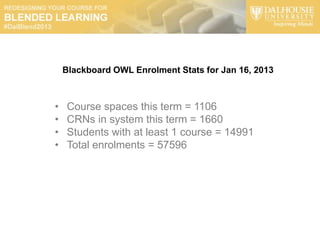
Blackboard OWL Enrolment Stats for Jan 16, 2013


•   Course spaces this term = 1106
•   CRNs in system this term = 1660
•   Students with at least 1 course = 14991
•   Total enrolments = 57596
The LMS in Blended Learning


"[The LMS is] focused primarily on helping
teachers increase the efficiency of the
administrative tasks of instruction
(e.g., distribute documents, make
assignments, give quizzes, initiate
discussion boards, assign students to
working groups, etc.)"

                                Mott, Jon, and
                                David A. Wiley.
                                (2009)
Definition #3


“the thoughtful integration of face-to-face and
online learning”


                                    COHERE (2012)
Definition #4


“Blended learning refers to enriched, student-
centred learning experiences made possible by
the harmonious integration of various strategies,
achieved by combining F2F interaction with ICT”


                                Torrisi-Steele (2011)
Why Blended Learning?


“The rules are changing, and there is increased
pressure on institutions of higher education to
evolve, adapt, or desist.”


                                  (Swail, 2002)
Why Blend?


• Flexibility, accessibility
• Interaction and engagement
• Improved learning outcomes

•   Increased demand
•   Greater student satisfaction and preparation
•   Higher digital literacy for the knowledge economy
•   Business case, optimization of resources
•   Improved teaching and learning
Student preparation


“Students in my traditional courses come to class like baby
birds with their mouths open for food. In my blended
course, students come in prepared and actively contribute
to the class.”


                                    Futch and Thompson (2012)
                                    The Blended Learning Toolkit
Challenges


• Workload – “course and a half” syndrome
• Insufficient support
• Bells and whistles

• Absence of policy, strategy, direction
• Students like F2F
• Student reluctance to go from passive to active learning
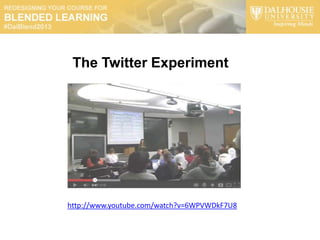
The Twitter Experiment


http://www.youtube.com/watch?v=6WPVWDkF7U8
References
Collaboration for Online Higher Education Research (COHERE), Innovative Practices Research Project: COHERE Report
on Blended Learning (2012)

Diaz, V., & Brown, M. (2010). Blended Learning: A Report on the ELI Focus Session. Educause, 2. Retrieved January
20, 2013, from http://www.educause.edu/Resources/BlendedLearningAReportontheELI/218492

Futch, L. and Thompson, K. (2012, October 10). The blended learning toolkit: A ready-made faculty development
program. Pre-conference workshop at Sloan-C ALN Conference, Orlando, FL.

Maise, E. (2006). The Blended Learning Imperative. In C. Bonk, & C. Graham (Eds.), The handbook of blended
learning: Global perspectives, local designs (pp. 22-26). San Francisco: Pfeiffer.

Mott, Jon, and David A. Wiley. (2009). Open for Learning: The CMS and the Open Learning Network. In Education:
Exploring our Connective Educational Landscape.

Swail, W.S. (2002). Higher education and the new demographics: Questions for policy. Change Magazine, 34(4), 15-23

Torrisi-Steele, Geraldine (2011). This thing called blended learning – a definition and planning approach. In Research
and Development in Higher Education: Higher Education on the Edge Volume 34.

What is blended learning?

  • 1.
    What is BlendedLearning? • WHAT - “blended learning” definitions • WHY – reasons to do it • WHY NOT – challenges to overcome • VIDEO – a blended example
  • 2.
    Definition #1 “all learningis blended…[it is] the use of two or more styles of content or context delivery or discovery” Maise (2006)
  • 3.
    Definition #2 “mixes F2Fand non-F2F activities, some performed synchronously, some asynchronously” Diaz, V., & Brown, M. (2010).
  • 4.
    Blackboard OWL EnrolmentStats for Jan 16, 2013 • Course spaces this term = 1106 • CRNs in system this term = 1660 • Students with at least 1 course = 14991 • Total enrolments = 57596
  • 5.
    The LMS inBlended Learning "[The LMS is] focused primarily on helping teachers increase the efficiency of the administrative tasks of instruction (e.g., distribute documents, make assignments, give quizzes, initiate discussion boards, assign students to working groups, etc.)" Mott, Jon, and David A. Wiley. (2009)
  • 6.
    Definition #3 “the thoughtfulintegration of face-to-face and online learning” COHERE (2012)
  • 7.
    Definition #4 “Blended learningrefers to enriched, student- centred learning experiences made possible by the harmonious integration of various strategies, achieved by combining F2F interaction with ICT” Torrisi-Steele (2011)
  • 8.
    Why Blended Learning? “Therules are changing, and there is increased pressure on institutions of higher education to evolve, adapt, or desist.” (Swail, 2002)
  • 9.
    Why Blend? • Flexibility,accessibility • Interaction and engagement • Improved learning outcomes • Increased demand • Greater student satisfaction and preparation • Higher digital literacy for the knowledge economy • Business case, optimization of resources • Improved teaching and learning
  • 10.
    Student preparation “Students inmy traditional courses come to class like baby birds with their mouths open for food. In my blended course, students come in prepared and actively contribute to the class.” Futch and Thompson (2012) The Blended Learning Toolkit
  • 11.
    Challenges • Workload –“course and a half” syndrome • Insufficient support • Bells and whistles • Absence of policy, strategy, direction • Students like F2F • Student reluctance to go from passive to active learning
  • 12.
  • 13.
    References Collaboration for OnlineHigher Education Research (COHERE), Innovative Practices Research Project: COHERE Report on Blended Learning (2012) Diaz, V., & Brown, M. (2010). Blended Learning: A Report on the ELI Focus Session. Educause, 2. Retrieved January 20, 2013, from http://www.educause.edu/Resources/BlendedLearningAReportontheELI/218492 Futch, L. and Thompson, K. (2012, October 10). The blended learning toolkit: A ready-made faculty development program. Pre-conference workshop at Sloan-C ALN Conference, Orlando, FL. Maise, E. (2006). The Blended Learning Imperative. In C. Bonk, & C. Graham (Eds.), The handbook of blended learning: Global perspectives, local designs (pp. 22-26). San Francisco: Pfeiffer. Mott, Jon, and David A. Wiley. (2009). Open for Learning: The CMS and the Open Learning Network. In Education: Exploring our Connective Educational Landscape. Swail, W.S. (2002). Higher education and the new demographics: Questions for policy. Change Magazine, 34(4), 15-23 Torrisi-Steele, Geraldine (2011). This thing called blended learning – a definition and planning approach. In Research and Development in Higher Education: Higher Education on the Edge Volume 34.

Editor's Notes

  • #3 Expansive topic --- Show 4 defs to get some ideasAll learning is blendedAny combination instructional modalities, philosophies, pedagogies, technologiesAll of it….put it all in the blender….that’s blended learning….OK….a bit too broad for our purposes
  • #4 Getting closer to what most people think…F2F with onlineEg. BBL to put up files, assignments, gradesBBL Coll to host live sessions online – webinar style
  • #5 With this definition, most of Dal is already engaged in BLAre these all blended courses?I know people who would argue that most of these are not really examples of BLBecause the use of online – BBL – is very basic
  • #7 Step up a little bit…from the homeworkWe have these 2 new words…thoughtful and integrationReminds me of how Wiley says much use of the LMS in HE is “administrative”Is more about instructional efficiencies and does not think so much about how it can enhance learningDoes not take advantage of more constructivist, student-centred, collaboratiive, interactive elementsThoughtful integration will hopefully do this…Getting closer to what we’re hoping to talk about in this workshop seriesStill kind of vaque…a little do general….and is it always online?
  • #8 Student learning experiences…focus on meaningful engagement…deeper learningIntegrated strategies…constructivistICT…not just online…classroom technologies…or using online in the classPedagogy trumps toolsExamples of uses
  • #9 The fundamental of education aren’t changing…What is changing?Technology (ICTs), the way we use technology…exponential increase in their use and powerThe article makes a link to the fact that we are becoming more and more of a knowledge societySo this is a challenge for HE, and BL holds promise to meet this challenge