Donna Anderson Grosse Ile School, QC, Canada Marie-Helen Goyetche Arundel School, QC, Canada Dorothy Taker Grosse Ile School, QC, Canada Gyeong Mi Heo , Ph.D. CEFRIO, QC, Canada Alain Breuleux, Ph.D. McGill University, QC, Canada Distributed Leadership  Facilitating Collaboration  in a Teacher Community of Practice
Building Community through Telecollaboration (BCT) A  province-wide initiative with educators and administrators from English school boards across Quebec  ( Breuleux, Heo, Wall, Morgan, & Flores, 2009 ) G oal of the BCT Project  “ T o encourage, facilitate and support collaboration among students, teachers and educational leaders to enhance learning across the community.”
The BCT project is based on a notion that ICT allows us to overcome the challenges of distance, professional isolation, and educational success in small and remote schools.  Phase 1 (2007-2009): Design research approach  ( Bereiter, 2005; Brown, 1992; Collins, Joseph, & Bielaczyc, 2004; Schoenfeld, 2006 )  Phase 2 (2009 - present) : Participatory design research approach  ( Silva & Breuleux, 1994 )   - T o emphasize the engagement of users  and participants in the design process.  Building Community through Telecollaboration (BCT)
Elementary Education System in  Quebec  Cycle 1 (Grades 1 and 2)  Cycle 2 (Grades 3 and 4)  Cycle 3 (Grades 5 and 6)  The cycle group leaders  Engaged  voluntarily  and  actively in the process of the project W ork ed  in close collaboration with the researchers and the practitioners Were  representative s  of the  BCT teachers   F acilitated and supported communication and collaboration among the teachers   Cycle Group Leaders
Conceptual Framework Conceptual and methodological context of participatory design research, including notions of professional learning networks within a community of practice. ( Blankenstein, Houston, & Cole, 2008; Hofman & Dijkstra, 2010; Little, 2002; Palincsar, Magnusson, Marano, Ford, & Brown, 1998; Schlager & Fusco, 2003; Wenger, 1998 )
A Distributed Leadership Community Teacher ownership is an important principle   that guides the leadership and management. BCT leadership team : R esearchers , consultants, and c ycle group leaders as representatives of the  teachers BCT Coordinating Committee : BCT leadership team, CEFRIO, LEARN Quebec – To provide feedback and strategic advice Support  groups for the  BCT  project:  English school boards  in Quebec ,   principals  and  other administrators in the 15 BCT schools, local techno-pedagogical consultants  a nd IT staff s .
A goal of the BCT project is to create and foster a culture of reflection and sharing among the network of teachers.  A professional  learning network fosters the move from individual practice to collaboration, professional engagement, and teacher leadership.  It  allow s  teachers to make sense of the challenges they face  in practice and to find out creative solutions .  The teachers and administrators have shaped the shared vision   that facilitating the use of ICT in support of effective teaching practices for students learning in the classroom.  A Culture of Sharing
In the BCT project,  conditions are created that allow students and teachers to build and share knowledge together through the use of ICT.  Collaboration through ICT tools   is both  (a) T he object of the project  and (b) A n element of solution to other challenges of teacher professional development .   ICT tools  BCT Website (http://bctcollaboration.wikispaces.com/) BCT Sakai portal (Discussion Forum - Asynchronous) Live Classroom (Synchronous) Web 2.0 for classroom projects: Blog, Wiki, VoiceThread, Skype, Google Docs, Google maps, and so on.  ICT for Collaboration
The essence of the BCT Project is professional learning.  Through  engag ing  in  the activities of the BCT community,  the teachers  become knowledgeable regarding how to use ICT for students ’  collaborati on  in classroom.  Face-to-face meeting (4 times/year) Agendas and topics mostly depend on collegial consensus.  H ands-on sessions about ICT tools  are mainly lead by experienced teachers. Professional Learning
Collaborative Activities in Cycle Groups 2009-2010 BCT Project 2009-2010 15 English schools in the Province of Quebec A pproximately 45 teachers and administrators Three  cycle  groups  participated in collaborative activities
Cycle One Collaborative Activities Voice T hread  learned about the tool Introductions project Class projects Sakai portal  share and access projects commenting and responding keeping up on events Cycle 1  W ikispace  Olympics project D isplay voicethreads, blogs, other collaborative projects
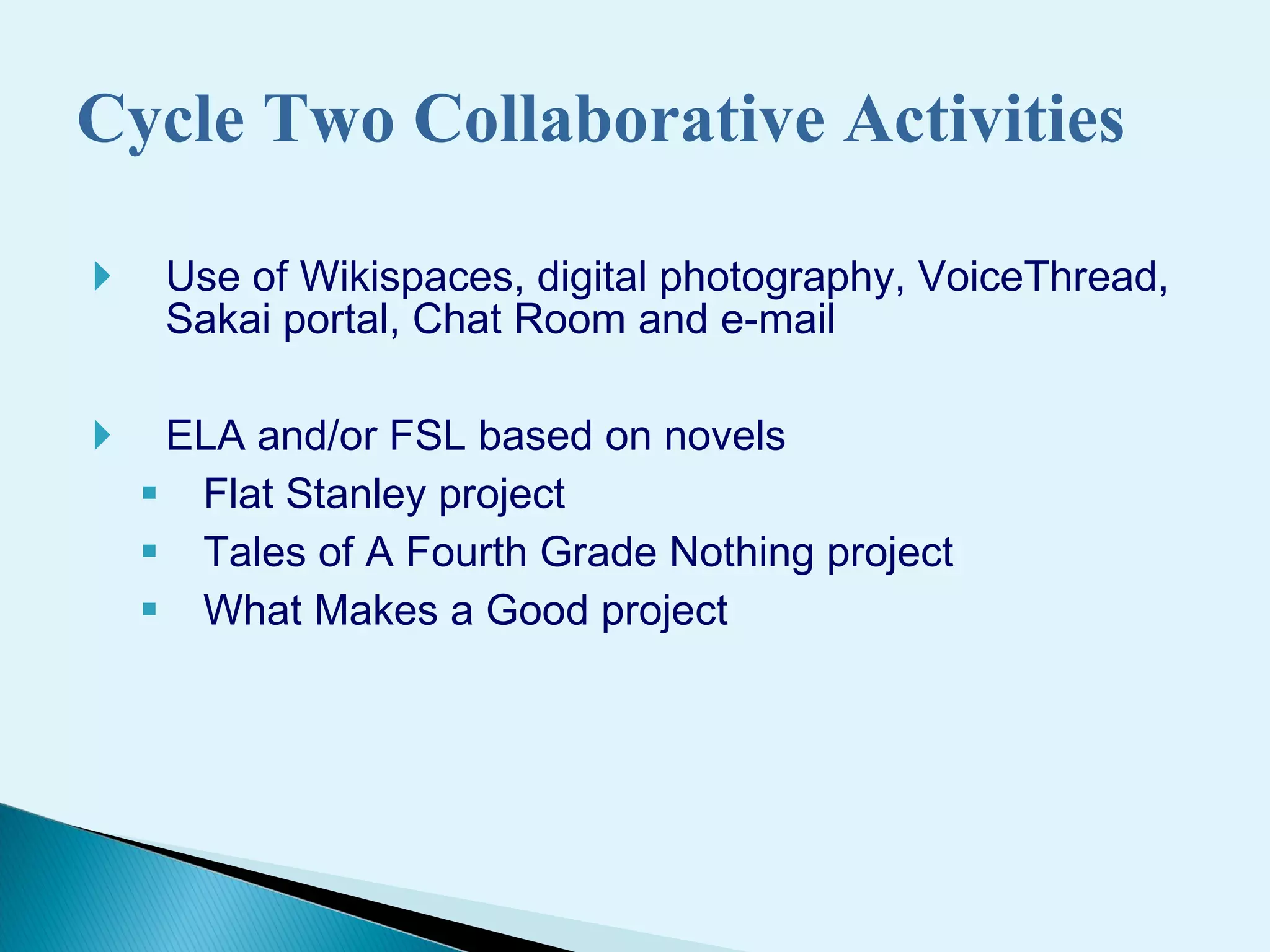
Cycle Two Collaborative Activities Use of Wikispaces, digital photography, Voice T hread, Sakai  portal , Chat Room and e - mail E LA and/or FSL based on novels Flat Stanley project Tales of A Fourth Grade Nothing project  What Makes a Good project
Cycle Three Collaborative Activities Use of Sakai Portal P roject development and planning A sking and answering questions concerning their projects Cycle 3 Wiki s pace B ook talks  M eet our characters  Literature Circles   Various activities around the 2010 Vancouver Olympics ( A rticles,  Pictures, and V oice T hread)
Roles of the Cycle Group Leaders A  core group to participate in the development of the project with the BCT leadership team R epresentatives of the members of their cycles E ncouraging teachers’ collaboration in a community of practice of teachers D eveloping professionally and improving teachers’ professional practice and students learning T eaching of ICT tools for collaborating and sharing projects S upporting and coordinating the cycle group online and in face-to-face sessions H elping teachers overcome the challenges of distance and professional isolation
Lessons learned related to  T eacher learning : have developed an increased expertise related to the use of ICT in their classrooms developed some valuable student collaborative learning projects Lessons learned related to  S tudent learning : enjoyed sharing their work with authentic audiences understood the importance of internet etiquette and internet safety Lessons learned related to Expertise: taking baby steps as not to discourage newcomers more experienced members helped others, gave presentations on ICT tools and help lead Cycle groups Lessons Learned (I)
Lessons  l earned  r elated to Support : support of the principal and other admin i strators in providing the resources, time and technical support support from the Cycle group leaders as well as the BCT leadership team for on line and during face to face sessions Lessons learned related to  T ime: be aware of the danger by overloading the teachers involvement in the project should blend in and not be an add on or something extra Lessons Learned (II)
Conclusion Benefits from the Participatory Design approach The roles of the cycle group leaders are crucial:  Designing, building, and cultivating a teacher community of practice  Facilitating communication and collaboration through ICT among teachers Exemplifying and supporting the BCT project and the BCT teachers along the way Professional development of the cycle group leaders  Leadership skills and teaching practice Confidence and strengths in using ICT
Gyeong Mi Heo , Ph.D. [email_address] Donna Anderson [email_address] Marie-Helen Goyetche [email_address] Dorothy Taker [email_address] Alain Breuleux, Ph.D. [email_address] Building Community through Telecollaboration (BCT) Project http://bctcollaboration.wikispaces.com

BCT_SITE 2011

  • 1.
    Donna Anderson GrosseIle School, QC, Canada Marie-Helen Goyetche Arundel School, QC, Canada Dorothy Taker Grosse Ile School, QC, Canada Gyeong Mi Heo , Ph.D. CEFRIO, QC, Canada Alain Breuleux, Ph.D. McGill University, QC, Canada Distributed Leadership Facilitating Collaboration in a Teacher Community of Practice
  • 2.
    Building Community throughTelecollaboration (BCT) A province-wide initiative with educators and administrators from English school boards across Quebec ( Breuleux, Heo, Wall, Morgan, & Flores, 2009 ) G oal of the BCT Project “ T o encourage, facilitate and support collaboration among students, teachers and educational leaders to enhance learning across the community.”
  • 3.
    The BCT projectis based on a notion that ICT allows us to overcome the challenges of distance, professional isolation, and educational success in small and remote schools. Phase 1 (2007-2009): Design research approach ( Bereiter, 2005; Brown, 1992; Collins, Joseph, & Bielaczyc, 2004; Schoenfeld, 2006 ) Phase 2 (2009 - present) : Participatory design research approach ( Silva & Breuleux, 1994 ) - T o emphasize the engagement of users and participants in the design process. Building Community through Telecollaboration (BCT)
  • 4.
    Elementary Education Systemin Quebec Cycle 1 (Grades 1 and 2) Cycle 2 (Grades 3 and 4) Cycle 3 (Grades 5 and 6) The cycle group leaders Engaged voluntarily and actively in the process of the project W ork ed in close collaboration with the researchers and the practitioners Were representative s of the BCT teachers F acilitated and supported communication and collaboration among the teachers   Cycle Group Leaders
  • 5.
    Conceptual Framework Conceptualand methodological context of participatory design research, including notions of professional learning networks within a community of practice. ( Blankenstein, Houston, & Cole, 2008; Hofman & Dijkstra, 2010; Little, 2002; Palincsar, Magnusson, Marano, Ford, & Brown, 1998; Schlager & Fusco, 2003; Wenger, 1998 )
  • 6.
    A Distributed LeadershipCommunity Teacher ownership is an important principle that guides the leadership and management. BCT leadership team : R esearchers , consultants, and c ycle group leaders as representatives of the teachers BCT Coordinating Committee : BCT leadership team, CEFRIO, LEARN Quebec – To provide feedback and strategic advice Support groups for the BCT project: English school boards in Quebec , principals and other administrators in the 15 BCT schools, local techno-pedagogical consultants a nd IT staff s .
  • 7.
    A goal ofthe BCT project is to create and foster a culture of reflection and sharing among the network of teachers. A professional learning network fosters the move from individual practice to collaboration, professional engagement, and teacher leadership. It allow s teachers to make sense of the challenges they face in practice and to find out creative solutions . The teachers and administrators have shaped the shared vision that facilitating the use of ICT in support of effective teaching practices for students learning in the classroom. A Culture of Sharing
  • 8.
    In the BCTproject, conditions are created that allow students and teachers to build and share knowledge together through the use of ICT. Collaboration through ICT tools is both (a) T he object of the project and (b) A n element of solution to other challenges of teacher professional development . ICT tools BCT Website (http://bctcollaboration.wikispaces.com/) BCT Sakai portal (Discussion Forum - Asynchronous) Live Classroom (Synchronous) Web 2.0 for classroom projects: Blog, Wiki, VoiceThread, Skype, Google Docs, Google maps, and so on. ICT for Collaboration
  • 9.
    The essence ofthe BCT Project is professional learning. Through engag ing in the activities of the BCT community, the teachers become knowledgeable regarding how to use ICT for students ’ collaborati on in classroom. Face-to-face meeting (4 times/year) Agendas and topics mostly depend on collegial consensus. H ands-on sessions about ICT tools are mainly lead by experienced teachers. Professional Learning
  • 10.
    Collaborative Activities inCycle Groups 2009-2010 BCT Project 2009-2010 15 English schools in the Province of Quebec A pproximately 45 teachers and administrators Three cycle groups participated in collaborative activities
  • 11.
    Cycle One CollaborativeActivities Voice T hread learned about the tool Introductions project Class projects Sakai portal share and access projects commenting and responding keeping up on events Cycle 1 W ikispace Olympics project D isplay voicethreads, blogs, other collaborative projects
  • 12.
    Cycle Two CollaborativeActivities Use of Wikispaces, digital photography, Voice T hread, Sakai portal , Chat Room and e - mail E LA and/or FSL based on novels Flat Stanley project Tales of A Fourth Grade Nothing project What Makes a Good project
  • 13.
    Cycle Three CollaborativeActivities Use of Sakai Portal P roject development and planning A sking and answering questions concerning their projects Cycle 3 Wiki s pace B ook talks M eet our characters Literature Circles Various activities around the 2010 Vancouver Olympics ( A rticles, Pictures, and V oice T hread)
  • 14.
    Roles of theCycle Group Leaders A core group to participate in the development of the project with the BCT leadership team R epresentatives of the members of their cycles E ncouraging teachers’ collaboration in a community of practice of teachers D eveloping professionally and improving teachers’ professional practice and students learning T eaching of ICT tools for collaborating and sharing projects S upporting and coordinating the cycle group online and in face-to-face sessions H elping teachers overcome the challenges of distance and professional isolation
  • 15.
    Lessons learned relatedto T eacher learning : have developed an increased expertise related to the use of ICT in their classrooms developed some valuable student collaborative learning projects Lessons learned related to S tudent learning : enjoyed sharing their work with authentic audiences understood the importance of internet etiquette and internet safety Lessons learned related to Expertise: taking baby steps as not to discourage newcomers more experienced members helped others, gave presentations on ICT tools and help lead Cycle groups Lessons Learned (I)
  • 16.
    Lessons learned r elated to Support : support of the principal and other admin i strators in providing the resources, time and technical support support from the Cycle group leaders as well as the BCT leadership team for on line and during face to face sessions Lessons learned related to T ime: be aware of the danger by overloading the teachers involvement in the project should blend in and not be an add on or something extra Lessons Learned (II)
  • 17.
    Conclusion Benefits fromthe Participatory Design approach The roles of the cycle group leaders are crucial: Designing, building, and cultivating a teacher community of practice Facilitating communication and collaboration through ICT among teachers Exemplifying and supporting the BCT project and the BCT teachers along the way Professional development of the cycle group leaders Leadership skills and teaching practice Confidence and strengths in using ICT
  • 18.
    Gyeong Mi Heo, Ph.D. [email_address] Donna Anderson [email_address] Marie-Helen Goyetche [email_address] Dorothy Taker [email_address] Alain Breuleux, Ph.D. [email_address] Building Community through Telecollaboration (BCT) Project http://bctcollaboration.wikispaces.com