INSTRUCTIONAL MEDIA
MODULE 1
Prepared by: Danessa D. Noriega
Dated: March 13th , 2017
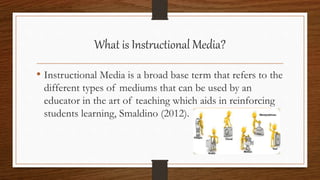
What is Instructional Media?
• Instructional Media is a broad base term that refers to the
different types of mediums that can be used by an
educator in the art of teaching which aids in reinforcing
students learning, Smaldino (2012).
CATEGORIES OF INSTRUCTIONAL MEDIA
• There are six (6) basic categories of instructional media.
• 1)TEXT
• 2)VISUALS
• 3)AUDIO
• 4)PEOPLE
• 5)MANIPULATIVES
• 6)VIDEO
USING INSTRUCTIONAL MEDIA IN THE CLASSROOM
• Using instructional media in the classroom requires a teacher to be innovate
and creative in planning, structuring and delivery of their lesson. Some ways
in which teacher can be prepared for the use and design of media within the
classroom are:
• (i) Assessing students prior knowledge – This refers to the knowledge
that most student would have on a particular subject. Teachers should gather
information about their students knowledge and skills levels to determine
what they know and what they don’t know. This can be obtained through
diagnostics assessment.
USING INSTRUCTIONAL MEDIA IN THE CLASSROOM
• (ii) Differences in learning – This refers to the Multiple ways in which students learn.
Teachers should have a clear understanding that students learn in different forms. As such
their lessons should be structured to facilitate the many different learning styles. For
example when planning a lesson the teacher should ensure that they incorporate audio
visuals aids and manipulatives in an attempt to reach all learning styles.
• (iii) Make the Objective known – This refers to the desire learning outcome of a lesson.
Teachers should ensure that both themselves and their students know and understand the
desire goal. To achieve this teachers must clearly express before teaching what the student
will know and be able to do at the end of the lesson. Through simple evaluation at the end
of the lesson, the teacher will know if the learning objective matches the expected outcome.
USING INSTRUCTIONAL MEDIA IN THE CLASSROOM
• (iv) Social Interaction – This foster student learning from each other by way of
interacting, with each other. In administering instruction teachers should foster into
their lessons, group work or peer teaching. For example, placing students in groups.
This facilitates greater productivity, creates active leaners and allows the learner to
identify their strengths and weakness.
• (v) Incorporating Realistic Contexts – Simply put being able to use what was
learn in their daily lives. It is of primary importance that teachers ensure that the
knowledge presented to their students can be applied to real world scenarios. In so
doing learners will be able to remember and apply the knowledge and skills that they
learn in the classroom into the world around them.
CONCLUSION
• In an attempt to create the 21st Century learning environment and enhance
the abilities of our 21st Century learners. Its is pivotal that educators
restructure their art of teaching to incorporate instructional media within the
classroom. On doing this they move away from being information dispensers
and become creative manages of the learning experience.
REFERENCES
• Smaldino, S. E. et..al,(2012). Instructional Technology and Media for
learning. Pages (1-33)

Module 1 assignment instructional media

  • 2.
    INSTRUCTIONAL MEDIA MODULE 1 Preparedby: Danessa D. Noriega Dated: March 13th , 2017
  • 3.
    What is InstructionalMedia? • Instructional Media is a broad base term that refers to the different types of mediums that can be used by an educator in the art of teaching which aids in reinforcing students learning, Smaldino (2012).
  • 4.
    CATEGORIES OF INSTRUCTIONALMEDIA • There are six (6) basic categories of instructional media. • 1)TEXT • 2)VISUALS • 3)AUDIO • 4)PEOPLE • 5)MANIPULATIVES • 6)VIDEO
  • 5.
    USING INSTRUCTIONAL MEDIAIN THE CLASSROOM • Using instructional media in the classroom requires a teacher to be innovate and creative in planning, structuring and delivery of their lesson. Some ways in which teacher can be prepared for the use and design of media within the classroom are: • (i) Assessing students prior knowledge – This refers to the knowledge that most student would have on a particular subject. Teachers should gather information about their students knowledge and skills levels to determine what they know and what they don’t know. This can be obtained through diagnostics assessment.
  • 6.
    USING INSTRUCTIONAL MEDIAIN THE CLASSROOM • (ii) Differences in learning – This refers to the Multiple ways in which students learn. Teachers should have a clear understanding that students learn in different forms. As such their lessons should be structured to facilitate the many different learning styles. For example when planning a lesson the teacher should ensure that they incorporate audio visuals aids and manipulatives in an attempt to reach all learning styles. • (iii) Make the Objective known – This refers to the desire learning outcome of a lesson. Teachers should ensure that both themselves and their students know and understand the desire goal. To achieve this teachers must clearly express before teaching what the student will know and be able to do at the end of the lesson. Through simple evaluation at the end of the lesson, the teacher will know if the learning objective matches the expected outcome.
  • 7.
    USING INSTRUCTIONAL MEDIAIN THE CLASSROOM • (iv) Social Interaction – This foster student learning from each other by way of interacting, with each other. In administering instruction teachers should foster into their lessons, group work or peer teaching. For example, placing students in groups. This facilitates greater productivity, creates active leaners and allows the learner to identify their strengths and weakness. • (v) Incorporating Realistic Contexts – Simply put being able to use what was learn in their daily lives. It is of primary importance that teachers ensure that the knowledge presented to their students can be applied to real world scenarios. In so doing learners will be able to remember and apply the knowledge and skills that they learn in the classroom into the world around them.
  • 8.
    CONCLUSION • In anattempt to create the 21st Century learning environment and enhance the abilities of our 21st Century learners. Its is pivotal that educators restructure their art of teaching to incorporate instructional media within the classroom. On doing this they move away from being information dispensers and become creative manages of the learning experience.
  • 9.
    REFERENCES • Smaldino, S.E. et..al,(2012). Instructional Technology and Media for learning. Pages (1-33)