Mobile Learning: Go for it!
stavrosnikou@sch.gr
2nd Scientix Conference
Brussels, 24-26 October 2014
Stavros Nikou, SDA Greece
Physics, Computer Science teacher
4th Lykeio Stavroupolis, Thessaloniki, GR
Computer Networks and Telematics Applications Lab
University of Macedonia, GR
1
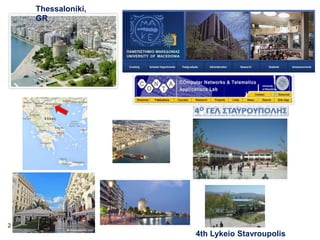
Thessaloniki,
GR
4th Lykeio Stavroupolis
2
Presentation outline
 Why m-learning
 Definitions
 M-learning
practices
 Characteristics
 Affordances
 for students
 for teachers
 Challenges
 Mobile apps
ecosystem
 M-learning in EU
 Conclusions
3
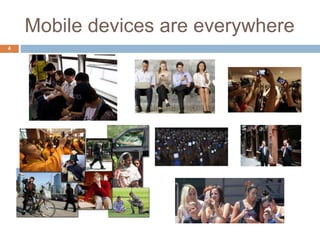
Mobile devices are everywhere
4
Why consider m-learning?
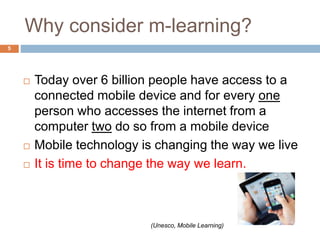
 Today over 6 billion people have access to a
connected mobile device and for every one
person who accesses the internet from a
computer two do so from a mobile device
 Mobile technology is changing the way we live
 It is time to change the way we learn.
(Unesco, Mobile Learning)
5
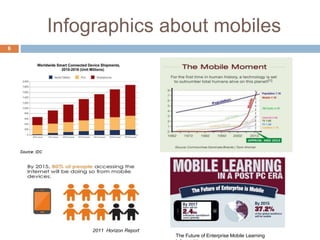
Infographics about mobiles
2011 Horizon Report
The Future of Enterprise Mobile Learning
6
Digital natives vs digital immigrants
 Digital immigrant, is an
individual who was born
before the existence of
digital technology and
adopted it to some extent
later in life.
 “A digital native is a person
who was born during or after
the general introduction of
digital technologies and
through interacting with
digital technology from an
early age, has a greater
comfort level using it” [1]
 21st century learners are
“Digital Natives”
[1] Prensky, "Digital Natives, Digital Immigrants“,
2001
7
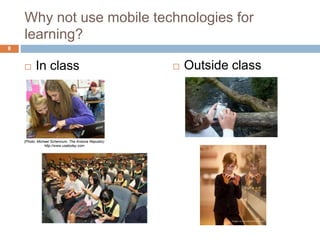
Why not use mobile technologies for
learning?
 In class  Outside class
(Photo: Michael Schennum, The Arizona Republic)
http://www.usatoday.com
8
What is mobile learning?
Mobile learning involves the use of mobile technology,
either alone or in combination with other
information and communication technology (ICT),
to enable learning
anytime and anywhere (UNESCO)
9
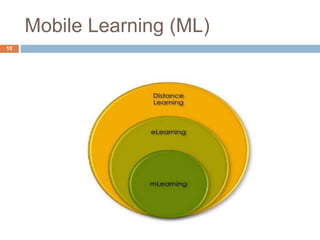
Mobile Learning (ML)
10
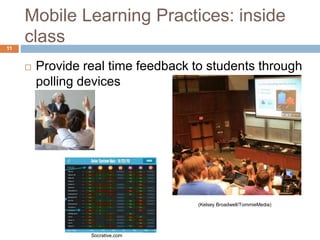
Mobile Learning Practices: inside
class
 Provide real time feedback to students through
polling devices
(Kelsey Broadwell/TommieMedia)
Socrative.com
11
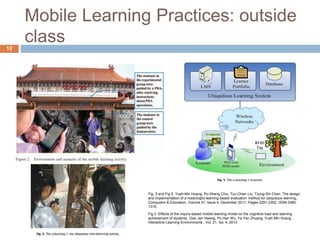
Mobile Learning Practices: outside
class
Fig. 3 and Fig 5. Yueh-Min Huang, Po-Sheng Chiu, Tzu-Chien Liu, Tzung-Shi Chen, The design
and implementation of a meaningful learning-based evaluation method for ubiquitous learning,
Computers & Education, Volume 57, Issue 4, December 2011, Pages 2291-2302, ISSN 0360-
1315,
Fig 2. Effects of the inquiry-based mobile learning model on the cognitive load and learning
achievement of students. Gwo Jen Hwang, Po Han Wu, Ya Yen Zhuang, Yueh Min Huang ,
Interactive Learning Environments , Vol. 21, Iss. 4, 2013
12
Mobile Learning is:
 Multimedia rich
 Bite-sized
 Time independent
 Location independent
 Just-in-time-learning
 Ubiquitous
 Adaptive
 Personalized
 Context-aware
 Situated and
Authentic
 Social and
collaborative
 Augmented Reality
enabled
 Gamification
supportive
 Cloud-based
13
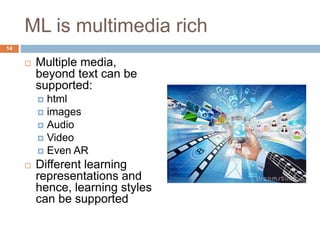
ML is multimedia rich
 Multiple media,
beyond text can be
supported:
 html
 images
 Audio
 Video
 Even AR
 Different learning
representations and
hence, learning styles
can be supported
14
ML is bite-sized
 Instead of lengthy
instructions and courses
 on-demand delivery of
short lessons through
mobiles
 People can now learn on
their spare time and learn
only what they're
interested in
 According to the Journal of
Applied Psychology,
learning in smaller chunks
can improve the
knowledge transfer by 17%
 e.g. while assembling a
product, a company
worker can instantly get
bite-sized instructions
through a mobile
application
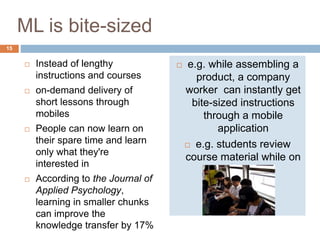
 e.g. students review
course material while on
a bus
15
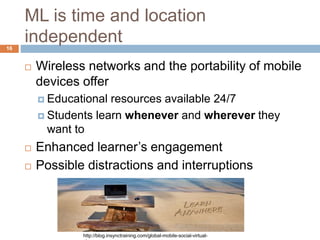
ML is time and location
independent
 Wireless networks and the portability of mobile
devices offer
 Educational resources available 24/7
 Students learn whenever and wherever they
want to
 Enhanced learner’s engagement
 Possible distractions and interruptions
http://blog.insynctraining.com/global-mobile-social-virtual-
16
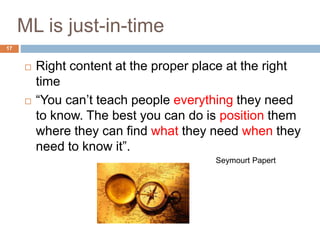
 Right content at the proper place at the right
time
 “You can’t teach people everything they need
to know. The best you can do is position them
where they can find what they need when they
need to know it”.
Seymourt Papert
ML is just-in-time
17
ML is adaptive and personalized
 A paradigm shift from the traditional one-size-fits-all
teaching approaches to adaptive and personalized learning
 The system fits its behavior to :
 the educational needs (such as learning goals and
interests),
 personal characteristics (such as learning styles and
different prior knowledge)
 particular circumstances (such as the learners’ time and
location as well as movements in the environment)
of the individual learner or a group of interconnected
learners [1]
[1] Wu, S., Chang, A., Chang, M., Liu, T.-C., & Heh, J.-S. (2008). Identifying Personalized Context-aware Knowledge Structure for Individual User in Ubiquitous Learning Environment.
In Proceedings of the 5th International Conference on Wireless, Mobile and Ubiquitous Technologies in Education, (WMUTE 2008) (pp. 95-99), Beijing, China.
18
Adaptation engine
 Input data into the adaptation engine is the learner’s
mobile context
 The adaptation engine acquires input data and produces
the adaptation results
 Output results of the adaptation engine are the adapted
mobile educational content [1]
[1] Economides, A. A. (2009). Adaptive context-aware pervasive and ubiquitous learning. International
Journal of Technology Enhanced Learning, 1(3), 169-192
19
ML is Context-aware
 Definition of Context
 “Any information that can be used to characterize the
situation of an entity” [1]
 Learning context :
 “ the current situation of a person related to a learning
activity” [2]
[1] Dey, A. K. & Abowd, G. D. (2000). Towards a better understanding of context and context-awareness.
Workshop on The What, Who, Where, When, Why and How of Context-awareness (CHI 2000). Hague,
Netherlands, 1-6 April.
[2] Luckin, R. (2010). Re-designing learning contexts :technology-rich, learner-centered ecologies.
London:Routledge.
20
ML can be Ubiquitous
 In mobile learning, learners are only
supported by their mobile devices, which they are
simply carrying with them [1]
 In ubiquitous learning, learners are supported,
during their learning process, by computing
devices, invisible and embedded in everyday
objects
 Ubiquitous learning is defined as: “the potential of
computer technology to make learning possible at
any time and at any place” [2]
[1] Liu, G. Z. & Hwang, G. J. (2009). A key step to understanding paradigm shifts in e-learning: Towards context-aware ubiquitous
learning. British Journal of EducationalTechnology, 40(6).
[2] Hwang, G. J. (2006). Criteria and Strategies of Ubiquitous Learning. In Proceedings of IEEE International Conference on Sensor
Networks, Ubiquitous and Trustworthy Computing, Taichung, Taiwan 5-7 June.
21
ML is situated
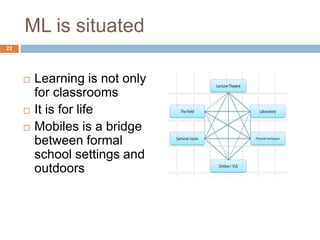
 Learning is not only
for classrooms
 It is for life
 Mobiles is a bridge
between formal
school settings and
outdoors
22
ML is authentic
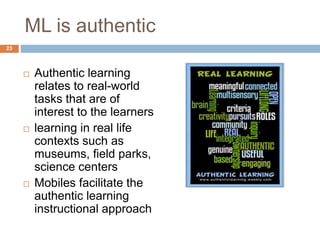
 Authentic learning
relates to real-world
tasks that are of
interest to the learners
 learning in real life
contexts such as
museums, field parks,
science centers
 Mobiles facilitate the
authentic learning
instructional approach
23
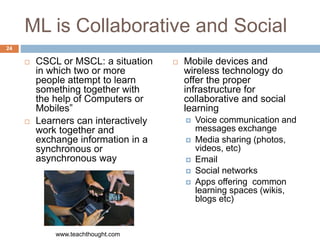
ML is Collaborative and Social
 CSCL or MSCL: a situation
in which two or more
people attempt to learn
something together with
the help of Computers or
Mobiles”
 Learners can interactively
work together and
exchange information in a
synchronous or
asynchronous way
 Mobile devices and
wireless technology do
offer the proper
infrastructure for
collaborative and social
learning
 Voice communication and
messages exchange
 Media sharing (photos,
videos, etc)
 Email
 Social networks
 Apps offering common
learning spaces (wikis,
blogs etc)
www.teachthought.com
24
ML supports AR
 Augmented Reality, a real-time technology
enabling the overlay of virtual graphics over
the real world, can be a great way for
enhancing learning experiences [1]
[1] E. Klopfer. Augmented learning: Research and design of mobile educational games. 2008
www.lm3labs.com
25
ML supports GBL
 Game based learning (GBL) is a type of game
play that has defined learning outcomes [1]
 Gamification takes game elements (such as
points, badges, competition, achievements) and
applies them to a non-game setting
 Examples:
 Location based services and social networks, such as
foursquare
 Mobile based scavenger hunts e.g. for city tours
[1] http://edtechreview.in/dictionary/298-what-is-game-based-learning
26
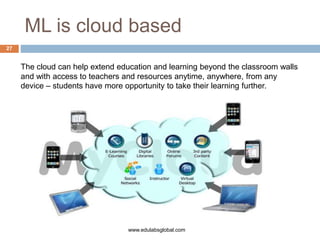
ML is cloud based
www.edulabsglobal.com
The cloud can help extend education and learning beyond the classroom walls
and with access to teachers and resources anytime, anywhere, from any
device – students have more opportunity to take their learning further.
27
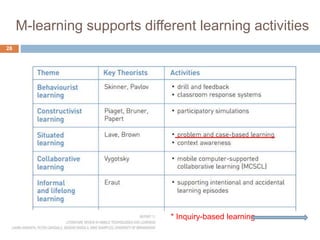
M-learning supports different learning activities
* Inquiry-based learning
28
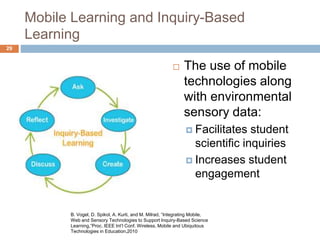
Mobile Learning and Inquiry-Based
Learning
 The use of mobile
technologies along
with environmental
sensory data:
 Facilitates student
scientific inquiries
 Increases student
engagement
B. Vogel, D. Spikol, A. Kurti, and M. Milrad, “Integrating Mobile,
Web and Sensory Technologies to Support Inquiry-Based Science
Learning,”Proc. IEEE Int’l Conf. Wireless, Mobile and Ubiquitous
Technologies in Education,2010
29
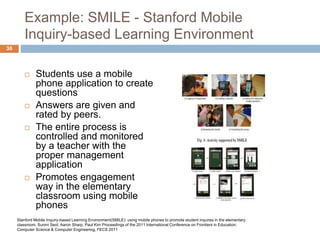
Example: SMILE - Stanford Mobile
Inquiry-based Learning Environment
 Students use a mobile
phone application to create
questions
 Answers are given and
rated by peers.
 The entire process is
controlled and monitored
by a teacher with the
proper management
application
 Promotes engagement
way in the elementary
classroom using mobile
phones
Stanford Mobile Inquiry-based Learning Environment(SMILE): using mobile phones to promote student inquires in the elementary
classroom, Sunmi Seol, Aaron Sharp, Paul Kim Proceedings of the 2011 International Conference on Frontiers in Education:
Computer Science & Computer Engineering, FECS 2011
30
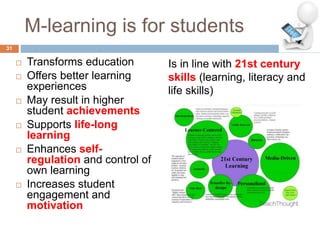
M-learning is for students
 Transforms education
 Offers better learning
experiences
 May result in higher
student achievements
 Supports life-long
learning
 Enhances self-
regulation and control of
own learning
 Increases student
engagement and
motivation
Is in line with 21st century
skills (learning, literacy and
life skills)
31
M-learning is for teachers
 Deliver mobile quizzes and assessments
 Deliver surveys for collecting student feedback
 Scheduling events in a class calendar
 Document sharing available online or
downloading for off-line access
 Upload multimedia material and use it in class
 User and rights management and authentication
 Reporting and analytics - measuring and tracking
student performance
 Easier administration
32
ML Challenges
 Lack of proper infrastructure e.g. low
bandwidth
 Battery life
 OS platforms
 Screen size and resolution
 Security, privacy and ethical issues
 Migrating existing learning content
 Possible student distraction
 Student may not afford it
The Guardian
33
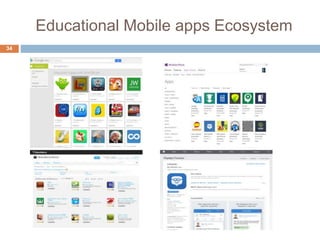
Educational Mobile apps Ecosystem
34
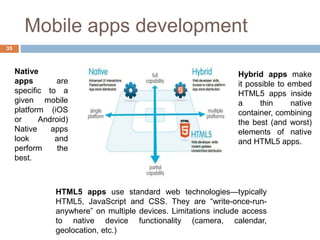
Mobile apps development
Native
apps are
specific to a
given mobile
platform (iOS
or Android)
Native apps
look and
perform the
best.
HTML5 apps use standard web technologies—typically
HTML5, JavaScript and CSS. They are “write-once-run-
anywhere” on multiple devices. Limitations include access
to native device functionality (camera, calendar,
geolocation, etc.)
Hybrid apps make
it possible to embed
HTML5 apps inside
a thin native
container, combining
the best (and worst)
elements of native
and HTML5 apps.
35
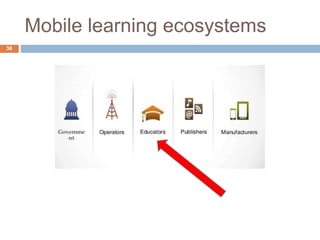
Mobile learning ecosystems
36
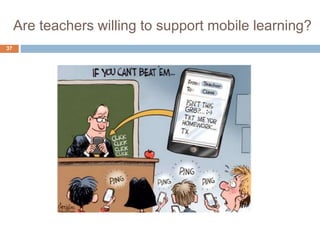
Are teachers willing to support mobile learning?
37
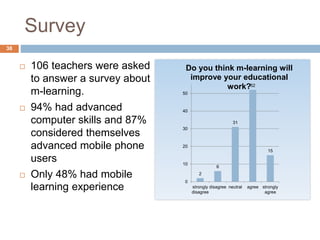
Survey
 106 teachers were asked
to answer a survey about
m-learning.
 94% had advanced
computer skills and 87%
considered themselves
advanced mobile phone
users
 Only 48% had mobile
learning experience
2
6
31
52
15
0
10
20
30
40
50
strongly
disagree
disagree neutral agree strongly
agree
Do you think m-learning will
improve your educational
work?
38
M-learning in EU
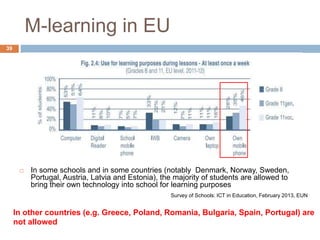
 In some schools and in some countries (notably Denmark, Norway, Sweden,
Portugal, Austria, Latvia and Estonia), the majority of students are allowed to
bring their own technology into school for learning purposes
Survey of Schools: ICT in Education, February 2013, EUN
39
In other countries (e.g. Greece, Poland, Romania, Bulgaria, Spain, Portugal) are
not allowed
Conclusions
40
Thank you!
stavrosnikou@sch.gr
41
http://tinyurl.com/lduftfv

Mobile learning: Go for it!, Stavros Nikou

  • 1.
    Mobile Learning: Gofor it! stavrosnikou@sch.gr 2nd Scientix Conference Brussels, 24-26 October 2014 Stavros Nikou, SDA Greece Physics, Computer Science teacher 4th Lykeio Stavroupolis, Thessaloniki, GR Computer Networks and Telematics Applications Lab University of Macedonia, GR 1
  • 2.
  • 3.
    Presentation outline  Whym-learning  Definitions  M-learning practices  Characteristics  Affordances  for students  for teachers  Challenges  Mobile apps ecosystem  M-learning in EU  Conclusions 3
  • 4.
    Mobile devices areeverywhere 4
  • 5.
    Why consider m-learning? Today over 6 billion people have access to a connected mobile device and for every one person who accesses the internet from a computer two do so from a mobile device  Mobile technology is changing the way we live  It is time to change the way we learn. (Unesco, Mobile Learning) 5
  • 6.
    Infographics about mobiles 2011Horizon Report The Future of Enterprise Mobile Learning 6
  • 7.
    Digital natives vsdigital immigrants  Digital immigrant, is an individual who was born before the existence of digital technology and adopted it to some extent later in life.  “A digital native is a person who was born during or after the general introduction of digital technologies and through interacting with digital technology from an early age, has a greater comfort level using it” [1]  21st century learners are “Digital Natives” [1] Prensky, "Digital Natives, Digital Immigrants“, 2001 7
  • 8.
    Why not usemobile technologies for learning?  In class  Outside class (Photo: Michael Schennum, The Arizona Republic) http://www.usatoday.com 8
  • 9.
    What is mobilelearning? Mobile learning involves the use of mobile technology, either alone or in combination with other information and communication technology (ICT), to enable learning anytime and anywhere (UNESCO) 9
  • 10.
  • 11.
    Mobile Learning Practices:inside class  Provide real time feedback to students through polling devices (Kelsey Broadwell/TommieMedia) Socrative.com 11
  • 12.
    Mobile Learning Practices:outside class Fig. 3 and Fig 5. Yueh-Min Huang, Po-Sheng Chiu, Tzu-Chien Liu, Tzung-Shi Chen, The design and implementation of a meaningful learning-based evaluation method for ubiquitous learning, Computers & Education, Volume 57, Issue 4, December 2011, Pages 2291-2302, ISSN 0360- 1315, Fig 2. Effects of the inquiry-based mobile learning model on the cognitive load and learning achievement of students. Gwo Jen Hwang, Po Han Wu, Ya Yen Zhuang, Yueh Min Huang , Interactive Learning Environments , Vol. 21, Iss. 4, 2013 12
  • 13.
    Mobile Learning is: Multimedia rich  Bite-sized  Time independent  Location independent  Just-in-time-learning  Ubiquitous  Adaptive  Personalized  Context-aware  Situated and Authentic  Social and collaborative  Augmented Reality enabled  Gamification supportive  Cloud-based 13
  • 14.
    ML is multimediarich  Multiple media, beyond text can be supported:  html  images  Audio  Video  Even AR  Different learning representations and hence, learning styles can be supported 14
  • 15.
    ML is bite-sized Instead of lengthy instructions and courses  on-demand delivery of short lessons through mobiles  People can now learn on their spare time and learn only what they're interested in  According to the Journal of Applied Psychology, learning in smaller chunks can improve the knowledge transfer by 17%  e.g. while assembling a product, a company worker can instantly get bite-sized instructions through a mobile application  e.g. students review course material while on a bus 15
  • 16.
    ML is timeand location independent  Wireless networks and the portability of mobile devices offer  Educational resources available 24/7  Students learn whenever and wherever they want to  Enhanced learner’s engagement  Possible distractions and interruptions http://blog.insynctraining.com/global-mobile-social-virtual- 16
  • 17.
     Right contentat the proper place at the right time  “You can’t teach people everything they need to know. The best you can do is position them where they can find what they need when they need to know it”. Seymourt Papert ML is just-in-time 17
  • 18.
    ML is adaptiveand personalized  A paradigm shift from the traditional one-size-fits-all teaching approaches to adaptive and personalized learning  The system fits its behavior to :  the educational needs (such as learning goals and interests),  personal characteristics (such as learning styles and different prior knowledge)  particular circumstances (such as the learners’ time and location as well as movements in the environment) of the individual learner or a group of interconnected learners [1] [1] Wu, S., Chang, A., Chang, M., Liu, T.-C., & Heh, J.-S. (2008). Identifying Personalized Context-aware Knowledge Structure for Individual User in Ubiquitous Learning Environment. In Proceedings of the 5th International Conference on Wireless, Mobile and Ubiquitous Technologies in Education, (WMUTE 2008) (pp. 95-99), Beijing, China. 18
  • 19.
    Adaptation engine  Inputdata into the adaptation engine is the learner’s mobile context  The adaptation engine acquires input data and produces the adaptation results  Output results of the adaptation engine are the adapted mobile educational content [1] [1] Economides, A. A. (2009). Adaptive context-aware pervasive and ubiquitous learning. International Journal of Technology Enhanced Learning, 1(3), 169-192 19
  • 20.
    ML is Context-aware Definition of Context  “Any information that can be used to characterize the situation of an entity” [1]  Learning context :  “ the current situation of a person related to a learning activity” [2] [1] Dey, A. K. & Abowd, G. D. (2000). Towards a better understanding of context and context-awareness. Workshop on The What, Who, Where, When, Why and How of Context-awareness (CHI 2000). Hague, Netherlands, 1-6 April. [2] Luckin, R. (2010). Re-designing learning contexts :technology-rich, learner-centered ecologies. London:Routledge. 20
  • 21.
    ML can beUbiquitous  In mobile learning, learners are only supported by their mobile devices, which they are simply carrying with them [1]  In ubiquitous learning, learners are supported, during their learning process, by computing devices, invisible and embedded in everyday objects  Ubiquitous learning is defined as: “the potential of computer technology to make learning possible at any time and at any place” [2] [1] Liu, G. Z. & Hwang, G. J. (2009). A key step to understanding paradigm shifts in e-learning: Towards context-aware ubiquitous learning. British Journal of EducationalTechnology, 40(6). [2] Hwang, G. J. (2006). Criteria and Strategies of Ubiquitous Learning. In Proceedings of IEEE International Conference on Sensor Networks, Ubiquitous and Trustworthy Computing, Taichung, Taiwan 5-7 June. 21
  • 22.
    ML is situated Learning is not only for classrooms  It is for life  Mobiles is a bridge between formal school settings and outdoors 22
  • 23.
    ML is authentic Authentic learning relates to real-world tasks that are of interest to the learners  learning in real life contexts such as museums, field parks, science centers  Mobiles facilitate the authentic learning instructional approach 23
  • 24.
    ML is Collaborativeand Social  CSCL or MSCL: a situation in which two or more people attempt to learn something together with the help of Computers or Mobiles”  Learners can interactively work together and exchange information in a synchronous or asynchronous way  Mobile devices and wireless technology do offer the proper infrastructure for collaborative and social learning  Voice communication and messages exchange  Media sharing (photos, videos, etc)  Email  Social networks  Apps offering common learning spaces (wikis, blogs etc) www.teachthought.com 24
  • 25.
    ML supports AR Augmented Reality, a real-time technology enabling the overlay of virtual graphics over the real world, can be a great way for enhancing learning experiences [1] [1] E. Klopfer. Augmented learning: Research and design of mobile educational games. 2008 www.lm3labs.com 25
  • 26.
    ML supports GBL Game based learning (GBL) is a type of game play that has defined learning outcomes [1]  Gamification takes game elements (such as points, badges, competition, achievements) and applies them to a non-game setting  Examples:  Location based services and social networks, such as foursquare  Mobile based scavenger hunts e.g. for city tours [1] http://edtechreview.in/dictionary/298-what-is-game-based-learning 26
  • 27.
    ML is cloudbased www.edulabsglobal.com The cloud can help extend education and learning beyond the classroom walls and with access to teachers and resources anytime, anywhere, from any device – students have more opportunity to take their learning further. 27
  • 28.
    M-learning supports differentlearning activities * Inquiry-based learning 28
  • 29.
    Mobile Learning andInquiry-Based Learning  The use of mobile technologies along with environmental sensory data:  Facilitates student scientific inquiries  Increases student engagement B. Vogel, D. Spikol, A. Kurti, and M. Milrad, “Integrating Mobile, Web and Sensory Technologies to Support Inquiry-Based Science Learning,”Proc. IEEE Int’l Conf. Wireless, Mobile and Ubiquitous Technologies in Education,2010 29
  • 30.
    Example: SMILE -Stanford Mobile Inquiry-based Learning Environment  Students use a mobile phone application to create questions  Answers are given and rated by peers.  The entire process is controlled and monitored by a teacher with the proper management application  Promotes engagement way in the elementary classroom using mobile phones Stanford Mobile Inquiry-based Learning Environment(SMILE): using mobile phones to promote student inquires in the elementary classroom, Sunmi Seol, Aaron Sharp, Paul Kim Proceedings of the 2011 International Conference on Frontiers in Education: Computer Science & Computer Engineering, FECS 2011 30
  • 31.
    M-learning is forstudents  Transforms education  Offers better learning experiences  May result in higher student achievements  Supports life-long learning  Enhances self- regulation and control of own learning  Increases student engagement and motivation Is in line with 21st century skills (learning, literacy and life skills) 31
  • 32.
    M-learning is forteachers  Deliver mobile quizzes and assessments  Deliver surveys for collecting student feedback  Scheduling events in a class calendar  Document sharing available online or downloading for off-line access  Upload multimedia material and use it in class  User and rights management and authentication  Reporting and analytics - measuring and tracking student performance  Easier administration 32
  • 33.
    ML Challenges  Lackof proper infrastructure e.g. low bandwidth  Battery life  OS platforms  Screen size and resolution  Security, privacy and ethical issues  Migrating existing learning content  Possible student distraction  Student may not afford it The Guardian 33
  • 34.
  • 35.
    Mobile apps development Native appsare specific to a given mobile platform (iOS or Android) Native apps look and perform the best. HTML5 apps use standard web technologies—typically HTML5, JavaScript and CSS. They are “write-once-run- anywhere” on multiple devices. Limitations include access to native device functionality (camera, calendar, geolocation, etc.) Hybrid apps make it possible to embed HTML5 apps inside a thin native container, combining the best (and worst) elements of native and HTML5 apps. 35
  • 36.
  • 37.
    Are teachers willingto support mobile learning? 37
  • 38.
    Survey  106 teacherswere asked to answer a survey about m-learning.  94% had advanced computer skills and 87% considered themselves advanced mobile phone users  Only 48% had mobile learning experience 2 6 31 52 15 0 10 20 30 40 50 strongly disagree disagree neutral agree strongly agree Do you think m-learning will improve your educational work? 38
  • 39.
    M-learning in EU In some schools and in some countries (notably Denmark, Norway, Sweden, Portugal, Austria, Latvia and Estonia), the majority of students are allowed to bring their own technology into school for learning purposes Survey of Schools: ICT in Education, February 2013, EUN 39 In other countries (e.g. Greece, Poland, Romania, Bulgaria, Spain, Portugal) are not allowed
  • 40.
  • 41.