Presented by:
Ayesha Javaid
Course: RDT
The genetic content of each somatic cell in an organism is the same, but not all
genes are expressed in every cell. The control of which genes are expressed
dictates whether a cell is (a) an eye cell or (b) a liver cell. It is the differential
gene expression patterns that arise in different cells that give rise to (c) a
complete organism.
Transcription and
translation occur
simultaneously in the
cytoplasm.
Regulation occurs at the
transcriptional level.
Eukaryotic transcription and
RNA processing occurs in
the nucleus
Translation takes place in
the cytoplasm
Gene expression is
regulated during:
1. Transcription
2. Translation
3. Post-translational modification
of proteins
Prokaryotic organisms Eukaryotic organisms
Lack nucleus Contain nucleus
DNA is found in the cytoplasm DNA is confined to the nuclear
compartment
RNA transcription and protein
formation occur almost
simultaneously
RNA transcription occurs prior to
protein formation, and it takes place
in the nucleus. Translation of RNA
to protein occurs in the cytoplasm.
Gene expression is regulated
primarily at the transcriptional level
Gene expression is regulated at
many levels (epigenetic,
transcriptional, nuclear shuttling,
post-transcriptional, translational,
and post-translational)
Refer back to this table as you review the subsequent sections in this chapter
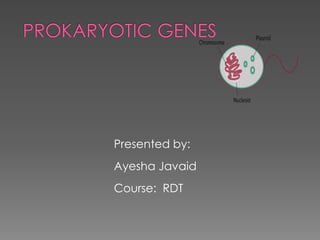
Prokaryotic DNA is organized into a
circular chromosome located in nucleoid region of
cytoplasm
Proteins with similar function or in the same
biochemical pathway are organized in blocks
called operons
Operons are regulated by three
molecule types:
1. Repressors – suppress transcription
2. Activators – increase transcription
3. Inducers – may suppress or activate
transcription depending upon the needs
of the cell
1. When tryptophan is plentiful
✔two tryptophan molecules bind the repressor protein
at the operator sequence
✔The complex physically blocks the RNA polymerase
from transcribing the tryptophan genes by binding to
operator
2. When tryptophan is absent
✔ the repressor protein does not bind to the operator
✔ The RNA polymerase can access the operator and the
genes are transcribed
Negative Regulators: Proteins that bind to the operator silence trp expression.
1. Glucose supplies become limited in cell
✔ cAMP levels increase
✔ cAMP binds to the CAP protein (a positive regulator)
✔ CAMP/CAP protein complex binds to an operator region
upstream of the genes required to use other sugar sources
When glucose levels fall,
E. coli may use other sugars
for fuel but must transcribe
new genes to do so.
Positive Regulators:
Proteins that bind the
promoter in order to
activate gene expression
Inducible operons:
Proteins that activate or
repress transcription
Activation/repression
depends on the local
environment and the
needs of the cell.
Eukaryotic gene expression is more
complex than in prokaryotes:
✔ Transcription and translation are
physically separated.
✔ Regulation can occur at many levels.
✔ 1st level begins with control of access to
the DNA – epigenetic regulation – and
occurs before transcription begins.
✔ Transcription factors are proteins that
control the transcripton of genetic
information from DNA to RNA
Organization of human genome
• 20,000 genes
• 23 chromosomes (thousands of
genes/chromosome)
• DNA is wound/compacted tightly with
proteins (histones)
• Expressed genes must be unwound
and made available to polymerases
DNA is folded around histone proteins to create (a) nucleosome
complexes.
These nucleosomes control the access of proteins to the underlying
DNA.
When viewed through an electron microscope (b), the nucleosomes
look like beads on a string. (credit “micrograph”: modification of work
by Chris Woodcock)
Chemical tags are added to histones and DNA
• Phosphate, methyl, acetyl groups serve as tags
• Tags are not permanent – can be added or
removed
Acts as signals to tell histones if region of
chromosome should be open or closed
Epigenetic regulation – “around genetics”
temporary changes to nuclear proteins and DNA
that do not alter nucleotide sequence but do alter
gene expression
Modifications affect nucleosome spacing
and gene expression.
Unwinding and
opening of DNA
allows
transcription
factors to bind
promoters and other
upstream regions
and initiate
transcription
• Gene transcription in
Eukaryotes requires RNA
polymerases.
• These RNA polymerases
require transcription factors
(specialized proteins) to
initiate transcription.
• These factors bind the
promoter sequence and
other DNA regulatory
sequences.
• Eukaryotic RNA polymerases
require transcription factors
in order to initiate
RNA polymerase II interacting with DNA (red) and
producing new RNA (green).
Credit: Protein Data Bank, Public Domain
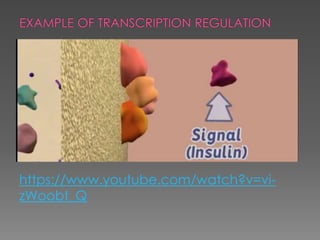
https://www.youtube.com/watch?v=vi-
zWoobt_Q
Promoter – Region of DNA upstream of coding
sequence (a few nucleotide to 100’s of nucleotides
long)
TATA box – a series of thymine and adenine
dinucleotides within the promoter just upstream of
the transcriptional start site
• Enhancer - a DNA sequence
that promotes transcription.
• Each enhancer is made up of
short DNA sequences called
distal control elements.
• Activators bind to the distal
control elements and interact
with mediator proteins and
transcription factors.
• Note: Two different genes may have
the same promoter but different distal
control elements, enabling differential
gene expression.
DNA bending protein changes the shape of
DNA and properly orients enhancer region.
RNA transcripts must be processed into
final form before translation can begin-
post transcriptional modification
This step can be regulated to control
gene expression
Pre-mRNA can be alternatively spliced to create
different proteins. This process occurs in the nucleus.
✔ Splicing requires proper identification of
introns.
✔ Errors in this process could lead to
splicing out of an intervening exon.
✔ Usually would be deleterious to
organism…
✔ But it could produce a protein variant
without loss of original protein.
✔ New variant might have had an
adaptive advantage.
• The protein-coding region of mRNA is flanked by 5' and 3'
untranslated regions (UTRs).
• RNA-binding proteins at these UTRs influences the RNA
stability:
• Can increase or decrease the length of time mRNA is present in
the cytoplasm.
• They also regulate mRNA localization and protein translation.
5’ cap methylated guanosine
triphosphate molecule (GTP)prevents
degradation of transcript.
Poly-A tail prevents
degradation of transcript.
Muhonen P, Holthofer H - (2009)
• microRNAs (miRNAs) –
short RNA molecules (21-
24 nucleotides) that
recognize s specific
sequence of mRNA.
• They associate with
ribonucleoprotein complex
called RNA-induced
silencing complex (RISC).
• RISC/miRNA bind to and
degrade the mRNA.
1. Translation controlled by proteins that bind and
initiate process (formation of initiation complex).
2. Eukaryotic initiation factor-2 (eIF-2) – first protein to
bind and form complex.
3. GTP binds to eIF-2 and this complex binds to 40S
ribosomal subunit.
4. Methionine initiator tRNA brings mRNA and binds
the eIF-2/GTP/40S complex
5. GTP is converted to GDP and energy is released.
6. Phosphate and eIF-2 are released and 60S binds
and translation occurs.
• When eIF-2 is phosphorylated, a conformation change occurs
• GTP cannot bind eIF-2: Translation cannot occur
• Proteins can be chemically modified – chemicals
added or removed
• These chemical changes regulate protein activity or
length of time they exist in cell.
• These changes can alter epigenetic accessibility,
transcription, mRNA stability, or translation—all resulting
in changes in expression of various genes.
For example, proteins with ubiquitin tags are marked for degradation.
Cancer is not a
single disease but
many diseases.
Mutations modify
cell-cycle control
and cells don’t stop
growing as they
normally would.
Breast Cancer Cells
Credit: National Cancer Institute
Breast cancer invades normal tissues
and establishes new centers of growth.
Note that the duct on inside of breast is
completely filled with tumor cells. This
histological slide is stained with H&E
stain and magnified to 100x.
Expression of genes not normally expressed
in a cell can be due to:
1. Gene mutation
2. Gene regulation
⮚ Epigenetic
⮚ Transcription
⮚ Post-transcription
⮚ Translation
⮚ Post-Translation
• Tumor Suppressor Genes – function to
prevent excess, inappropriate cell growth
• Tumor suppressor gene p53 – mutated in
over 50% of all cancer types
• p53 functions as a transcription factor
✔ Cause cancer when
mutated
✔ Alter transcriptional
activity of a gene
that control cell
growth
✔ Ex. Myc –
transcription factor
that is activated in
Burkett’s Lymphoma
Histology slide Burkitt's lymphoma
Malignant B-cell lymphocytes seen in
Burkitt's lymphoma, stained with
hematoxylin and eosin (H&E) stain
National Cancer Institute (NCI); Author: Louis M. Staudt
Proto-oncogenes - positive cell-cycle regulators
⮚ Mutations that activate transcription
factors
⮚ Overexpression of the epidermal growth
factor receptor (EGFR) in a subset of breast
cancers
⮚ Leads to activation of protein kinases
⮚ Leads to overexpression of transcription
factors that control genes involved in cell
cycle
Drugs that prevent activation of EGFR may be
useful in treating this type of cancer.

Gene Expression.pptx

  • 1.
  • 2.
    The genetic contentof each somatic cell in an organism is the same, but not all genes are expressed in every cell. The control of which genes are expressed dictates whether a cell is (a) an eye cell or (b) a liver cell. It is the differential gene expression patterns that arise in different cells that give rise to (c) a complete organism.
  • 3.
    Transcription and translation occur simultaneouslyin the cytoplasm. Regulation occurs at the transcriptional level.
  • 4.
    Eukaryotic transcription and RNAprocessing occurs in the nucleus Translation takes place in the cytoplasm Gene expression is regulated during: 1. Transcription 2. Translation 3. Post-translational modification of proteins
  • 5.
    Prokaryotic organisms Eukaryoticorganisms Lack nucleus Contain nucleus DNA is found in the cytoplasm DNA is confined to the nuclear compartment RNA transcription and protein formation occur almost simultaneously RNA transcription occurs prior to protein formation, and it takes place in the nucleus. Translation of RNA to protein occurs in the cytoplasm. Gene expression is regulated primarily at the transcriptional level Gene expression is regulated at many levels (epigenetic, transcriptional, nuclear shuttling, post-transcriptional, translational, and post-translational) Refer back to this table as you review the subsequent sections in this chapter
  • 6.
    Prokaryotic DNA isorganized into a circular chromosome located in nucleoid region of cytoplasm Proteins with similar function or in the same biochemical pathway are organized in blocks called operons Operons are regulated by three molecule types: 1. Repressors – suppress transcription 2. Activators – increase transcription 3. Inducers – may suppress or activate transcription depending upon the needs of the cell
  • 7.
    1. When tryptophanis plentiful ✔two tryptophan molecules bind the repressor protein at the operator sequence ✔The complex physically blocks the RNA polymerase from transcribing the tryptophan genes by binding to operator
  • 8.
    2. When tryptophanis absent ✔ the repressor protein does not bind to the operator ✔ The RNA polymerase can access the operator and the genes are transcribed Negative Regulators: Proteins that bind to the operator silence trp expression.
  • 9.
    1. Glucose suppliesbecome limited in cell ✔ cAMP levels increase ✔ cAMP binds to the CAP protein (a positive regulator) ✔ CAMP/CAP protein complex binds to an operator region upstream of the genes required to use other sugar sources When glucose levels fall, E. coli may use other sugars for fuel but must transcribe new genes to do so. Positive Regulators: Proteins that bind the promoter in order to activate gene expression
  • 10.
    Inducible operons: Proteins thatactivate or repress transcription Activation/repression depends on the local environment and the needs of the cell.
  • 12.
    Eukaryotic gene expressionis more complex than in prokaryotes: ✔ Transcription and translation are physically separated. ✔ Regulation can occur at many levels. ✔ 1st level begins with control of access to the DNA – epigenetic regulation – and occurs before transcription begins. ✔ Transcription factors are proteins that control the transcripton of genetic information from DNA to RNA
  • 13.
    Organization of humangenome • 20,000 genes • 23 chromosomes (thousands of genes/chromosome) • DNA is wound/compacted tightly with proteins (histones) • Expressed genes must be unwound and made available to polymerases
  • 14.
    DNA is foldedaround histone proteins to create (a) nucleosome complexes. These nucleosomes control the access of proteins to the underlying DNA. When viewed through an electron microscope (b), the nucleosomes look like beads on a string. (credit “micrograph”: modification of work by Chris Woodcock)
  • 15.
    Chemical tags areadded to histones and DNA • Phosphate, methyl, acetyl groups serve as tags • Tags are not permanent – can be added or removed Acts as signals to tell histones if region of chromosome should be open or closed Epigenetic regulation – “around genetics” temporary changes to nuclear proteins and DNA that do not alter nucleotide sequence but do alter gene expression
  • 16.
    Modifications affect nucleosomespacing and gene expression. Unwinding and opening of DNA allows transcription factors to bind promoters and other upstream regions and initiate transcription
  • 17.
    • Gene transcriptionin Eukaryotes requires RNA polymerases. • These RNA polymerases require transcription factors (specialized proteins) to initiate transcription. • These factors bind the promoter sequence and other DNA regulatory sequences. • Eukaryotic RNA polymerases require transcription factors in order to initiate RNA polymerase II interacting with DNA (red) and producing new RNA (green). Credit: Protein Data Bank, Public Domain
  • 18.
  • 19.
    Promoter – Regionof DNA upstream of coding sequence (a few nucleotide to 100’s of nucleotides long) TATA box – a series of thymine and adenine dinucleotides within the promoter just upstream of the transcriptional start site
  • 20.
    • Enhancer -a DNA sequence that promotes transcription. • Each enhancer is made up of short DNA sequences called distal control elements. • Activators bind to the distal control elements and interact with mediator proteins and transcription factors. • Note: Two different genes may have the same promoter but different distal control elements, enabling differential gene expression. DNA bending protein changes the shape of DNA and properly orients enhancer region.
  • 21.
    RNA transcripts mustbe processed into final form before translation can begin- post transcriptional modification This step can be regulated to control gene expression
  • 22.
    Pre-mRNA can bealternatively spliced to create different proteins. This process occurs in the nucleus.
  • 24.
    ✔ Splicing requiresproper identification of introns. ✔ Errors in this process could lead to splicing out of an intervening exon. ✔ Usually would be deleterious to organism… ✔ But it could produce a protein variant without loss of original protein. ✔ New variant might have had an adaptive advantage.
  • 25.
    • The protein-codingregion of mRNA is flanked by 5' and 3' untranslated regions (UTRs). • RNA-binding proteins at these UTRs influences the RNA stability: • Can increase or decrease the length of time mRNA is present in the cytoplasm. • They also regulate mRNA localization and protein translation. 5’ cap methylated guanosine triphosphate molecule (GTP)prevents degradation of transcript. Poly-A tail prevents degradation of transcript.
  • 26.
    Muhonen P, HolthoferH - (2009) • microRNAs (miRNAs) – short RNA molecules (21- 24 nucleotides) that recognize s specific sequence of mRNA. • They associate with ribonucleoprotein complex called RNA-induced silencing complex (RISC). • RISC/miRNA bind to and degrade the mRNA.
  • 27.
    1. Translation controlledby proteins that bind and initiate process (formation of initiation complex). 2. Eukaryotic initiation factor-2 (eIF-2) – first protein to bind and form complex. 3. GTP binds to eIF-2 and this complex binds to 40S ribosomal subunit. 4. Methionine initiator tRNA brings mRNA and binds the eIF-2/GTP/40S complex 5. GTP is converted to GDP and energy is released. 6. Phosphate and eIF-2 are released and 60S binds and translation occurs.
  • 28.
    • When eIF-2is phosphorylated, a conformation change occurs • GTP cannot bind eIF-2: Translation cannot occur
  • 29.
    • Proteins canbe chemically modified – chemicals added or removed • These chemical changes regulate protein activity or length of time they exist in cell. • These changes can alter epigenetic accessibility, transcription, mRNA stability, or translation—all resulting in changes in expression of various genes. For example, proteins with ubiquitin tags are marked for degradation.
  • 30.
    Cancer is nota single disease but many diseases. Mutations modify cell-cycle control and cells don’t stop growing as they normally would. Breast Cancer Cells Credit: National Cancer Institute Breast cancer invades normal tissues and establishes new centers of growth. Note that the duct on inside of breast is completely filled with tumor cells. This histological slide is stained with H&E stain and magnified to 100x.
  • 31.
    Expression of genesnot normally expressed in a cell can be due to: 1. Gene mutation 2. Gene regulation ⮚ Epigenetic ⮚ Transcription ⮚ Post-transcription ⮚ Translation ⮚ Post-Translation
  • 32.
    • Tumor SuppressorGenes – function to prevent excess, inappropriate cell growth • Tumor suppressor gene p53 – mutated in over 50% of all cancer types • p53 functions as a transcription factor
  • 33.
    ✔ Cause cancerwhen mutated ✔ Alter transcriptional activity of a gene that control cell growth ✔ Ex. Myc – transcription factor that is activated in Burkett’s Lymphoma Histology slide Burkitt's lymphoma Malignant B-cell lymphocytes seen in Burkitt's lymphoma, stained with hematoxylin and eosin (H&E) stain National Cancer Institute (NCI); Author: Louis M. Staudt Proto-oncogenes - positive cell-cycle regulators
  • 34.
    ⮚ Mutations thatactivate transcription factors ⮚ Overexpression of the epidermal growth factor receptor (EGFR) in a subset of breast cancers ⮚ Leads to activation of protein kinases ⮚ Leads to overexpression of transcription factors that control genes involved in cell cycle Drugs that prevent activation of EGFR may be useful in treating this type of cancer.