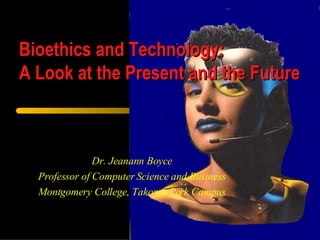
Dr. Jeanann Boyce Professor of Computer Science and Business Montgomery College, Takoma Park Campus Bioethics and Technology: A Look at the Present and the Future
Presenter Dr. Jeanann Boyce Professor of Computer Science at Montgomery College and Adjunct Professor of Information Science at  Johns Hopkins and Bowie State University. Member of Robotics International, Society of Manufacturing Engineers. Teaches AI programming and Information Systems,  ED Chair District of Columbia Engineering & Architectural Societies Developed and implemented first Ethics in the Information Age courses at University of Maryland University College and Montgomery College
Purposes of the Presentation Current Issues in Biotechnology Consider some  Ethical Questions regarding the development of current Biotechnical advancements
Part 1:  Current Issues in Biotechnology:  The Three Faces of AI
Divergent Paths of Intelligence-  Hardware, Software, Human Three Distinct Areas of Internet Evolution Sentient Machines Disembodied Entities Human Technogenics (or Cyborgs)
Intelligent Equipment: Cogito, ergo est?
Sentient Machines HAL of 2001 Robotics with Positronic Brains- neural networks versus expert systems.  Norseen of Lockheed Martin has proposed mathematical constructs “semiotic reality”,emergent  process of biochemical induced, electromagnetic field mediated interaction of information with uniquely configured neural structures, and expressed into work via protein reconfiguration, under the term  BioFusion .   Computers that think like Humans?  When Things Start to Think- Neil Gerstenfeld 1999
Expert Systems Easy to do the “hard things”, hard to do the “easy” things Expert systems working closely with human Robotics, partial mechanicals Problem solving, menial tasks, decision-making Marketing through PDA’s
Technical Boyce rule of time/machine transference As machines have become faster, our patience has become less.  Will our brains adjust? 2020 1975- 4 Mz 2001- 2 Gz 3 Trillion transactions/sec ???
Ethical Questions? Is it possible that machines will develop attitudes on their relationship towards humans? Is this what we want? If not, what should we do to prevent this from happening?
Disembodied and Distributed Intelligence:  The Web as Neural Network
Devices connecting you to the Technology Full   sensory vs. Desktop Head Mounted Display System Display System
Wearables VR based technology MIT The Phantom MIT-WAM arm  Mini-Macro actuator  JPL FRHC  The Salisbury Hand  The Talon Force Sensing Fingertip Stephen Mann’s Haptic Interfaces
Professional Applications Medical - Surgeons can practice surgeries before operating on live patients  Robot assisted surgery, Sept. 20, 2001 Transatlantic gall bladder removed from NYC surgeon in Stasbourg France Engineering & Architecture Engineers and technicians can design parts and assemble parts in simulations Military personnel can train pilots and use synthetic theaters of war Scientists  Financialists  Education bridging the gap of time and space Excellent for those with Disabilities
Imagine  a world in which knowledge can be shared in real time within simulations that can integrate information that spans the course of history. Real time interactions promise unlimited opportunities for people from diverse cultures to communicate.
Definitions of the Internet Unstructured network of servers Non-regulated, communications mechanism Cross-cultural, non-academic knowledge base No TRAFFIC MANAGERS No RUBBISH COLLECTORS
Disembodied Online Entities Corporate Persona - Legal Entity Avatars – Virtual Egos (see  www.kurzweilai.net ) Virtual Reality and the Internet Interface Perceptual Realities of Time, Space, and Ownership of Data
Wallace and the Talking Dolls Alice – the online AVATAR Digital Animation and Acting models, Voice Puppets-
Distributed Intelligence Using the Power of the Internet for Cultural and Technical Problem solving Data collection and analysis Tracking
Ethical Questions? Is there any right to privacy of information? What does this do to our communications with other humans?
3.  Technogenics – Human/machine interfaces
Human Technogenics Computer scientists predict that within the next twenty years neural interfaces will be designed that will not only increase the dynamic range of senses, but will also enhance memory and enable "cyberthink" — invisible communication with others.  This technology will facilitate consistent and constant access to information when and where it is needed.
Cyborgs and such… Kevin Warwick head of the Cybernetics Department at the University of Reading is the first guinea pig. (www.kevinwarwick.com)
Yorick – FDA Kids Web Site Electronic devices and mechanical parts  Glass eye, silicon nose, gel-filled chin
Yorick cont’d
Alas, More Yorick Hip Joint Pacemakers
BioChips Implantable   computer or organic chips that can monitor, control, provide feedback on different body functions, including neural activities
Implants Other work in microelectromechanical systems (MEMS) develops miniature structures that can be used to communicate directly with neurons without harming them. Peter Fromherz and Alfred Stett at the Max Planck Institute of Biochemistry in Munich have succeeded in making a silicon chip that can directly stimulate a single nerve cell without damaging the cell.  1997 Nagoya University, Japan--Eye of Newt used in artificial retina design that combines semiconductor components with living nerve cells from newts.  Light sensitive photoconductors. *  Companies such as AVID (Norco, Calif.), Electronic ID, Inc. (Cleburne, Tx.), and Electronic Identification Devices, Ltd. (Santa Barbara, Calif.) sell both the chips and the detectors.
Brain Circuitry Chips Brain Pacemakers - FDA approved 1997 Neurochips for other controls as well as assisting in treatment of depression, Alzheimers, Parkinsons, etc Neurochips with Robotic interface—monkey controlling computer mouse by thought 3/2002 Artificial Stimulants, e.g.Provigil
Tissue Engineering 4 Brothers—Jay, Chuck, Marty, and Frank Vacanti Cartilage molded around a  biodegradable polymer, impregnated with  patient’s own  cells Scaffold, surgical coral
Pittsburgh Tissue Engineering Initiative: University of Pittsburgh School of Medicine and UPMC Health System   McGowan Institute on Regenerative Medicine Biomedicals Medical devices and Artificial Organs Cellular Therapeutics and  Hemodynamics   “ Researchers at the McGowan Institute are developing a tissue-engineered patch that can replace a section of damaged heart muscle, allowing reconstruction of functional myocardium in dysfunctional regions of the heart. This patch will consist of cells seeded onto a bioerodible matrix that has been designed to transmit appropriate stresses to the cells through their in-vitro training period and after placement into the diseased myocardium. Vascularization of this implanted construct will be achieved by a proprietary surgical procedure.”
Welcome to the Tissue-Engineering Pages Since , 22.07.2002   Portable pancreas promises diabetes relief Researchers developing a portable "artificial pancreas" for people with diabetes claim to be only a few months away from completing the world s first working prototype.  Posted on 2002-06-25 @ 01:43:56   "Functional" kidneys grown from stem cells The "New Scientist" reported that US scientists claim to have grown functional kidneys using stem cells taken from cloned cow embryos.  Posted on 2002-06-13 @ 10:37:51   Spinal cord recovery hurdle cleared An enzyme that clears a path for growing nerves can help damaged spinal cord to repair itself, researchers have found. For treating paralysing injuries  Posted on 2002-04-17 @ 00:09:18
Tissue Engineering (cont’d)
Transgenics and Genetic Manipulation
Disembodied Tissues
Current Developments with Chimeras
Nonhuman Animal – Nonhuman Animal interface “ Spidergoats”: a Canadian biotech company has spliced the genes of spider’s genome that spin spiderwebs (one of the strongest fibers known to mankind) into the genome of a goat, creating a product called  BioSteel®
Flying Pigs?
Alternate View of Humanity, continued…. Biological species? –Homo Sapiens?  But members of the same genus can interbreed if the correct number of chromosomes is present, and although the offspring are often sterile, this is a statistical probability, not a steadfast rule.  Also artificial reproduction may change (see ANDi, the transgenic monkey) the statistics.
Implications of Creating New Life Forms Further advances in the blending of nonhuman animal and human DNA could result, intentionally or not, in chimeric entities possessing degrees of intelligence or sentience  never before seen in nonhuman animals Similarly, the blending of biological and cybernetic materials could result in sentience  never seen before in machines
Plant/Human Interfaces Tobacco as Vaccine Producer—Personalized Medicine WP 7/15/2002 KY project sponsored by the California company Large Scale Biology Corp.. Australian tobacco Tumor fragments inserted into DNA Harvested, vaccine for lymphoma extracted
Designer Pills MIT Pharmacy on a Chip—ChipRx prototype Microchips pockmarked with drug-filled reservoirs each sealed with a gold cap and wired to a power source-Microfluidics “ Smart  pill” adjusts timing and dosage, as well as functioning as 24 health monitor Size of a matchstick
Chococeuticals
Ethical Questions? Where does the person/machine interface end? What is the definition of what it means to be human?
What Does It Mean to Be Human?
The Next Biotech Hero? Washington Post April 26, 2002 -  The Next Generation: Biotechnology May Make Superhero Fantasy a Reality Moving into the popular  culture   Who will decide what kind  of humans we create?
Human Technogenics The Next Wonder Woman and Superman?
The Race to become the first human cyborg Kevin Warwick head of the Cybernetics Department at the University of Reading claims to be the first human guinea pig. ( www.kevinwarwick.com )
Race for cyborgs,cont’d… University of Toronto professor Steven Mann describes himself as the world’s only full-time cyborg.
Gene Machine DNA Sequencer—dissects and catalogues DNA Celera Genomics Group and Applied Biosystems In corporate lawsuit with MJ Research, Inc of Massachusetts
An Obligation of Stewardship What is our role on the planet? Who gets the parts? Who decides who gets the parts? Who pays for the changes in the human condition?
Biotechnology meets Jerry Springer – the Ted Williams debacle  Tarnishing Ted's Legacy: Now That's Coldblooded    By Sally Jenkins Saturday, July 13, 2002; Page D01  The black comedy that is the passing of Ted Williams gets blacker with every passing moment. Can we bear to learn another macabre detail, without barking hysterically through our nostrils? He has been drained of blood and filled with preservatives. Alcor reportedly will hang him upside down in a steel vat. His son, John Henry, supposedly wants to "harvest" his DNA and sell it for a price.
Ted Williams cont’d Is his body merely property? If so, who owns it? California – Moore Case
As different forms of Artificial Intelligence* in the technical environment emerge, the courts must determine where these creations fall on the continuum of personhood. * Including transgenic humanoids?
For the future: Expect intense cross-disciplinary debate, discussion, as new intelligent life is created through biotechnology .
For the Future???
NBIC – the synergistic combination of 4 major areas of science and technology Nanoscience and Nanotechnology Biotechnology and Biomedicine Information Technology Cognitive Science
Carbon Tubes Carbon nanotubes are fullerene-related structures which consist of graphene cylinders closed at either end with  caps  containing pentagonal rings . tubes can be opened and  filled  with a variety of materials including biological molecules.
Nano-Info  Products such “Smart Dust”  Remote sensing  “ Lifelog”sensors  Nose Chip
Nano-Bio-Cogno Brain Pacemakers - FDA approved 1997 Neurochips for other controls as well as assisting in treatment of depression, Alzheimers, Parkinsons, etc Neuroprostethic devices aimed at restoring or augmenting performance of the brain.
Cogno-Bio-Info Medical imaging such as: CT scans PET (positron emission tomography) scanning fMRIs
Professional Uses of Bio-Info (Surgical VR) Medical - Surgeons can practice surgeries before operating on live patients  Robot assisted surgery, Sept. 20, 2001 Transatlantic gall bladder removed from NYC surgeon in Stasbourg France Computer Motion Corporation, Santa Barbara California Not US approved, $900,000
Nanotechnology of Metal Manipulaion Layers at the atomic and molecular level Produce a variety of devices and materials
Check Out On The Web Google “nanotechnology” and tissue engineering www.nano.gov

Bioethics Uvt2008

  • 1.
    Dr. Jeanann BoyceProfessor of Computer Science and Business Montgomery College, Takoma Park Campus Bioethics and Technology: A Look at the Present and the Future
  • 2.
    Presenter Dr. JeanannBoyce Professor of Computer Science at Montgomery College and Adjunct Professor of Information Science at Johns Hopkins and Bowie State University. Member of Robotics International, Society of Manufacturing Engineers. Teaches AI programming and Information Systems, ED Chair District of Columbia Engineering & Architectural Societies Developed and implemented first Ethics in the Information Age courses at University of Maryland University College and Montgomery College
  • 3.
    Purposes of thePresentation Current Issues in Biotechnology Consider some Ethical Questions regarding the development of current Biotechnical advancements
  • 4.
    Part 1: Current Issues in Biotechnology: The Three Faces of AI
  • 5.
    Divergent Paths ofIntelligence- Hardware, Software, Human Three Distinct Areas of Internet Evolution Sentient Machines Disembodied Entities Human Technogenics (or Cyborgs)
  • 6.
  • 7.
    Sentient Machines HALof 2001 Robotics with Positronic Brains- neural networks versus expert systems. Norseen of Lockheed Martin has proposed mathematical constructs “semiotic reality”,emergent process of biochemical induced, electromagnetic field mediated interaction of information with uniquely configured neural structures, and expressed into work via protein reconfiguration, under the term BioFusion . Computers that think like Humans? When Things Start to Think- Neil Gerstenfeld 1999
  • 8.
    Expert Systems Easyto do the “hard things”, hard to do the “easy” things Expert systems working closely with human Robotics, partial mechanicals Problem solving, menial tasks, decision-making Marketing through PDA’s
  • 9.
    Technical Boyce ruleof time/machine transference As machines have become faster, our patience has become less. Will our brains adjust? 2020 1975- 4 Mz 2001- 2 Gz 3 Trillion transactions/sec ???
  • 10.
    Ethical Questions? Isit possible that machines will develop attitudes on their relationship towards humans? Is this what we want? If not, what should we do to prevent this from happening?
  • 11.
    Disembodied and DistributedIntelligence: The Web as Neural Network
  • 12.
    Devices connecting youto the Technology Full sensory vs. Desktop Head Mounted Display System Display System
  • 13.
    Wearables VR basedtechnology MIT The Phantom MIT-WAM arm Mini-Macro actuator JPL FRHC The Salisbury Hand The Talon Force Sensing Fingertip Stephen Mann’s Haptic Interfaces
  • 14.
    Professional Applications Medical- Surgeons can practice surgeries before operating on live patients Robot assisted surgery, Sept. 20, 2001 Transatlantic gall bladder removed from NYC surgeon in Stasbourg France Engineering & Architecture Engineers and technicians can design parts and assemble parts in simulations Military personnel can train pilots and use synthetic theaters of war Scientists Financialists Education bridging the gap of time and space Excellent for those with Disabilities
  • 15.
    Imagine aworld in which knowledge can be shared in real time within simulations that can integrate information that spans the course of history. Real time interactions promise unlimited opportunities for people from diverse cultures to communicate.
  • 16.
    Definitions of theInternet Unstructured network of servers Non-regulated, communications mechanism Cross-cultural, non-academic knowledge base No TRAFFIC MANAGERS No RUBBISH COLLECTORS
  • 17.
    Disembodied Online EntitiesCorporate Persona - Legal Entity Avatars – Virtual Egos (see www.kurzweilai.net ) Virtual Reality and the Internet Interface Perceptual Realities of Time, Space, and Ownership of Data
  • 18.
    Wallace and theTalking Dolls Alice – the online AVATAR Digital Animation and Acting models, Voice Puppets-
  • 19.
    Distributed Intelligence Usingthe Power of the Internet for Cultural and Technical Problem solving Data collection and analysis Tracking
  • 20.
    Ethical Questions? Isthere any right to privacy of information? What does this do to our communications with other humans?
  • 21.
    3. Technogenics– Human/machine interfaces
  • 22.
    Human Technogenics Computerscientists predict that within the next twenty years neural interfaces will be designed that will not only increase the dynamic range of senses, but will also enhance memory and enable "cyberthink" — invisible communication with others. This technology will facilitate consistent and constant access to information when and where it is needed.
  • 23.
    Cyborgs and such…Kevin Warwick head of the Cybernetics Department at the University of Reading is the first guinea pig. (www.kevinwarwick.com)
  • 24.
    Yorick – FDAKids Web Site Electronic devices and mechanical parts Glass eye, silicon nose, gel-filled chin
  • 25.
  • 26.
    Alas, More YorickHip Joint Pacemakers
  • 27.
    BioChips Implantable computer or organic chips that can monitor, control, provide feedback on different body functions, including neural activities
  • 28.
    Implants Other workin microelectromechanical systems (MEMS) develops miniature structures that can be used to communicate directly with neurons without harming them. Peter Fromherz and Alfred Stett at the Max Planck Institute of Biochemistry in Munich have succeeded in making a silicon chip that can directly stimulate a single nerve cell without damaging the cell. 1997 Nagoya University, Japan--Eye of Newt used in artificial retina design that combines semiconductor components with living nerve cells from newts. Light sensitive photoconductors. * Companies such as AVID (Norco, Calif.), Electronic ID, Inc. (Cleburne, Tx.), and Electronic Identification Devices, Ltd. (Santa Barbara, Calif.) sell both the chips and the detectors.
  • 29.
    Brain Circuitry ChipsBrain Pacemakers - FDA approved 1997 Neurochips for other controls as well as assisting in treatment of depression, Alzheimers, Parkinsons, etc Neurochips with Robotic interface—monkey controlling computer mouse by thought 3/2002 Artificial Stimulants, e.g.Provigil
  • 30.
    Tissue Engineering 4Brothers—Jay, Chuck, Marty, and Frank Vacanti Cartilage molded around a biodegradable polymer, impregnated with patient’s own cells Scaffold, surgical coral
  • 31.
    Pittsburgh Tissue EngineeringInitiative: University of Pittsburgh School of Medicine and UPMC Health System McGowan Institute on Regenerative Medicine Biomedicals Medical devices and Artificial Organs Cellular Therapeutics and Hemodynamics “ Researchers at the McGowan Institute are developing a tissue-engineered patch that can replace a section of damaged heart muscle, allowing reconstruction of functional myocardium in dysfunctional regions of the heart. This patch will consist of cells seeded onto a bioerodible matrix that has been designed to transmit appropriate stresses to the cells through their in-vitro training period and after placement into the diseased myocardium. Vascularization of this implanted construct will be achieved by a proprietary surgical procedure.”
  • 32.
    Welcome to theTissue-Engineering Pages Since , 22.07.2002   Portable pancreas promises diabetes relief Researchers developing a portable "artificial pancreas" for people with diabetes claim to be only a few months away from completing the world s first working prototype. Posted on 2002-06-25 @ 01:43:56 "Functional" kidneys grown from stem cells The "New Scientist" reported that US scientists claim to have grown functional kidneys using stem cells taken from cloned cow embryos. Posted on 2002-06-13 @ 10:37:51 Spinal cord recovery hurdle cleared An enzyme that clears a path for growing nerves can help damaged spinal cord to repair itself, researchers have found. For treating paralysing injuries Posted on 2002-04-17 @ 00:09:18
  • 33.
  • 34.
  • 35.
  • 36.
  • 37.
    Nonhuman Animal –Nonhuman Animal interface “ Spidergoats”: a Canadian biotech company has spliced the genes of spider’s genome that spin spiderwebs (one of the strongest fibers known to mankind) into the genome of a goat, creating a product called BioSteel®
  • 38.
  • 39.
    Alternate View ofHumanity, continued…. Biological species? –Homo Sapiens? But members of the same genus can interbreed if the correct number of chromosomes is present, and although the offspring are often sterile, this is a statistical probability, not a steadfast rule. Also artificial reproduction may change (see ANDi, the transgenic monkey) the statistics.
  • 40.
    Implications of CreatingNew Life Forms Further advances in the blending of nonhuman animal and human DNA could result, intentionally or not, in chimeric entities possessing degrees of intelligence or sentience never before seen in nonhuman animals Similarly, the blending of biological and cybernetic materials could result in sentience never seen before in machines
  • 41.
    Plant/Human Interfaces Tobaccoas Vaccine Producer—Personalized Medicine WP 7/15/2002 KY project sponsored by the California company Large Scale Biology Corp.. Australian tobacco Tumor fragments inserted into DNA Harvested, vaccine for lymphoma extracted
  • 42.
    Designer Pills MITPharmacy on a Chip—ChipRx prototype Microchips pockmarked with drug-filled reservoirs each sealed with a gold cap and wired to a power source-Microfluidics “ Smart pill” adjusts timing and dosage, as well as functioning as 24 health monitor Size of a matchstick
  • 43.
  • 44.
    Ethical Questions? Wheredoes the person/machine interface end? What is the definition of what it means to be human?
  • 45.
    What Does ItMean to Be Human?
  • 46.
    The Next BiotechHero? Washington Post April 26, 2002 - The Next Generation: Biotechnology May Make Superhero Fantasy a Reality Moving into the popular culture Who will decide what kind of humans we create?
  • 47.
    Human Technogenics TheNext Wonder Woman and Superman?
  • 48.
    The Race tobecome the first human cyborg Kevin Warwick head of the Cybernetics Department at the University of Reading claims to be the first human guinea pig. ( www.kevinwarwick.com )
  • 49.
    Race for cyborgs,cont’d…University of Toronto professor Steven Mann describes himself as the world’s only full-time cyborg.
  • 50.
    Gene Machine DNASequencer—dissects and catalogues DNA Celera Genomics Group and Applied Biosystems In corporate lawsuit with MJ Research, Inc of Massachusetts
  • 51.
    An Obligation ofStewardship What is our role on the planet? Who gets the parts? Who decides who gets the parts? Who pays for the changes in the human condition?
  • 52.
    Biotechnology meets JerrySpringer – the Ted Williams debacle Tarnishing Ted's Legacy: Now That's Coldblooded By Sally Jenkins Saturday, July 13, 2002; Page D01 The black comedy that is the passing of Ted Williams gets blacker with every passing moment. Can we bear to learn another macabre detail, without barking hysterically through our nostrils? He has been drained of blood and filled with preservatives. Alcor reportedly will hang him upside down in a steel vat. His son, John Henry, supposedly wants to "harvest" his DNA and sell it for a price.
  • 53.
    Ted Williams cont’dIs his body merely property? If so, who owns it? California – Moore Case
  • 54.
    As different formsof Artificial Intelligence* in the technical environment emerge, the courts must determine where these creations fall on the continuum of personhood. * Including transgenic humanoids?
  • 55.
    For the future:Expect intense cross-disciplinary debate, discussion, as new intelligent life is created through biotechnology .
  • 56.
  • 57.
    NBIC – thesynergistic combination of 4 major areas of science and technology Nanoscience and Nanotechnology Biotechnology and Biomedicine Information Technology Cognitive Science
  • 58.
    Carbon Tubes Carbonnanotubes are fullerene-related structures which consist of graphene cylinders closed at either end with caps containing pentagonal rings . tubes can be opened and filled with a variety of materials including biological molecules.
  • 59.
    Nano-Info Productssuch “Smart Dust” Remote sensing “ Lifelog”sensors Nose Chip
  • 60.
    Nano-Bio-Cogno Brain Pacemakers- FDA approved 1997 Neurochips for other controls as well as assisting in treatment of depression, Alzheimers, Parkinsons, etc Neuroprostethic devices aimed at restoring or augmenting performance of the brain.
  • 61.
    Cogno-Bio-Info Medical imagingsuch as: CT scans PET (positron emission tomography) scanning fMRIs
  • 62.
    Professional Uses ofBio-Info (Surgical VR) Medical - Surgeons can practice surgeries before operating on live patients Robot assisted surgery, Sept. 20, 2001 Transatlantic gall bladder removed from NYC surgeon in Stasbourg France Computer Motion Corporation, Santa Barbara California Not US approved, $900,000
  • 63.
    Nanotechnology of MetalManipulaion Layers at the atomic and molecular level Produce a variety of devices and materials
  • 64.
    Check Out OnThe Web Google “nanotechnology” and tissue engineering www.nano.gov