BLUE BRAIN
BY-
Sumit Kumar
Mentor:
Mr. Vivek Sharma
Asst. Professor
Cs/It
INTRODUCTION
• Human brain the most valuable creation of God.The
man is called intelligent because of the brain.
• Today we developed because we can think, which other
animals cannot do, but we loss the knowledge of the
brain when the body is destroyed after the death of
man.
• That knowledge might have been used for
development of the human society.
• What happen if we create a brain and upload the
content of natural brain into it??
What Is Blue Brain?
• IBM is now developing blue brain
which is going to be the world’s first
virtual brain within 30 years.
• We will be able to scan ourselves
onto the computers.
• Artificial brain that can think,
response,take decision and keep
anything in memory.
• After the death of the body the
virtual brain will act as a man.
OBJECTIVES
• The main objective of
the project are to gain a
complete understanding
of the brain
• To enable better and
faster development of
brain disease
treatments.
PROJECT DESCRIPTION
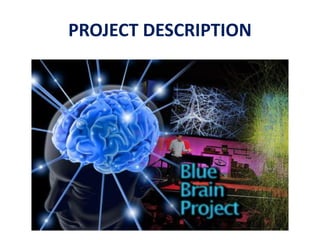
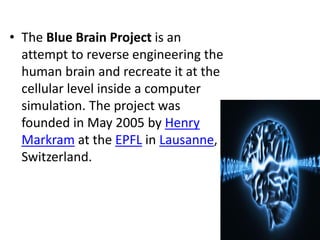
• The Blue Brain Project is an
attempt to reverse engineering the
human brain and recreate it at the
cellular level inside a computer
simulation. The project was
founded in May 2005 by Henry
Markram at the EPFL in Lausanne,
Switzerland.
•The research involves studying slices of
living brain tissue using microscopes
and patch clamp electrodes. Data is collected
about all the many different neuron types.
This data is used to build biologically realistic
models of neurons and networks of neurons
in the cerebral cortex. The simulations are
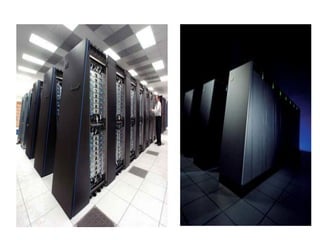
carried out on a Blue Gene supercomputer
built by IBM. Hence the name "Blue Brain".
The simulation software is based
around Michael Hines's NEURON, together
with other custom-built components.
BRAIN SIMULATION
NATURAL BRAIN
 INPUT
• By neurons
• By sensory cells
 INTERPRETATION
 MEMORY
VIRTUAL BRAIN
 INPUT
• ANN(artificial neutral
network) with silicon chip
• Electric impulses
 INTERPRETATION
 MEMORY
Uploading Human Brain
• The uploading is possible by the use of small
robots known as the nanobots.
• These robots are small enough to travel
throughout are circulatory system.
• Travelling into the spine and brain, they will be
able to monitor the activity and structure of our
central nervous system.
• They will be able to provide an interface with the
computer while we still reside in our biological
form.
• Nanobots could also carefully scan the
structure of our brain, providing a complete
readout of the connection.
• This information ,when entered into a
computer ,could then continue to function as
us .
• Thus the data stored in the entire brain will be
uploaded into the computer.
EXAMPLE OF BLUE
BRAIN
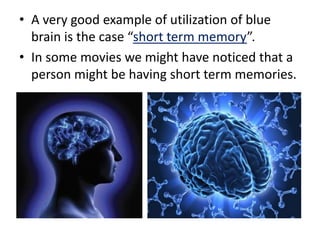
• A very good example of utilization of blue
brain is the case “short term memory”.
• In some movies we might have noticed that a
person might be having short term memories.
• A another situation is that when a person gets
older, then he starts forgetting or takes a bit
more time to recognize to a person.
• For the above reason we need a blue brain . It
is a simple chip that can be installed into the
human brain for which the short term
memory and volatile memory at the old age
can be avoided.
BLUE BRAIN PROJECT
OBJECTIVES
• The project will search for insights into how
human being think and remember.
• Scientists think that blue brain could also help
to cure the Parkinson's disease.
• The brain circuitry is in a complex state of flux,
the brain rewiring itself every moment of its
existence . If the scientists can crack open the
secret of how and why the brain does it , the
knowledge could lead to new breed of super
computers .
RESEARCH WORK
• IBM developing the “BLUE BRAIN” .
• IBM , in partnership with scientists at
Switzerland’s Ecolab polytechnique .
• Brain and mind institute will begin
simulating the brain’s biological
systems.
ADVANTAGES
• Remembering things without any effort .
• Making decision without the presence of
person.
• Using intelligence of a person after the death.
• Understanding the activities of animals.
• Allowing the deaf to hear via direct nerve
stimulation.
DISADVANTAGES
• We become dependent upon the computer.
• Others may use technical knowledge against
us.
• Another fear is found with respect to human
cloning.
• A very costly procedure of regaining the
memory back.
CONCLUSION
• We will be able to transfer ourselves into
computers at some point.
• It will bring both benefits and harm to human
society.
• Very soon this technology will be highly
accepted whole over the world.
REFRENCES
•“Engineering in Medicine and Biology Society”, 2008.
EMBS 2008. 30th Annual International Conference of
the IEEE
•Henry Markram, “The Blue Brain Project”, Nature
Reviews Neuroscience 2006 February.
• Simulated brain closer to thought BBC News 22 April
2009.
•“Project Milestones”. Blue Brain.
http://bluebrain.epfl.ch/Jahia/site/bluebrain/op/edit/
pid/19085
• Graham-Rowe, Duncan. “Mission to build a
simulated brain begins”, NewScientist, June 2005. pp.
1879-85.
•Blue Gene: http://www.research.ibm.com/bluegene
•The Blue Brain Project:
http://bluebrainproject.epfl.ch
THANK YOU

Blue brain presentation

  • 1.
    BLUE BRAIN BY- Sumit Kumar Mentor: Mr.Vivek Sharma Asst. Professor Cs/It
  • 2.
    INTRODUCTION • Human brainthe most valuable creation of God.The man is called intelligent because of the brain. • Today we developed because we can think, which other animals cannot do, but we loss the knowledge of the brain when the body is destroyed after the death of man. • That knowledge might have been used for development of the human society. • What happen if we create a brain and upload the content of natural brain into it??
  • 3.
    What Is BlueBrain? • IBM is now developing blue brain which is going to be the world’s first virtual brain within 30 years. • We will be able to scan ourselves onto the computers. • Artificial brain that can think, response,take decision and keep anything in memory. • After the death of the body the virtual brain will act as a man.
  • 4.
    OBJECTIVES • The mainobjective of the project are to gain a complete understanding of the brain • To enable better and faster development of brain disease treatments.
  • 5.
  • 6.
    • The BlueBrain Project is an attempt to reverse engineering the human brain and recreate it at the cellular level inside a computer simulation. The project was founded in May 2005 by Henry Markram at the EPFL in Lausanne, Switzerland.
  • 7.
    •The research involvesstudying slices of living brain tissue using microscopes and patch clamp electrodes. Data is collected about all the many different neuron types. This data is used to build biologically realistic models of neurons and networks of neurons in the cerebral cortex. The simulations are carried out on a Blue Gene supercomputer built by IBM. Hence the name "Blue Brain". The simulation software is based around Michael Hines's NEURON, together with other custom-built components.
  • 8.
    BRAIN SIMULATION NATURAL BRAIN INPUT • By neurons • By sensory cells  INTERPRETATION  MEMORY VIRTUAL BRAIN  INPUT • ANN(artificial neutral network) with silicon chip • Electric impulses  INTERPRETATION  MEMORY
  • 9.
    Uploading Human Brain •The uploading is possible by the use of small robots known as the nanobots. • These robots are small enough to travel throughout are circulatory system. • Travelling into the spine and brain, they will be able to monitor the activity and structure of our central nervous system. • They will be able to provide an interface with the computer while we still reside in our biological form.
  • 10.
    • Nanobots couldalso carefully scan the structure of our brain, providing a complete readout of the connection. • This information ,when entered into a computer ,could then continue to function as us . • Thus the data stored in the entire brain will be uploaded into the computer.
  • 11.
  • 12.
    • A verygood example of utilization of blue brain is the case “short term memory”. • In some movies we might have noticed that a person might be having short term memories.
  • 13.
    • A anothersituation is that when a person gets older, then he starts forgetting or takes a bit more time to recognize to a person. • For the above reason we need a blue brain . It is a simple chip that can be installed into the human brain for which the short term memory and volatile memory at the old age can be avoided.
  • 14.
  • 15.
    • The projectwill search for insights into how human being think and remember. • Scientists think that blue brain could also help to cure the Parkinson's disease. • The brain circuitry is in a complex state of flux, the brain rewiring itself every moment of its existence . If the scientists can crack open the secret of how and why the brain does it , the knowledge could lead to new breed of super computers .
  • 16.
  • 18.
    • IBM developingthe “BLUE BRAIN” . • IBM , in partnership with scientists at Switzerland’s Ecolab polytechnique . • Brain and mind institute will begin simulating the brain’s biological systems.
  • 19.
    ADVANTAGES • Remembering thingswithout any effort . • Making decision without the presence of person. • Using intelligence of a person after the death. • Understanding the activities of animals. • Allowing the deaf to hear via direct nerve stimulation.
  • 20.
    DISADVANTAGES • We becomedependent upon the computer. • Others may use technical knowledge against us. • Another fear is found with respect to human cloning. • A very costly procedure of regaining the memory back.
  • 21.
    CONCLUSION • We willbe able to transfer ourselves into computers at some point. • It will bring both benefits and harm to human society. • Very soon this technology will be highly accepted whole over the world.
  • 22.
    REFRENCES •“Engineering in Medicineand Biology Society”, 2008. EMBS 2008. 30th Annual International Conference of the IEEE •Henry Markram, “The Blue Brain Project”, Nature Reviews Neuroscience 2006 February. • Simulated brain closer to thought BBC News 22 April 2009. •“Project Milestones”. Blue Brain. http://bluebrain.epfl.ch/Jahia/site/bluebrain/op/edit/ pid/19085
  • 23.
    • Graham-Rowe, Duncan.“Mission to build a simulated brain begins”, NewScientist, June 2005. pp. 1879-85. •Blue Gene: http://www.research.ibm.com/bluegene •The Blue Brain Project: http://bluebrainproject.epfl.ch
  • 24.