PRINCIPALS
OF
BRACHYTHERAPY
Presenter :-
Dr. ADITYA SINGLA
DEFINITION
 Derives from the Greek word ‘BRACHY’ – meaning short-distance
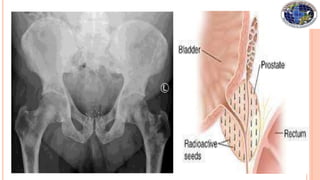
Brachytherapy involves placing small radiation sources internally, either
into or immediately next to the tumor in a geometrical fashion , allowing
precise radiation dose delivery (1)
1) Stewart AJ & Jones B. In Devlin Brachytherapy: Applications and techniques. 2007.
HISTORY
 1896 :- Radioactivity was described by Becquerel
 1898 :- Marie curie extracted radium from pitchblende ore
 1901 :- Danlos and Bloc performed first radium implant
 1931 :- The term brachytherapy proposed first time by Forsell
 1940-1950 :- Brachytherapy rules were developed and followed
 1953 :- Aterloading technique first introduced by Henschke in New
York – removed hazard of radiation exposure. Also Ir-192 used first
time by Henschke
 1953 :- LDR brachytherapy became the gold standard
 1968 :- HDR brachytherapy was introduced
 1970s :- Brachytherapy is established as a safe and effective
standard of care for many gynecological cancers
ADVANTAGES
 High dose of radiation is delivered to tumor in short time.So
biologically very effective
 Normal tissue spared due to rapid dose fall off
 Better tumor control
 Radiation morbidity minimal
 Acute reactions appear when treatment is over; so no
treatment breaks. Also radiation reactions localized &
manageable
 Treatment time short – reduces risk of tumor repopulation
DISADVANTAGES
 Invasive procedure
 Radiation hazard due to radioisotopes (in olden days due to
preloading techniques, now risk decreased )
 General anesthesia required
 Dose inhomogeneity is higher than EBRT (but acceptable if
rules followed)
 Because of greater conformity, small errors in source
placement can lead to extreme changes from the intended
dose distribution
TYPES OF BRACHYTHERAPY
 Classification
⚫ Based on Duration of implant
⚫ Based on Source position
⚫ Based on Source loading pattern
⚫ Based on Dose rate
TYPES OF BRACHYTHERAPY
 Classification
⚫ Based on Duration of implant
⚫ Based on Source placement
⚫ Based on source loading pattern
⚫ Based on Dose rate
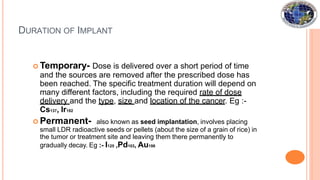
DURATION OF IMPLANT
 Temporary- Dose is delivered over a short period of time
and the sources are removed after the prescribed dose has
been reached. The specific treatment duration will depend on
many different factors, including the required rate of dose
delivery and the type, size and location of the cancer. Eg :-
Cs137, Ir192
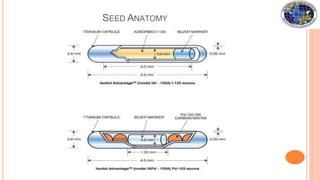
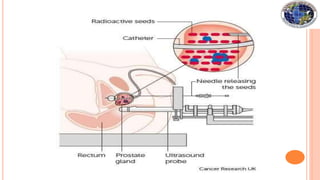
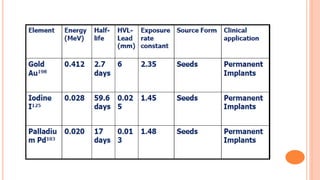
 Permanent- also known as seed implantation, involves placing
small LDR radioactive seeds or pellets (about the size of a grain of rice) in
the tumor or treatment site and leaving them there permanently to
gradually decay. Eg :- I125 ,Pd103, Au198
SEED ANATOMY
TYPES OF BRACHYTHERAPY
 Classification
⚫ Based on Duration of implant
⚫ Based on Source placement
⚫ Based on Source loading pattern
⚫ Based on Dose rate
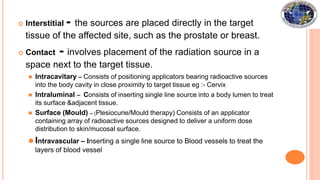
 Interstitial - the sources are placed directly in the target
tissue of the affected site, such as the prostate or breast.
 Contact - involves placement of the radiation source in a
space next to the target tissue.
⚫ Intracavitary – Consists of positioning applicators bearing radioactive sources
into the body cavity in close proximity to target tissue eg :- Cervix
⚫ Intraluminal – Consists of inserting single line source into a body lumen to treat
its surface &adjacent tissue.
⚫ Surface (Mould) – (Plesiocurie/Mould therapy) Consists of an applicator
containing array of radioactive sources designed to deliver a uniform dose
distribution to skin/mucosal surface.
⚫ Intravascular – Inserting a single line source to Blood vessels to treat the
layers of blood vessel
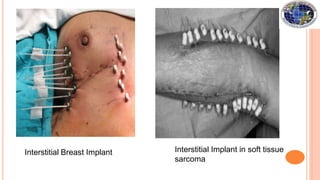
Interstitial Breast Implant Interstitial Implant in soft tissue
sarcoma
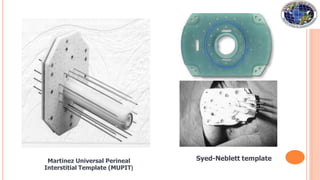
Martinez Universal Perineal
Interstitial Template (MUPIT)
Syed-Neblett template
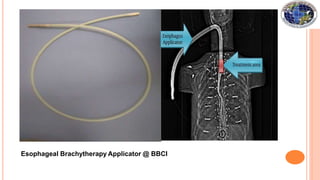
Esophageal Brachytherapy Applicator @ BBCI
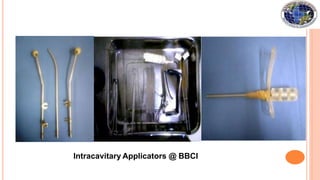
Intracavitary Applicators @ BBCI
TYPES OF BRACHYTHERAPY
 Classification
⚫ Based on Duration of implant
⚫ Based on Source placement
⚫ Based on Source loading pattern
⚫ Based on Dose rate
 Pre-loading
into the tumor
:- Inserting needles/tubes containing radioactive material directly
 After-loading :- First, the non-radioactive tubes inserted into tumor
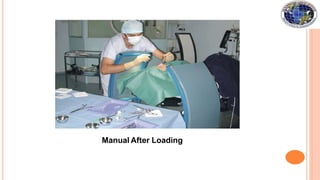
 Manual After Loading :- Ir192 wires, sources manipulated into applicator by means of forceps
& hand-held tools
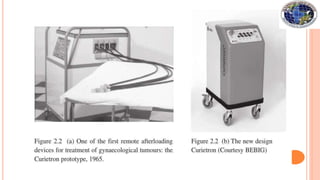
 Remote After Loading :- consists of pneumatically or motor-driven source transport system
PRELOADING (PROS & CONS)
 Advantage:
⚫ – Loose & flexible system(can be inserted even in distorted cervix)
⚫ – Excellent clinical result
⚫ – Cheap
⚫ – Long term results with least morbidity (due toLDR)
 • Disadvantages:
⚫ – Hasty application -Improper geometry in dose distribution
⚫ – Loose system – high chance of slipping of applicators – improper geometry
⚫ – Application needed special instruments to maintain distance.
⚫ – Radiation hazard
⚫ – Optimization not possible
AFTER LOADING (MANUAL)
 Advantages
⚫ Circumvents radiation protection problems of preloading
⚫ Allows better applicator placement and verification prior to source placement.
⚫ Radiation hazard can be minimized in the OT/bystanders as patient loaded
in ward.
⚫ Advantages of preloading remain as practised at LDR.
 Disadvantages:
⚫ specialized applicators are required.
Manual After Loading
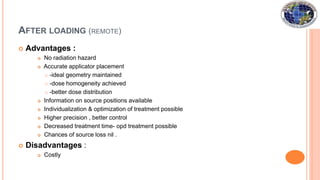
 Advantages :
 No radiation hazard
 Accurate applicator placement
 -ideal geometry maintained
 -dose homogeneity achieved
 -better dose distribution
 Information on source positions available
 Individualization & optimization of treatment possible
 Higher precision , better control
 Decreased treatment time- opd treatment possible
 Chances of source loss nil .
 Disadvantages :
 Costly
AFTER LOADING (REMOTE)
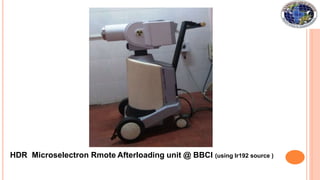
HDR Microselectron Rmote Afterloading unit @ BBCI (using Ir192 source )
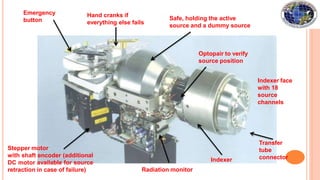
Emergency
button
Hand cranks if
everything else fails
Safe, holding the active
source and a dummy source
Optopair to verify
source position
Indexer face
with 18
source
channels
Transfer
tube
connector
Stepper motor
with shaft encoder (additional
DC motor available for source
retraction in case of failure)
Indexer
Radiation monitor
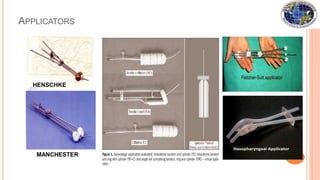
APPLICATORS
HENSCHKE
MANCHESTER
TYPES OF BRACHYTHERAPY
 Classification
⚫ Based on Duration of implant
⚫ Based on Source placement
⚫ Based on Source loading pattern
⚫ Based on Dose rate
 Low-dose rate(LDR)- Emit radiation at a rate of 0.4–2 Gy/hour.
 Medium-dose rate (MDR)- characterized by a medium rate of dose
delivery, ranging between 2-12 Gy/hour.
 High-dose rate (HDR)-when the rate of dose delivery exceeds
12 Gy/h.
 Pulsed-dose rate (PDR) - involves short pulses of radiation, typically
once an hour, to simulate the overall rate and effectiveness of LDR
treatment. (1ci)
 Ultra low dose rate - Dose range 0.03 to 0.3 Gy/Hr
HDR V/S LDR
 Advantages :-
⚫ Radiation protection
⚫ Allows shorter treatments times
⚫ HDR sources are of smaller diameter than the cesium sources that are
used for intracavitary LDR ,hence reduced need of Anaesthesia
⚫ HDR makes treatment dose distribution optimization possible
 Disadvantage
 Radiobiological
 Limited experience
 The economic disadvantage
 Greater potential risks
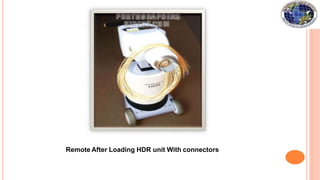
Remote After Loading HDR unit With connectors
KEY ELEMENT
 Obsolete or historical
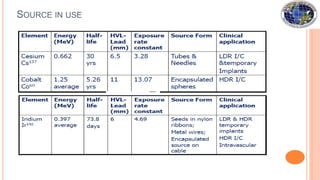
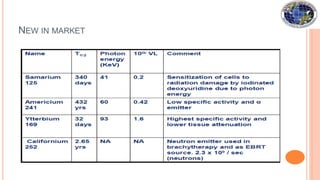
 226Ra, 222Rn
 • Currently used sealed sources
 137 Cs, 192Ir, 60Co, 125I, 103Pd,198Au, 90Sr.
IDEAL ISOTOPE
 Easily available & Cost effective
 Gamma ray energy high enough to avoid increased energy deposition in bone & low
enough to minimise radiation protection requirements
 Preferably monoenergetic: Optimum 300 KeV to 400 KeV(max=600 kev)
 Absence of charged particle emission or it should be easily screened (Beta energy
as low as possible: filtration)
 Half life such that correction for decay during treatment is minimal
⚫ – Moderate (few years) T1/2 for removable implants
⚫ – Shorter T1/2 for permanent implants
 Moderate gamma ray constant (determines activity & output) &also determine
shielding required.
 No daughter product; No gaseous disintegration product to prevent physical damage
to source and to avoid source contamination
 High Specific Activity (Ci/gm) to allow fabrication of smaller sources & to achieve
higher output (adequate photon yield)
 Material available is insoluble & non-toxic form
 Sources can be made in different shapes & sizes: Tubes, needle, wire, rod, beads
etc.
 Should withstand sterilization process
 Disposable without radiation hazard to environment
 Isotropic: same magnitude in all directions around the source
 No self attenuation
SOURCE IN USE
NEW IN MARKET
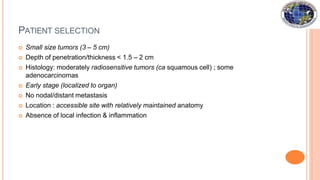
PATIENT SELECTION
 Small size tumors (3 – 5 cm)
 Depth of penetration/thickness < 1.5 – 2 cm
 Histology: moderately radiosensitive tumors (ca squamous cell) ; some
adenocarcinomas
 Early stage (localized to organ)
 No nodal/distant metastasis
 Location : accessible site with relatively maintained anatomy
 Absence of local infection & inflammation
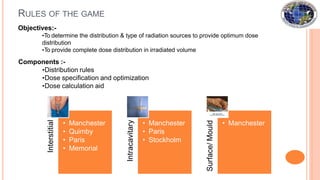
RULES OF THE GAME
Interstitial
• Manchester
• Quimby
• Paris
• Memorial
Intracavitary
• Manchester
• Paris
• Stockholm
Surface/
Mould
• Manchester
Objectives:-
•To determine the distribution & type of radiation sources to provide optimum dose
distribution
•To provide complete dose distribution in irradiated volume
Components :-
•Distribution rules
•Dose specification and optimization
•Dose calculation aid
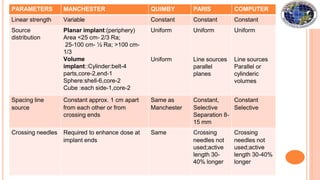
PARAMETERS MANCHESTER QUIMBY PARIS COMPUTER
Linear strength Variable Constant Constant Constant
Source
distribution
Planar implant:(periphery)
Area <25 cm- 2/3 Ra;
25-100 cm- ½ Ra; >100 cm-
1/3
Volume
implant::Cylinder:belt-4
parts,core-2,end-1
Sphere:shell-6,core-2
Cube :each side-1,core-2
Uniform Uniform Uniform
Uniform Line sources
parallel
planes
Line sources
Parallel or
cylinderic
volumes
Spacing line Constant approx. 1 cm apart Same as Constant, Constant
source from each other or from Manchester Selective Selective
crossing ends Separation 8-
15 mm
Crossing needles Required to enhance dose at Same Crossing Crossing
implant ends needles not needles not
used;active used;active
length 30- length 30-40%
40% longer longer
CLINICAL DEMO !!!
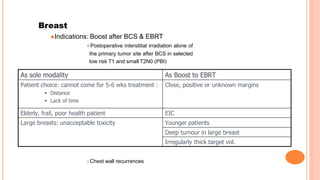
Breast
⚫Indications: Boost after BCS & EBRT
⚫Postoperative interstitial irradiation alone of
the primary tumor site after BCS in selected
low risk T1 and small T2N0 (PBI)
⚫Chest wall recurrences
As sole modality As Boost to EBRT
Patient choice: cannot come for 5-6 wks treatment :
 Distance
 Lack of time
Close, positive or unknown margins
Elderly, frail, poor health patient EIC
Large breasts: unacceptable toxicity Younger patients
Deep tumour in large breast
Irregularly thick target vol.
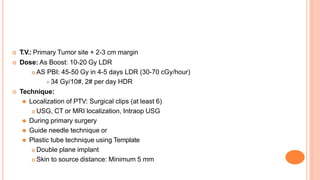
 T.V.: Primary Tumor site + 2-3 cm margin
 Dose: As Boost: 10-20 Gy LDR
 AS PBI: 45-50 Gy in 4-5 days LDR (30-70 cGy/hour)
⚫ 34 Gy/10#, 2# per day HDR
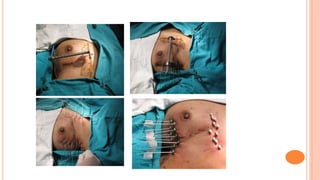
 Technique:
⚫ Localization of PTV: Surgical clips (at least 6)
 USG, CT or MRI localization, Intraop USG
⚫ During primary surgery
⚫ Guide needle technique or
⚫ Plastic tube technique using Template
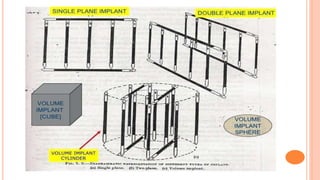
 Double plane implant
 Skin to source distance: Minimum 5 mm
THANKS

brachytherapy class.pptx

  • 1.
  • 2.
    DEFINITION  Derives fromthe Greek word ‘BRACHY’ – meaning short-distance Brachytherapy involves placing small radiation sources internally, either into or immediately next to the tumor in a geometrical fashion , allowing precise radiation dose delivery (1) 1) Stewart AJ & Jones B. In Devlin Brachytherapy: Applications and techniques. 2007.
  • 3.
    HISTORY  1896 :-Radioactivity was described by Becquerel  1898 :- Marie curie extracted radium from pitchblende ore  1901 :- Danlos and Bloc performed first radium implant  1931 :- The term brachytherapy proposed first time by Forsell  1940-1950 :- Brachytherapy rules were developed and followed  1953 :- Aterloading technique first introduced by Henschke in New York – removed hazard of radiation exposure. Also Ir-192 used first time by Henschke  1953 :- LDR brachytherapy became the gold standard  1968 :- HDR brachytherapy was introduced  1970s :- Brachytherapy is established as a safe and effective standard of care for many gynecological cancers
  • 4.
    ADVANTAGES  High doseof radiation is delivered to tumor in short time.So biologically very effective  Normal tissue spared due to rapid dose fall off  Better tumor control  Radiation morbidity minimal  Acute reactions appear when treatment is over; so no treatment breaks. Also radiation reactions localized & manageable  Treatment time short – reduces risk of tumor repopulation
  • 5.
    DISADVANTAGES  Invasive procedure Radiation hazard due to radioisotopes (in olden days due to preloading techniques, now risk decreased )  General anesthesia required  Dose inhomogeneity is higher than EBRT (but acceptable if rules followed)  Because of greater conformity, small errors in source placement can lead to extreme changes from the intended dose distribution
  • 6.
    TYPES OF BRACHYTHERAPY Classification ⚫ Based on Duration of implant ⚫ Based on Source position ⚫ Based on Source loading pattern ⚫ Based on Dose rate
  • 7.
    TYPES OF BRACHYTHERAPY Classification ⚫ Based on Duration of implant ⚫ Based on Source placement ⚫ Based on source loading pattern ⚫ Based on Dose rate
  • 8.
    DURATION OF IMPLANT Temporary- Dose is delivered over a short period of time and the sources are removed after the prescribed dose has been reached. The specific treatment duration will depend on many different factors, including the required rate of dose delivery and the type, size and location of the cancer. Eg :- Cs137, Ir192  Permanent- also known as seed implantation, involves placing small LDR radioactive seeds or pellets (about the size of a grain of rice) in the tumor or treatment site and leaving them there permanently to gradually decay. Eg :- I125 ,Pd103, Au198
  • 9.
  • 12.
    TYPES OF BRACHYTHERAPY Classification ⚫ Based on Duration of implant ⚫ Based on Source placement ⚫ Based on Source loading pattern ⚫ Based on Dose rate
  • 13.
     Interstitial -the sources are placed directly in the target tissue of the affected site, such as the prostate or breast.  Contact - involves placement of the radiation source in a space next to the target tissue. ⚫ Intracavitary – Consists of positioning applicators bearing radioactive sources into the body cavity in close proximity to target tissue eg :- Cervix ⚫ Intraluminal – Consists of inserting single line source into a body lumen to treat its surface &adjacent tissue. ⚫ Surface (Mould) – (Plesiocurie/Mould therapy) Consists of an applicator containing array of radioactive sources designed to deliver a uniform dose distribution to skin/mucosal surface. ⚫ Intravascular – Inserting a single line source to Blood vessels to treat the layers of blood vessel
  • 14.
    Interstitial Breast ImplantInterstitial Implant in soft tissue sarcoma
  • 15.
    Martinez Universal Perineal InterstitialTemplate (MUPIT) Syed-Neblett template
  • 16.
  • 17.
  • 18.
    TYPES OF BRACHYTHERAPY Classification ⚫ Based on Duration of implant ⚫ Based on Source placement ⚫ Based on Source loading pattern ⚫ Based on Dose rate
  • 19.
     Pre-loading into thetumor :- Inserting needles/tubes containing radioactive material directly  After-loading :- First, the non-radioactive tubes inserted into tumor  Manual After Loading :- Ir192 wires, sources manipulated into applicator by means of forceps & hand-held tools  Remote After Loading :- consists of pneumatically or motor-driven source transport system
  • 20.
    PRELOADING (PROS &CONS)  Advantage: ⚫ – Loose & flexible system(can be inserted even in distorted cervix) ⚫ – Excellent clinical result ⚫ – Cheap ⚫ – Long term results with least morbidity (due toLDR)  • Disadvantages: ⚫ – Hasty application -Improper geometry in dose distribution ⚫ – Loose system – high chance of slipping of applicators – improper geometry ⚫ – Application needed special instruments to maintain distance. ⚫ – Radiation hazard ⚫ – Optimization not possible
  • 21.
    AFTER LOADING (MANUAL) Advantages ⚫ Circumvents radiation protection problems of preloading ⚫ Allows better applicator placement and verification prior to source placement. ⚫ Radiation hazard can be minimized in the OT/bystanders as patient loaded in ward. ⚫ Advantages of preloading remain as practised at LDR.  Disadvantages: ⚫ specialized applicators are required.
  • 22.
  • 23.
     Advantages : No radiation hazard  Accurate applicator placement  -ideal geometry maintained  -dose homogeneity achieved  -better dose distribution  Information on source positions available  Individualization & optimization of treatment possible  Higher precision , better control  Decreased treatment time- opd treatment possible  Chances of source loss nil .  Disadvantages :  Costly AFTER LOADING (REMOTE)
  • 25.
    HDR Microselectron RmoteAfterloading unit @ BBCI (using Ir192 source )
  • 26.
    Emergency button Hand cranks if everythingelse fails Safe, holding the active source and a dummy source Optopair to verify source position Indexer face with 18 source channels Transfer tube connector Stepper motor with shaft encoder (additional DC motor available for source retraction in case of failure) Indexer Radiation monitor
  • 27.
  • 28.
    TYPES OF BRACHYTHERAPY Classification ⚫ Based on Duration of implant ⚫ Based on Source placement ⚫ Based on Source loading pattern ⚫ Based on Dose rate
  • 29.
     Low-dose rate(LDR)-Emit radiation at a rate of 0.4–2 Gy/hour.  Medium-dose rate (MDR)- characterized by a medium rate of dose delivery, ranging between 2-12 Gy/hour.  High-dose rate (HDR)-when the rate of dose delivery exceeds 12 Gy/h.  Pulsed-dose rate (PDR) - involves short pulses of radiation, typically once an hour, to simulate the overall rate and effectiveness of LDR treatment. (1ci)  Ultra low dose rate - Dose range 0.03 to 0.3 Gy/Hr
  • 30.
    HDR V/S LDR Advantages :- ⚫ Radiation protection ⚫ Allows shorter treatments times ⚫ HDR sources are of smaller diameter than the cesium sources that are used for intracavitary LDR ,hence reduced need of Anaesthesia ⚫ HDR makes treatment dose distribution optimization possible  Disadvantage  Radiobiological  Limited experience  The economic disadvantage  Greater potential risks
  • 31.
    Remote After LoadingHDR unit With connectors
  • 32.
    KEY ELEMENT  Obsoleteor historical  226Ra, 222Rn  • Currently used sealed sources  137 Cs, 192Ir, 60Co, 125I, 103Pd,198Au, 90Sr.
  • 33.
    IDEAL ISOTOPE  Easilyavailable & Cost effective  Gamma ray energy high enough to avoid increased energy deposition in bone & low enough to minimise radiation protection requirements  Preferably monoenergetic: Optimum 300 KeV to 400 KeV(max=600 kev)  Absence of charged particle emission or it should be easily screened (Beta energy as low as possible: filtration)  Half life such that correction for decay during treatment is minimal ⚫ – Moderate (few years) T1/2 for removable implants ⚫ – Shorter T1/2 for permanent implants  Moderate gamma ray constant (determines activity & output) &also determine shielding required.
  • 34.
     No daughterproduct; No gaseous disintegration product to prevent physical damage to source and to avoid source contamination  High Specific Activity (Ci/gm) to allow fabrication of smaller sources & to achieve higher output (adequate photon yield)  Material available is insoluble & non-toxic form  Sources can be made in different shapes & sizes: Tubes, needle, wire, rod, beads etc.  Should withstand sterilization process  Disposable without radiation hazard to environment  Isotropic: same magnitude in all directions around the source  No self attenuation
  • 35.
  • 37.
  • 38.
    PATIENT SELECTION  Smallsize tumors (3 – 5 cm)  Depth of penetration/thickness < 1.5 – 2 cm  Histology: moderately radiosensitive tumors (ca squamous cell) ; some adenocarcinomas  Early stage (localized to organ)  No nodal/distant metastasis  Location : accessible site with relatively maintained anatomy  Absence of local infection & inflammation
  • 39.
    RULES OF THEGAME Interstitial • Manchester • Quimby • Paris • Memorial Intracavitary • Manchester • Paris • Stockholm Surface/ Mould • Manchester Objectives:- •To determine the distribution & type of radiation sources to provide optimum dose distribution •To provide complete dose distribution in irradiated volume Components :- •Distribution rules •Dose specification and optimization •Dose calculation aid
  • 40.
    PARAMETERS MANCHESTER QUIMBYPARIS COMPUTER Linear strength Variable Constant Constant Constant Source distribution Planar implant:(periphery) Area <25 cm- 2/3 Ra; 25-100 cm- ½ Ra; >100 cm- 1/3 Volume implant::Cylinder:belt-4 parts,core-2,end-1 Sphere:shell-6,core-2 Cube :each side-1,core-2 Uniform Uniform Uniform Uniform Line sources parallel planes Line sources Parallel or cylinderic volumes Spacing line Constant approx. 1 cm apart Same as Constant, Constant source from each other or from Manchester Selective Selective crossing ends Separation 8- 15 mm Crossing needles Required to enhance dose at Same Crossing Crossing implant ends needles not needles not used;active used;active length 30- length 30-40% 40% longer longer
  • 42.
  • 43.
    Breast ⚫Indications: Boost afterBCS & EBRT ⚫Postoperative interstitial irradiation alone of the primary tumor site after BCS in selected low risk T1 and small T2N0 (PBI) ⚫Chest wall recurrences As sole modality As Boost to EBRT Patient choice: cannot come for 5-6 wks treatment :  Distance  Lack of time Close, positive or unknown margins Elderly, frail, poor health patient EIC Large breasts: unacceptable toxicity Younger patients Deep tumour in large breast Irregularly thick target vol.
  • 44.
     T.V.: PrimaryTumor site + 2-3 cm margin  Dose: As Boost: 10-20 Gy LDR  AS PBI: 45-50 Gy in 4-5 days LDR (30-70 cGy/hour) ⚫ 34 Gy/10#, 2# per day HDR  Technique: ⚫ Localization of PTV: Surgical clips (at least 6)  USG, CT or MRI localization, Intraop USG ⚫ During primary surgery ⚫ Guide needle technique or ⚫ Plastic tube technique using Template  Double plane implant  Skin to source distance: Minimum 5 mm
  • 46.