Brachytherapy and GYN malignancy
Brachytherapy Brachytherapy ( brachy , from the Greek for “short distance”) consists of placing sealed radioactive sources close to or contact with the target tissue. Interstitial, intracavity, or transluminal approach. Temporary, or permanent implant. Low or high dose rate.
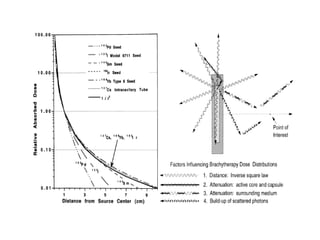
Introduction Discovery in 1898 Short  distance (cm) High radiation dose can be delivered  locally  to the tumor with  rapid dose fall-off  in the surrounding normal tissue
 
Radioactive sources
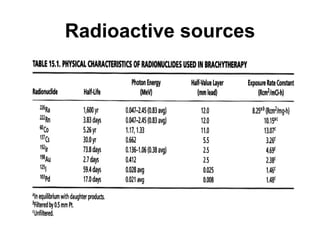
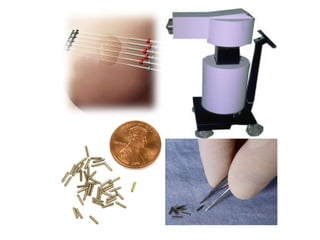
Radioactive sources Radium-226 Average energy 0.83Mev (0.5mm of platinum) A filtration of at least 0.5mm platinum is sufficient to absorb all the α particles and most of the β particles emitted by the radium and its daughter products.  Half life ~ 1600  years It was loaded into cells about  1cm long  and  1mm in diameter .  Radium sources are manufactured as  needles  or  tubes  in a variety of lengths and activities
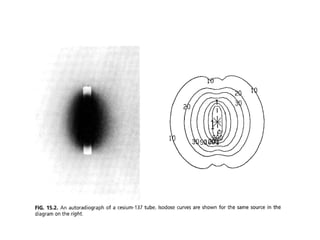
Radioactive sources Cesium-137 Substitute for radium in both interstitial and intracavitary brachytherapy Energy  0.662Mev nearly the same penetrating power as radium Half life  30 years  (clinically used 7 years without replacement) It was doubly encapsulated in  stainless-steel  needles and tubes.
 
Radioactive sources Cobalt-60 High specific activity Small  sources  required for some special applicators More expensive  than  137 Cs and short half life (5.26 years) The sources can be used to replace  226 Ra in intracavitary application
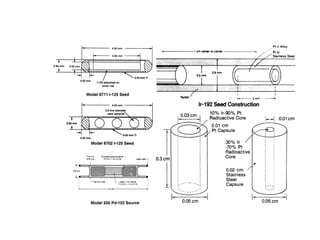
Radioactive sources Iridium-192 It has a complicated γ ray spectrum with an average energy of 0.38 MeV. -> It required  less shielding for personnel protection.  It has the disadvantage of a  short half-life  (73.8 days) It is fabricated in the form of  thin flexible  wires which can be cut to desired  lengths
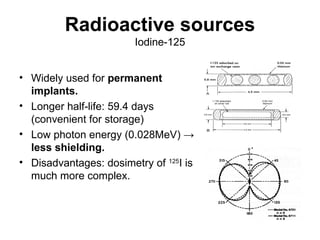
Radioactive sources Iodine-125 Widely used for  permanent implants.   Longer half-life: 59.4 days (convenient for storage) Low photon energy (0.028MeV) ->  less shielding.  Disadvantages: dosimetry of  125 I is much more complex.
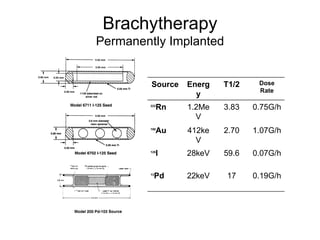
Brachytherapy Permanently Implanted 0.19G/h 17 22keV 13 Pd 0.07G/h 59.6 28keV 125 I 1.07G/h 2.70 412keV 198 Au 0.75G/h 3.83 1.2MeV 222 Rn Dose Rate T1/2 Energy Source
Radioactive sources ICRU38 LDR  sources: 0.4-2 Gy/hr ( 137 Cs) HDR  sources: ≥ 12 Gy/hr  ( 60 Co,  192 Ir) 226 Ra   leakage Radon gas. 137 Cs better than  226 Ra    less shielding and microsphere form with leakage  gas.  137 Cs better than  60 Co    less shielding  and cheap. 192 Ir  better than  137 Cs    lower energy require less shielding for personnal protection and higher  specific activity. 103 Pd better than  198 Au and  125 I    less shielding and biologic advantage .
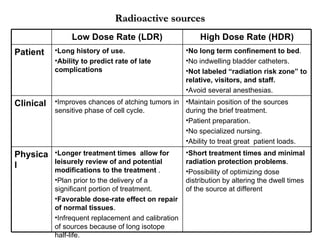
Radioactive sources Short treatment times and minimal radiation protection problems . Possibility of optimizing dose distribution by altering the dwell times of the source at different Longer treatment times  allow for leisurely review of and potential   modifications to the treatment  .  Plan prior to the delivery of a significant portion of treatment. Favorable dose-rate effect on repair of normal tissues . Infrequent replacement and calibration of sources because of long isotope half-life. Physical Maintain position of the sources during the brief treatment. Patient preparation. No specialized nursing. Ability to treat great  patient loads. Improves chances of atching tumors in sensitive phase of cell cycle. Clinical No long term confinement to bed . No indwelling bladder catheters. Not labeled “radiation risk zone” to relative, visitors, and staff. Avoid several anesthesias. Long history of use.   Ability to predict rate of late complications Patient High Dose Rate (HDR) Low Dose Rate (LDR)
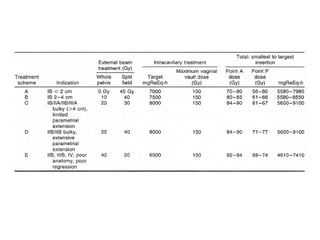
 
 
Brachytherapy and GYN Malignancy
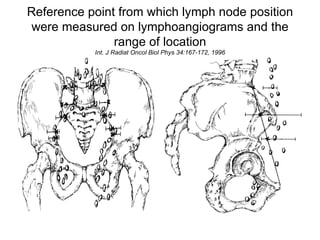
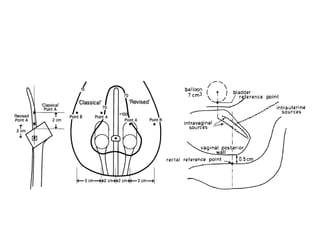
Reference point from which lymph node position were measured on lymphoangiograms and the range of location Int. J Radiat Oncol Biol Phys 34:167-172, 1996
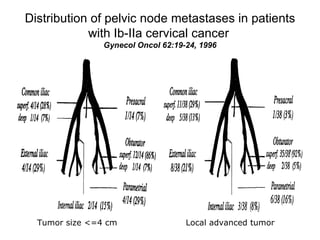
Distribution of pelvic node metastases in patients with Ib-IIa cervical cancer   Gynecol Oncol 62:19-24, 1996 Tumor size <=4 cm Local advanced tumor
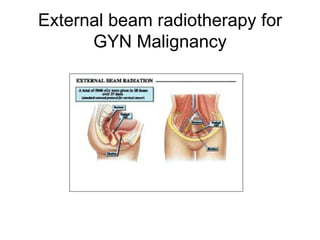
External beam radiotherapy for GYN Malignancy
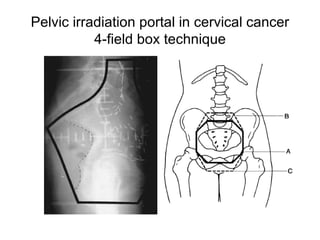
Pelvic irradiation portal in cervical cancer 4-field box technique
 
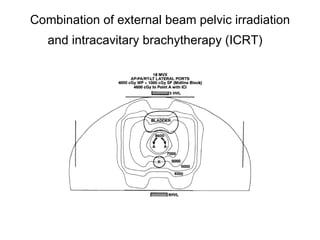
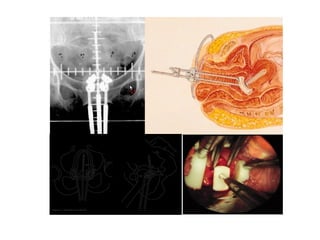
Combination of external beam pelvic irradiation and intracavitary brachytherapy (ICRT)
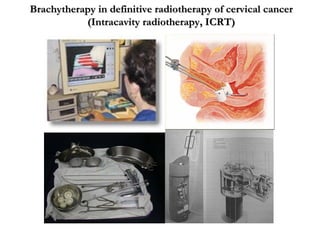
Brachytherapy in definitive radiotherapy of cervical cancer (Intracavity radiotherapy, ICRT)
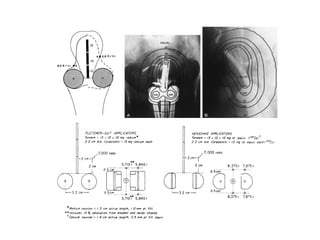
Intracavitary Radiotherapy (ICRT)


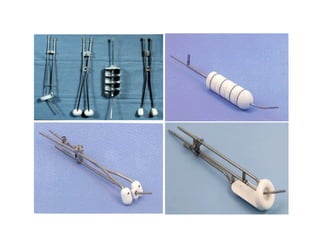
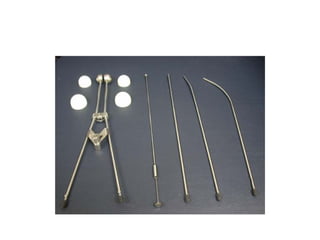
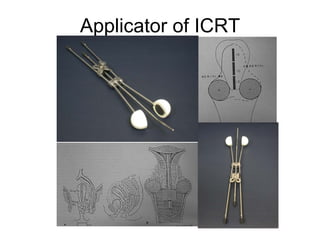
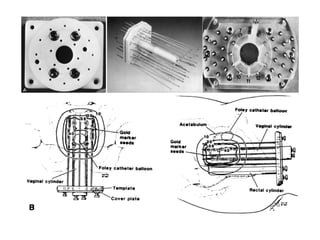
Applicator of ICRT
 
 
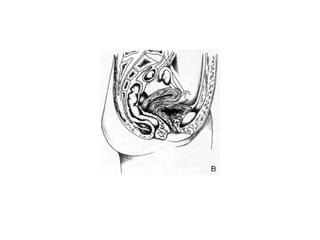
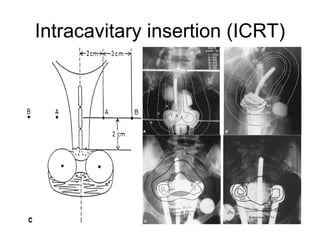
Intracavitary insertion (ICRT)


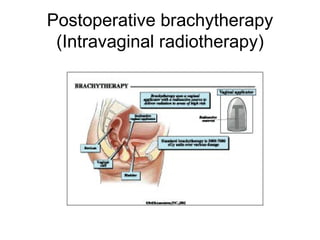
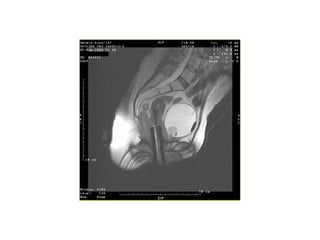
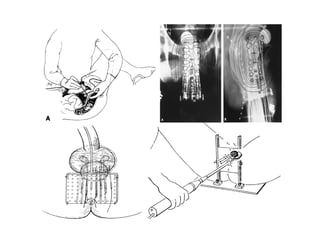
Postoperative brachytherapy (Intravaginal radiotherapy)
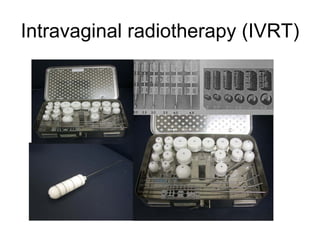
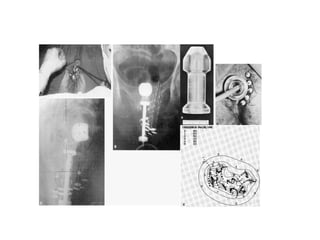
Intravaginal radiotherapy (IVRT)
 
 
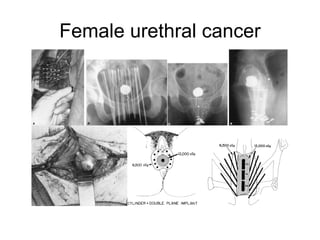
Female urethral cancer
 
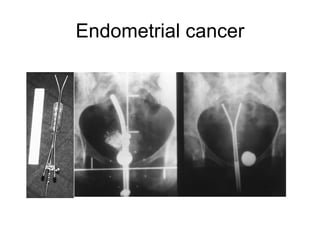
Endometrial cancer

Brachytherapy And Gyn Malignancy

  • 1.
  • 2.
    Brachytherapy Brachytherapy (brachy , from the Greek for “short distance”) consists of placing sealed radioactive sources close to or contact with the target tissue. Interstitial, intracavity, or transluminal approach. Temporary, or permanent implant. Low or high dose rate.
  • 3.
    Introduction Discovery in1898 Short distance (cm) High radiation dose can be delivered locally to the tumor with rapid dose fall-off in the surrounding normal tissue
  • 4.
  • 5.
  • 6.
    Radioactive sources Radium-226Average energy 0.83Mev (0.5mm of platinum) A filtration of at least 0.5mm platinum is sufficient to absorb all the α particles and most of the β particles emitted by the radium and its daughter products. Half life ~ 1600 years It was loaded into cells about 1cm long and 1mm in diameter . Radium sources are manufactured as needles or tubes in a variety of lengths and activities
  • 7.
    Radioactive sources Cesium-137Substitute for radium in both interstitial and intracavitary brachytherapy Energy 0.662Mev nearly the same penetrating power as radium Half life 30 years (clinically used 7 years without replacement) It was doubly encapsulated in stainless-steel needles and tubes.
  • 8.
  • 9.
    Radioactive sources Cobalt-60High specific activity Small sources required for some special applicators More expensive than 137 Cs and short half life (5.26 years) The sources can be used to replace 226 Ra in intracavitary application
  • 10.
    Radioactive sources Iridium-192It has a complicated γ ray spectrum with an average energy of 0.38 MeV. -> It required less shielding for personnel protection. It has the disadvantage of a short half-life (73.8 days) It is fabricated in the form of thin flexible wires which can be cut to desired lengths
  • 11.
    Radioactive sources Iodine-125Widely used for permanent implants. Longer half-life: 59.4 days (convenient for storage) Low photon energy (0.028MeV) -> less shielding. Disadvantages: dosimetry of 125 I is much more complex.
  • 12.
    Brachytherapy Permanently Implanted0.19G/h 17 22keV 13 Pd 0.07G/h 59.6 28keV 125 I 1.07G/h 2.70 412keV 198 Au 0.75G/h 3.83 1.2MeV 222 Rn Dose Rate T1/2 Energy Source
  • 13.
    Radioactive sources ICRU38LDR sources: 0.4-2 Gy/hr ( 137 Cs) HDR sources: ≥ 12 Gy/hr ( 60 Co, 192 Ir) 226 Ra  leakage Radon gas. 137 Cs better than 226 Ra  less shielding and microsphere form with leakage gas. 137 Cs better than 60 Co  less shielding and cheap. 192 Ir better than 137 Cs  lower energy require less shielding for personnal protection and higher specific activity. 103 Pd better than 198 Au and 125 I  less shielding and biologic advantage .
  • 14.
    Radioactive sources Shorttreatment times and minimal radiation protection problems . Possibility of optimizing dose distribution by altering the dwell times of the source at different Longer treatment times allow for leisurely review of and potential modifications to the treatment . Plan prior to the delivery of a significant portion of treatment. Favorable dose-rate effect on repair of normal tissues . Infrequent replacement and calibration of sources because of long isotope half-life. Physical Maintain position of the sources during the brief treatment. Patient preparation. No specialized nursing. Ability to treat great patient loads. Improves chances of atching tumors in sensitive phase of cell cycle. Clinical No long term confinement to bed . No indwelling bladder catheters. Not labeled “radiation risk zone” to relative, visitors, and staff. Avoid several anesthesias. Long history of use. Ability to predict rate of late complications Patient High Dose Rate (HDR) Low Dose Rate (LDR)
  • 15.
  • 16.
  • 17.
  • 18.
    Reference point fromwhich lymph node position were measured on lymphoangiograms and the range of location Int. J Radiat Oncol Biol Phys 34:167-172, 1996
  • 19.
    Distribution of pelvicnode metastases in patients with Ib-IIa cervical cancer Gynecol Oncol 62:19-24, 1996 Tumor size <=4 cm Local advanced tumor
  • 20.
    External beam radiotherapyfor GYN Malignancy
  • 21.
    Pelvic irradiation portalin cervical cancer 4-field box technique
  • 22.
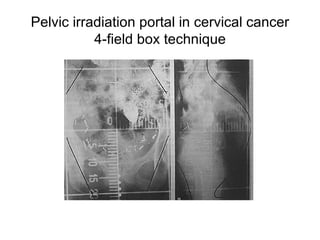
    Pelvic irradiation portalin cervical cancer 4-field box technique
  • 23.
  • 24.
    Combination of externalbeam pelvic irradiation and intracavitary brachytherapy (ICRT)
  • 25.
    Brachytherapy in definitiveradiotherapy of cervical cancer (Intracavity radiotherapy, ICRT)
  • 26.
  • 27.
  • 28.
  • 29.
  • 30.
  • 31.
  • 32.
  • 33.
  • 34.
  • 35.
  • 36.
  • 37.
  • 38.
  • 39.
  • 40.
  • 41.
  • 42.
  • 43.
  • 44.
  • 45.
  • 46.