Gap Correction in
Rt
Dr Kiran Kumar BR
GAP IN RT
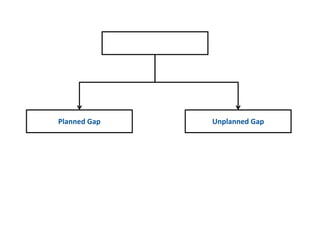
Unplanned Gap
Planned Gap
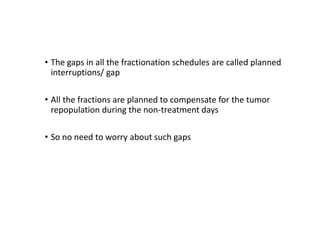
• The gaps in all the fractionation schedules are called planned
interruptions/ gap
• All the fractions are planned to compensate for the tumor
repopulation during the non-treatment days
• So no need to worry about such gaps
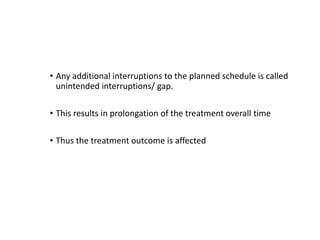
• Any additional interruptions to the planned schedule is called
unintended interruptions/ gap.
• This results in prolongation of the treatment overall time
• Thus the treatment outcome is affected
Planned Interruptions
• Public holidays
• Weekends
• Machine service
Unplanned Interruptions
• Machine breakdown
• Radiotherapy reactions
• Patient unwillingness
Effects of interruptions
Planned gap between fractions
• Gaps are to achieve the aim of
RT
• Repair
• Redistribution
• Repopulation
• Reoxygenation
Unplanned gap between fractions
• Gaps affect Local control of
tumor & Reduces cure rate
• Repopulation of tumors
• Effects depends on
• Prolongation length
• Tumor proliferation rate (slow/
fast)
• Interruption timing
Prolongation length
•Effect in treatment outcome due to small gaps (1-2
days) is difficult to determine
•Gap of 1 week induce a loss of tumor control from
3-25%
•For breast cancer (post operative irradiation for 5
weeks) with a prolongation length of 1 week has a
increase risk of recurrence & death
•For squamous carcinoma the overall treatment time
should never exceed 56 days.
Tumor proliferation rate
• Patients with fast growing tumors will be adversely affected by interruptions
• For a slow growing tumors gap of 5 days doesn’t affect the treatment
outcome
Interruption timing
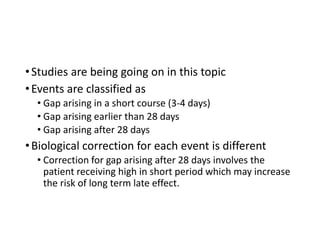
•Studies are being going on in this topic
•Events are classified as
• Gap arising in a short course (3-4 days)
• Gap arising earlier than 28 days
• Gap arising after 28 days
•Biological correction for each event is different
• Correction for gap arising after 28 days involves the
patient receiving high in short period which may increase
the risk of long term late effect.
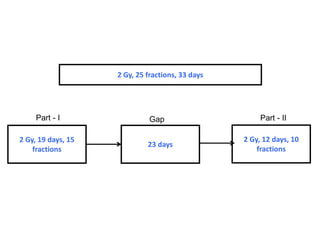
2 Gy, 19 days, 15
fractions
2 Gy, 12 days, 10
fractions
23 days
2 Gy, 25 fractions, 33 days
Part - I Part - II
Gap
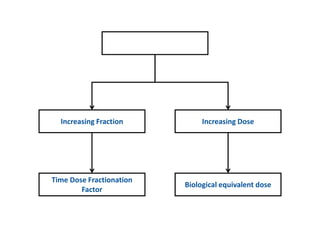
GAP Correction
Increasing Dose
Increasing Fraction
Time Dose Fractionation
Factor
Biological equivalent dose
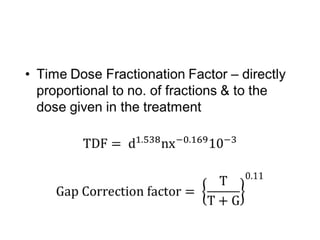
Time Dose Fractionation Factor
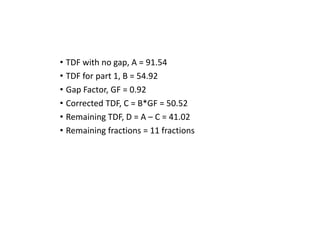
• TDF with no gap, A = 91.54
• TDF for part 1, B = 54.92
• Gap Factor, GF = 0.92
• Corrected TDF, C = B*GF = 50.52
• Remaining TDF, D = A – C = 41.02
• Remaining fractions = 11 fractions
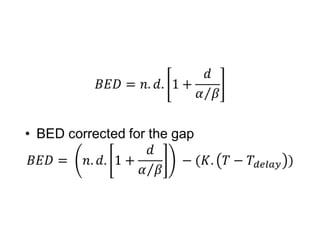
Biological Equivalent Dose
•Thank You

Gap correction

  • 1.
  • 2.
    GAP IN RT UnplannedGap Planned Gap
  • 3.
    • The gapsin all the fractionation schedules are called planned interruptions/ gap • All the fractions are planned to compensate for the tumor repopulation during the non-treatment days • So no need to worry about such gaps
  • 4.
    • Any additionalinterruptions to the planned schedule is called unintended interruptions/ gap. • This results in prolongation of the treatment overall time • Thus the treatment outcome is affected
  • 5.
    Planned Interruptions • Publicholidays • Weekends • Machine service Unplanned Interruptions • Machine breakdown • Radiotherapy reactions • Patient unwillingness
  • 6.
    Effects of interruptions Plannedgap between fractions • Gaps are to achieve the aim of RT • Repair • Redistribution • Repopulation • Reoxygenation Unplanned gap between fractions • Gaps affect Local control of tumor & Reduces cure rate • Repopulation of tumors • Effects depends on • Prolongation length • Tumor proliferation rate (slow/ fast) • Interruption timing
  • 7.
    Prolongation length •Effect intreatment outcome due to small gaps (1-2 days) is difficult to determine •Gap of 1 week induce a loss of tumor control from 3-25% •For breast cancer (post operative irradiation for 5 weeks) with a prolongation length of 1 week has a increase risk of recurrence & death •For squamous carcinoma the overall treatment time should never exceed 56 days.
  • 8.
    Tumor proliferation rate •Patients with fast growing tumors will be adversely affected by interruptions • For a slow growing tumors gap of 5 days doesn’t affect the treatment outcome
  • 9.
    Interruption timing •Studies arebeing going on in this topic •Events are classified as • Gap arising in a short course (3-4 days) • Gap arising earlier than 28 days • Gap arising after 28 days •Biological correction for each event is different • Correction for gap arising after 28 days involves the patient receiving high in short period which may increase the risk of long term late effect.
  • 10.
    2 Gy, 19days, 15 fractions 2 Gy, 12 days, 10 fractions 23 days 2 Gy, 25 fractions, 33 days Part - I Part - II Gap
  • 11.
    GAP Correction Increasing Dose IncreasingFraction Time Dose Fractionation Factor Biological equivalent dose
  • 12.
  • 13.
    • TDF withno gap, A = 91.54 • TDF for part 1, B = 54.92 • Gap Factor, GF = 0.92 • Corrected TDF, C = B*GF = 50.52 • Remaining TDF, D = A – C = 41.02 • Remaining fractions = 11 fractions
  • 14.
  • 15.