











Particle beam
RT
Dr kanhu
RADIATION THERAPY
CONVENTIONAL
TECHNIQUE
CONFORMAL TECHNIQUE
X-ray
¥-ray
ARE THESE
everything
NO
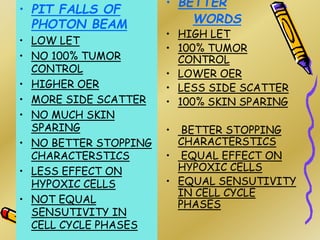
• PIT FALLS OF
PHOTON BEAM
• LOW LET
• NO 100% TUMOR
CONTROL
• HIGHER OER
• MORE SIDE SCATTER
• NO MUCH SKIN
SPARING
• NO BETTER STOPPING
CHARACTERSTICS
• LESS EFFECT ON
HYPOXIC CELLS
• NOT EQUAL
SENSUTIVITY IN
CELL CYCLE PHASES
• BETTER
WORDS
• HIGH LET
• 100% TUMOR
CONTROL
• LOWER OER
• LESS SIDE SCATTER
• 100% SKIN SPARING
• BETTER STOPPING
CHARACTERSTICS
• EQUAL EFFECT ON
HYPOXIC CELLS
• EQUAL SENSUTIVITY
IN CELL CYCLE
PHASES
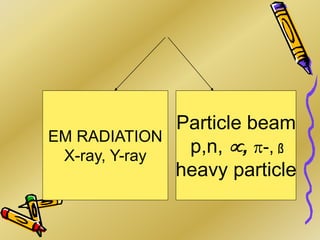
EM RADIATION
X-ray, Y-ray
Particle beam
p,n, , -, ß
heavy particle
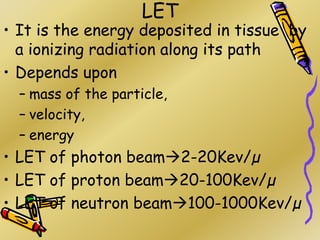
LET
• It is the energy deposited in tissue by
a ionizing radiation along its path
• Depends upon
– mass of the particle,
– velocity,
– energy
• LET of photon beam2-20Kev/µ
• LET of proton beam20-100Kev/µ
• LET of neutron beam100-1000Kev/µ
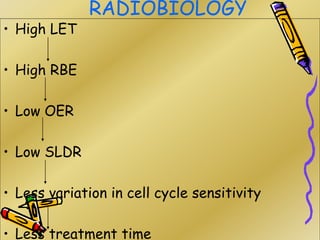
RADIOBIOLOGY
• High LET
• High RBE
• Low OER
• Low SLDR
• Less variation in cell cycle sensitivity
• Less treatment time
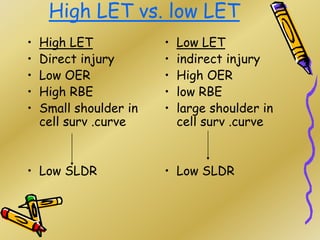
High LET vs. low LET
• High LET
• Direct injury
• Low OER
• High RBE
• Small shoulder in
cell surv .curve
• Low SLDR
• Low LET
• indirect injury
• High OER
• low RBE
• large shoulder in
cell surv .curve
• Low SLDR
HIGH LET
LOW LET
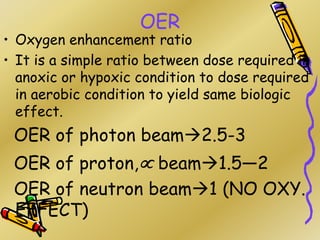
OER
• Oxygen enhancement ratio
• It is a simple ratio between dose required in
anoxic or hypoxic condition to dose required
in aerobic condition to yield same biologic
effect.
OER of photon beam2.5-3
OER of proton, beam1.5—2
OER of neutron beam1 (NO OXY.
EFFECT)
RBE
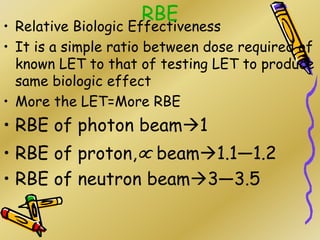
• Relative Biologic Effectiveness
• It is a simple ratio between dose required of
known LET to that of testing LET to produce
same biologic effect
• More the LET=More RBE
• RBE of photon beam1
• RBE of proton, beam1.1—1.2
• RBE of neutron beam3—3.5
CONCLUSION
•HIGH LET
•HIGH RBE
•LOW OER
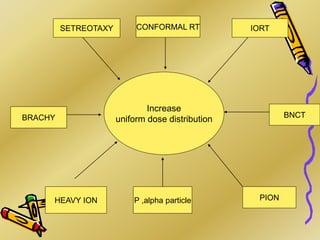
Increase
uniform dose distribution
P ,alpha particle
HEAVY ION
BNCT
PION
IORT
CONFORMAL RT
BRACHY
SETREOTAXY
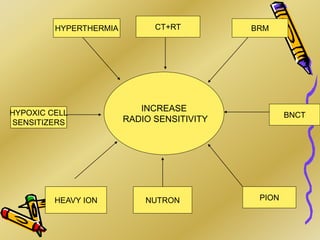
INCREASE
RADIO SENSITIVITY
NUTRON
HEAVY ION
BNCT
PION
BRM
CT+RT
HYPOXIC CELL
SENSITIZERS
HYPERTHERMIA
PROTON BEAM
BRAGG PEAK EFFECT
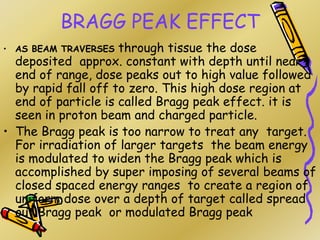
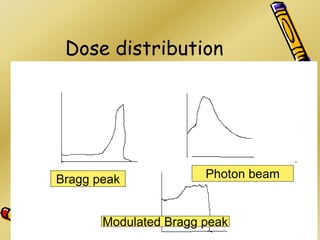
• AS BEAM TRAVERSES through tissue the dose
deposited approx. constant with depth until near
end of range, dose peaks out to high value followed
by rapid fall off to zero. This high dose region at
end of particle is called Bragg peak effect. it is
seen in proton beam and charged particle.
• The Bragg peak is too narrow to treat any target.
For irradiation of larger targets the beam energy
is modulated to widen the Bragg peak which is
accomplished by super imposing of several beams of
closed spaced energy ranges to create a region of
uniform dose over a depth of target called spread
out Bragg peak or modulated Bragg peak
Dose distribution
Bragg peak Photon beam
Modulated Bragg peak
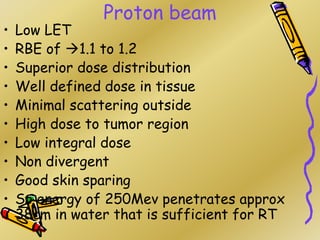
Proton beam
• Low LET
• RBE of 1.1 to 1.2
• Superior dose distribution
• Well defined dose in tissue
• Minimal scattering outside
• High dose to tumor region
• Low integral dose
• Non divergent
• Good skin sparing
• So energy of 250Mev penetrates approx
38cm in water that is sufficient for RT
SO IN SINGLE WORD PROTON
BEAM HAS SUPERIOR DOSE
DISTRIBUTION RATHER THAN
HIGH LET
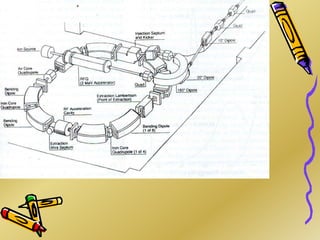
PROTON MACHINES
• 19 centers in world wide.21 centers under
process
• Cyclotrons(higher energy)(100-200Mev)
• Synchrotron( simple energy variability)
• The Loma Linda proton facility in
California is the largest of its kind in world
Proton Radiosurgey
• According to Laskell defined
radiosurgey is a procedure involving
single# of ionizing RT focused on
intracranial target localized by
stereotactic method
• This was 1st led by Dr, Raymond at MGH
treating inoperable AVM & pit adenomas
• The 2nd one technique system capable of
stereotactic alignment(STAR)
developed because of inherent
restriction of fixed horizontal beam at
HCL
 particle
• for all particle
purpose the dose
localization
radiobiological
properties are
equivalent to proton
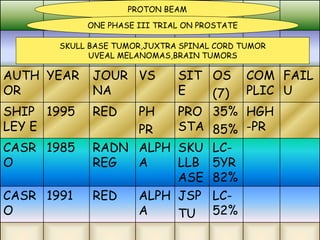
AUTH
OR
YEAR JOUR
NA
VS SIT
E
OS
(7)
COM
PLIC
FAIL
U
SHIP
LEY E
1995 RED PH
PR
PRO
STA
35%
85%
HGH
-PR
CASR
O
1985 RADN
REG
ALPH
A
SKU
LLB
ASE
LC-
5YR
82%
CASR
O
1991 RED ALPH
A
JSP
TU
LC-
52%
PROTON BEAM
ONE PHASE III TRIAL ON PROSTATE
SKULL BASE TUMOR,JUXTRA SPINAL CORD TUMOR
UVEAL MELANOMAS,BRAIN TUMORS
PION BEAM
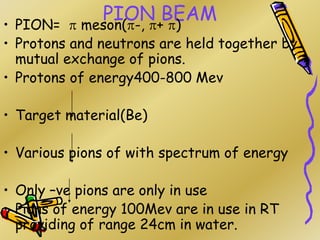
• PION=  meson(-, + )
• Protons and neutrons are held together by
mutual exchange of pions.
• Protons of energy400-800 Mev
• Target material(Be)
• Various pions of with spectrum of energy
• Only –ve pions are only in use
• Pions of energy 100Mev are in use in RT
providing of range 24cm in water.
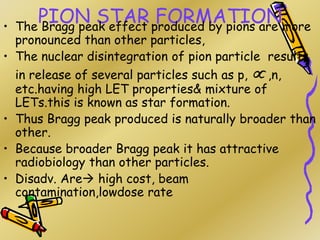
PION STAR FORMATION
• The Bragg peak effect produced by pions are more
pronounced than other particles,
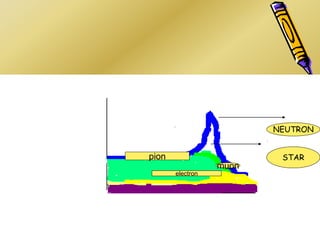
• The nuclear disintegration of pion particle results
in release of several particles such as p,  ,n,
etc.having high LET properties& mixture of
LETs.this is known as star formation.
• Thus Bragg peak produced is naturally broader than
other.
• Because broader Bragg peak it has attractive
radiobiology than other particles.
• Disadv. Are high cost, beam
contamination,lowdose rate
•
pion
muon
electron
NEUTRON
STAR
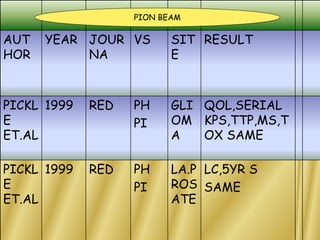
AUT
HOR
YEAR JOUR
NA
VS SIT
E
RESULT
PICKL
E
ET.AL
1999 RED PH
PI
GLI
OM
A
QOL,SERIAL
KPS,TTP,MS,T
OX SAME
PICKL
E
ET.AL
1999 RED PH
PI
LA.P
ROS
ATE
LC,5YR S
SAME
PION BEAM
OTHER HEAVY
PARTICLES
• C.N,Ar,Ne,Si etc
• Produced in an Accelerator by stripping of
their electrons.These ions are then
injected into synchrotrons for
acceleration.
• High LET
• High RBE
• Broad Bragg peaK
• Adv. In deep seated tumors
Neutron Beam
Neutron Beam
• High-fast,medium,slow
• Slow---small range,no OER adv.
• Range between 6-15 Mev are suitable for
RT
• At present neutron beams are used only in
trials.
• D-T generators,cyclotrons,linear
accelerators
• Neutrons are produced by bombarding of
deuterons ,protons with target materials
like Usually Be &,Tritium.
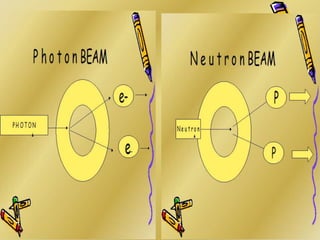
Neutron BEAM
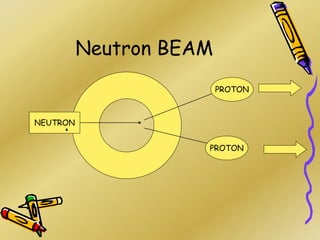
NEUTRON
PROTON
PROTON
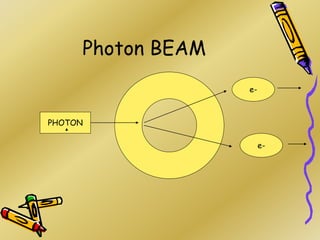
Photon BEAM
PHOTON
e-
e-
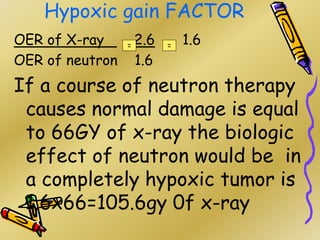
Hypoxic gain FACTOR
OER of X-ray 2.6 1.6
OER of neutron 1.6
If a course of neutron therapy
causes normal damage is equal
to 66GY of x-ray the biologic
effect of neutron would be in
a completely hypoxic tumor is
1.6x66=105.6gy 0f x-ray
= =
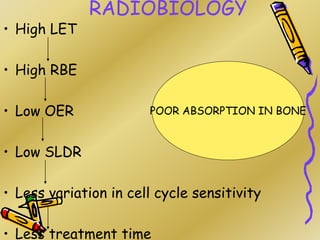
RADIOBIOLOGY
• High LET
• High RBE
• Low OER
• Low SLDR
• Less variation in cell cycle sensitivity
• Less treatment time
POOR ABSORPTION IN BONE
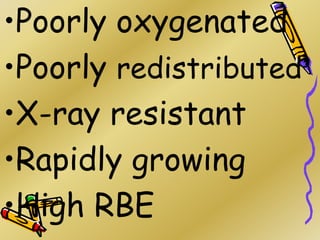
•Poorly oxygenated
•Poorly redistributed
•X-ray resistant
•Rapidly growing
•High RBE
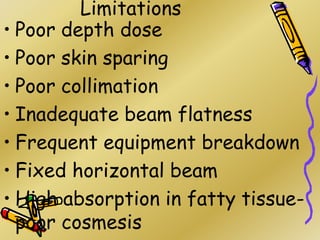
Limitations
• Poor depth dose
• Poor skin sparing
• Poor collimation
• Inadequate beam flatness
• Frequent equipment breakdown
• Fixed horizontal beam
• High absorption in fatty tissue-
poor cosmesis
So in single word neutron
beam have high
LET(RBE)
properties but poor
distribution
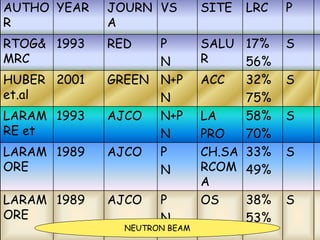
AUTHO
R
YEAR JOURN
A
VS SITE LRC P
RTOG&
MRC
1993 RED P
N
SALU
R
17%
56%
S
HUBER
et.al
2001 GREEN N+P
N
ACC 32%
75%
S
LARAM
RE et
1993 AJCO N+P
N
LA
PRO
58%
70%
S
LARAM
ORE
1989 AJCO P
N
CH.SA
RCOM
A
33%
49%
S
LARAM
ORE
1989 AJCO P
N
OS 38%
53%
S
NEUTRON BEAM
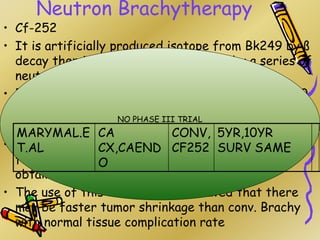
Neutron Brachytherapy
• Cf-252
• It is artificially produced isotope from Bk249 by ß
decay then it is steeped up to Cf252 by a series of
neutron capture reactions.
• Energy range of neutron is 2.3Mev,Y ray is 40-100
Kev.
• RBE of –6 for neutron component
• Various studies showed that the use of Cf252 is
feasible the results are equivalent to those
obtained using standard Y sources .
• The use of this in trials has indicated that there
may be faster tumor shrinkage than conv. Brachy
with normal tissue complication rate
NO PHASE III TRIAL
MARYMAL.E
T.AL
CA
CX,CAEND
O
CONV,
CF252
5YR,10YR
SURV SAME
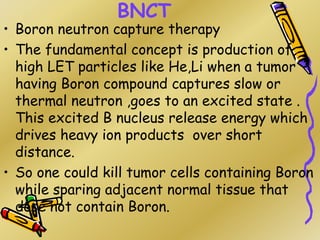
BNCT
• Boron neutron capture therapy
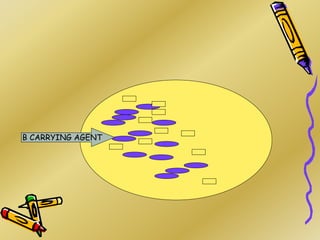
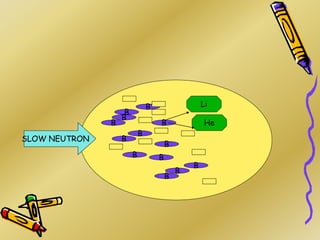
• The fundamental concept is production of
high LET particles like He,Li when a tumor
having Boron compound captures slow or
thermal neutron ,goes to an excited state .
This excited B nucleus release energy which
drives heavy ion products over short
distance.
• So one could kill tumor cells containing Boron
while sparing adjacent normal tissue that
dose not contain Boron.
Boron carrying agents
• Should be non toxic
• High tumor to normal tissue ratio
• Agents are
– Dihydroxyborylphenylalanine
– SEVERAL CLINICAL PROTOCOLS UNDERWAY
ON GBM,MAL.MELANOMA,BRAIN METS, RA
B CARRYING AGENT
B
B
B
B
B
B
B
B
B
B
B
B
B
B
B
B
B
B
B
B
B
B
B
B
B
B
Li
He
SLOW NEUTRON
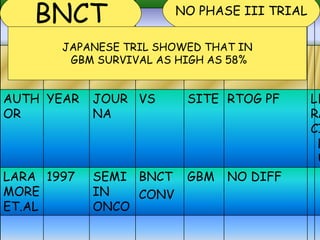
AUTH
OR
YEAR JOUR
NA
VS SITE RTOG PF L
R
C
F
A
I
L
U
LARA
MORE
ET.AL
1997 SEMI
IN
ONCO
BNCT
CONV
GBM NO DIFF
BNCT NO PHASE III TRIAL
JAPANESE TRIL SHOWED THAT IN
GBM SURVIVAL AS HIGH AS 58%
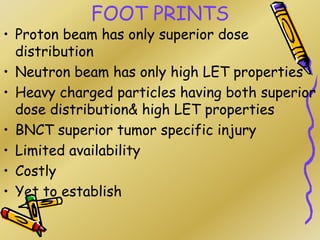
FOOT PRINTS
• Proton beam has only superior dose
distribution
• Neutron beam has only high LET properties
• Heavy charged particles having both superior
dose distribution& high LET properties
• BNCT superior tumor specific injury
• Limited availability
• Costly
• Yet to establish
PARTICLE BEAM RADIOTHERAPY

PARTICLE BEAM RADIOTHERAPY

  • 1.
  • 2.
  • 3.
  • 4.
  • 5.
  • 6.
  • 7.
    • PIT FALLSOF PHOTON BEAM • LOW LET • NO 100% TUMOR CONTROL • HIGHER OER • MORE SIDE SCATTER • NO MUCH SKIN SPARING • NO BETTER STOPPING CHARACTERSTICS • LESS EFFECT ON HYPOXIC CELLS • NOT EQUAL SENSUTIVITY IN CELL CYCLE PHASES • BETTER WORDS • HIGH LET • 100% TUMOR CONTROL • LOWER OER • LESS SIDE SCATTER • 100% SKIN SPARING • BETTER STOPPING CHARACTERSTICS • EQUAL EFFECT ON HYPOXIC CELLS • EQUAL SENSUTIVITY IN CELL CYCLE PHASES
  • 8.
    EM RADIATION X-ray, Y-ray Particlebeam p,n, , -, ß heavy particle
  • 9.
    LET • It isthe energy deposited in tissue by a ionizing radiation along its path • Depends upon – mass of the particle, – velocity, – energy • LET of photon beam2-20Kev/µ • LET of proton beam20-100Kev/µ • LET of neutron beam100-1000Kev/µ
  • 10.
    RADIOBIOLOGY • High LET •High RBE • Low OER • Low SLDR • Less variation in cell cycle sensitivity • Less treatment time
  • 11.
    High LET vs.low LET • High LET • Direct injury • Low OER • High RBE • Small shoulder in cell surv .curve • Low SLDR • Low LET • indirect injury • High OER • low RBE • large shoulder in cell surv .curve • Low SLDR
  • 12.
  • 13.
    OER • Oxygen enhancementratio • It is a simple ratio between dose required in anoxic or hypoxic condition to dose required in aerobic condition to yield same biologic effect. OER of photon beam2.5-3 OER of proton, beam1.5—2 OER of neutron beam1 (NO OXY. EFFECT)
  • 14.
    RBE • Relative BiologicEffectiveness • It is a simple ratio between dose required of known LET to that of testing LET to produce same biologic effect • More the LET=More RBE • RBE of photon beam1 • RBE of proton, beam1.1—1.2 • RBE of neutron beam3—3.5
  • 15.
  • 16.
    Increase uniform dose distribution P,alpha particle HEAVY ION BNCT PION IORT CONFORMAL RT BRACHY SETREOTAXY
  • 17.
  • 18.
  • 19.
    BRAGG PEAK EFFECT •AS BEAM TRAVERSES through tissue the dose deposited approx. constant with depth until near end of range, dose peaks out to high value followed by rapid fall off to zero. This high dose region at end of particle is called Bragg peak effect. it is seen in proton beam and charged particle. • The Bragg peak is too narrow to treat any target. For irradiation of larger targets the beam energy is modulated to widen the Bragg peak which is accomplished by super imposing of several beams of closed spaced energy ranges to create a region of uniform dose over a depth of target called spread out Bragg peak or modulated Bragg peak
  • 20.
    Dose distribution Bragg peakPhoton beam Modulated Bragg peak
  • 22.
    Proton beam • LowLET • RBE of 1.1 to 1.2 • Superior dose distribution • Well defined dose in tissue • Minimal scattering outside • High dose to tumor region • Low integral dose • Non divergent • Good skin sparing • So energy of 250Mev penetrates approx 38cm in water that is sufficient for RT
  • 23.
    SO IN SINGLEWORD PROTON BEAM HAS SUPERIOR DOSE DISTRIBUTION RATHER THAN HIGH LET
  • 24.
    PROTON MACHINES • 19centers in world wide.21 centers under process • Cyclotrons(higher energy)(100-200Mev) • Synchrotron( simple energy variability) • The Loma Linda proton facility in California is the largest of its kind in world
  • 25.
    Proton Radiosurgey • Accordingto Laskell defined radiosurgey is a procedure involving single# of ionizing RT focused on intracranial target localized by stereotactic method • This was 1st led by Dr, Raymond at MGH treating inoperable AVM & pit adenomas • The 2nd one technique system capable of stereotactic alignment(STAR) developed because of inherent restriction of fixed horizontal beam at HCL
  • 26.
     particle • forall particle purpose the dose localization radiobiological properties are equivalent to proton
  • 28.
    AUTH OR YEAR JOUR NA VS SIT E OS (7) COM PLIC FAIL U SHIP LEYE 1995 RED PH PR PRO STA 35% 85% HGH -PR CASR O 1985 RADN REG ALPH A SKU LLB ASE LC- 5YR 82% CASR O 1991 RED ALPH A JSP TU LC- 52% PROTON BEAM ONE PHASE III TRIAL ON PROSTATE SKULL BASE TUMOR,JUXTRA SPINAL CORD TUMOR UVEAL MELANOMAS,BRAIN TUMORS
  • 29.
    PION BEAM • PION= meson(-, + ) • Protons and neutrons are held together by mutual exchange of pions. • Protons of energy400-800 Mev • Target material(Be) • Various pions of with spectrum of energy • Only –ve pions are only in use • Pions of energy 100Mev are in use in RT providing of range 24cm in water.
  • 30.
    PION STAR FORMATION •The Bragg peak effect produced by pions are more pronounced than other particles, • The nuclear disintegration of pion particle results in release of several particles such as p,  ,n, etc.having high LET properties& mixture of LETs.this is known as star formation. • Thus Bragg peak produced is naturally broader than other. • Because broader Bragg peak it has attractive radiobiology than other particles. • Disadv. Are high cost, beam contamination,lowdose rate •
  • 31.
  • 32.
    AUT HOR YEAR JOUR NA VS SIT E RESULT PICKL E ET.AL 1999RED PH PI GLI OM A QOL,SERIAL KPS,TTP,MS,T OX SAME PICKL E ET.AL 1999 RED PH PI LA.P ROS ATE LC,5YR S SAME PION BEAM
  • 33.
    OTHER HEAVY PARTICLES • C.N,Ar,Ne,Sietc • Produced in an Accelerator by stripping of their electrons.These ions are then injected into synchrotrons for acceleration. • High LET • High RBE • Broad Bragg peaK • Adv. In deep seated tumors
  • 34.
  • 35.
    Neutron Beam • High-fast,medium,slow •Slow---small range,no OER adv. • Range between 6-15 Mev are suitable for RT • At present neutron beams are used only in trials. • D-T generators,cyclotrons,linear accelerators • Neutrons are produced by bombarding of deuterons ,protons with target materials like Usually Be &,Tritium.
  • 36.
  • 37.
  • 39.
    Hypoxic gain FACTOR OERof X-ray 2.6 1.6 OER of neutron 1.6 If a course of neutron therapy causes normal damage is equal to 66GY of x-ray the biologic effect of neutron would be in a completely hypoxic tumor is 1.6x66=105.6gy 0f x-ray = =
  • 40.
    RADIOBIOLOGY • High LET •High RBE • Low OER • Low SLDR • Less variation in cell cycle sensitivity • Less treatment time POOR ABSORPTION IN BONE
  • 41.
    •Poorly oxygenated •Poorly redistributed •X-rayresistant •Rapidly growing •High RBE
  • 42.
    Limitations • Poor depthdose • Poor skin sparing • Poor collimation • Inadequate beam flatness • Frequent equipment breakdown • Fixed horizontal beam • High absorption in fatty tissue- poor cosmesis
  • 43.
    So in singleword neutron beam have high LET(RBE) properties but poor distribution
  • 44.
    AUTHO R YEAR JOURN A VS SITELRC P RTOG& MRC 1993 RED P N SALU R 17% 56% S HUBER et.al 2001 GREEN N+P N ACC 32% 75% S LARAM RE et 1993 AJCO N+P N LA PRO 58% 70% S LARAM ORE 1989 AJCO P N CH.SA RCOM A 33% 49% S LARAM ORE 1989 AJCO P N OS 38% 53% S NEUTRON BEAM
  • 45.
    Neutron Brachytherapy • Cf-252 •It is artificially produced isotope from Bk249 by ß decay then it is steeped up to Cf252 by a series of neutron capture reactions. • Energy range of neutron is 2.3Mev,Y ray is 40-100 Kev. • RBE of –6 for neutron component • Various studies showed that the use of Cf252 is feasible the results are equivalent to those obtained using standard Y sources . • The use of this in trials has indicated that there may be faster tumor shrinkage than conv. Brachy with normal tissue complication rate NO PHASE III TRIAL MARYMAL.E T.AL CA CX,CAEND O CONV, CF252 5YR,10YR SURV SAME
  • 46.
    BNCT • Boron neutroncapture therapy • The fundamental concept is production of high LET particles like He,Li when a tumor having Boron compound captures slow or thermal neutron ,goes to an excited state . This excited B nucleus release energy which drives heavy ion products over short distance. • So one could kill tumor cells containing Boron while sparing adjacent normal tissue that dose not contain Boron.
  • 47.
    Boron carrying agents •Should be non toxic • High tumor to normal tissue ratio • Agents are – Dihydroxyborylphenylalanine – SEVERAL CLINICAL PROTOCOLS UNDERWAY ON GBM,MAL.MELANOMA,BRAIN METS, RA
  • 48.
  • 49.
  • 50.
  • 51.
    AUTH OR YEAR JOUR NA VS SITERTOG PF L R C F A I L U LARA MORE ET.AL 1997 SEMI IN ONCO BNCT CONV GBM NO DIFF BNCT NO PHASE III TRIAL JAPANESE TRIL SHOWED THAT IN GBM SURVIVAL AS HIGH AS 58%
  • 52.
    FOOT PRINTS • Protonbeam has only superior dose distribution • Neutron beam has only high LET properties • Heavy charged particles having both superior dose distribution& high LET properties • BNCT superior tumor specific injury • Limited availability • Costly • Yet to establish