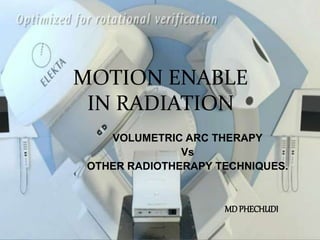
MOTION ENABLE
IN RADIATION
VOLUMETRIC ARC THERAPY
Vs
OTHER RADIOTHERAPY TECHNIQUES.
MD PHECHUDI
OBJECTIVE
 INTRODUCTION
 EVOLUTION OR HISTORY
 DEFINITIONS
 PRINCIPLES OF VARIOUS TECHNIQUES
 VOLUMETRIC ARCH THERAPY
• PHYSICAL ASPECTS
• ELEKTA MACHINE
• VARIAN
 COMPARISM
 JOURNAL DISCUSSIONS
 CONCLUSION
INTRODUCTION
 There are two broad categories of radiation therapy; both
are designed to target the tumor precisely while minimizing
exposure to the surrounding, healthy tissue.
 In the first category, external beam radiation therapy
(EBRT), the radiation is usually delivered by a machine
called a linear accelerator, or linac.
 In the second treatment category, the radiation is
delivered by radioactive material placed inside the body
near the cancer
It all started……
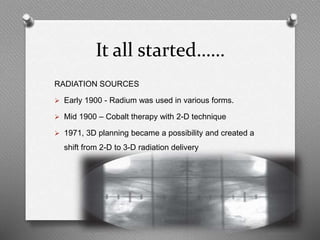
RADIATION SOURCES
 Early 1900 - Radium was used in various forms.
 Mid 1900 – Cobalt therapy with 2-D technique
 1971, 3D planning became a possibility and created a
shift from 2-D to 3-D radiation delivery
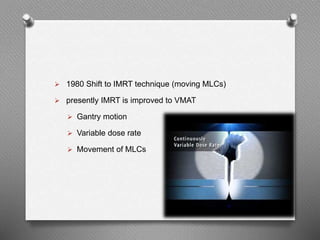
 1980 Shift to IMRT technique (moving MLCs)
 presently IMRT is improved to VMAT
 Gantry motion
 Variable dose rate
 Movement of MLCs
DEFINITIONS OF TERMS
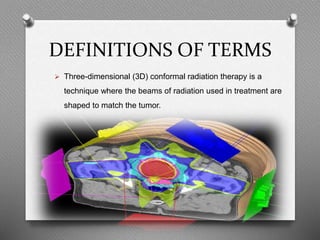
 Three-dimensional (3D) conformal radiation therapy is a
technique where the beams of radiation used in treatment are
shaped to match the tumor.
 Stereotactic radiotherapy is a way of targeting
radiotherapy very precisely at the tumor, with the
radiotherapy beams
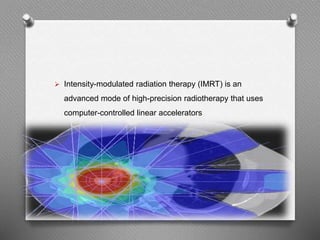
 Intensity-modulated radiation therapy (IMRT) is an
advanced mode of high-precision radiotherapy that uses
computer-controlled linear accelerators
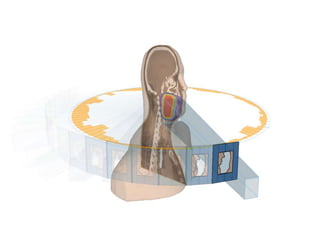
 VMAT is a new type of IMRT technique. The
radiotherapy machine rotates around the patient during
treatment
PRINCIPLES
3-D CONFORMAL
 3-DCRT begins with virtual simulation
 Virtual simulation creates a permanent digital file
 Scanned images are then linked into treatment planning
software that allows physicians to visualize the treatment area in
three dimensions.
 Clinicians input these selections into computer systems that
control treatment delivery.
Elith, C., et al (2011)
CONT’
Intensity Modulated Radiation Therapy
 IMRT links CT scans to treatment planning software that allows the
cancerous area to be visualized in three dimensions
 3DCRT and IMRT differ in how the pattern and volume of radiation
delivered to the tumor is determined.
 In IMRT, the physician designates specific doses of radiation
(constraints) that the tumor and normal surrounding tissues should
receive.
 A sophisticated computer program is used to develop an
individualized plan to meet the constraints.
 This process is termed "inverse treatment planning“.
 As a unique feature, it also involves dynamic multi-leaf collimators
(DMLCs)
CONT’
Stereotactic
 SRS, or stereotactic radiosurgery, is a technique that is most commonly
used for tumors in the brain or spinal column.
 Unlike IMRT, SRS is typically delivered in a maximum of five sessions
using higher doses of radiation with each session.
 A focused high-intensity beam of radiation is used to target the tumor.
 SBRT, or stereotactic body radiation therapy, is a very similar technique to
SRS, but is used for targets that are outside the brain and the spine.
 SBRT is most commonly used for targets in the lung, liver, pancreas and
kidney, and is typically delivered in a maximum of five sessions.
THE VMAT
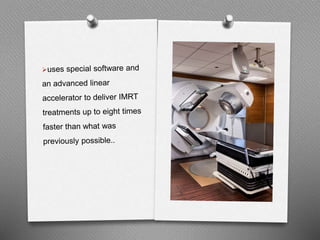
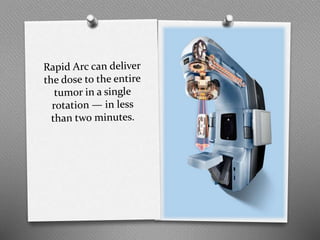
 VMAT is a new type of intensity-modulated radiation therapy
(IMRT) treatment technique that uses the same hardware (i.e. a
digital linear accelerator) as used for IMRT or conformal
treatment, but delivers the radiotherapy treatment using a
rotational or arc geometry rather than several static beams.
 This technique uses continuous modulation (i.e. moving the
collimator leaves) of the multileaf collimator (MLC) fields,
continuous change of the fluence rate (the intensity of the X rays)
and gantry rotation speed across a single or multiple 360 degree
rotations
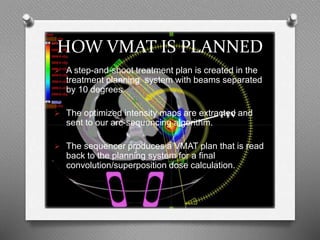
HOW VMAT IS PLANNED
 A step-and-shoot treatment plan is created in the
treatment planning system with beams separated
by 10 degrees.
 The optimized intensity maps are extracted and
sent to our arc-sequencing algorithm.
 The sequencer produces a VMAT plan that is read
back to the planning system for a final
convolution/superposition dose calculation.
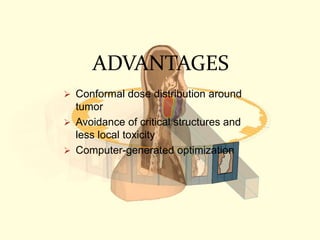
ADVANTAGES
 Conformal dose distribution around
tumor
 Avoidance of critical structures and
less local toxicity
 Computer-generated optimization
DISADVANTAGES
 Equipment costs higher
 Treatment time often longer
 Learning curve can be steep
 Additional quality assurance
necessary
 Special immobilization required
JOURNAL DISCUSSION
O VMAT for node-positive left-sided breast
cancer allows the maximum doses to
organs at risk (the heart) while retaining
target homogeneity and coverage when
compared to IMRT.
Pasler, M. et al (2013)
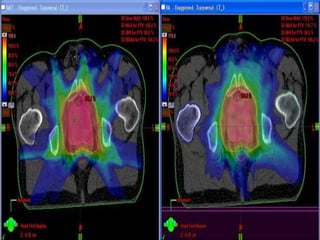
JOURNAL DISCUSSION
O Two other studies conducted on 10 and 9
prostate patients treatment plans shows
VMAT being the most efficient treatment
technique with improved quality when
comparing to 3D-conformal treatments,
providing best OAR sparing especially for
the rectum.
Wolff, D. et al (2009)
Palma, D. et al (2008)
JOURNAL DISCUSSION
O Another article comparing VMAT to
stereotactic body radiotherapy (SBRT) in
15 lung cancer patients mention that
faster delivery times, better conformity to
target, sharper dose fall-off in normal
tissues and lower dose to normal lung
than the 3D plans for lung SBRT was
demonstrated VMAT plans.
Zhang, G.G et al (2011)
SUGGESTIONS AND
RECOMENDATIONS
LIST OF ILLUSTRATION
REFERENCE
Pasler, M., Georg, D., Bartelt, S. & Lutterbach, J., (2013) Node-positive
left-sided breast cancer: does VMAT improve treatment plan quality with
respect to IMRT? Strahlentherapie und Onkologie, vol 5, no 189, 380-
386
Onal, C., Arslan, G., Parlak, C. & Sonmez S., (2014) Comparison of
IMRT and VMAT plans with different energy levels using Monte-Carlo
algorithm for prostate cancer. Jpn J Radiol, vol 1, no 32, 224–232
Alvarez-Moret, J., Pohl, F., Koelbl, O. & Dobler, B. (2010) Evaluation of
volumetric modulated arc therapy (VMAT) with Oncentra MasterPlan®
for the treatment of head and neck cancer. Radiation Oncology, Vol 5,
no 110
REFERENCE
Wolff a, D., Stieler, F., Welzel, G., Lorenz, F., Abo-Madyan , Y., Mai, S.,
Herskind, C., Polednik, M., Steil, V., Wenz, F. & Lohr, F., (2009) Volumetric
modulated arc therapy (VMAT) vs. serial tomotherapy, step-and-shoot
IMRT and 3D-conformal RT for treatment of prostate cancer.
Radiotherapy and Oncology, vol 1, no 93, 226-233
Palma, D., Vollans, E., James, K., Nakano, S., Moiseenko, V., Shaffer,
R., Mckenzie, M., Morris, J. & Otto, K., (2008) Volumetric modulated arc
therapy for delivery of prostate radiotherapy: comparison with intensity
modulated radiotherapy and 3D-conformal radiotherapy. Radiation
Oncology, Vol. 72, No. 4, 996–1001.
Elith, C.,Dempsey, S.E.,Findlay, L.,Warren-Forward, H.M.,
(2011) An Introduction to the Intensity-modulated Radiation Therapy
(IMRT) Techniques, Tomotherapy, and VMAT. Journal of Medical
Imaging and Radiation Science,vol 1,no. 42,37-43
REFERENCES
Zhang, G.G., Ku, L., Thomas J Dilling, T.J., Stevens, C.W., Ray R Zhang,
R.R., Li, W., & Vladimir Feygelman V., (2011) Volumetric modulated arc
planning for lung stereotactic body radiotherapy using conventional and
unflattened photon beams: a dosimetric comparison with 3D technique.
Radiation Oncology, vol 6, no 152
Huang, C., (2012) Treatment of Multiple Brain Metastases Using
Stereotactic Radiosurgery with Single-Isocenter Volumetric Modulated
Arc Therapy: Comparison with Conventional Dynamic Conformal Arc and
Static Beam Stereotactic Radiosurgery. Radiation Oncology. vol 1

The vmat vs other recent radiotherapy techniques

  • 1.
    MOTION ENABLE IN RADIATION VOLUMETRICARC THERAPY Vs OTHER RADIOTHERAPY TECHNIQUES. MD PHECHUDI
  • 2.
    OBJECTIVE  INTRODUCTION  EVOLUTIONOR HISTORY  DEFINITIONS  PRINCIPLES OF VARIOUS TECHNIQUES  VOLUMETRIC ARCH THERAPY • PHYSICAL ASPECTS • ELEKTA MACHINE • VARIAN  COMPARISM  JOURNAL DISCUSSIONS  CONCLUSION
  • 3.
    INTRODUCTION  There aretwo broad categories of radiation therapy; both are designed to target the tumor precisely while minimizing exposure to the surrounding, healthy tissue.  In the first category, external beam radiation therapy (EBRT), the radiation is usually delivered by a machine called a linear accelerator, or linac.  In the second treatment category, the radiation is delivered by radioactive material placed inside the body near the cancer
  • 4.
    It all started…… RADIATIONSOURCES  Early 1900 - Radium was used in various forms.  Mid 1900 – Cobalt therapy with 2-D technique  1971, 3D planning became a possibility and created a shift from 2-D to 3-D radiation delivery
  • 5.
     1980 Shiftto IMRT technique (moving MLCs)  presently IMRT is improved to VMAT  Gantry motion  Variable dose rate  Movement of MLCs
  • 6.
    DEFINITIONS OF TERMS Three-dimensional (3D) conformal radiation therapy is a technique where the beams of radiation used in treatment are shaped to match the tumor.
  • 7.
     Stereotactic radiotherapyis a way of targeting radiotherapy very precisely at the tumor, with the radiotherapy beams
  • 8.
     Intensity-modulated radiationtherapy (IMRT) is an advanced mode of high-precision radiotherapy that uses computer-controlled linear accelerators
  • 9.
     VMAT isa new type of IMRT technique. The radiotherapy machine rotates around the patient during treatment
  • 10.
    PRINCIPLES 3-D CONFORMAL  3-DCRTbegins with virtual simulation  Virtual simulation creates a permanent digital file  Scanned images are then linked into treatment planning software that allows physicians to visualize the treatment area in three dimensions.  Clinicians input these selections into computer systems that control treatment delivery. Elith, C., et al (2011)
  • 11.
    CONT’ Intensity Modulated RadiationTherapy  IMRT links CT scans to treatment planning software that allows the cancerous area to be visualized in three dimensions  3DCRT and IMRT differ in how the pattern and volume of radiation delivered to the tumor is determined.  In IMRT, the physician designates specific doses of radiation (constraints) that the tumor and normal surrounding tissues should receive.  A sophisticated computer program is used to develop an individualized plan to meet the constraints.  This process is termed "inverse treatment planning“.  As a unique feature, it also involves dynamic multi-leaf collimators (DMLCs)
  • 12.
    CONT’ Stereotactic  SRS, orstereotactic radiosurgery, is a technique that is most commonly used for tumors in the brain or spinal column.  Unlike IMRT, SRS is typically delivered in a maximum of five sessions using higher doses of radiation with each session.  A focused high-intensity beam of radiation is used to target the tumor.  SBRT, or stereotactic body radiation therapy, is a very similar technique to SRS, but is used for targets that are outside the brain and the spine.  SBRT is most commonly used for targets in the lung, liver, pancreas and kidney, and is typically delivered in a maximum of five sessions.
  • 13.
    THE VMAT  VMATis a new type of intensity-modulated radiation therapy (IMRT) treatment technique that uses the same hardware (i.e. a digital linear accelerator) as used for IMRT or conformal treatment, but delivers the radiotherapy treatment using a rotational or arc geometry rather than several static beams.  This technique uses continuous modulation (i.e. moving the collimator leaves) of the multileaf collimator (MLC) fields, continuous change of the fluence rate (the intensity of the X rays) and gantry rotation speed across a single or multiple 360 degree rotations
  • 16.
    HOW VMAT ISPLANNED  A step-and-shoot treatment plan is created in the treatment planning system with beams separated by 10 degrees.  The optimized intensity maps are extracted and sent to our arc-sequencing algorithm.  The sequencer produces a VMAT plan that is read back to the planning system for a final convolution/superposition dose calculation.
  • 17.
    ADVANTAGES  Conformal dosedistribution around tumor  Avoidance of critical structures and less local toxicity  Computer-generated optimization
  • 18.
    DISADVANTAGES  Equipment costshigher  Treatment time often longer  Learning curve can be steep  Additional quality assurance necessary  Special immobilization required
  • 20.
    JOURNAL DISCUSSION O VMATfor node-positive left-sided breast cancer allows the maximum doses to organs at risk (the heart) while retaining target homogeneity and coverage when compared to IMRT. Pasler, M. et al (2013)
  • 21.
    JOURNAL DISCUSSION O Twoother studies conducted on 10 and 9 prostate patients treatment plans shows VMAT being the most efficient treatment technique with improved quality when comparing to 3D-conformal treatments, providing best OAR sparing especially for the rectum. Wolff, D. et al (2009) Palma, D. et al (2008)
  • 22.
    JOURNAL DISCUSSION O Anotherarticle comparing VMAT to stereotactic body radiotherapy (SBRT) in 15 lung cancer patients mention that faster delivery times, better conformity to target, sharper dose fall-off in normal tissues and lower dose to normal lung than the 3D plans for lung SBRT was demonstrated VMAT plans. Zhang, G.G et al (2011)
  • 23.
  • 25.
  • 26.
    REFERENCE Pasler, M., Georg,D., Bartelt, S. & Lutterbach, J., (2013) Node-positive left-sided breast cancer: does VMAT improve treatment plan quality with respect to IMRT? Strahlentherapie und Onkologie, vol 5, no 189, 380- 386 Onal, C., Arslan, G., Parlak, C. & Sonmez S., (2014) Comparison of IMRT and VMAT plans with different energy levels using Monte-Carlo algorithm for prostate cancer. Jpn J Radiol, vol 1, no 32, 224–232 Alvarez-Moret, J., Pohl, F., Koelbl, O. & Dobler, B. (2010) Evaluation of volumetric modulated arc therapy (VMAT) with Oncentra MasterPlan® for the treatment of head and neck cancer. Radiation Oncology, Vol 5, no 110
  • 27.
    REFERENCE Wolff a, D.,Stieler, F., Welzel, G., Lorenz, F., Abo-Madyan , Y., Mai, S., Herskind, C., Polednik, M., Steil, V., Wenz, F. & Lohr, F., (2009) Volumetric modulated arc therapy (VMAT) vs. serial tomotherapy, step-and-shoot IMRT and 3D-conformal RT for treatment of prostate cancer. Radiotherapy and Oncology, vol 1, no 93, 226-233 Palma, D., Vollans, E., James, K., Nakano, S., Moiseenko, V., Shaffer, R., Mckenzie, M., Morris, J. & Otto, K., (2008) Volumetric modulated arc therapy for delivery of prostate radiotherapy: comparison with intensity modulated radiotherapy and 3D-conformal radiotherapy. Radiation Oncology, Vol. 72, No. 4, 996–1001. Elith, C.,Dempsey, S.E.,Findlay, L.,Warren-Forward, H.M., (2011) An Introduction to the Intensity-modulated Radiation Therapy (IMRT) Techniques, Tomotherapy, and VMAT. Journal of Medical Imaging and Radiation Science,vol 1,no. 42,37-43
  • 28.
    REFERENCES Zhang, G.G., Ku,L., Thomas J Dilling, T.J., Stevens, C.W., Ray R Zhang, R.R., Li, W., & Vladimir Feygelman V., (2011) Volumetric modulated arc planning for lung stereotactic body radiotherapy using conventional and unflattened photon beams: a dosimetric comparison with 3D technique. Radiation Oncology, vol 6, no 152 Huang, C., (2012) Treatment of Multiple Brain Metastases Using Stereotactic Radiosurgery with Single-Isocenter Volumetric Modulated Arc Therapy: Comparison with Conventional Dynamic Conformal Arc and Static Beam Stereotactic Radiosurgery. Radiation Oncology. vol 1