DR. MANOJ KUMAR B  MODERATOR:PROF. S.C. SHARMA DEPTT. OF RADIOTHERAPY AND ONCOLOGY PGIMER,CHANDIGARH BRACHYTHERAPY  PRINCIPLE AND METHODS
BRACHYTHERAPY  Type of radiation treatment in which radioactive sources are arranged in such a fashion that radiation is delivered to the tumor at a short distance by interstitial, intracavitary or surface application.
CLINICAL ADVANTAGES High biological efficacy  Rapid dose fall-off  High tolerance Tolerable acute intense reaction Decreased risk of tumor population High control rate Better cosmesis Minimal radiation morbidity  Day care procedure
LIMITATIONS & DISADVANTAGES Difficult for inaccessible regions  Limited for small tumors (T 1 _T 2 ) Invasive procedures, require GA Higher dose inhomogeneity Greater conformation –small errors in placement of sources lead to extreme changes from the intended dose distribution Radioactive hazards (not now) Costly
SELECTION CRITERIA Easily accessible lesions Early stage diseases (Ideal implant  ≤ 5 cm) Well localized tumor to organ of origin No nodal or distant metastases No local infections or inflammation Favorable histology- mod. diff. i.e. SCC Non DM / HTN  Proliferative/ ulcerative lesions preferred
INDICATIONS RADICAL  RADIATION  Skin malignancies- BCC, SCC Head & neck cancers Ca cx Ca prostate BOOST AFTER EXT.RT±CCT Head & neck cancers Ca Breast Esophagus Anal canal
INDICATIONS... PERIOPERTIVE STS Ca Breast POSTOP Ca Endometrium Ca cx Ca Breast PALLIATIVE Bronchogenic  Ca Biliary duct malignancy Ca Esophagus Recurrent tumors BENIGN Keloids / Pterygium OTHERS Endovascular/Rad. stent
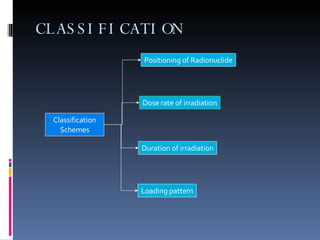
CLASSIFICATION Classification Schemes Positioning of Radionuclide Dose rate of irradiation Duration of irradiation Loading pattern
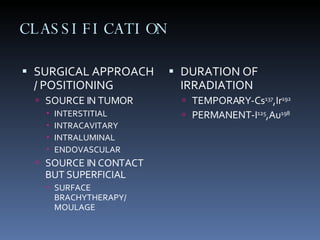
CLASSIFICATION SURGICAL APPROACH / POSITIONING  SOURCE IN TUMOR INTERSTITIAL INTRACAVITARY INTRALUMINAL ENDOVASCULAR SOURCE IN CONTACT BUT SUPERFICIAL SURFACE BRACHYTHERAPY/ MOULAGE DURATION OF IRRADIATION  TEMPORARY-Cs 137 ,Ir 192 PERMANENT-I 125 ,Au 198
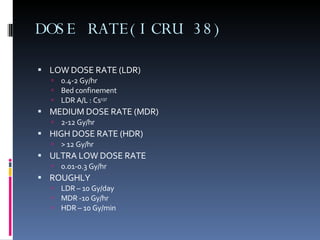
DOSE RATE(ICRU 38) LOW DOSE RATE (LDR) 0.4-2 Gy/hr Bed confinement LDR A/L : Cs 137 MEDIUM DOSE RATE (MDR) 2-12 Gy/hr HIGH DOSE RATE (HDR) > 12 Gy/hr ULTRA LOW DOSE RATE  0.01-0.3 Gy/hr ROUGHLY  LDR – 10 Gy/day MDR -10 Gy/hr HDR – 10 Gy/min
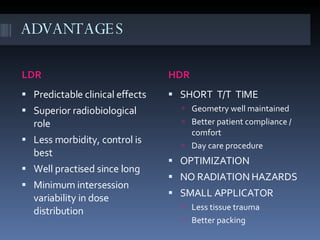
ADVANTAGES LDR HDR Predictable clinical effects Superior radiobiological role Less morbidity, control is best Well practised since long Minimum intersession variability in dose distribution SHORT  T/T  TIME Geometry well maintained Better patient compliance / comfort Day care procedure OPTIMIZATION NO RADIATION HAZARDS SMALL APPLICATOR  Less tissue trauma Better packing
MDR BRACHYTHERAPY ADVANTAGES Comparative shorter T/T time One time treatment can be used Patient convenience Radio biologically acceptable  nearer to LDR Brachytherapy DISADVANTAGES Late complications increases if correction not done
SOURCE LOADING TECHNIQUE PRELOADING  SYSTEM Live sources ADVANTAGES Clinical results are best Affordable Long term results with lesser morbidities DISADVANTAGES Radiation hazards Special instruments Difficult application / hasty Geometry not maintained ? Optimization
AFTER LOADING TECHNIQUE MANUAL Avoids radiation protection issue of preloading Better applicator placement Verification prior to source placement Min. radiation hazard Advantages of preloading  REMOTE CONTROLLED No radiation hazard Accurate placement Geometry maintained Better dose distribution Highly precise Short  T/T  time Day care procedure Mainly used for HDR
INTERSTITIAL BRACHYTHERAPY Sealed Radioactive sources directly implanted into the tumor in a geometric fashion First suggested by Alexander Graham Bell ADVANTAGES Higher local dose in shorter time Rapid dose fall Better tumor control Lesser radiation morbidities Superior cosmetics Functional preservation of organs
INTERSTITIAL BRACHYTHERAPY… DISADVANTAGES Radiation hazards in older days Costly Not applicable to inaccessible areas INTENTION OF TREATMENT Always  RADICAL  As radical brachytherapy alone (smaller lesions) Local boost in combination with EBRT (larger lesion) NEVER USED FOR PALLIATION
SELECTION CRITERIA Easily accessible lesions, at least from one side Early stage disease T  1 -T 2   and sometimes early T 3   Ideally total size of implant ≤ 5 cm Non DM /HTN No local infection Proliferative and ulcerative lesions preferred
CLINICAL APPLICATIONS Head & neck tumors Early stage oropharyngeal cancers Ca breast- Boost /PBI Ca prostate Soft tissue sarcoma Gynecologic malignancies Ca anal canal and rectum Ca lung and pancreas
TYPES OF INTERSTITIAL IMPLANTS ACCORDING TO SIZE/LOCATION/PROXIMITY OF TUMOR TO NORMAL STRUCTURES TEMPORARY Radioactive sources removed after desirable dose has been delivered Rigid stainless steel needles/flexible Teflon / nylon guides/plastic tubes Preloaded/After loaded PERMANENT Preloaded – rigid needle eg. Ra 226  ,Cs 137   After loaded – Manual/ Remote Advantages Flexibility of implant design Reduction of radiation exposure levels resulting in more accurate placement of needles and guides
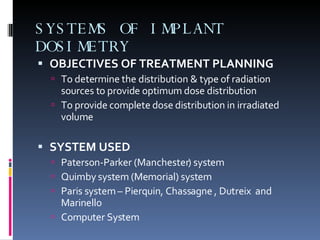
SYSTEMS OF IMPLANT DOSIMETRY OBJECTIVES OF TREATMENT PLANNING To determine the distribution & type of radiation sources to provide optimum dose distribution To provide complete dose distribution in irradiated volume SYSTEM USED  Paterson-Parker (Manchester) system Quimby system (Memorial) system Paris system – Pierquin, Chassagne , Dutreix  and Marinello Computer System
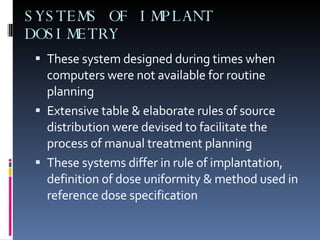
SYSTEMS OF IMPLANT DOSIMETRY These system designed during times when computers were not available for routine planning Extensive table & elaborate rules of source distribution were devised to facilitate the process of manual treatment planning These systems differ in rule of implantation, definition of dose uniformity & method used in reference dose specification
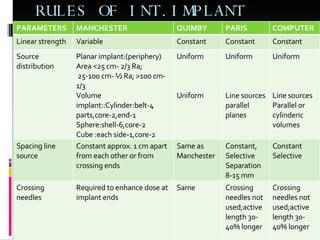
RULES OF INT.IMPLANT SYSTEM PARAMETERS MANCHESTER QUIMBY PARIS COMPUTER Linear strength Variable Constant Constant Constant Source distribution Planar implant:(periphery) Area <25 cm- 2/3 Ra; 25-100 cm- ½ Ra; >100 cm- 1/3 Volume implant::Cylinder:belt-4 parts,core-2,end-1 Sphere:shell-6,core-2 Cube :each side-1,core-2  Uniform  Uniform Uniform Line sources parallel planes Uniform Line sources  Parallel or cylinderic volumes Spacing line source Constant approx. 1 cm apart from each other or from crossing ends Same as Manchester Constant, Selective Separation 8-15 mm Constant Selective Crossing needles Required to enhance dose at implant ends Same Crossing needles not used;active length 30-40% longer Crossing needles not used;active length 30-40% longer
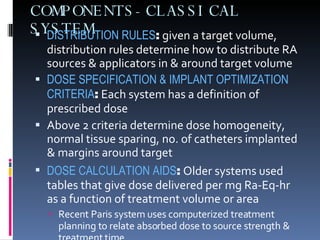
COMPONENTS-CLASSICAL SYSTEM DISTRIBUTION RULES :  given a target volume, distribution rules determine how to distribute RA sources & applicators in & around target volume DOSE SPECIFICATION & IMPLANT OPTIMIZATION CRITERIA :  Each system has a definition of prescribed dose Above 2 criteria determine dose homogeneity, normal tissue sparing, no. of catheters implanted & margins around target  DOSE CALCULATION AIDS :  Older systems used tables that give dose delivered per mg Ra-Eq-hr as a function of treatment volume or area Recent Paris system uses computerized treatment planning to relate absorbed dose to source strength & treatment time
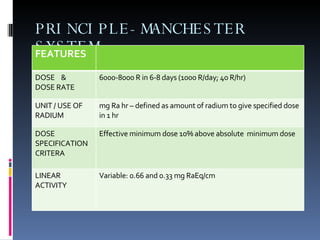
PRINCIPLE-MANCHESTER SYSTEM FEATURES DOSE  &  DOSE RATE  6000-8000 R in 6-8 days (1000 R/day; 40 R/hr) UNIT / USE OF RADIUM mg Ra hr – defined as amount of radium to give specified dose in 1 hr DOSE SPECIFICATION CRITERA Effective minimum dose 10% above absolute  minimum dose  LINEAR ACTIVITY Variable: 0.66 and 0.33 mg RaEq/cm
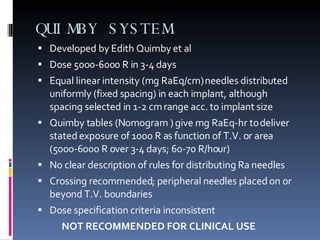
QUIMBY SYSTEM Developed by Edith Quimby et al  Dose 5000-6000 R in 3-4 days Equal linear intensity (mg RaEq/cm) needles distributed uniformly (fixed spacing) in each implant, although spacing selected in 1-2 cm range acc. to implant size Quimby tables (Nomogram ) give mg RaEq-hr to deliver stated exposure of 1000 R as function of T.V. or area (5000-6000 R over 3-4 days; 60-70 R/hour)  No clear description of rules for distributing Ra needles Crossing recommended; peripheral needles placed on or beyond T.V. boundaries Dose specification criteria inconsistent NOT RECOMMENDED FOR CLINICAL USE
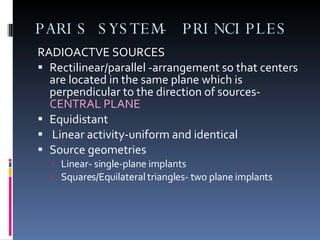
PARIS SYSTEM- PRINCIPLES RADIOACTVE SOURCES Rectilinear/parallel -arrangement so that centers are located in the same plane which is perpendicular to the direction of sources-  CENTRAL PLANE Equidistant  Linear activity-uniform and identical Source geometries Linear- single-plane implants  Squares/Equilateral triangles- two plane implants
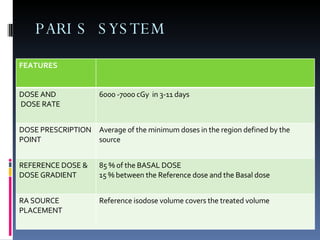
PARIS SYSTEM FEATURES DOSE AND DOSE RATE 6000 -7000 cGy  in 3-11 days DOSE PRESCRIPTION POINT Average of the minimum doses in the region defined by the source  REFERENCE DOSE & DOSE GRADIENT 85 % of the BASAL DOSE  15 % between the Reference dose and the Basal dose RA SOURCE PLACEMENT Reference isodose volume covers the treated volume
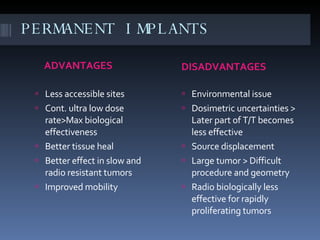
PERMANENT IMPLANTS ADVANTAGES  DISADVANTAGES Less accessible sites Cont. ultra low dose rate>Max biological effectiveness Better tissue heal Better effect in slow and radio resistant tumors Improved mobility Environmental issue Dosimetric uncertainties > Later part of T/T becomes less effective Source displacement Large tumor > Difficult procedure and geometry Radio biologically less effective for rapidly proliferating tumors
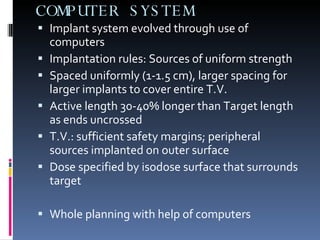
COMPUTER SYSTEM Implant system evolved through use of computers Implantation rules: Sources of uniform strength Spaced uniformly (1-1.5 cm), larger spacing for larger implants to cover entire T.V. Active length 30-40% longer than Target length as ends uncrossed T.V.: sufficient safety margins; peripheral sources implanted on outer surface  Dose specified by isodose surface that surrounds target Whole planning with help of computers
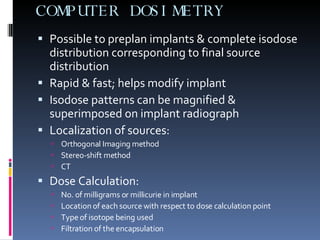
COMPUTER DOSIMETRY Possible to preplan implants & complete isodose distribution corresponding to final source distribution Rapid & fast; helps modify implant Isodose patterns can be magnified & superimposed on implant radiograph Localization of sources: Orthogonal Imaging method Stereo-shift method CT Dose Calculation: No. of milligrams or millicurie in implant Location of each source with respect to dose calculation point Type of isotope being used Filtration of the encapsulation
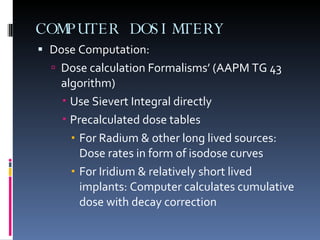
COMPUTER DOSIMTERY Dose Computation: Dose calculation Formalisms’ (AAPM TG 43 algorithm) Use Sievert Integral directly Precalculated dose tables For Radium & other long lived sources: Dose rates in form of isodose curves For Iridium & relatively short lived implants: Computer calculates cumulative dose with decay correction
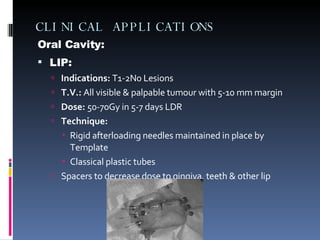
CLINICAL APPLICATIONS Oral Cavity: LIP: Indications:  T1-2N0 Lesions  T.V.:  All visible & palpable tumour with 5-10 mm margin Dose:  50-70Gy in 5-7 days LDR Technique:   Rigid afterloading needles maintained in place by Template Classical plastic tubes Spacers to decrease dose to gingiva, teeth & other lip
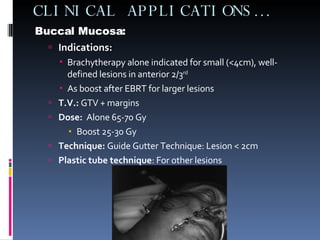
CLINICAL APPLICATIONS… Buccal Mucosa: Indications:   Brachytherapy alone indicated for small (<4cm), well-defined lesions in anterior 2/3 rd As boost after EBRT for larger lesions T.V.:  GTV + margins Dose:   Alone 65-70 Gy Boost 25-30 Gy Technique:  Guide Gutter Technique: Lesion < 2cm Plastic tube technique : For other lesions
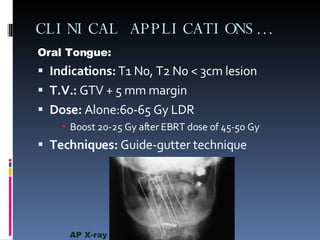
CLINICAL APPLICATIONS… Oral Tongue: Indications:  T1 N0, T2 N0 < 3cm lesion T.V.:  GTV + 5 mm margin Dose:  Alone:60-65 Gy LDR Boost 20-25 Gy after EBRT dose of 45-50 Gy Techniques:  Guide-gutter technique AP X-ray
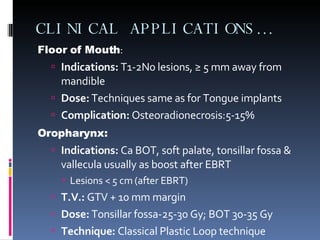
CLINICAL APPLICATIONS… Floor of Mouth : Indications:  T1-2N0 lesions,  ≥ 5 mm away from mandible Dose:  Techniques same as for Tongue implants Complication:  Osteoradionecrosis:5-15%  Oropharynx: Indications:  Ca BOT , soft palate, tonsillar fossa & vallecula usually as boost after EBRT Lesions < 5 cm (after EBRT) T.V.:  GTV + 10 mm margin Dose:  Tonsillar fossa-25-30 Gy; BOT 30-35 Gy Technique:  Classical Plastic Loop technique
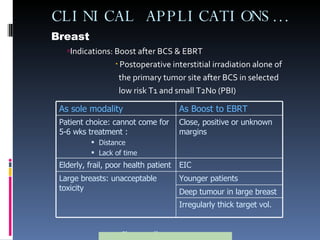
CLINICAL APPLICATIONS… Breast Indications: Boost after BCS & EBRT Postoperative interstitial irradiation alone of  the primary tumor site after BCS in selected  low risk T1 and small T2N0 (PBI) Chest wall recurrences Moderator: Prof. S. C. Sharma As sole modality As Boost to EBRT Patient choice: cannot come for 5-6 wks treatment :  Distance Lack of time Close, positive or unknown margins Elderly, frail, poor health patient EIC Large breasts: unacceptable toxicity Younger patients Deep tumour in large breast Irregularly thick target vol.
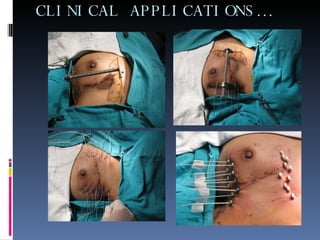
CLINICAL APPLICATIONS… T.V.:  Primary Tumor site + 2-3 cm margin Dose:  As Boost: 10-20 Gy LDR AS PBI: 45-50 Gy in 4-5 days LDR (30-70 cGy/hour) 34 Gy/10#, 2# per day HDR Technique: Localization of PTV: Surgical clips (at least 6) USG, CT or MRI localization, Intraop USG During primary surgery Guide needle technique or Plastic tube technique using Template Double plane implant Skin to source distance: Minimum 5 mm
CLINICAL APPLICATIONS…
CLINICAL APPLICATIONS… Prostate: Indications Brachytherapy as monotherapy: Stage T1-2a & Gleason score 2-6 & PSA  ≤ 10 ng/ml As boost after EBRT Stage T2b, T2c or Gleason score 7-10 or PSA > 10 ng/ml For brachytherapy, Prostate size < 50 cc Exclusion criteria: Life expectancy < 5 yrs Large or poorly healed TURP defect Distant Mets or operative risk T.V.:  Whole prostate within capsule + 2-3 mm margin Methods:  Permanent Implant (I 125  or Pd 103 ) or  Temporary Implant (Ir 192 )
CLINICAL APPLICATIONS… Technique for Permanent implant Retropubic approach with  I 125  seeds- Disappointing results Modern technique: Transperineal Approach TRUS guided Two step approach Volume study of prostate Computer planning  Seed positioning  Coverage check -USG & Flouroscopy Check Cystoscopy Post-implant image based dosimetry
CLINICAL APPLICATIONS Dose:   I 125 :  145 Gy  as sole RT 100-110 Gy as boost to 40-50 Gy EBRT Pd 103 : 125 Gy as sole RT 90-100 Gy as boost to 40-50 Gy EBRT Temporary Implants with Ir 192   (LDR or HDR): Procedure same as above; lesser no. of plastic catheters required (8-15) Dose:  LDR 30-35 Gy seeds left for 3 days(Boost to 45 Gy EBRT) HDR 20-25 Gy, 4-6 Gy/#(Boost to 45 Gy EBRT)
CLINICAL APPLICATIONS Soft tissue Sarcomas  (using Ir 192  or I 125 ) Indications: As sole postop RT: completely resected intermediate or high grade tumours of extremity or superficial trunk with -ve margins As boost to postop EBRT: Intermediate or high grade sarcoma with +/- margins Postop pts with small lesions & +ve/uncertain margins Deep lesions Low grade sarcomas T.V.:   GTV + 2-5 cm margin GTV based on preop MRI & clinical findings Dose:  LDR (Ir seeds or wires) as sole treatment 45-50 Gy in 4-6 days As boost to 45-50 Gy EBRT: 15-25 Gy in 2-3 days
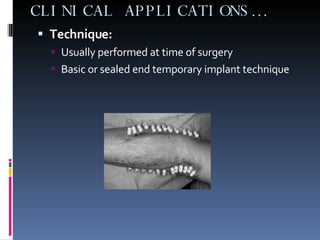
CLINICAL APPLICATIONS… Technique: Usually performed at time of surgery Basic or sealed end temporary implant technique
Brain:  Permanent or temporary (using I 125  or   Ir 192  seeds/wires   ) Indications:   As boost to EBRT or recurrence Anaplastic astrocytoma or GBM, unifocal, well cicumscribed, peripheral lesions & < 5 cm in diameter T.V.:  Contrast enhancing area on MRI +/- 5mm margin Dose:  LDR 50-60 Gy, 0.4-0.5 Gy/hr Technique:  Planning CT/MRI done CLINICAL APPLICATIONS…
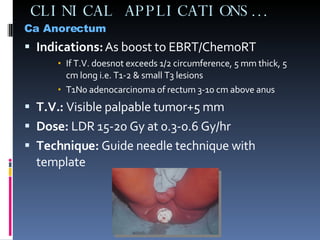
CLINICAL APPLICATIONS… Ca Anorectum Indications:  As boost to EBRT/ChemoRT If T.V. doesnot exceeds 1/2 circumference, 5 mm thick, 5 cm long i.e. T1-2 & small T3 lesions T1N0 adenocarcinoma of rectum 3-10 cm above anus T.V.:  Visible palpable tumor+5 mm  Dose:  LDR 15-20 Gy at 0.3-0.6 Gy/hr Technique:  Guide needle technique with template
CLINICAL APPLICATIONS… Gynecological Tumors  ( Ir 192  LDR or HDR) Indications: Ca Cervix Ca Endometrium Postop local recurrence Ca Vagina & Vulva Radical BT in select early lesions (T1-2N0) Boost after EBRT in large lesions (T2-3N1) Technique:   Guide-gutter technique Blind plastic tube implant (transperineal technique) Plastic or guide needles
CLINICAL APPLICATION – CA CX   ABS Recommendations Bulky primary disease Prior hysterectomy-inability to place tandem Post hysterectomy  vault recc./cut-through hysterectomy/cervical stump presentation Extesive parametrial involvement  Distorted anatomy Narrow vagina & fornices Extensive / Distal vaginal wall involvement Re-irradiation after recurrences Prior course of RT to area of interest
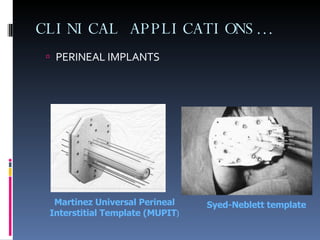
CLINICAL APPLICATIONS… PERINEAL IMPLANTS Martinez Universal Perineal Interstitial Template (MUPIT ) Syed-Neblett template
CLINICAL APPLICATIONS… Dose: Radical BT: LDR: 55-60 Gy @ 50-90 cGy/hr HDR: 3.5 Gy/#@ 2#/day/12-16# Boost LDR: 15-25 Gy , 50-90 cGy/hr HDR: as above, no. of # depend upon EBRT doses
CLINICAL APPLICATIONS… Other sites: Lung:  Permanent perioperative BT, I 125  seeds, Au 198  Grains Persistent or recurrent ds after EBRT or residual ds after surgery Pancreas:  Permanent perioperative BT, I 125  seeds Locally advanced unresectable ds Penis & Urethra:
INTRACAVITARY APPLICATION Radioactive sources are placed in a existing cavity usually inside a predefined applicator with special geometry Uses: Cervix Endometrium Vagina Maxilla Nasopharynx
PARIS SYSTEM Single application of radium Two cork colpostats (cylinder) and an intrauterine tube Delivers a dose of 7000- 8000 mg-hrs of radium over a period of five days(45R/hr) (5500mg/hr Equal amount of radium used in the uterus and the vagina  Intrauterine sources  3 radioactive sources, with source strengths in the ratio of 1:1:0.5  colpostats  sources with the same strength as the topmost uterine source
STOCKHOLM SYSTEM Fractionated course of radiation delivered over a period of one month.  Usually 2-3 applications, each for a period of 20- 30 hours (repeated 3weekly)  Intravaginal boxes -lead or gold  intrauterine tube -flexible rubber Unequal loading 30 - 90 mg of radium in uterus 60 - 80 mg in vagina  Total prescribed dose -6500-7100 mg Ra  4500 mg Ra contributed by the vaginal box (dose rate-110R/hr  or 2500mg/hr/#)
DRAWBACKS OF PARIS AND STOCKHOLM SYSTEMS Long treatment time Discomfort to the patient No dose prescription
MANCHESTER SYSTEM To  define  the treatment in terms of dose to a point. Criteria of the point:  Anatomically comparable Position  where the dosage is not highly sensitive to small alteration in applicator position Allows correlation of the dose levels with the clinical effects  To  design  a set of applicators and their loading  which would give the same dose rate irrespective of the combination of applicators used To  formulate  a set of rules regarding the activity, relationship and positioning of the radium sources in the uterine tumors and the vaginal ovoids, for the desired dose rate
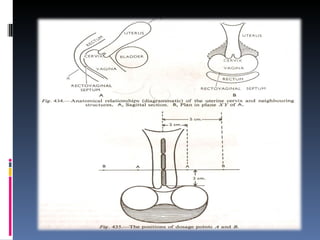
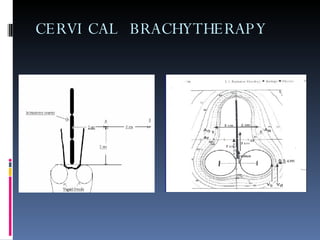
POINT   A PARACERVICAL TRIANGLE  where initial lesion of radiation necrosis occurs Area in the medial edge of broad ligament where the uterine vessel cross over the ureter The point A -fixed point 2cm lateral to  the center of uterine canal and 2 cm from the mucosa of the lateral fornix POINT   B Rate of dose fall-off  laterally Imp. Calculating total dose-Combined with EBRT Proximity to important OBTURATOR LNs Same level as point A but 5 cm from midline Dose ~20-25 % of the dose at point A
 
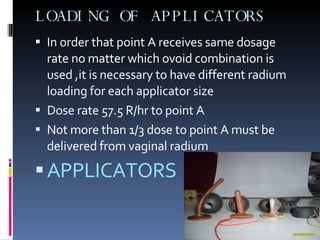
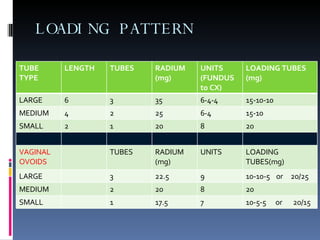
LOADING OF APPLICATORS In order that point A receives same dosage rate no matter which ovoid combination is used ,it is necessary to have different radium loading for each applicator size Dose rate 57.5 R/hr to point A Not more than 1/3 dose to point A must be delivered from vaginal radium APPLICATORS
LOADING PATTERN TUBE TYPE LENGTH TUBES RADIUM (mg) UNITS  (FUNDUS to CX) LOADING TUBES (mg) LARGE 6 3 35 6-4-4 15-10-10 MEDIUM 4 2 25 6-4 15-10 SMALL 2 1 20 8 20 VAGINAL OVOIDS TUBES  RADIUM (mg) UNITS LOADING TUBES(mg) LARGE 3 22.5 9 10-10-5  or  20/25 MEDIUM 2 20 8 20 SMALL 1 17.5 7 10-5-5  or  20/15
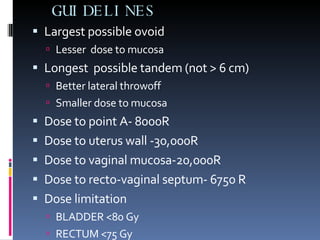
GUIDELINES Largest possible ovoid Lesser  dose to mucosa  Longest  possible tandem (not > 6 cm) Better lateral throwoff Smaller dose to mucosa Dose to point A- 8000R Dose to uterus wall -30,000R Dose to vaginal mucosa-20,000R Dose to recto-vaginal septum- 6750 R Dose limitation BLADDER <80 Gy RECTUM <75 Gy
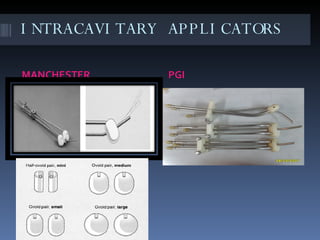
INTRACAVITARY APPLICATORS MANCHESTER  PGI
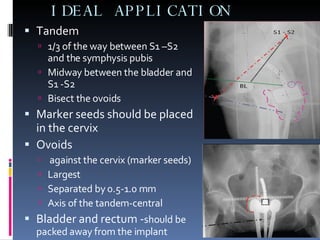
IDEAL APPLICATION Tandem  1/3 of the way between S1 –S2 and the symphysis pubis Midway between the bladder and S1 -S2 Bisect the ovoids Marker seeds should be placed in the cervix Ovoids  against the cervix (marker seeds) Largest  Separated by 0.5-1.0 mm Axis of the tandem-central Bladder and rectum - should be packed away from the implant
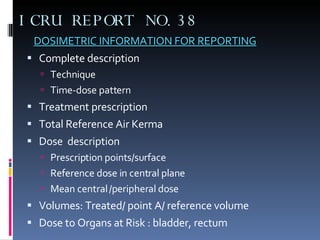
ICRU REPORT NO.38 DOSIMETRIC INFORMATION FOR REPORTING Complete description  Technique Time-dose pattern Treatment prescription Total Reference Air Kerma  Dose  description Prescription points/surface Reference dose in central plane Mean central /peripheral dose  Volumes: Treated/ point A/ reference volume  Dose to Organs at Risk : bladder, rectum
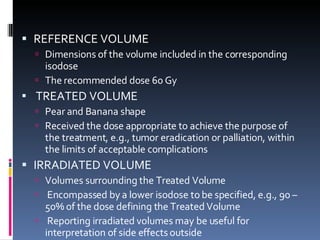
REFERENCE VOLUME  Dimensions of the volume included in the corresponding isodose  The recommended dose 60 Gy TREATED VOLUME Pear and Banana shape  Received the dose appropriate to achieve the purpose of the treatment, e.g., tumor eradication or palliation, within the limits of acceptable complications IRRADIATED VOLUME Volumes surrounding the Treated Volume Encompassed by a lower isodose to be specified, e.g., 90 – 50% of the dose defining the Treated Volume Reporting irradiated volumes may be useful for interpretation of side effects outside
CERVICAL BRACHYTHERAPY
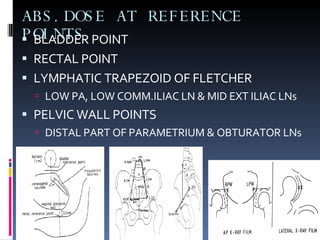
ABS.DOSE AT REFERENCE POINTS BLADDER POINT RECTAL POINT LYMPHATIC TRAPEZOID OF FLETCHER LOW PA, LOW COMM.ILIAC LN & MID EXT ILIAC LNs PELVIC WALL POINTS DISTAL PART OF PARAMETRIUM & OBTURATOR LNs
DOSE SCHEDULE LDR (<200cgy/hr) 35-40 Gy at point A MDR (200-1200cgy/hr)  35 Gy LDR EQUIVALENT  at point A HDR(>1200cgy/hr) 9 Gy in 2 # 6.8Gy in 3# at point A
EXTERNAL RT WITH BRACHYTHERAPY Brachytherapy can follow external irradiation SIMULTANEOUS Stage I - II with very minimal parametriun involvement  HDR -5 sessions (9gy /#/ 5, 1week apart) 40 Gy by XRT simultaneously SANDWICH Stage I-II MDR  40 Gy LDR eq.—› XRT 40 Gy —› MDR 35 Gy LDR eq.  In both above cases a MIDLINE SHIELD is used
POST OP/ VAULT BRACHYTHERAPY  Vault RT No residual disease 8500 cGy at 5mm from the surface of the vault  2 sessions 1 week apart  Residual disease  CTV of 2 cm given to gross tumor and the prescription of 8500cgy encompassing the whole CTV is made 2 sessions 1 week apart Mostly after XRT
POST OP BRACHYTHERAPY CONTRAINDICATIONS Vaginal wall involvement ( middle- lower 1\3) Heavy parametrium infiltration VVF or VRF Inadequate space Medical contraindications Metastatic disease Supplementary radiation 2000 cGy \10# \ 2 weeks
SURFACE MOULDS  Radiation is delivered by arranging RA sources over the surface of tumor Types  Planar  Circular Square Rectangular Line source  Cylinder
INDICATIONS Superficial /Accessible tumors Skin ca Post mastectomy recurrence Oral tumor hard palate ,alveolus Penile carcinoma
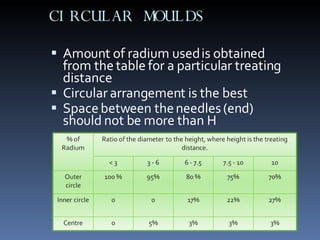
CIRCULAR MOULDS  Amount of radium used is obtained from the table for a particular treating distance Circular arrangement is the best Space between the needles (end) should not be more than H
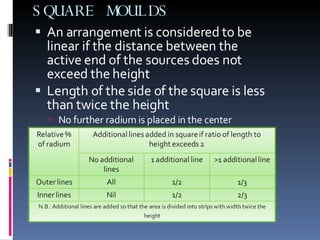
SQUARE MOULDS An arrangement is considered to be linear if the distance between the active end of the sources does not exceed the height Length of the side of the square is less than twice the height No further radium is placed in the center
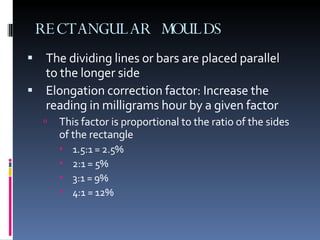
RECTANGULAR MOULDS The dividing lines or bars are placed parallel to the longer side  Elongation correction factor: Increase the reading in milligrams hour by a given factor This factor is proportional to the ratio of the sides of the rectangle  1.5:1 = 2.5% 2:1 = 5% 3:1 = 9% 4:1 = 12%
CIRCULAR MOULDS CURVED SURFACES COAXIAL RINGS Irregular area Curved surfaces: convex, concave The smaller area is used for calculation of radium dose and implant rules Cylinder mould: Amount of radium is 30D 2 DISTRIBUION RULES In case of coaxial rings  radium is placed at a distance equal to 2H
INTRALUMINAL BRACHYTHERAPY Radioactive source is passed through a tube and passed into a hollow lumen Sites Esophagus Bronchus : Bronchogenic carcinoma Definitive : T 1 -T 2 tumors Palliative Dyspnea Cough Atelectasis Biliary tract
RADIOBIOLOGY Biological effects  depend on Dose prescribed  Treated volume  Dose rate  Fractionation  Treatment duration Heterogeneous dose distribution Higher average dose Short treatment
RADIOBIOLOGY – 4 Rs Repair Reassortment / redistribution  Repopulation Reoxygenation
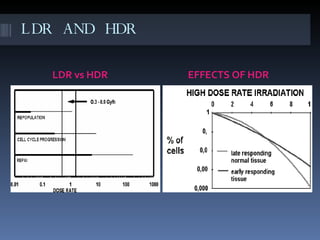
RADIOBIOLOGY- LDR Repair of Sublethal damage  Most significant- 1 Gy/min and 0.3 Gy /h DNA repair  Dynamic process Special kinetics Simple exponential kinetics Reassortment - slow and imp. <1 Gy/min Repopulation-slowest and significant Reoxygenation - relative slow process may be a disadvantage
LDR AND HDR LDR vs HDR EFFECTS OF HDR
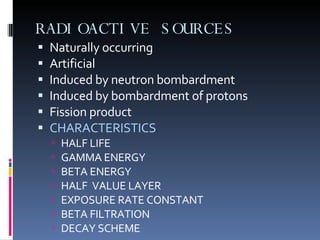
RADIOACTIVE SOURCES Naturally occurring Artificial Induced by neutron bombardment Induced by bombardment of protons Fission product CHARACTERISTICS HALF LIFE GAMMA ENERGY BETA ENERGY HALF  VALUE LAYER EXPOSURE RATE CONSTANT BETA FILTRATION DECAY SCHEME
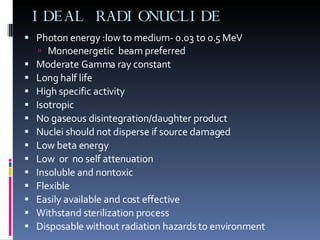
IDEAL RADIONUCLIDE Photon energy :low to medium- 0.03 to 0.5 MeV Monoenergetic  beam preferred  Moderate Gamma ray constant Long half life High specific activity Isotropic  No gaseous disintegration/daughter product Nuclei should not disperse if source damaged Low beta energy Low  or  no self attenuation Insoluble and nontoxic Flexible Easily available and cost effective Withstand sterilization process Disposable without radiation hazards to environment
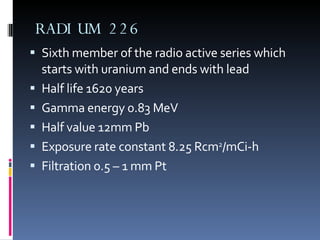
RADIUM 226 Sixth member of the radio active series which starts with uranium and ends with lead Half life 1620 years Gamma energy 0.83 MeV Half value 12mm Pb Exposure rate constant 8.25 Rcm 2 /mCi-h Filtration 0.5 – 1 mm Pt
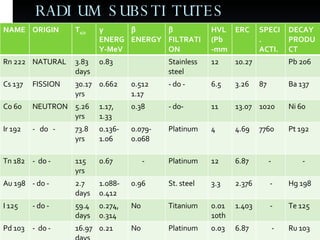
RADIUM SUBSTITUTES NAME ORIGIN T 1/2 γ ENERGY-MeV β  ENERGY β  FILTRATION HVL (Pb -mm) ERC SPECI. ACTI. DECAY PRODUCT Rn 222 NATURAL 3.83 days 0.83 Stainless steel 12 10.27 Pb 206 Cs 137 FISSION 30.17 yrs 0.662 0.512 1.17 - do - 6.5 3.26 87 Ba 137 Co 60 NEUTRON  ACTIVAT. 5.26  yrs 1.17, 1.33 0.38 - do- 11 13.07 1020 Ni 60 Ir 192 -  do  - 73.8 yrs 0.136- 1.06 0.079-0.068 Platinum 4 4.69 7760 Pt 192 Tn 182 -  do -  115  yrs 0.67 - Platinum 12 6.87 - -  Au 198 - do - 2.7  days 1.088- 0.412 0.96 St. steel 3.3 2.376 - Hg 198 I 125 - do - 59.4  days 0.274, 0.314 No Titanium 0.01 10th 1.403 -  Te 125 Pd 103 -  do - 16.97 days 0.21 No Platinum 0.03 6.87 - Ru 103
Thank You

Brachytherapy Final

  • 1.
    DR. MANOJ KUMARB MODERATOR:PROF. S.C. SHARMA DEPTT. OF RADIOTHERAPY AND ONCOLOGY PGIMER,CHANDIGARH BRACHYTHERAPY PRINCIPLE AND METHODS
  • 2.
    BRACHYTHERAPY Typeof radiation treatment in which radioactive sources are arranged in such a fashion that radiation is delivered to the tumor at a short distance by interstitial, intracavitary or surface application.
  • 3.
    CLINICAL ADVANTAGES Highbiological efficacy Rapid dose fall-off High tolerance Tolerable acute intense reaction Decreased risk of tumor population High control rate Better cosmesis Minimal radiation morbidity Day care procedure
  • 4.
    LIMITATIONS & DISADVANTAGESDifficult for inaccessible regions Limited for small tumors (T 1 _T 2 ) Invasive procedures, require GA Higher dose inhomogeneity Greater conformation –small errors in placement of sources lead to extreme changes from the intended dose distribution Radioactive hazards (not now) Costly
  • 5.
    SELECTION CRITERIA Easilyaccessible lesions Early stage diseases (Ideal implant ≤ 5 cm) Well localized tumor to organ of origin No nodal or distant metastases No local infections or inflammation Favorable histology- mod. diff. i.e. SCC Non DM / HTN Proliferative/ ulcerative lesions preferred
  • 6.
    INDICATIONS RADICAL RADIATION Skin malignancies- BCC, SCC Head & neck cancers Ca cx Ca prostate BOOST AFTER EXT.RT±CCT Head & neck cancers Ca Breast Esophagus Anal canal
  • 7.
    INDICATIONS... PERIOPERTIVE STSCa Breast POSTOP Ca Endometrium Ca cx Ca Breast PALLIATIVE Bronchogenic Ca Biliary duct malignancy Ca Esophagus Recurrent tumors BENIGN Keloids / Pterygium OTHERS Endovascular/Rad. stent
  • 8.
    CLASSIFICATION Classification SchemesPositioning of Radionuclide Dose rate of irradiation Duration of irradiation Loading pattern
  • 9.
    CLASSIFICATION SURGICAL APPROACH/ POSITIONING SOURCE IN TUMOR INTERSTITIAL INTRACAVITARY INTRALUMINAL ENDOVASCULAR SOURCE IN CONTACT BUT SUPERFICIAL SURFACE BRACHYTHERAPY/ MOULAGE DURATION OF IRRADIATION TEMPORARY-Cs 137 ,Ir 192 PERMANENT-I 125 ,Au 198
  • 10.
    DOSE RATE(ICRU 38)LOW DOSE RATE (LDR) 0.4-2 Gy/hr Bed confinement LDR A/L : Cs 137 MEDIUM DOSE RATE (MDR) 2-12 Gy/hr HIGH DOSE RATE (HDR) > 12 Gy/hr ULTRA LOW DOSE RATE 0.01-0.3 Gy/hr ROUGHLY LDR – 10 Gy/day MDR -10 Gy/hr HDR – 10 Gy/min
  • 11.
    ADVANTAGES LDR HDRPredictable clinical effects Superior radiobiological role Less morbidity, control is best Well practised since long Minimum intersession variability in dose distribution SHORT T/T TIME Geometry well maintained Better patient compliance / comfort Day care procedure OPTIMIZATION NO RADIATION HAZARDS SMALL APPLICATOR Less tissue trauma Better packing
  • 12.
    MDR BRACHYTHERAPY ADVANTAGESComparative shorter T/T time One time treatment can be used Patient convenience Radio biologically acceptable nearer to LDR Brachytherapy DISADVANTAGES Late complications increases if correction not done
  • 13.
    SOURCE LOADING TECHNIQUEPRELOADING SYSTEM Live sources ADVANTAGES Clinical results are best Affordable Long term results with lesser morbidities DISADVANTAGES Radiation hazards Special instruments Difficult application / hasty Geometry not maintained ? Optimization
  • 14.
    AFTER LOADING TECHNIQUEMANUAL Avoids radiation protection issue of preloading Better applicator placement Verification prior to source placement Min. radiation hazard Advantages of preloading REMOTE CONTROLLED No radiation hazard Accurate placement Geometry maintained Better dose distribution Highly precise Short T/T time Day care procedure Mainly used for HDR
  • 15.
    INTERSTITIAL BRACHYTHERAPY SealedRadioactive sources directly implanted into the tumor in a geometric fashion First suggested by Alexander Graham Bell ADVANTAGES Higher local dose in shorter time Rapid dose fall Better tumor control Lesser radiation morbidities Superior cosmetics Functional preservation of organs
  • 16.
    INTERSTITIAL BRACHYTHERAPY… DISADVANTAGESRadiation hazards in older days Costly Not applicable to inaccessible areas INTENTION OF TREATMENT Always RADICAL As radical brachytherapy alone (smaller lesions) Local boost in combination with EBRT (larger lesion) NEVER USED FOR PALLIATION
  • 17.
    SELECTION CRITERIA Easilyaccessible lesions, at least from one side Early stage disease T 1 -T 2 and sometimes early T 3 Ideally total size of implant ≤ 5 cm Non DM /HTN No local infection Proliferative and ulcerative lesions preferred
  • 18.
    CLINICAL APPLICATIONS Head& neck tumors Early stage oropharyngeal cancers Ca breast- Boost /PBI Ca prostate Soft tissue sarcoma Gynecologic malignancies Ca anal canal and rectum Ca lung and pancreas
  • 19.
    TYPES OF INTERSTITIALIMPLANTS ACCORDING TO SIZE/LOCATION/PROXIMITY OF TUMOR TO NORMAL STRUCTURES TEMPORARY Radioactive sources removed after desirable dose has been delivered Rigid stainless steel needles/flexible Teflon / nylon guides/plastic tubes Preloaded/After loaded PERMANENT Preloaded – rigid needle eg. Ra 226 ,Cs 137 After loaded – Manual/ Remote Advantages Flexibility of implant design Reduction of radiation exposure levels resulting in more accurate placement of needles and guides
  • 20.
    SYSTEMS OF IMPLANTDOSIMETRY OBJECTIVES OF TREATMENT PLANNING To determine the distribution & type of radiation sources to provide optimum dose distribution To provide complete dose distribution in irradiated volume SYSTEM USED Paterson-Parker (Manchester) system Quimby system (Memorial) system Paris system – Pierquin, Chassagne , Dutreix and Marinello Computer System
  • 21.
    SYSTEMS OF IMPLANTDOSIMETRY These system designed during times when computers were not available for routine planning Extensive table & elaborate rules of source distribution were devised to facilitate the process of manual treatment planning These systems differ in rule of implantation, definition of dose uniformity & method used in reference dose specification
  • 22.
    RULES OF INT.IMPLANTSYSTEM PARAMETERS MANCHESTER QUIMBY PARIS COMPUTER Linear strength Variable Constant Constant Constant Source distribution Planar implant:(periphery) Area <25 cm- 2/3 Ra; 25-100 cm- ½ Ra; >100 cm- 1/3 Volume implant::Cylinder:belt-4 parts,core-2,end-1 Sphere:shell-6,core-2 Cube :each side-1,core-2 Uniform Uniform Uniform Line sources parallel planes Uniform Line sources Parallel or cylinderic volumes Spacing line source Constant approx. 1 cm apart from each other or from crossing ends Same as Manchester Constant, Selective Separation 8-15 mm Constant Selective Crossing needles Required to enhance dose at implant ends Same Crossing needles not used;active length 30-40% longer Crossing needles not used;active length 30-40% longer
  • 23.
    COMPONENTS-CLASSICAL SYSTEM DISTRIBUTIONRULES : given a target volume, distribution rules determine how to distribute RA sources & applicators in & around target volume DOSE SPECIFICATION & IMPLANT OPTIMIZATION CRITERIA : Each system has a definition of prescribed dose Above 2 criteria determine dose homogeneity, normal tissue sparing, no. of catheters implanted & margins around target DOSE CALCULATION AIDS : Older systems used tables that give dose delivered per mg Ra-Eq-hr as a function of treatment volume or area Recent Paris system uses computerized treatment planning to relate absorbed dose to source strength & treatment time
  • 24.
    PRINCIPLE-MANCHESTER SYSTEM FEATURESDOSE & DOSE RATE 6000-8000 R in 6-8 days (1000 R/day; 40 R/hr) UNIT / USE OF RADIUM mg Ra hr – defined as amount of radium to give specified dose in 1 hr DOSE SPECIFICATION CRITERA Effective minimum dose 10% above absolute minimum dose LINEAR ACTIVITY Variable: 0.66 and 0.33 mg RaEq/cm
  • 25.
    QUIMBY SYSTEM Developedby Edith Quimby et al Dose 5000-6000 R in 3-4 days Equal linear intensity (mg RaEq/cm) needles distributed uniformly (fixed spacing) in each implant, although spacing selected in 1-2 cm range acc. to implant size Quimby tables (Nomogram ) give mg RaEq-hr to deliver stated exposure of 1000 R as function of T.V. or area (5000-6000 R over 3-4 days; 60-70 R/hour) No clear description of rules for distributing Ra needles Crossing recommended; peripheral needles placed on or beyond T.V. boundaries Dose specification criteria inconsistent NOT RECOMMENDED FOR CLINICAL USE
  • 26.
    PARIS SYSTEM- PRINCIPLESRADIOACTVE SOURCES Rectilinear/parallel -arrangement so that centers are located in the same plane which is perpendicular to the direction of sources- CENTRAL PLANE Equidistant Linear activity-uniform and identical Source geometries Linear- single-plane implants Squares/Equilateral triangles- two plane implants
  • 27.
    PARIS SYSTEM FEATURESDOSE AND DOSE RATE 6000 -7000 cGy in 3-11 days DOSE PRESCRIPTION POINT Average of the minimum doses in the region defined by the source REFERENCE DOSE & DOSE GRADIENT 85 % of the BASAL DOSE 15 % between the Reference dose and the Basal dose RA SOURCE PLACEMENT Reference isodose volume covers the treated volume
  • 28.
    PERMANENT IMPLANTS ADVANTAGES DISADVANTAGES Less accessible sites Cont. ultra low dose rate>Max biological effectiveness Better tissue heal Better effect in slow and radio resistant tumors Improved mobility Environmental issue Dosimetric uncertainties > Later part of T/T becomes less effective Source displacement Large tumor > Difficult procedure and geometry Radio biologically less effective for rapidly proliferating tumors
  • 29.
    COMPUTER SYSTEM Implantsystem evolved through use of computers Implantation rules: Sources of uniform strength Spaced uniformly (1-1.5 cm), larger spacing for larger implants to cover entire T.V. Active length 30-40% longer than Target length as ends uncrossed T.V.: sufficient safety margins; peripheral sources implanted on outer surface Dose specified by isodose surface that surrounds target Whole planning with help of computers
  • 30.
    COMPUTER DOSIMETRY Possibleto preplan implants & complete isodose distribution corresponding to final source distribution Rapid & fast; helps modify implant Isodose patterns can be magnified & superimposed on implant radiograph Localization of sources: Orthogonal Imaging method Stereo-shift method CT Dose Calculation: No. of milligrams or millicurie in implant Location of each source with respect to dose calculation point Type of isotope being used Filtration of the encapsulation
  • 31.
    COMPUTER DOSIMTERY DoseComputation: Dose calculation Formalisms’ (AAPM TG 43 algorithm) Use Sievert Integral directly Precalculated dose tables For Radium & other long lived sources: Dose rates in form of isodose curves For Iridium & relatively short lived implants: Computer calculates cumulative dose with decay correction
  • 32.
    CLINICAL APPLICATIONS OralCavity: LIP: Indications: T1-2N0 Lesions T.V.: All visible & palpable tumour with 5-10 mm margin Dose: 50-70Gy in 5-7 days LDR Technique: Rigid afterloading needles maintained in place by Template Classical plastic tubes Spacers to decrease dose to gingiva, teeth & other lip
  • 33.
    CLINICAL APPLICATIONS… BuccalMucosa: Indications: Brachytherapy alone indicated for small (<4cm), well-defined lesions in anterior 2/3 rd As boost after EBRT for larger lesions T.V.: GTV + margins Dose: Alone 65-70 Gy Boost 25-30 Gy Technique: Guide Gutter Technique: Lesion < 2cm Plastic tube technique : For other lesions
  • 34.
    CLINICAL APPLICATIONS… OralTongue: Indications: T1 N0, T2 N0 < 3cm lesion T.V.: GTV + 5 mm margin Dose: Alone:60-65 Gy LDR Boost 20-25 Gy after EBRT dose of 45-50 Gy Techniques: Guide-gutter technique AP X-ray
  • 35.
    CLINICAL APPLICATIONS… Floorof Mouth : Indications: T1-2N0 lesions, ≥ 5 mm away from mandible Dose: Techniques same as for Tongue implants Complication: Osteoradionecrosis:5-15% Oropharynx: Indications: Ca BOT , soft palate, tonsillar fossa & vallecula usually as boost after EBRT Lesions < 5 cm (after EBRT) T.V.: GTV + 10 mm margin Dose: Tonsillar fossa-25-30 Gy; BOT 30-35 Gy Technique: Classical Plastic Loop technique
  • 36.
    CLINICAL APPLICATIONS… BreastIndications: Boost after BCS & EBRT Postoperative interstitial irradiation alone of the primary tumor site after BCS in selected low risk T1 and small T2N0 (PBI) Chest wall recurrences Moderator: Prof. S. C. Sharma As sole modality As Boost to EBRT Patient choice: cannot come for 5-6 wks treatment : Distance Lack of time Close, positive or unknown margins Elderly, frail, poor health patient EIC Large breasts: unacceptable toxicity Younger patients Deep tumour in large breast Irregularly thick target vol.
  • 37.
    CLINICAL APPLICATIONS… T.V.: Primary Tumor site + 2-3 cm margin Dose: As Boost: 10-20 Gy LDR AS PBI: 45-50 Gy in 4-5 days LDR (30-70 cGy/hour) 34 Gy/10#, 2# per day HDR Technique: Localization of PTV: Surgical clips (at least 6) USG, CT or MRI localization, Intraop USG During primary surgery Guide needle technique or Plastic tube technique using Template Double plane implant Skin to source distance: Minimum 5 mm
  • 38.
  • 39.
    CLINICAL APPLICATIONS… Prostate:Indications Brachytherapy as monotherapy: Stage T1-2a & Gleason score 2-6 & PSA ≤ 10 ng/ml As boost after EBRT Stage T2b, T2c or Gleason score 7-10 or PSA > 10 ng/ml For brachytherapy, Prostate size < 50 cc Exclusion criteria: Life expectancy < 5 yrs Large or poorly healed TURP defect Distant Mets or operative risk T.V.: Whole prostate within capsule + 2-3 mm margin Methods: Permanent Implant (I 125 or Pd 103 ) or Temporary Implant (Ir 192 )
  • 40.
    CLINICAL APPLICATIONS… Techniquefor Permanent implant Retropubic approach with I 125 seeds- Disappointing results Modern technique: Transperineal Approach TRUS guided Two step approach Volume study of prostate Computer planning Seed positioning Coverage check -USG & Flouroscopy Check Cystoscopy Post-implant image based dosimetry
  • 41.
    CLINICAL APPLICATIONS Dose: I 125 : 145 Gy as sole RT 100-110 Gy as boost to 40-50 Gy EBRT Pd 103 : 125 Gy as sole RT 90-100 Gy as boost to 40-50 Gy EBRT Temporary Implants with Ir 192 (LDR or HDR): Procedure same as above; lesser no. of plastic catheters required (8-15) Dose: LDR 30-35 Gy seeds left for 3 days(Boost to 45 Gy EBRT) HDR 20-25 Gy, 4-6 Gy/#(Boost to 45 Gy EBRT)
  • 42.
    CLINICAL APPLICATIONS Softtissue Sarcomas (using Ir 192 or I 125 ) Indications: As sole postop RT: completely resected intermediate or high grade tumours of extremity or superficial trunk with -ve margins As boost to postop EBRT: Intermediate or high grade sarcoma with +/- margins Postop pts with small lesions & +ve/uncertain margins Deep lesions Low grade sarcomas T.V.: GTV + 2-5 cm margin GTV based on preop MRI & clinical findings Dose: LDR (Ir seeds or wires) as sole treatment 45-50 Gy in 4-6 days As boost to 45-50 Gy EBRT: 15-25 Gy in 2-3 days
  • 43.
    CLINICAL APPLICATIONS… Technique:Usually performed at time of surgery Basic or sealed end temporary implant technique
  • 44.
    Brain: Permanentor temporary (using I 125 or Ir 192 seeds/wires ) Indications: As boost to EBRT or recurrence Anaplastic astrocytoma or GBM, unifocal, well cicumscribed, peripheral lesions & < 5 cm in diameter T.V.: Contrast enhancing area on MRI +/- 5mm margin Dose: LDR 50-60 Gy, 0.4-0.5 Gy/hr Technique: Planning CT/MRI done CLINICAL APPLICATIONS…
  • 45.
    CLINICAL APPLICATIONS… CaAnorectum Indications: As boost to EBRT/ChemoRT If T.V. doesnot exceeds 1/2 circumference, 5 mm thick, 5 cm long i.e. T1-2 & small T3 lesions T1N0 adenocarcinoma of rectum 3-10 cm above anus T.V.: Visible palpable tumor+5 mm Dose: LDR 15-20 Gy at 0.3-0.6 Gy/hr Technique: Guide needle technique with template
  • 46.
    CLINICAL APPLICATIONS… GynecologicalTumors ( Ir 192 LDR or HDR) Indications: Ca Cervix Ca Endometrium Postop local recurrence Ca Vagina & Vulva Radical BT in select early lesions (T1-2N0) Boost after EBRT in large lesions (T2-3N1) Technique: Guide-gutter technique Blind plastic tube implant (transperineal technique) Plastic or guide needles
  • 47.
    CLINICAL APPLICATION –CA CX ABS Recommendations Bulky primary disease Prior hysterectomy-inability to place tandem Post hysterectomy vault recc./cut-through hysterectomy/cervical stump presentation Extesive parametrial involvement Distorted anatomy Narrow vagina & fornices Extensive / Distal vaginal wall involvement Re-irradiation after recurrences Prior course of RT to area of interest
  • 48.
    CLINICAL APPLICATIONS… PERINEALIMPLANTS Martinez Universal Perineal Interstitial Template (MUPIT ) Syed-Neblett template
  • 49.
    CLINICAL APPLICATIONS… Dose:Radical BT: LDR: 55-60 Gy @ 50-90 cGy/hr HDR: 3.5 Gy/#@ 2#/day/12-16# Boost LDR: 15-25 Gy , 50-90 cGy/hr HDR: as above, no. of # depend upon EBRT doses
  • 50.
    CLINICAL APPLICATIONS… Othersites: Lung: Permanent perioperative BT, I 125 seeds, Au 198 Grains Persistent or recurrent ds after EBRT or residual ds after surgery Pancreas: Permanent perioperative BT, I 125 seeds Locally advanced unresectable ds Penis & Urethra:
  • 51.
    INTRACAVITARY APPLICATION Radioactivesources are placed in a existing cavity usually inside a predefined applicator with special geometry Uses: Cervix Endometrium Vagina Maxilla Nasopharynx
  • 52.
    PARIS SYSTEM Singleapplication of radium Two cork colpostats (cylinder) and an intrauterine tube Delivers a dose of 7000- 8000 mg-hrs of radium over a period of five days(45R/hr) (5500mg/hr Equal amount of radium used in the uterus and the vagina Intrauterine sources 3 radioactive sources, with source strengths in the ratio of 1:1:0.5 colpostats sources with the same strength as the topmost uterine source
  • 53.
    STOCKHOLM SYSTEM Fractionatedcourse of radiation delivered over a period of one month. Usually 2-3 applications, each for a period of 20- 30 hours (repeated 3weekly) Intravaginal boxes -lead or gold intrauterine tube -flexible rubber Unequal loading 30 - 90 mg of radium in uterus 60 - 80 mg in vagina Total prescribed dose -6500-7100 mg Ra 4500 mg Ra contributed by the vaginal box (dose rate-110R/hr or 2500mg/hr/#)
  • 54.
    DRAWBACKS OF PARISAND STOCKHOLM SYSTEMS Long treatment time Discomfort to the patient No dose prescription
  • 55.
    MANCHESTER SYSTEM To define the treatment in terms of dose to a point. Criteria of the point: Anatomically comparable Position where the dosage is not highly sensitive to small alteration in applicator position Allows correlation of the dose levels with the clinical effects To design a set of applicators and their loading which would give the same dose rate irrespective of the combination of applicators used To formulate a set of rules regarding the activity, relationship and positioning of the radium sources in the uterine tumors and the vaginal ovoids, for the desired dose rate
  • 56.
    POINT A PARACERVICAL TRIANGLE where initial lesion of radiation necrosis occurs Area in the medial edge of broad ligament where the uterine vessel cross over the ureter The point A -fixed point 2cm lateral to the center of uterine canal and 2 cm from the mucosa of the lateral fornix POINT B Rate of dose fall-off laterally Imp. Calculating total dose-Combined with EBRT Proximity to important OBTURATOR LNs Same level as point A but 5 cm from midline Dose ~20-25 % of the dose at point A
  • 57.
  • 58.
    LOADING OF APPLICATORSIn order that point A receives same dosage rate no matter which ovoid combination is used ,it is necessary to have different radium loading for each applicator size Dose rate 57.5 R/hr to point A Not more than 1/3 dose to point A must be delivered from vaginal radium APPLICATORS
  • 59.
    LOADING PATTERN TUBETYPE LENGTH TUBES RADIUM (mg) UNITS (FUNDUS to CX) LOADING TUBES (mg) LARGE 6 3 35 6-4-4 15-10-10 MEDIUM 4 2 25 6-4 15-10 SMALL 2 1 20 8 20 VAGINAL OVOIDS TUBES RADIUM (mg) UNITS LOADING TUBES(mg) LARGE 3 22.5 9 10-10-5 or 20/25 MEDIUM 2 20 8 20 SMALL 1 17.5 7 10-5-5 or 20/15
  • 60.
    GUIDELINES Largest possibleovoid Lesser dose to mucosa Longest possible tandem (not > 6 cm) Better lateral throwoff Smaller dose to mucosa Dose to point A- 8000R Dose to uterus wall -30,000R Dose to vaginal mucosa-20,000R Dose to recto-vaginal septum- 6750 R Dose limitation BLADDER <80 Gy RECTUM <75 Gy
  • 61.
  • 62.
    IDEAL APPLICATION Tandem 1/3 of the way between S1 –S2 and the symphysis pubis Midway between the bladder and S1 -S2 Bisect the ovoids Marker seeds should be placed in the cervix Ovoids against the cervix (marker seeds) Largest Separated by 0.5-1.0 mm Axis of the tandem-central Bladder and rectum - should be packed away from the implant
  • 63.
    ICRU REPORT NO.38DOSIMETRIC INFORMATION FOR REPORTING Complete description Technique Time-dose pattern Treatment prescription Total Reference Air Kerma Dose description Prescription points/surface Reference dose in central plane Mean central /peripheral dose Volumes: Treated/ point A/ reference volume Dose to Organs at Risk : bladder, rectum
  • 64.
    REFERENCE VOLUME Dimensions of the volume included in the corresponding isodose The recommended dose 60 Gy TREATED VOLUME Pear and Banana shape Received the dose appropriate to achieve the purpose of the treatment, e.g., tumor eradication or palliation, within the limits of acceptable complications IRRADIATED VOLUME Volumes surrounding the Treated Volume Encompassed by a lower isodose to be specified, e.g., 90 – 50% of the dose defining the Treated Volume Reporting irradiated volumes may be useful for interpretation of side effects outside
  • 65.
  • 66.
    ABS.DOSE AT REFERENCEPOINTS BLADDER POINT RECTAL POINT LYMPHATIC TRAPEZOID OF FLETCHER LOW PA, LOW COMM.ILIAC LN & MID EXT ILIAC LNs PELVIC WALL POINTS DISTAL PART OF PARAMETRIUM & OBTURATOR LNs
  • 67.
    DOSE SCHEDULE LDR(<200cgy/hr) 35-40 Gy at point A MDR (200-1200cgy/hr) 35 Gy LDR EQUIVALENT at point A HDR(>1200cgy/hr) 9 Gy in 2 # 6.8Gy in 3# at point A
  • 68.
    EXTERNAL RT WITHBRACHYTHERAPY Brachytherapy can follow external irradiation SIMULTANEOUS Stage I - II with very minimal parametriun involvement HDR -5 sessions (9gy /#/ 5, 1week apart) 40 Gy by XRT simultaneously SANDWICH Stage I-II MDR 40 Gy LDR eq.—› XRT 40 Gy —› MDR 35 Gy LDR eq. In both above cases a MIDLINE SHIELD is used
  • 69.
    POST OP/ VAULTBRACHYTHERAPY Vault RT No residual disease 8500 cGy at 5mm from the surface of the vault 2 sessions 1 week apart Residual disease CTV of 2 cm given to gross tumor and the prescription of 8500cgy encompassing the whole CTV is made 2 sessions 1 week apart Mostly after XRT
  • 70.
    POST OP BRACHYTHERAPYCONTRAINDICATIONS Vaginal wall involvement ( middle- lower 1\3) Heavy parametrium infiltration VVF or VRF Inadequate space Medical contraindications Metastatic disease Supplementary radiation 2000 cGy \10# \ 2 weeks
  • 71.
    SURFACE MOULDS Radiation is delivered by arranging RA sources over the surface of tumor Types Planar Circular Square Rectangular Line source Cylinder
  • 72.
    INDICATIONS Superficial /Accessibletumors Skin ca Post mastectomy recurrence Oral tumor hard palate ,alveolus Penile carcinoma
  • 73.
    CIRCULAR MOULDS Amount of radium used is obtained from the table for a particular treating distance Circular arrangement is the best Space between the needles (end) should not be more than H
  • 74.
    SQUARE MOULDS Anarrangement is considered to be linear if the distance between the active end of the sources does not exceed the height Length of the side of the square is less than twice the height No further radium is placed in the center
  • 75.
    RECTANGULAR MOULDS Thedividing lines or bars are placed parallel to the longer side Elongation correction factor: Increase the reading in milligrams hour by a given factor This factor is proportional to the ratio of the sides of the rectangle 1.5:1 = 2.5% 2:1 = 5% 3:1 = 9% 4:1 = 12%
  • 76.
    CIRCULAR MOULDS CURVEDSURFACES COAXIAL RINGS Irregular area Curved surfaces: convex, concave The smaller area is used for calculation of radium dose and implant rules Cylinder mould: Amount of radium is 30D 2 DISTRIBUION RULES In case of coaxial rings radium is placed at a distance equal to 2H
  • 77.
    INTRALUMINAL BRACHYTHERAPY Radioactivesource is passed through a tube and passed into a hollow lumen Sites Esophagus Bronchus : Bronchogenic carcinoma Definitive : T 1 -T 2 tumors Palliative Dyspnea Cough Atelectasis Biliary tract
  • 78.
    RADIOBIOLOGY Biological effects depend on Dose prescribed Treated volume Dose rate Fractionation Treatment duration Heterogeneous dose distribution Higher average dose Short treatment
  • 79.
    RADIOBIOLOGY – 4Rs Repair Reassortment / redistribution Repopulation Reoxygenation
  • 80.
    RADIOBIOLOGY- LDR Repairof Sublethal damage Most significant- 1 Gy/min and 0.3 Gy /h DNA repair Dynamic process Special kinetics Simple exponential kinetics Reassortment - slow and imp. <1 Gy/min Repopulation-slowest and significant Reoxygenation - relative slow process may be a disadvantage
  • 81.
    LDR AND HDRLDR vs HDR EFFECTS OF HDR
  • 82.
    RADIOACTIVE SOURCES Naturallyoccurring Artificial Induced by neutron bombardment Induced by bombardment of protons Fission product CHARACTERISTICS HALF LIFE GAMMA ENERGY BETA ENERGY HALF VALUE LAYER EXPOSURE RATE CONSTANT BETA FILTRATION DECAY SCHEME
  • 83.
    IDEAL RADIONUCLIDE Photonenergy :low to medium- 0.03 to 0.5 MeV Monoenergetic beam preferred Moderate Gamma ray constant Long half life High specific activity Isotropic No gaseous disintegration/daughter product Nuclei should not disperse if source damaged Low beta energy Low or no self attenuation Insoluble and nontoxic Flexible Easily available and cost effective Withstand sterilization process Disposable without radiation hazards to environment
  • 84.
    RADIUM 226 Sixthmember of the radio active series which starts with uranium and ends with lead Half life 1620 years Gamma energy 0.83 MeV Half value 12mm Pb Exposure rate constant 8.25 Rcm 2 /mCi-h Filtration 0.5 – 1 mm Pt
  • 85.
    RADIUM SUBSTITUTES NAMEORIGIN T 1/2 γ ENERGY-MeV β ENERGY β FILTRATION HVL (Pb -mm) ERC SPECI. ACTI. DECAY PRODUCT Rn 222 NATURAL 3.83 days 0.83 Stainless steel 12 10.27 Pb 206 Cs 137 FISSION 30.17 yrs 0.662 0.512 1.17 - do - 6.5 3.26 87 Ba 137 Co 60 NEUTRON ACTIVAT. 5.26 yrs 1.17, 1.33 0.38 - do- 11 13.07 1020 Ni 60 Ir 192 - do - 73.8 yrs 0.136- 1.06 0.079-0.068 Platinum 4 4.69 7760 Pt 192 Tn 182 - do - 115 yrs 0.67 - Platinum 12 6.87 - - Au 198 - do - 2.7 days 1.088- 0.412 0.96 St. steel 3.3 2.376 - Hg 198 I 125 - do - 59.4 days 0.274, 0.314 No Titanium 0.01 10th 1.403 - Te 125 Pd 103 - do - 16.97 days 0.21 No Platinum 0.03 6.87 - Ru 103
  • 86.