PROGRAMME B.COM
SUBJECT
QUANTITATIVE TECHNIQUE – I
SEMESTER III
UNIVERSITY VIJAYANAGAR SRI
KRISHNADEVARAYA UNIVERSITY,
BALLARI
SESSION 54
RECAP
• Karl Pearson's Co-efficient of Skewness Under
Continuous Series Problems---------02
LEARNING OBJECTIVES
• The aim of the chapter is to make students to
understand Measures of Skewness, Karl Pearson
Co-efficient of Skewness and Bowley's Co-efficient
of skewness
LEARNING OUTCOMES
• After this Unit The Students can be able to apply to
Sample Population Data by Differentiating Normal
and Abnormal Distributions with regard to
Dispersion & Skewness.
SESSION - 54
• Bowely's Co-efficient of Skewness Under Individual
and Discrete Series Problems----------------02
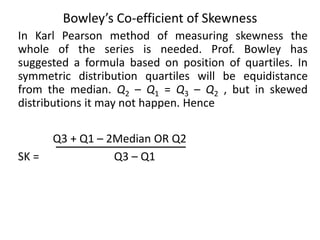
Bowley’s Co-efficient of Skewness
In Karl Pearson method of measuring skewness the
whole of the series is needed. Prof. Bowley has
suggested a formula based on position of quartiles. In
symmetric distribution quartiles will be equidistance
from the median. Q2 – Q1 = Q3 – Q2 , but in skewed
distributions it may not happen. Hence
Q3 + Q1 – 2Median OR Q2
SK = Q3 – Q1
CONTD
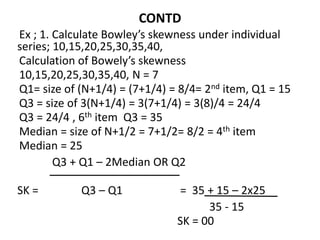
Ex ; 1. Calculate Bowley’s skewness under individual
series; 10,15,20,25,30,35,40,
Calculation of Bowely’s skewness
10,15,20,25,30,35,40, N = 7
Q1= size of (N+1/4) = (7+1/4) = 8/4= 2nd item, Q1 = 15
Q3 = size of 3(N+1/4) = 3(7+1/4) = 3(8)/4 = 24/4
Q3 = 24/4 , 6th item Q3 = 35
Median = size of N+1/2 = 7+1/2= 8/2 = 4th item
Median = 25
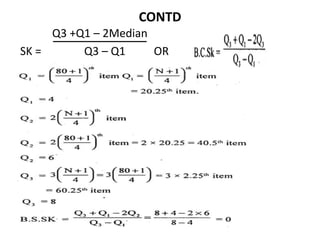
Q3 + Q1 – 2Median OR Q2
SK = Q3 – Q1 = 35 + 15 – 2x25
35 - 15
SK = 00
CONTD
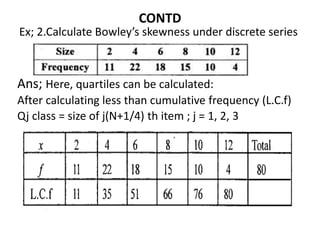
Ex; 2.Calculate Bowley’s skewness under discrete series
Ans; Here, quartiles can be calculated:
After calculating less than cumulative frequency (L.C.f)
Qj class = size of j(N+1/4) th item ; j = 1, 2, 3
CONTD
Q3 +Q1 – 2Median
SK = Q3 – Q1 OR
SUMMARY
As we already discussed and learnt today on skewness
as below
Bowely's Co-efficient of Skewness Under Individual and
Discrete Series Problems----------------02
MCQs
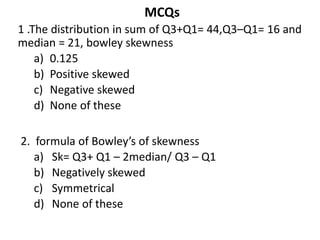
1 .The distribution in sum of Q3+Q1= 44,Q3–Q1= 16 and
median = 21, bowley skewness
a) 0.125
b) Positive skewed
c) Negative skewed
d) None of these
2. formula of Bowley’s of skewness
a) Sk= Q3+ Q1 – 2median/ Q3 – Q1
b) Negatively skewed
c) Symmetrical
d) None of these
MCQs
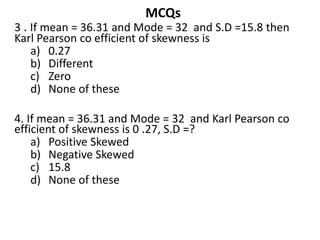
3 . If mean = 36.31 and Mode = 32 and S.D =15.8 then
Karl Pearson co efficient of skewness is
a) 0.27
b) Different
c) Zero
d) None of these
4. If mean = 36.31 and Mode = 32 and Karl Pearson co
efficient of skewness is 0 .27, S.D =?
a) Positive Skewed
b) Negative Skewed
c) 15.8
d) None of these
MCQs
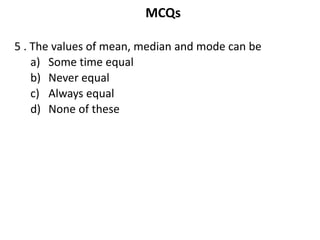
5 . The values of mean, median and mode can be
a) Some time equal
b) Never equal
c) Always equal
d) None of these
CONTD
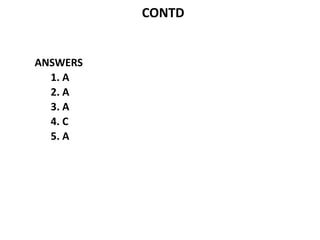
ANSWERS
1. A
2. A
3. A
4. C
5. A
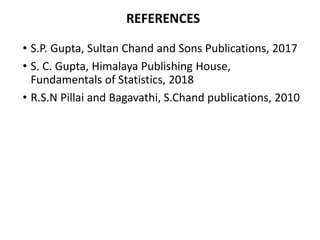
REFERENCES
• S.P. Gupta, Sultan Chand and Sons Publications, 2017
• S. C. Gupta, Himalaya Publishing House,
Fundamentals of Statistics, 2018
• R.S.N Pillai and Bagavathi, S.Chand publications, 2010
THANK YOU

Bowley skewness 1

  • 1.
    PROGRAMME B.COM SUBJECT QUANTITATIVE TECHNIQUE– I SEMESTER III UNIVERSITY VIJAYANAGAR SRI KRISHNADEVARAYA UNIVERSITY, BALLARI SESSION 54
  • 2.
    RECAP • Karl Pearson'sCo-efficient of Skewness Under Continuous Series Problems---------02
  • 3.
    LEARNING OBJECTIVES • Theaim of the chapter is to make students to understand Measures of Skewness, Karl Pearson Co-efficient of Skewness and Bowley's Co-efficient of skewness
  • 4.
    LEARNING OUTCOMES • Afterthis Unit The Students can be able to apply to Sample Population Data by Differentiating Normal and Abnormal Distributions with regard to Dispersion & Skewness.
  • 5.
    SESSION - 54 •Bowely's Co-efficient of Skewness Under Individual and Discrete Series Problems----------------02
  • 6.
    Bowley’s Co-efficient ofSkewness In Karl Pearson method of measuring skewness the whole of the series is needed. Prof. Bowley has suggested a formula based on position of quartiles. In symmetric distribution quartiles will be equidistance from the median. Q2 – Q1 = Q3 – Q2 , but in skewed distributions it may not happen. Hence Q3 + Q1 – 2Median OR Q2 SK = Q3 – Q1
  • 7.
    CONTD Ex ; 1.Calculate Bowley’s skewness under individual series; 10,15,20,25,30,35,40, Calculation of Bowely’s skewness 10,15,20,25,30,35,40, N = 7 Q1= size of (N+1/4) = (7+1/4) = 8/4= 2nd item, Q1 = 15 Q3 = size of 3(N+1/4) = 3(7+1/4) = 3(8)/4 = 24/4 Q3 = 24/4 , 6th item Q3 = 35 Median = size of N+1/2 = 7+1/2= 8/2 = 4th item Median = 25 Q3 + Q1 – 2Median OR Q2 SK = Q3 – Q1 = 35 + 15 – 2x25 35 - 15 SK = 00
  • 8.
    CONTD Ex; 2.Calculate Bowley’sskewness under discrete series Ans; Here, quartiles can be calculated: After calculating less than cumulative frequency (L.C.f) Qj class = size of j(N+1/4) th item ; j = 1, 2, 3
  • 9.
    CONTD Q3 +Q1 –2Median SK = Q3 – Q1 OR
  • 10.
    SUMMARY As we alreadydiscussed and learnt today on skewness as below Bowely's Co-efficient of Skewness Under Individual and Discrete Series Problems----------------02
  • 11.
    MCQs 1 .The distributionin sum of Q3+Q1= 44,Q3–Q1= 16 and median = 21, bowley skewness a) 0.125 b) Positive skewed c) Negative skewed d) None of these 2. formula of Bowley’s of skewness a) Sk= Q3+ Q1 – 2median/ Q3 – Q1 b) Negatively skewed c) Symmetrical d) None of these
  • 12.
    MCQs 3 . Ifmean = 36.31 and Mode = 32 and S.D =15.8 then Karl Pearson co efficient of skewness is a) 0.27 b) Different c) Zero d) None of these 4. If mean = 36.31 and Mode = 32 and Karl Pearson co efficient of skewness is 0 .27, S.D =? a) Positive Skewed b) Negative Skewed c) 15.8 d) None of these
  • 13.
    MCQs 5 . Thevalues of mean, median and mode can be a) Some time equal b) Never equal c) Always equal d) None of these
  • 14.
  • 15.
    REFERENCES • S.P. Gupta,Sultan Chand and Sons Publications, 2017 • S. C. Gupta, Himalaya Publishing House, Fundamentals of Statistics, 2018 • R.S.N Pillai and Bagavathi, S.Chand publications, 2010
  • 16.