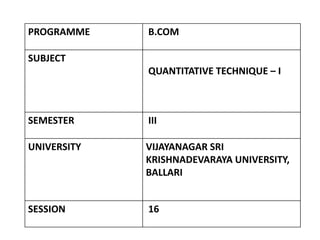
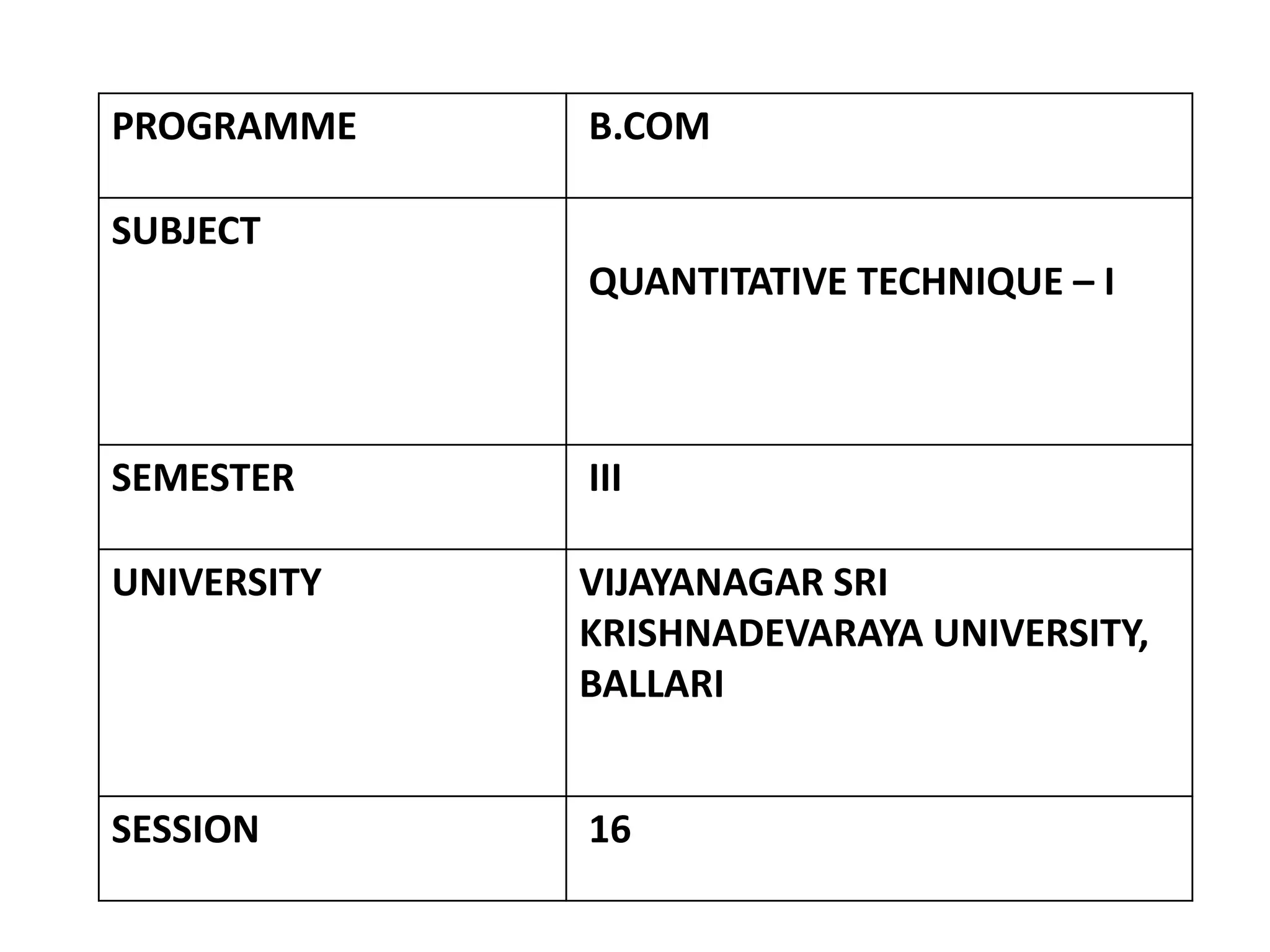
PROGRAMME B.COM
SUBJECT
QUANTITATIVE TECHNIQUE – I
SEMESTER III
UNIVERSITY VIJAYANAGAR SRI
KRISHNADEVARAYA UNIVERSITY,
BALLARI
SESSION 16
RECAP
• Tabulation of Data, Meaning, Objectives & Rules for
Tabulation
LEARNING OBJECTIVES
• The aim of the chapter is to make students to
present data in textual and Tabular format including
the technique of creating frequency distribution
and working out bi-variate distribution table
LEARNING OUTCOMES
• After the Chapter, The Students Shall be able to
Describe and Understand the Rules & Types of
Classification, Frequency Distribution, Class Interval
& its Types, Basic Principles Tabulation and The
Sorting of Data.
SESSION - 16
• Types of Tables, Preparation of Blank Table and
Problems - 01
Types of Tables
• Statistical tables can be classified under two general
categories, namely, general tables and summary
tables.
General tables contain a collection of detailed
information including all that is relevant to the
subject or theme.
Summary tables are designed to serve some
specific purposes. They are smaller in size than
general tables, emphasize on some aspect of data
and are generally incorporated within the text.
CONTD
• The statistical tables may further be classified into two
broad classes namely simple tables and complex
tables.
 A simple table summarizes information on a
single characteristic and is also called a univariate
table.
 A complex table summarizes the complicated
information and presents them into two or more
interrelated categories.
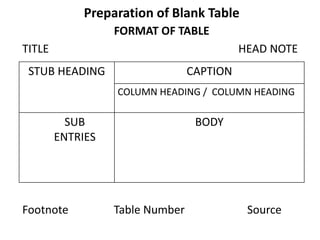
Preparation of Blank Table
FORMAT OF TABLE
TITLE HEAD NOTE
Footnote Table Number Source
STUB HEADING CAPTION
COLUMN HEADING / COLUMN HEADING
SUB
ENTRIES
BODY
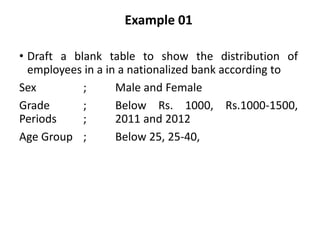
Example 01
• Draft a blank table to show the distribution of
employees in a in a nationalized bank according to
Sex ; Male and Female
Grade ; Below Rs. 1000, Rs.1000-1500,
Periods ; 2011 and 2012
Age Group ; Below 25, 25-40,
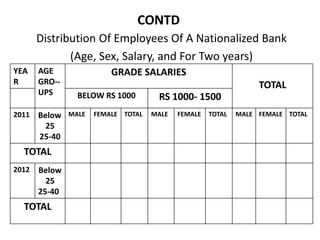
CONTD
Distribution Of Employees Of A Nationalized Bank
(Age, Sex, Salary, and For Two years)
YEA
R
AGE
GRO--
UPS
GRADE SALARIES
TOTAL
BELOW RS 1000 RS 1000- 1500
2011 Below
25
25-40
MALE FEMALE TOTAL MALE FEMALE TOTAL MALE FEMALE TOTAL
TOTAL
2012 Below
25
25-40
TOTAL
SUMMARY
As we already discussed and learnt today on
Classifications and Tabulation as below
• Types of Tables, Preparation of Blank Table and
Problems 01
MCQs
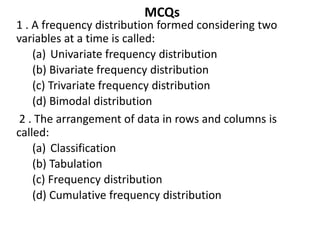
1 . A frequency distribution formed considering two
variables at a time is called:
(a) Univariate frequency distribution
(b) Bivariate frequency distribution
(c) Trivariate frequency distribution
(d) Bimodal distribution
2 . The arrangement of data in rows and columns is
called:
(a) Classification
(b) Tabulation
(c) Frequency distribution
(d) Cumulative frequency distribution
MCQs
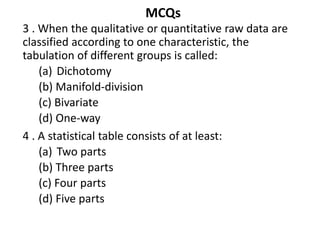
3 . When the qualitative or quantitative raw data are
classified according to one characteristic, the
tabulation of different groups is called:
(a) Dichotomy
(b) Manifold-division
(c) Bivariate
(d) One-way
4 . A statistical table consists of at least:
(a) Two parts
(b) Three parts
(c) Four parts
(d) Five parts
MCQs
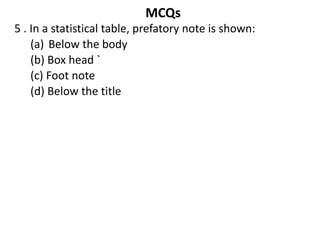
5 . In a statistical table, prefatory note is shown:
(a) Below the body
(b) Box head `
(c) Foot note
(d) Below the title
CONTD
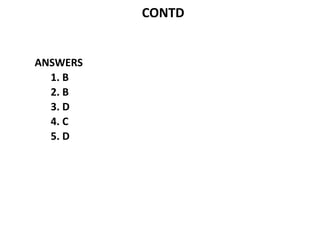
ANSWERS
1. B
2. B
3. D
4. C
5. D
REFERENCES
• S.P. Gupta, Sultan Chand and Sons Publications, 2017
• S. C. Gupta, Himalaya Publishing House,
Fundamentals of Statistics, 2018
• R.S.N Pillai and Bagavathi, S.Chand publications, 2010
THANK YOU

Tabulation 2

  • 1.
    PROGRAMME B.COM SUBJECT QUANTITATIVE TECHNIQUE– I SEMESTER III UNIVERSITY VIJAYANAGAR SRI KRISHNADEVARAYA UNIVERSITY, BALLARI SESSION 16
  • 2.
    RECAP • Tabulation ofData, Meaning, Objectives & Rules for Tabulation
  • 3.
    LEARNING OBJECTIVES • Theaim of the chapter is to make students to present data in textual and Tabular format including the technique of creating frequency distribution and working out bi-variate distribution table
  • 4.
    LEARNING OUTCOMES • Afterthe Chapter, The Students Shall be able to Describe and Understand the Rules & Types of Classification, Frequency Distribution, Class Interval & its Types, Basic Principles Tabulation and The Sorting of Data.
  • 5.
    SESSION - 16 •Types of Tables, Preparation of Blank Table and Problems - 01
  • 6.
    Types of Tables •Statistical tables can be classified under two general categories, namely, general tables and summary tables. General tables contain a collection of detailed information including all that is relevant to the subject or theme. Summary tables are designed to serve some specific purposes. They are smaller in size than general tables, emphasize on some aspect of data and are generally incorporated within the text.
  • 7.
    CONTD • The statisticaltables may further be classified into two broad classes namely simple tables and complex tables.  A simple table summarizes information on a single characteristic and is also called a univariate table.  A complex table summarizes the complicated information and presents them into two or more interrelated categories.
  • 8.
    Preparation of BlankTable FORMAT OF TABLE TITLE HEAD NOTE Footnote Table Number Source STUB HEADING CAPTION COLUMN HEADING / COLUMN HEADING SUB ENTRIES BODY
  • 9.
    Example 01 • Drafta blank table to show the distribution of employees in a in a nationalized bank according to Sex ; Male and Female Grade ; Below Rs. 1000, Rs.1000-1500, Periods ; 2011 and 2012 Age Group ; Below 25, 25-40,
  • 10.
    CONTD Distribution Of EmployeesOf A Nationalized Bank (Age, Sex, Salary, and For Two years) YEA R AGE GRO-- UPS GRADE SALARIES TOTAL BELOW RS 1000 RS 1000- 1500 2011 Below 25 25-40 MALE FEMALE TOTAL MALE FEMALE TOTAL MALE FEMALE TOTAL TOTAL 2012 Below 25 25-40 TOTAL
  • 11.
    SUMMARY As we alreadydiscussed and learnt today on Classifications and Tabulation as below • Types of Tables, Preparation of Blank Table and Problems 01
  • 12.
    MCQs 1 . Afrequency distribution formed considering two variables at a time is called: (a) Univariate frequency distribution (b) Bivariate frequency distribution (c) Trivariate frequency distribution (d) Bimodal distribution 2 . The arrangement of data in rows and columns is called: (a) Classification (b) Tabulation (c) Frequency distribution (d) Cumulative frequency distribution
  • 13.
    MCQs 3 . Whenthe qualitative or quantitative raw data are classified according to one characteristic, the tabulation of different groups is called: (a) Dichotomy (b) Manifold-division (c) Bivariate (d) One-way 4 . A statistical table consists of at least: (a) Two parts (b) Three parts (c) Four parts (d) Five parts
  • 14.
    MCQs 5 . Ina statistical table, prefatory note is shown: (a) Below the body (b) Box head ` (c) Foot note (d) Below the title
  • 15.
  • 16.
    REFERENCES • S.P. Gupta,Sultan Chand and Sons Publications, 2017 • S. C. Gupta, Himalaya Publishing House, Fundamentals of Statistics, 2018 • R.S.N Pillai and Bagavathi, S.Chand publications, 2010
  • 17.