MORPHOLOGY
Chapter 6
MORPHOLOGY
 In biology: the study of the form and
structure of animals and plants
 In linguistics: the study and description of
how words are formed in a language
MORPHEMES
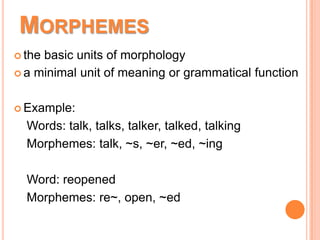
 the basic units of morphology
 a minimal unit of meaning or grammatical function
 Example:
Words: talk, talks, talker, talked, talking
Morphemes: talk, ~s, ~er, ~ed, ~ing
Word: reopened
Morphemes: re~, open, ~ed
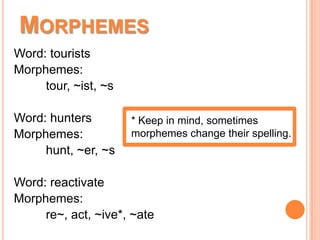
Word: tourists
Morphemes:
tour, ~ist, ~s
Word: hunters
Morphemes:
hunt, ~er, ~s
Word: reactivate
Morphemes:
re~, act, ~ive*, ~ate
MORPHEMES
* Keep in mind, sometimes
morphemes change their spelling.
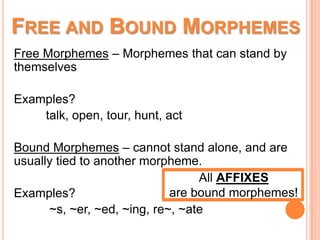
Free Morphemes – Morphemes that can stand by
themselves
Examples?
talk, open, tour, hunt, act
Bound Morphemes – cannot stand alone, and are
usually tied to another morpheme.
Examples?
~s, ~er, ~ed, ~ing, re~, ~ate
FREE AND BOUND MORPHEMES
All AFFIXES
are bound morphemes!
FREE AND BOUND MORPHEMES
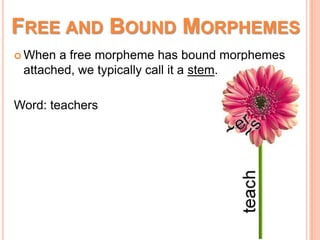
 When a free morpheme has bound morphemes
attached, we typically call it a stem.
Word: teachers
FREE AND BOUND MORPHEMES
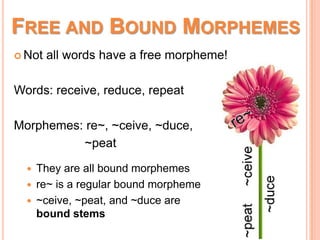
 Not all words have a free morpheme!
Words: receive, reduce, repeat
Morphemes: re~, ~ceive, ~duce,
~peat
 They are all bound morphemes
 re~ is a regular bound morpheme
 ~ceive, ~peat, and ~duce are
bound stems
MORPHEMES
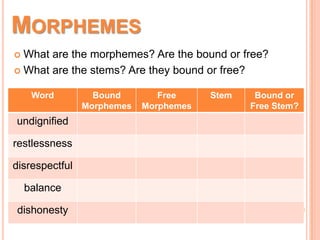
 What are the morphemes? Are the bound or free?
 What are the stems? Are they bound or free?
Word Bound
Morphemes
Free
Morphemes
Stem Bound or
Free Stem?
undignified
restlessness
disrespectful
balance
dishonesty
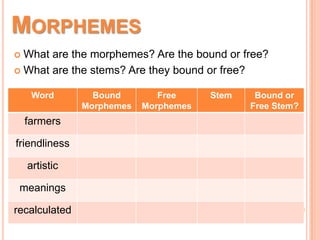
MORPHEMES
 What are the morphemes? Are the bound or free?
 What are the stems? Are they bound or free?
Word Bound
Morphemes
Free
Morphemes
Stem Bound or
Free Stem?
farmers
friendliness
artistic
meanings
recalculated
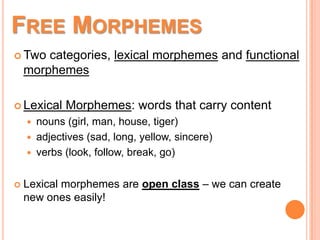
FREE MORPHEMES
 Two categories, lexical morphemes and functional
morphemes
 Lexical Morphemes: words that carry content
 nouns (girl, man, house, tiger)
 adjectives (sad, long, yellow, sincere)
 verbs (look, follow, break, go)
 Lexical morphemes are open class – we can create
new ones easily!
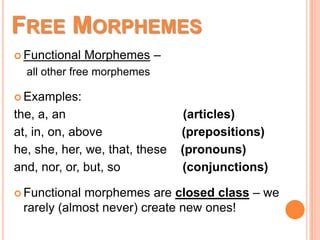
FREE MORPHEMES
 Functional Morphemes –
all other free morphemes
 Examples:
the, a, an (articles)
at, in, on, above (prepositions)
he, she, her, we, that, these (pronouns)
and, nor, or, but, so (conjunctions)
 Functional morphemes are closed class – we
rarely (almost never) create new ones!
BOUND MORPHEMES
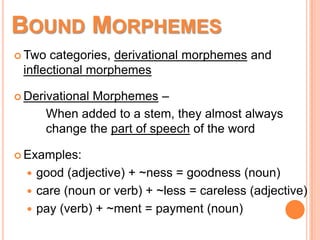
 Two categories, derivational morphemes and
inflectional morphemes
 Derivational Morphemes –
When added to a stem, they almost always
change the part of speech of the word
 Examples:
 good (adjective) + ~ness = goodness (noun)
 care (noun or verb) + ~less = careless (adjective)
 pay (verb) + ~ment = payment (noun)
BOUND MORPHEMES
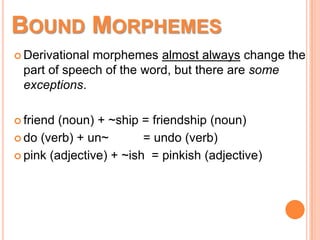
 Derivational morphemes almost always change the
part of speech of the word, but there are some
exceptions.
 friend (noun) + ~ship = friendship (noun)
 do (verb) + un~ = undo (verb)
 pink (adjective) + ~ish = pinkish (adjective)
BOUND MORPHEMES
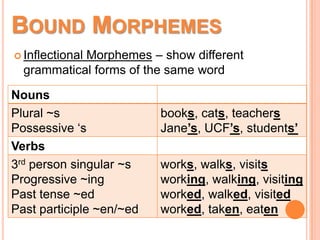
 Inflectional Morphemes – show different
grammatical forms of the same word
Nouns
Plural ~s
Possessive ‘s
books, cats, teachers
Jane’s, UCF’s, students’
Verbs
3rd person singular ~s
Progressive ~ing
Past tense ~ed
Past participle ~en/~ed
works, walks, visits
working, walking, visiting
worked, walked, visited
worked, taken, eaten
BOUND MORPHEMES
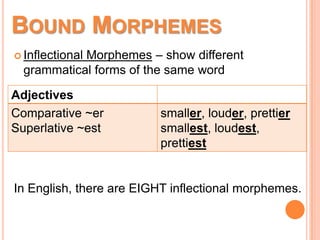
 Inflectional Morphemes – show different
grammatical forms of the same word
Adjectives
Comparative ~er
Superlative ~est
smaller, louder, prettier
smallest, loudest,
prettiest
In English, there are EIGHT inflectional morphemes.
BOUND MORPHEMES
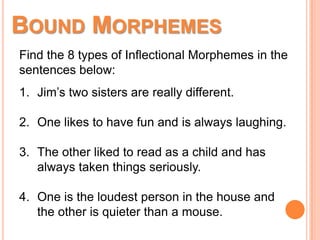
Find the 8 types of Inflectional Morphemes in the
sentences below:
1. Jim’s two sisters are really different.
2. One likes to have fun and is always laughing.
3. The other liked to read as a child and has
always taken things seriously.
4. One is the loudest person in the house and
the other is quieter than a mouse.

Chapter 6: Morphology

  • 1.
  • 2.
    MORPHOLOGY  In biology:the study of the form and structure of animals and plants  In linguistics: the study and description of how words are formed in a language
  • 3.
    MORPHEMES  the basicunits of morphology  a minimal unit of meaning or grammatical function  Example: Words: talk, talks, talker, talked, talking Morphemes: talk, ~s, ~er, ~ed, ~ing Word: reopened Morphemes: re~, open, ~ed
  • 4.
    Word: tourists Morphemes: tour, ~ist,~s Word: hunters Morphemes: hunt, ~er, ~s Word: reactivate Morphemes: re~, act, ~ive*, ~ate MORPHEMES * Keep in mind, sometimes morphemes change their spelling.
  • 5.
    Free Morphemes –Morphemes that can stand by themselves Examples? talk, open, tour, hunt, act Bound Morphemes – cannot stand alone, and are usually tied to another morpheme. Examples? ~s, ~er, ~ed, ~ing, re~, ~ate FREE AND BOUND MORPHEMES All AFFIXES are bound morphemes!
  • 6.
    FREE AND BOUNDMORPHEMES  When a free morpheme has bound morphemes attached, we typically call it a stem. Word: teachers
  • 7.
    FREE AND BOUNDMORPHEMES  Not all words have a free morpheme! Words: receive, reduce, repeat Morphemes: re~, ~ceive, ~duce, ~peat  They are all bound morphemes  re~ is a regular bound morpheme  ~ceive, ~peat, and ~duce are bound stems
  • 8.
    MORPHEMES  What arethe morphemes? Are the bound or free?  What are the stems? Are they bound or free? Word Bound Morphemes Free Morphemes Stem Bound or Free Stem? undignified restlessness disrespectful balance dishonesty
  • 9.
    MORPHEMES  What arethe morphemes? Are the bound or free?  What are the stems? Are they bound or free? Word Bound Morphemes Free Morphemes Stem Bound or Free Stem? farmers friendliness artistic meanings recalculated
  • 10.
    FREE MORPHEMES  Twocategories, lexical morphemes and functional morphemes  Lexical Morphemes: words that carry content  nouns (girl, man, house, tiger)  adjectives (sad, long, yellow, sincere)  verbs (look, follow, break, go)  Lexical morphemes are open class – we can create new ones easily!
  • 11.
    FREE MORPHEMES  FunctionalMorphemes – all other free morphemes  Examples: the, a, an (articles) at, in, on, above (prepositions) he, she, her, we, that, these (pronouns) and, nor, or, but, so (conjunctions)  Functional morphemes are closed class – we rarely (almost never) create new ones!
  • 12.
    BOUND MORPHEMES  Twocategories, derivational morphemes and inflectional morphemes  Derivational Morphemes – When added to a stem, they almost always change the part of speech of the word  Examples:  good (adjective) + ~ness = goodness (noun)  care (noun or verb) + ~less = careless (adjective)  pay (verb) + ~ment = payment (noun)
  • 13.
    BOUND MORPHEMES  Derivationalmorphemes almost always change the part of speech of the word, but there are some exceptions.  friend (noun) + ~ship = friendship (noun)  do (verb) + un~ = undo (verb)  pink (adjective) + ~ish = pinkish (adjective)
  • 14.
    BOUND MORPHEMES  InflectionalMorphemes – show different grammatical forms of the same word Nouns Plural ~s Possessive ‘s books, cats, teachers Jane’s, UCF’s, students’ Verbs 3rd person singular ~s Progressive ~ing Past tense ~ed Past participle ~en/~ed works, walks, visits working, walking, visiting worked, walked, visited worked, taken, eaten
  • 15.
    BOUND MORPHEMES  InflectionalMorphemes – show different grammatical forms of the same word Adjectives Comparative ~er Superlative ~est smaller, louder, prettier smallest, loudest, prettiest In English, there are EIGHT inflectional morphemes.
  • 16.
    BOUND MORPHEMES Find the8 types of Inflectional Morphemes in the sentences below: 1. Jim’s two sisters are really different. 2. One likes to have fun and is always laughing. 3. The other liked to read as a child and has always taken things seriously. 4. One is the loudest person in the house and the other is quieter than a mouse.