MORPHOLOGY
What is MORPHOLOGY?
Morphology is the branch of linguistics
that studies the structure of words.
Study of internal structure of words.
MORPHEME- smallest linguistic unit which
has a meaning or grammatical function.
ALLOMORPHS- morphemes having the
same function but different in form.
Example:
SINCERE/SINCERITY ,
SEVERE/SEVERITY,
CONFUSE/CONFUSION
CLASSIFICATION OF MORPHOLOGY
•Root- nucleus of the word that affixes attach to.
shout-ed, act-ion, care-ful, love-ly
•Affix- a bound morpheme which added to the root words.
Suffix- talk-ing, quick-ly, hope-ful, sad-ly, perform-ance
Prefix- un-happy, pre-existing, de-code, il-legal,mis-
place
Infix- s placed within a word; these are rare in English,
though cupful can be made plural as cupsful by inserting
the plural s as an infix.
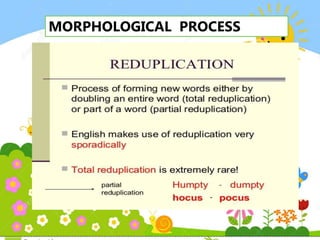
MORPHOLOGICAL PROCESS
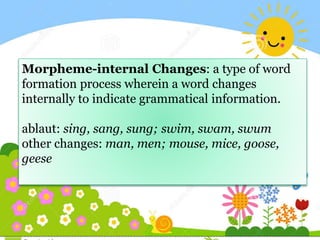
Morpheme-internal Changes: a type of word
formation process wherein a word changes
internally to indicate grammatical information.
ablaut: sing, sang, sung; swim, swam, swum
other changes: man, men; mouse, mice, goose,
geese
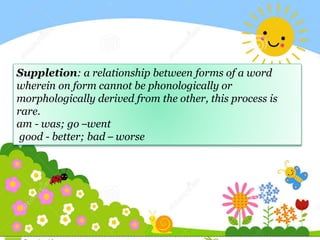
Suppletion: a relationship between forms of a word
wherein on form cannot be phonologically or
morphologically derived from the other, this process is
rare.
am - was; go –went
good - better; bad – worse
Kinds of Words according to
Morpheme Structure
2. Complex words
- root word + at least 1 affix.
-example:
worker, reread, retelling
Kinds of Words according to
Morpheme Structure
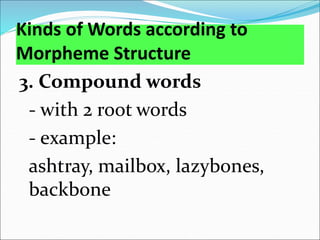
3. Compound words
- with 2 root words
- example:
ashtray, mailbox, lazybones,
backbone
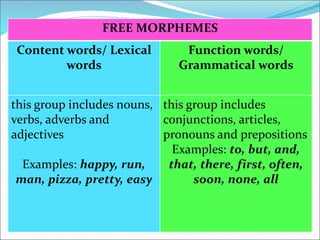
FREE MORPHEMES
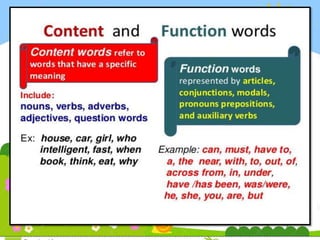
Content words/ Lexical
words
Function words/
Grammatical words
this group includes nouns,
verbs, adverbs and
adjectives
Examples: happy, run,
man, pizza, pretty, easy
this group includes
conjunctions, articles,
pronouns and prepositions
Examples: to, but, and,
that, there, first, often,
soon, none, all
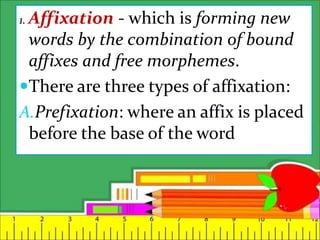
1. Affixation - which is forming new
words by the combination of bound
affixes and free morphemes.
There are three types of affixation:
A.Prefixation: where an affix is placed
before the base of the word
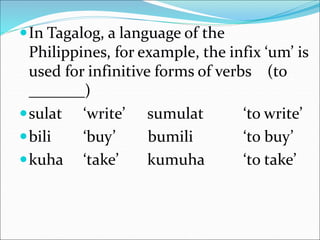
In Tagalog, a language of the
Philippines, for example, the infix ‘um’ is
used for infinitive forms of verbs (to
_______)
sulat ‘write’ sumulat ‘to write’
bili ‘buy’ bumili ‘to buy’
kuha ‘take’ kumuha ‘to take’
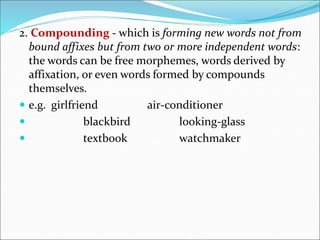
2. Compounding - which is forming new words not from
bound affixes but from two or more independent words:
the words can be free morphemes, words derived by
affixation, or even words formed by compounds
themselves.
 e.g. girlfriend air-conditioner
 blackbird looking-glass
 textbook watchmaker
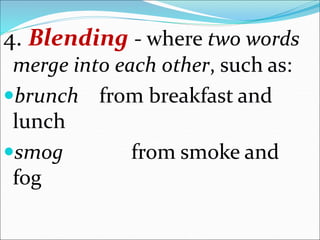
4. Blending - where two words
merge into each other, such as:
brunch from breakfast and
lunch
smog from smoke and
fog
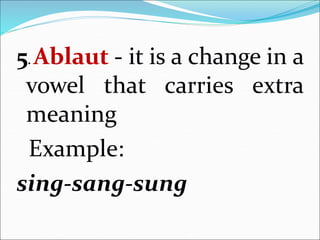
5. Ablaut - it is a change in a
vowel that carries extra
meaning
Example:
sing-sang-sung
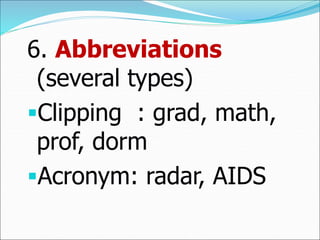
6. Abbreviations
(several types)
Clipping : grad, math,
prof, dorm
Acronym: radar, AIDS
The End!

morphology morphological presentation byh

  • 2.
  • 3.
    What is MORPHOLOGY? Morphologyis the branch of linguistics that studies the structure of words. Study of internal structure of words.
  • 4.
    MORPHEME- smallest linguisticunit which has a meaning or grammatical function. ALLOMORPHS- morphemes having the same function but different in form. Example: SINCERE/SINCERITY , SEVERE/SEVERITY, CONFUSE/CONFUSION
  • 5.
    CLASSIFICATION OF MORPHOLOGY •Root-nucleus of the word that affixes attach to. shout-ed, act-ion, care-ful, love-ly •Affix- a bound morpheme which added to the root words. Suffix- talk-ing, quick-ly, hope-ful, sad-ly, perform-ance Prefix- un-happy, pre-existing, de-code, il-legal,mis- place Infix- s placed within a word; these are rare in English, though cupful can be made plural as cupsful by inserting the plural s as an infix.
  • 7.
  • 8.
    Morpheme-internal Changes: atype of word formation process wherein a word changes internally to indicate grammatical information. ablaut: sing, sang, sung; swim, swam, swum other changes: man, men; mouse, mice, goose, geese
  • 9.
    Suppletion: a relationshipbetween forms of a word wherein on form cannot be phonologically or morphologically derived from the other, this process is rare. am - was; go –went good - better; bad – worse
  • 10.
    Kinds of Wordsaccording to Morpheme Structure 2. Complex words - root word + at least 1 affix. -example: worker, reread, retelling
  • 11.
    Kinds of Wordsaccording to Morpheme Structure 3. Compound words - with 2 root words - example: ashtray, mailbox, lazybones, backbone
  • 12.
    FREE MORPHEMES Content words/Lexical words Function words/ Grammatical words this group includes nouns, verbs, adverbs and adjectives Examples: happy, run, man, pizza, pretty, easy this group includes conjunctions, articles, pronouns and prepositions Examples: to, but, and, that, there, first, often, soon, none, all
  • 13.
    1. Affixation -which is forming new words by the combination of bound affixes and free morphemes. There are three types of affixation: A.Prefixation: where an affix is placed before the base of the word
  • 14.
    In Tagalog, alanguage of the Philippines, for example, the infix ‘um’ is used for infinitive forms of verbs (to _______) sulat ‘write’ sumulat ‘to write’ bili ‘buy’ bumili ‘to buy’ kuha ‘take’ kumuha ‘to take’
  • 15.
    2. Compounding -which is forming new words not from bound affixes but from two or more independent words: the words can be free morphemes, words derived by affixation, or even words formed by compounds themselves.  e.g. girlfriend air-conditioner  blackbird looking-glass  textbook watchmaker
  • 16.
    4. Blending -where two words merge into each other, such as: brunch from breakfast and lunch smog from smoke and fog
  • 17.
    5. Ablaut -it is a change in a vowel that carries extra meaning Example: sing-sang-sung
  • 18.
    6. Abbreviations (several types) Clipping: grad, math, prof, dorm Acronym: radar, AIDS
  • 20.