
* 
Chapter 2 
Boolean Algebra
* 
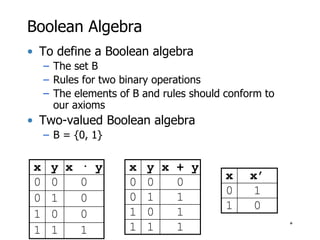
Boolean Algebra 
• To define a Boolean algebra 
– The set B 
– Rules for two binary operations 
– The elements of B and rules should conform to 
our axioms 
• Two-valued Boolean algebra 
– B = {0, 1} 
x y x · y 
0 0 0 
0 1 0 
1 0 0 
1 1 1 
x y x + y 
0 0 0 
0 1 1 
1 0 1 
1 1 1 
x x’ 
0 1 
1 0
* 
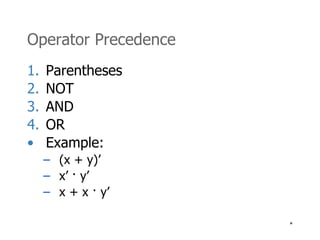
Operator Precedence 
1. Parentheses 
2. NOT 
3. AND 
4. OR 
• Example: 
– (x + y)’ 
– x’ · y’ 
– x + x · y’
* 
Boolean Functions 
• Consists of 
– binary variables (normal or complement form) 
– the constants, 0 and 1 
– logic operation symbols, “+” and “·” 
• Example: 
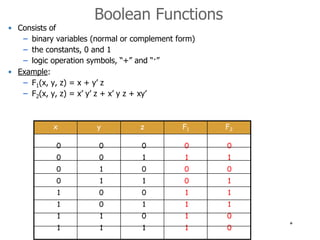
– F1(x, y, z) = x + y’ z 
– F2(x, y, z) = x’ y’ z + x’ y z + xy’ 
x y z F1 F2 
0 0 0 0 0 
1 
0 
0 
1 
1 
1 
1 
1 
0 
1 
1 
1 
0 
0 
0 0 1 
0 1 0 
0 1 1 
1 0 0 
1 0 1 
1 1 0 
1 1 1
* 
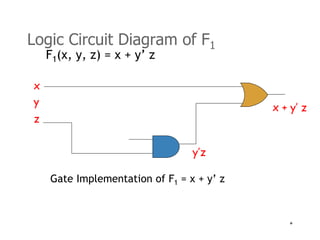
Logic Circuit Diagram of F1 
F1(x, y, z) = x + y’ z 
x 
y 
z 
y’z 
x + y’ z 
Gate Implementation of F1 = x + y’ z
* 
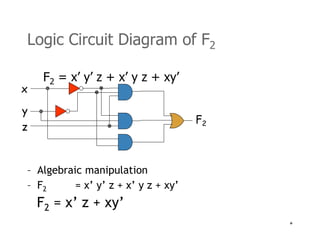
Logic Circuit Diagram of F2 
F2 = x’ y’ z + x’ y z + xy’ 
x 
y 
z 
– Algebraic manipulation 
– F2 = x’ y’ z + x’ y z + xy’ 
F2 = x’ z + xy’ 
F2
* 
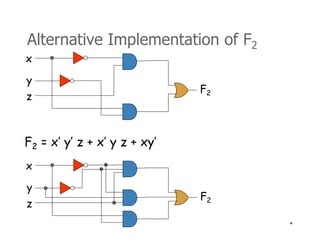
Alternative Implementation of F2 
x 
y 
F2 
z 
F2 = x’ y’ z + x’ y z + xy’ 
F2 
x 
y 
z
* 
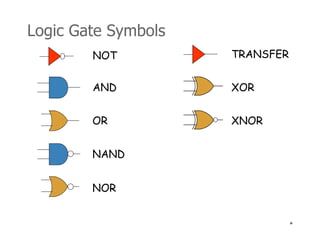
Logic Gate Symbols 
NOT 
AND 
OR 
NAND 
NOR 
TRANSFER 
XOR 
XNOR
* 
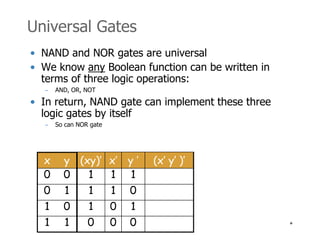
Universal Gates 
• NAND and NOR gates are universal 
• We know any Boolean function can be written in 
terms of three logic operations: 
– AND, OR, NOT 
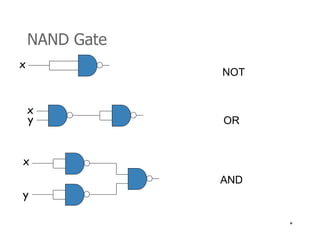
• In return, NAND gate can implement these three 
logic gates by itself 
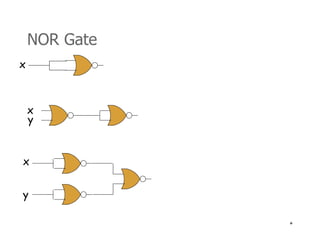
– So can NOR gate 
x y (xy)’ x’ y ’ (x’ y’ )’ 
1 1 
1 0 
0 1 
0 0 
1 
1 
1 
0 
0 0 
0 1 
1 0 
1 1
* 
NAND Gate 
x 
xy 
x 
y 
NOT 
OR 
AND
* 
NOR Gate 
x 
xy 
x 
y
* 
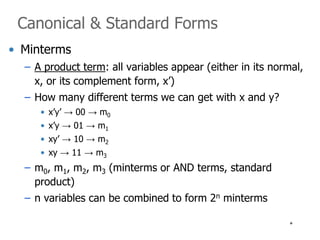
Canonical & Standard Forms 
• Minterms 
– A product term: all variables appear (either in its normal, 
x, or its complement form, x’) 
– How many different terms we can get with x and y? 
• x’y’ → 00 → m0 
• x’y → 01 → m1 
• xy’ → 10 → m2 
• xy → 11 → m3 
– m0, m1, m2, m3 (minterms or AND terms, standard 
product) 
– n variables can be combined to form 2n minterms
Canonical & Standard Forms 
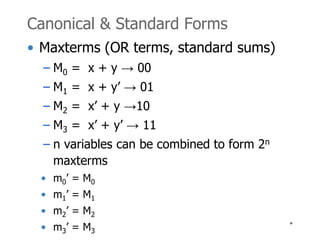
• Maxterms (OR terms, standard sums) 
– M0 = x + y → 00 
– M1 = x + y’ → 01 
– M2 = x’ + y →10 
– M3 = x’ + y’ → 11 
– n variables can be combined to form 2n 
maxterms 
• m0’ = M0 
• m1’ = M1 
• m2’ = M2 
• m3’ = M3 
*
* 
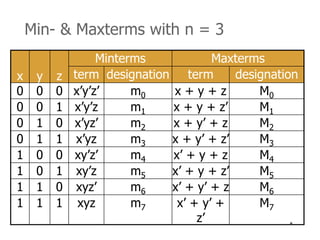
Min- & Maxterms with n = 3 
x y z 
Minterms Maxterms 
term designation term designation 
0 0 0 x’y’z’ m0 x + y + z M0 
0 0 1 x’y’z m1 x + y + z’ M1 
0 1 0 x’yz’ m2 x + y’ + z M2 
0 1 1 x’yz m3 x + y’ + z’ M3 
1 0 0 xy’z’ m4 x’ + y + z M4 
1 0 1 xy’z m5 x’ + y + z’ M5 
1 1 0 xyz’ m6 x’ + y’ + z M6 
1 1 1 xyz m7 x’ + y’ + 
z’ 
M7
* 
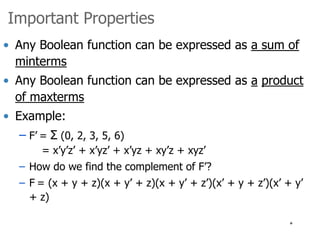
Important Properties 
• Any Boolean function can be expressed as a sum of 
minterms 
• Any Boolean function can be expressed as a product 
of maxterms 
• Example: 
– F’ = Σ (0, 2, 3, 5, 6) 
= x’y’z’ + x’yz’ + x’yz + xy’z + xyz’ 
– How do we find the complement of F’? 
– F = (x + y + z)(x + y’ + z)(x + y’ + z’)(x’ + y + z’)(x’ + y’ 
+ z)
* 
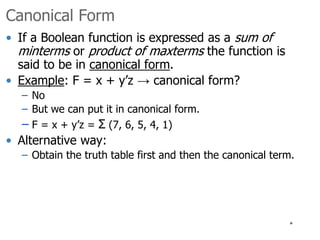
Canonical Form 
• If a Boolean function is expressed as a sum of 
minterms or product of maxterms the function is 
said to be in canonical form. 
• Example: F = x + y’z → canonical form? 
– No 
– But we can put it in canonical form. 
– F = x + y’z = Σ (7, 6, 5, 4, 1) 
• Alternative way: 
– Obtain the truth table first and then the canonical term.
* 
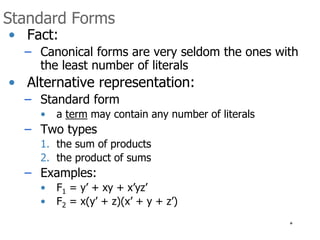
Standard Forms 
• Fact: 
– Canonical forms are very seldom the ones with 
the least number of literals 
• Alternative representation: 
– Standard form 
• a term may contain any number of literals 
– Two types 
1. the sum of products 
2. the product of sums 
– Examples: 
• F1 = y’ + xy + x’yz’ 
• F2 = x(y’ + z)(x’ + y + z’)
* 
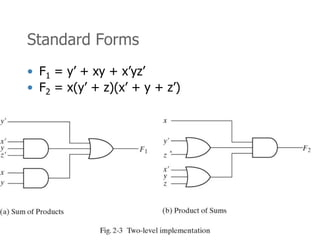
Standard Forms 
• F1 = y’ + xy + x’yz’ 
• F2 = x(y’ + z)(x’ + y + z’) 
‘
* 
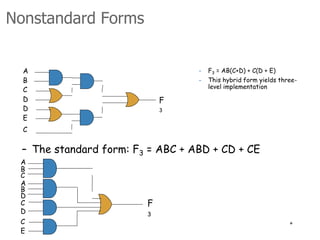
Nonstandard Forms 
A 
B 
C 
D 
F 
3 
D 
E 
C 
– The standard form: F3 = ABC + ABD + CD + CE 
ABC 
F 
3 
AB 
D 
C 
D 
C 
E 
– F3 = AB(C+D) + C(D + E) 
– This hybrid form yields three-level 
implementation
By : 
Debarati Das 
1PI13CS052 
PES University

Boolean algebra

  • 1.
    * Chapter 2 Boolean Algebra
  • 2.
    * Boolean Algebra • To define a Boolean algebra – The set B – Rules for two binary operations – The elements of B and rules should conform to our axioms • Two-valued Boolean algebra – B = {0, 1} x y x · y 0 0 0 0 1 0 1 0 0 1 1 1 x y x + y 0 0 0 0 1 1 1 0 1 1 1 1 x x’ 0 1 1 0
  • 3.
    * Operator Precedence 1. Parentheses 2. NOT 3. AND 4. OR • Example: – (x + y)’ – x’ · y’ – x + x · y’
  • 4.
    * Boolean Functions • Consists of – binary variables (normal or complement form) – the constants, 0 and 1 – logic operation symbols, “+” and “·” • Example: – F1(x, y, z) = x + y’ z – F2(x, y, z) = x’ y’ z + x’ y z + xy’ x y z F1 F2 0 0 0 0 0 1 0 0 1 1 1 1 1 0 1 1 1 0 0 0 0 1 0 1 0 0 1 1 1 0 0 1 0 1 1 1 0 1 1 1
  • 5.
    * Logic CircuitDiagram of F1 F1(x, y, z) = x + y’ z x y z y’z x + y’ z Gate Implementation of F1 = x + y’ z
  • 6.
    * Logic CircuitDiagram of F2 F2 = x’ y’ z + x’ y z + xy’ x y z – Algebraic manipulation – F2 = x’ y’ z + x’ y z + xy’ F2 = x’ z + xy’ F2
  • 7.
    * Alternative Implementationof F2 x y F2 z F2 = x’ y’ z + x’ y z + xy’ F2 x y z
  • 8.
    * Logic GateSymbols NOT AND OR NAND NOR TRANSFER XOR XNOR
  • 9.
    * Universal Gates • NAND and NOR gates are universal • We know any Boolean function can be written in terms of three logic operations: – AND, OR, NOT • In return, NAND gate can implement these three logic gates by itself – So can NOR gate x y (xy)’ x’ y ’ (x’ y’ )’ 1 1 1 0 0 1 0 0 1 1 1 0 0 0 0 1 1 0 1 1
  • 10.
    * NAND Gate x xy x y NOT OR AND
  • 11.
    * NOR Gate x xy x y
  • 12.
    * Canonical &Standard Forms • Minterms – A product term: all variables appear (either in its normal, x, or its complement form, x’) – How many different terms we can get with x and y? • x’y’ → 00 → m0 • x’y → 01 → m1 • xy’ → 10 → m2 • xy → 11 → m3 – m0, m1, m2, m3 (minterms or AND terms, standard product) – n variables can be combined to form 2n minterms
  • 13.
    Canonical & StandardForms • Maxterms (OR terms, standard sums) – M0 = x + y → 00 – M1 = x + y’ → 01 – M2 = x’ + y →10 – M3 = x’ + y’ → 11 – n variables can be combined to form 2n maxterms • m0’ = M0 • m1’ = M1 • m2’ = M2 • m3’ = M3 *
  • 14.
    * Min- &Maxterms with n = 3 x y z Minterms Maxterms term designation term designation 0 0 0 x’y’z’ m0 x + y + z M0 0 0 1 x’y’z m1 x + y + z’ M1 0 1 0 x’yz’ m2 x + y’ + z M2 0 1 1 x’yz m3 x + y’ + z’ M3 1 0 0 xy’z’ m4 x’ + y + z M4 1 0 1 xy’z m5 x’ + y + z’ M5 1 1 0 xyz’ m6 x’ + y’ + z M6 1 1 1 xyz m7 x’ + y’ + z’ M7
  • 15.
    * Important Properties • Any Boolean function can be expressed as a sum of minterms • Any Boolean function can be expressed as a product of maxterms • Example: – F’ = Σ (0, 2, 3, 5, 6) = x’y’z’ + x’yz’ + x’yz + xy’z + xyz’ – How do we find the complement of F’? – F = (x + y + z)(x + y’ + z)(x + y’ + z’)(x’ + y + z’)(x’ + y’ + z)
  • 16.
    * Canonical Form • If a Boolean function is expressed as a sum of minterms or product of maxterms the function is said to be in canonical form. • Example: F = x + y’z → canonical form? – No – But we can put it in canonical form. – F = x + y’z = Σ (7, 6, 5, 4, 1) • Alternative way: – Obtain the truth table first and then the canonical term.
  • 17.
    * Standard Forms • Fact: – Canonical forms are very seldom the ones with the least number of literals • Alternative representation: – Standard form • a term may contain any number of literals – Two types 1. the sum of products 2. the product of sums – Examples: • F1 = y’ + xy + x’yz’ • F2 = x(y’ + z)(x’ + y + z’)
  • 18.
    * Standard Forms • F1 = y’ + xy + x’yz’ • F2 = x(y’ + z)(x’ + y + z’) ‘
  • 19.
    * Nonstandard Forms A B C D F 3 D E C – The standard form: F3 = ABC + ABD + CD + CE ABC F 3 AB D C D C E – F3 = AB(C+D) + C(D + E) – This hybrid form yields three-level implementation
  • 20.
    By : DebaratiDas 1PI13CS052 PES University