Chapter 2:
Boolean Algebra and Logic Gates
F1= XY’ + X’Z
X Y Z X’ Y’ XY’ X’Z F1
0 0 0 1 1 0 0 0
0 0 1 1 1 0 1 1
0 1 0 1 0 0 0 0
0 1 1 1 0 0 1 1
1 0 0 0 1 1 0 1
1 0 1 0 1 1 0 1
1 1 0 0 0 0 0 0
1 1 1 0 0 0 0 0
F1
F2= X’Y’Z + X’YZ + XY’
X Y Z X’ Y’ X’Y’Z X’YZ XY’ F2
0 0 0 1 1 0 0 0 0
0 0 1 1 1 1 0 0 1
0 1 0 1 0 0 0 0 0
0 1 1 1 0 0 1 0 1
1 0 0 0 1 0 0 1 1
1 0 1 0 1 0 0 1 1
1 1 0 0 0 0 0 0 0
1 1 1 0 0 0 0 0 0
X Y Z F1 F2
0 0 0 0 0
0 0 1 1 1
0 1 0 0 0
0 1 1 1 1
1 0 0 1 1
1 0 1 1 1
1 1 0 0 0
1 1 1 0 0
F
1
F2= X’Y’Z + X’YZ + XY’
F1= XY’ + X’Z
F(x, y, z) = xy + x’z + yz
= xy + x’z + yz.1
By Postulate 5(a)
By Postulate 4(a)
By Theorem 2
CANONICAL FORMS
• How to express a boolean function algebraically from
a given truth table?
X Y Z F
0 0 0 0
0 0 1 1
0 1 0 0
0 1 1 1
1 0 0 1
1 0 1 1
1 1 0 0
1 1 1 0
F(x,y,z)=?
Summation of Minterms
• F(x,y,z)=?
X Y Z Term Designation F
0 0 0 X’Y’Z’ m0 0
0 0 1 X’Y’Z m1 1
0 1 0 X’YZ’ m2 0
0 1 1 X’YZ m3 1
1 0 0 XY’Z’ m4 1
1 0 1 XY’Z m5 1
1 1 0 XYZ’ m6 0
1 1 1 XYZ m7 0
Summation of Minterms
• F(x,y,z)= m1+ m3 + m4 + m5 = X’Y’Z+X’YZ+XY’Z’+XY’Z
=∑(1, 3, 4, 5)
X Y Z Term Designation F
0 0 0 X’Y’Z’ m0 0
0 0 1 X’Y’Z m1 1
0 1 0 X’YZ’ m2 0
0 1 1 X’YZ m3 1
1 0 0 XY’Z’ m4 1
1 0 1 XY’Z m5 1
1 1 0 XYZ’ m6 0
1 1 1 XYZ m7 0
Summation of Minterms
• F(x,y,z)= m1+ m3 + m4 + m5 = X’Y’Z+X’YZ+XY’Z’+XY’Z
=∑(1, 3, 4, 5)
• F’ = m0 + m2 + m6 + m7 = X’Y’Z’+X’YZ’+XYZ’+XYZ
X Y Z Term Designation F
0 0 0 X’Y’Z’ m0 0
0 0 1 X’Y’Z m1 1
0 1 0 X’YZ’ m2 0
0 1 1 X’YZ m3 1
1 0 0 XY’Z’ m4 1
1 0 1 XY’Z m5 1
1 1 0 XYZ’ m6 0
1 1 1 XYZ m7 0
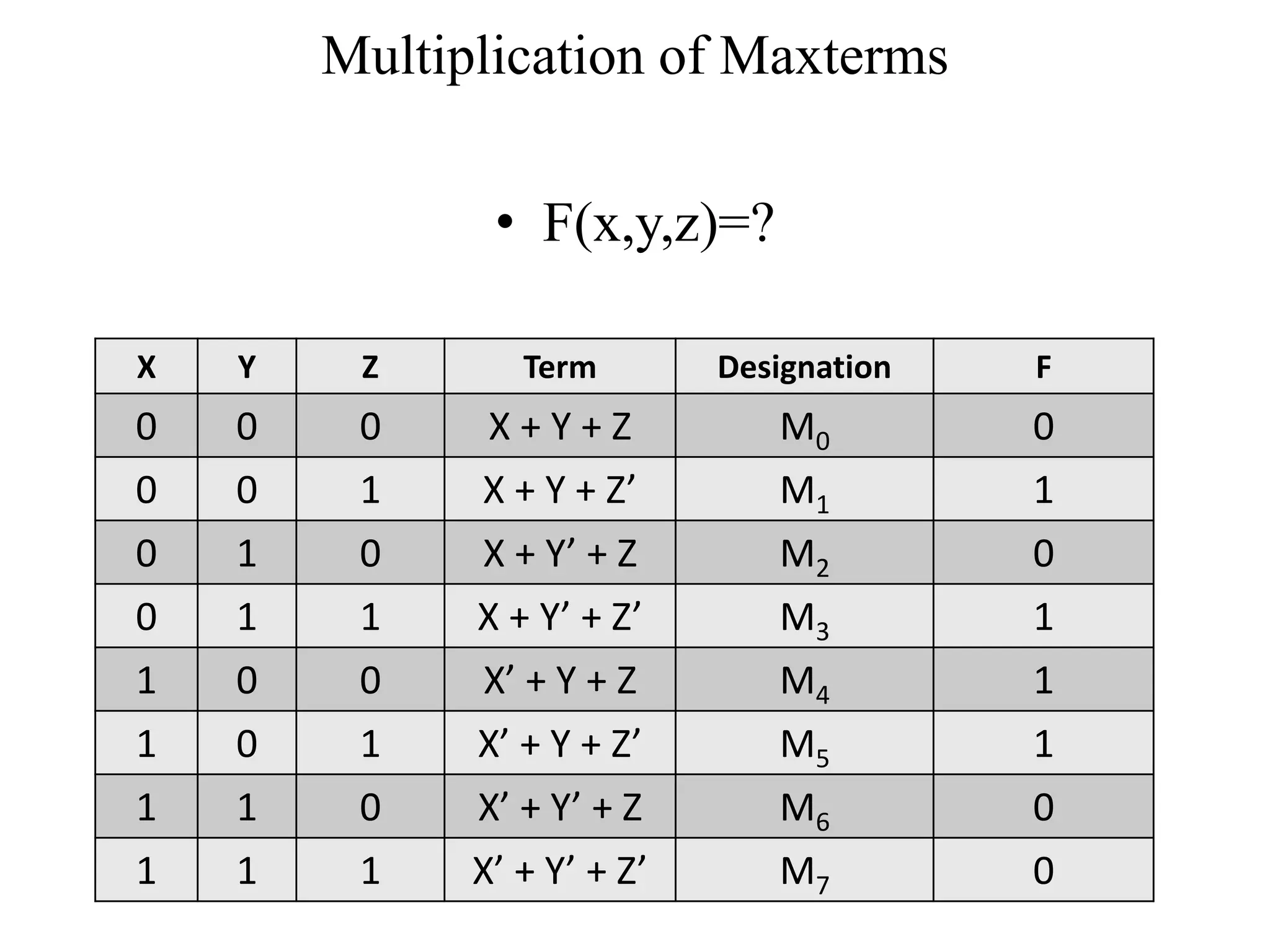
• F(x,y,z)=?
X Y Z Term Designation F
0 0 0 X + Y + Z M0 0
0 0 1 X + Y + Z’ M1 1
0 1 0 X + Y’ + Z M2 0
0 1 1 X + Y’ + Z’ M3 1
1 0 0 X’ + Y + Z M4 1
1 0 1 X’ + Y + Z’ M5 1
1 1 0 X’ + Y’ + Z M6 0
1 1 1 X’ + Y’ + Z’ M7 0
Multiplication of Maxterms
By MinTerms, F = m1+ m3 + m4 + m5 = X’Y’Z+X’YZ+XY’Z’+XY’Z
F’ = m0 + m2 + m6 + m7 = X’Y’Z’+X’YZ’+XYZ’+XYZ
.
=> F = (X’Y’Z’+X’YZ’+XYZ’+XYZ)’ =(X+Y+Z) (X+Y’+Z) (X’+Y’+Z) (X’+Y’+Z’)
X Y Z Term Designation F
0 0 0 X + Y + Z M0 0
0 0 1 X + Y + Z’ M1 1
0 1 0 X + Y’ + Z M2 0
0 1 1 X + Y’ + Z’ M3 1
1 0 0 X’ + Y + Z M4 1
1 0 1 X’ + Y + Z’ M5 1
1 1 0 X’ + Y’ + Z M6 0
1 1 1 X’ + Y’ + Z’ M7 0
Multiplication of Maxterms
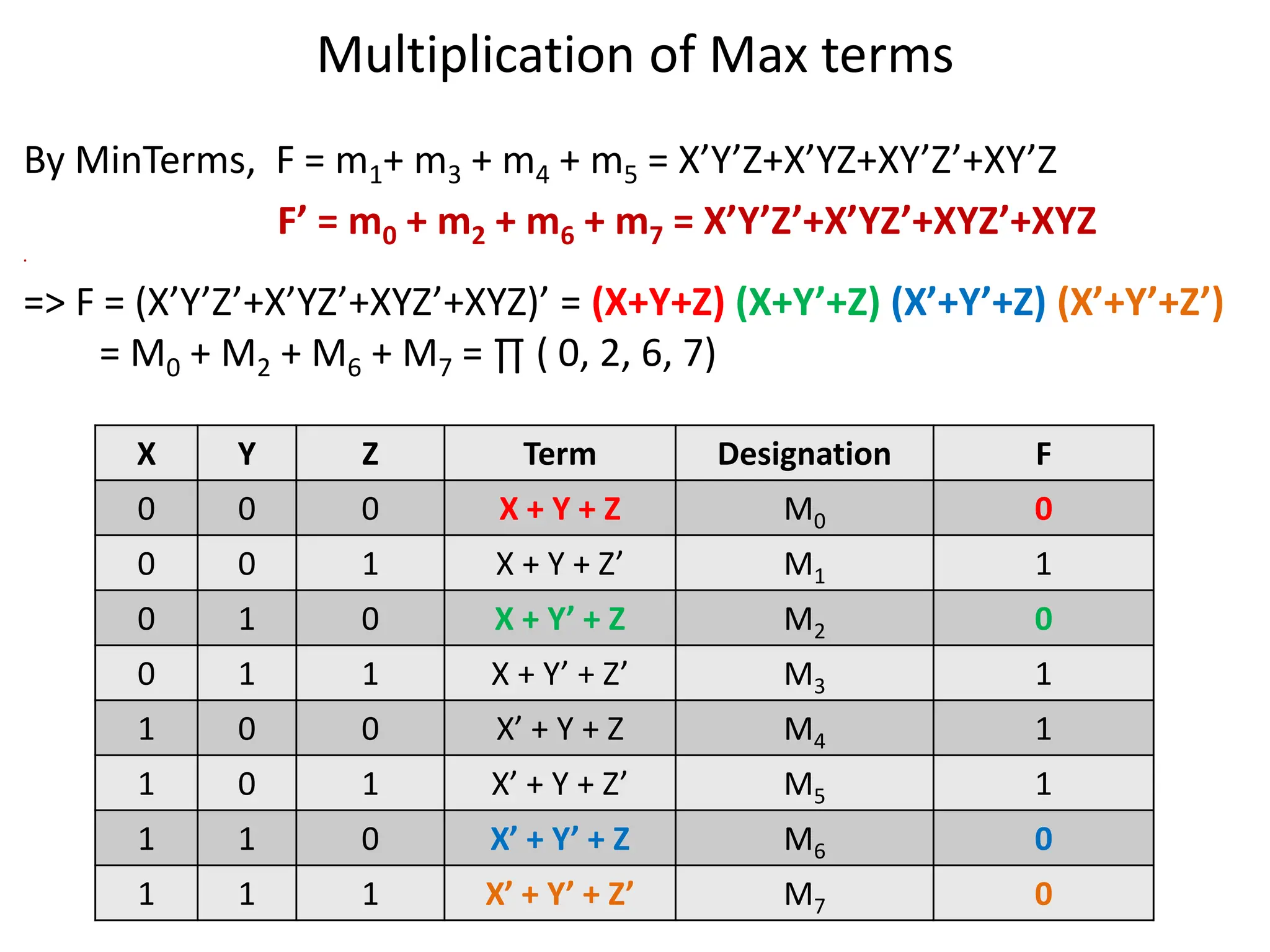
Multiplication of Max terms
By MinTerms, F = m1+ m3 + m4 + m5 = X’Y’Z+X’YZ+XY’Z’+XY’Z
F’ = m0 + m2 + m6 + m7 = X’Y’Z’+X’YZ’+XYZ’+XYZ
.
=> F = (X’Y’Z’+X’YZ’+XYZ’+XYZ)’ = (X+Y+Z) (X+Y’+Z) (X’+Y’+Z) (X’+Y’+Z’)
= M0 + M2 + M6 + M7 = ∏ ( 0, 2, 6, 7)
X Y Z Term Designation F
0 0 0 X + Y + Z M0 0
0 0 1 X + Y + Z’ M1 1
0 1 0 X + Y’ + Z M2 0
0 1 1 X + Y’ + Z’ M3 1
1 0 0 X’ + Y + Z M4 1
1 0 1 X’ + Y + Z’ M5 1
1 1 0 X’ + Y’ + Z M6 0
1 1 1 X’ + Y’ + Z’ M7 0
Boolean functions expressed as a sum of minterms or product of
maxterms are called canonical form
By MinTerms, F = m1+ m3 + m4 + m5 = ∑(1, 3, 4, 5) (function gives 1)
By MaxTerms, F = M0 M2 M6 M7 = ∏ ( 0, 2, 6, 7) (function gives 0)
X Y Z MinTerms Designation MaxTerms Designation F
0 0 0 X’Y’Z’ m0 X + Y + Z M0 0
0 0 1 X’Y’Z m1 X + Y + Z’ M1 1
0 1 0 X’YZ’ m2 X + Y’ + Z M2 0
0 1 1 X’YZ m3 X + Y’ + Z’ M3 1
1 0 0 XY’Z’ m4 X’ + Y + Z M4 1
1 0 1 XY’Z m5 X’ + Y + Z’ M5 1
1 1 0 XYZ’ m6 X’ + Y’ + Z M6 0
1 1 1 XYZ m7 X’ + Y’ + Z’ M7 0
Conversion Between Canonical Forms
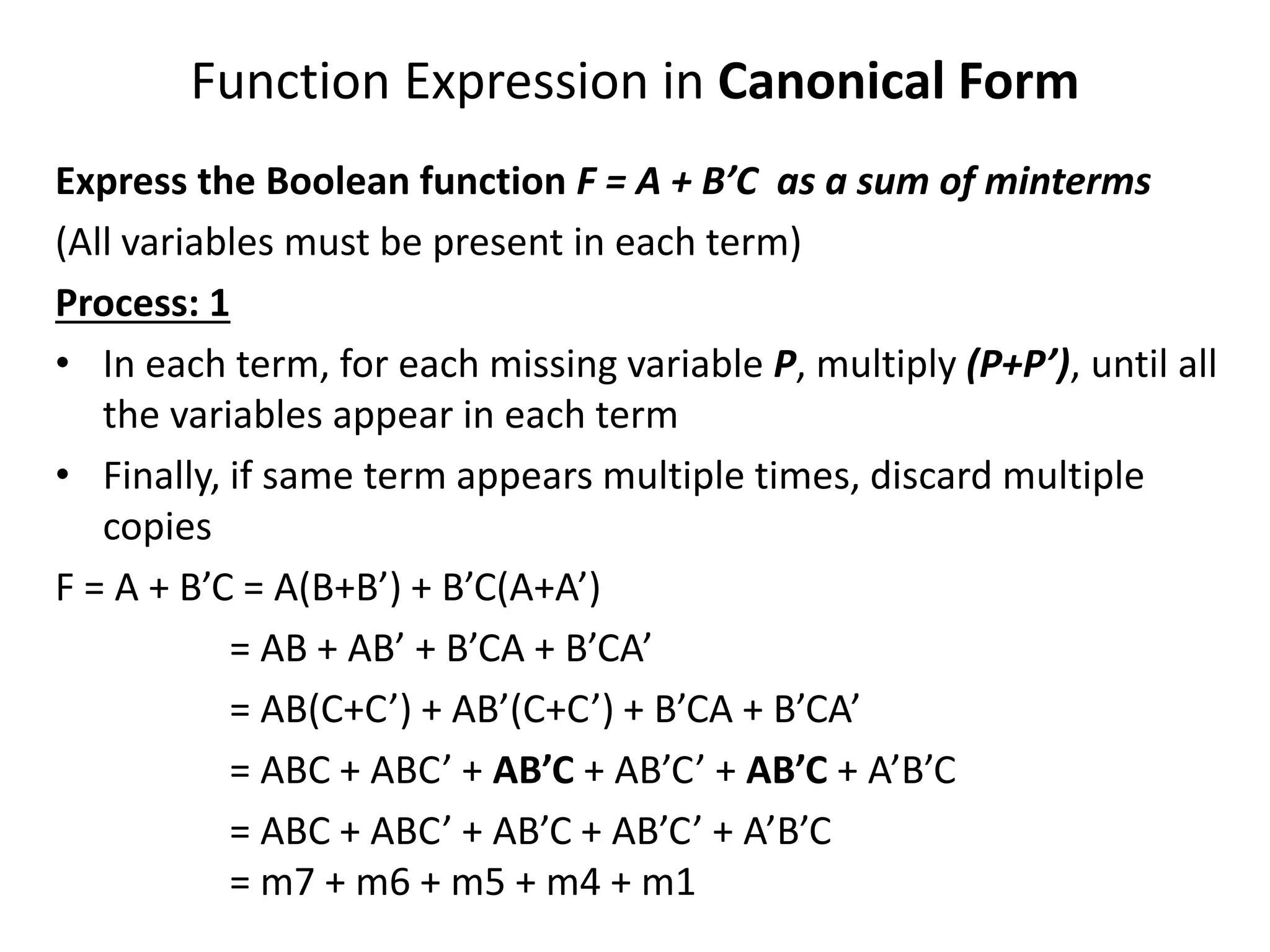
Function Expression in Canonical Form
Express the Boolean function F = A + B’C as a sum of minterms
(All variables must be present in each term)
Process: 1
• In each term, for each missing variable P, multiply (P+P’), until all
the variables appear in each term
• Finally, if same term appears multiple times, discard multiple
copies
F = A + B’C = A(B+B’) + B’C(A+A’)
= AB + AB’ + B’CA + B’CA’
= AB(C+C’) + AB’(C+C’) + B’CA + B’CA’
= ABC + ABC’ + AB’C + AB’C’ + AB’C + A’B’C
= ABC + ABC’ + AB’C + AB’C’ + A’B’C
= m7 + m6 + m5 + m4 + m1
Conversion to Canonical Form
Express the Boolean function F = A + B’C as a sum of minterms.
Process: 2
• Draw the Truth Table
• Read the minterms from the
truth table
F = m1 + m4 + m5 + m6 + m7
Conversion to Canonical Form
Express the Boolean function F = xy + x’z as a product of maxterms
Process: 1
• Convert the function into OR terms using the distributive law
F = xy + x’z
= (xy + x’) (xy + z)
= (x + x’)(y + x’) (x + z)(y + z)
= (x’ + y)(x + z)(y + z)
• For each missing variable P, add the PP’ with each term, until all
the variables appear in each term.
F = (x’ + y)(x + z)(y + z) = (x’ + y + zz’) (x + z + yy’) (y + z + xx’)
= (x’ + y + z)(x’ + y + z’) (x + y + z)(x + y’ + z) (x + y + z)(x’ + y + z)
= (x’ + y + z)(x’ + y + z’) (x + y + z)(x + y’ + z)
Distributive Law:
1. X(Y+Z) = XY + XZ
2. X+(YZ) = (X+Y) (X+Z)
Conversion to Canonical Form
Express the Boolean function F = xy + x’z as a product of maxterms
Process: 2
• Draw the Truth Table
• Read the maxterms from the
truth table
F = M0M2M4M5
X Y Z F
0 0 0 0
0 0 1 1
0 1 0 0
0 1 1 1
1 0 0 0
1 0 1 0
1 1 0 1
1 1 1 1
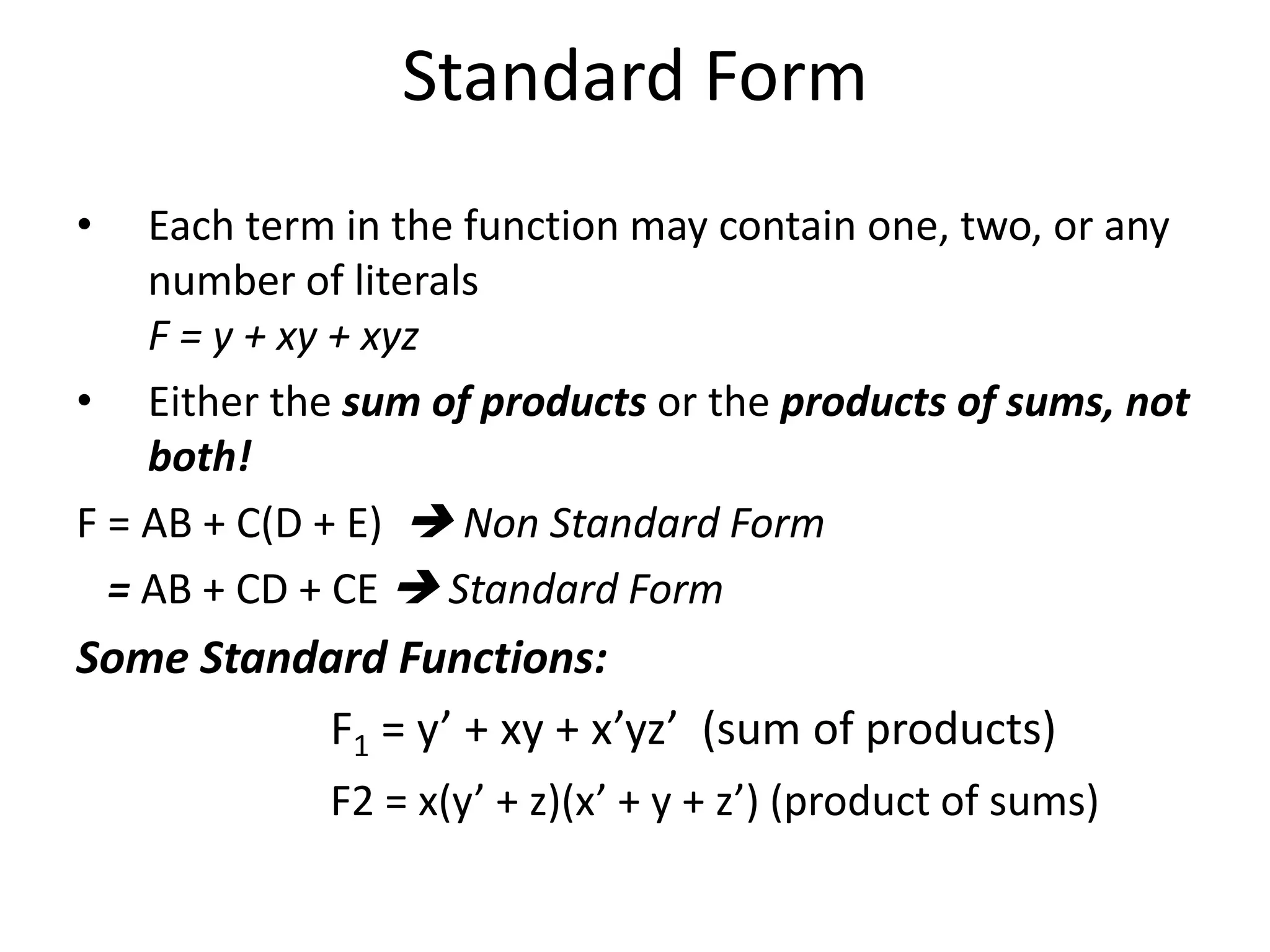
Standard Form
• Each term in the function may contain one, two, or any
number of literals
F = y + xy + xyz
• Either the sum of products or the products of sums, not
both!
F = AB + C(D + E)  Non Standard Form
= AB + CD + CE  Standard Form
Some Standard Functions:
F1 = y’ + xy + x’yz’ (sum of products)
F2 = x(y’ + z)(x’ + y + z’) (product of sums)
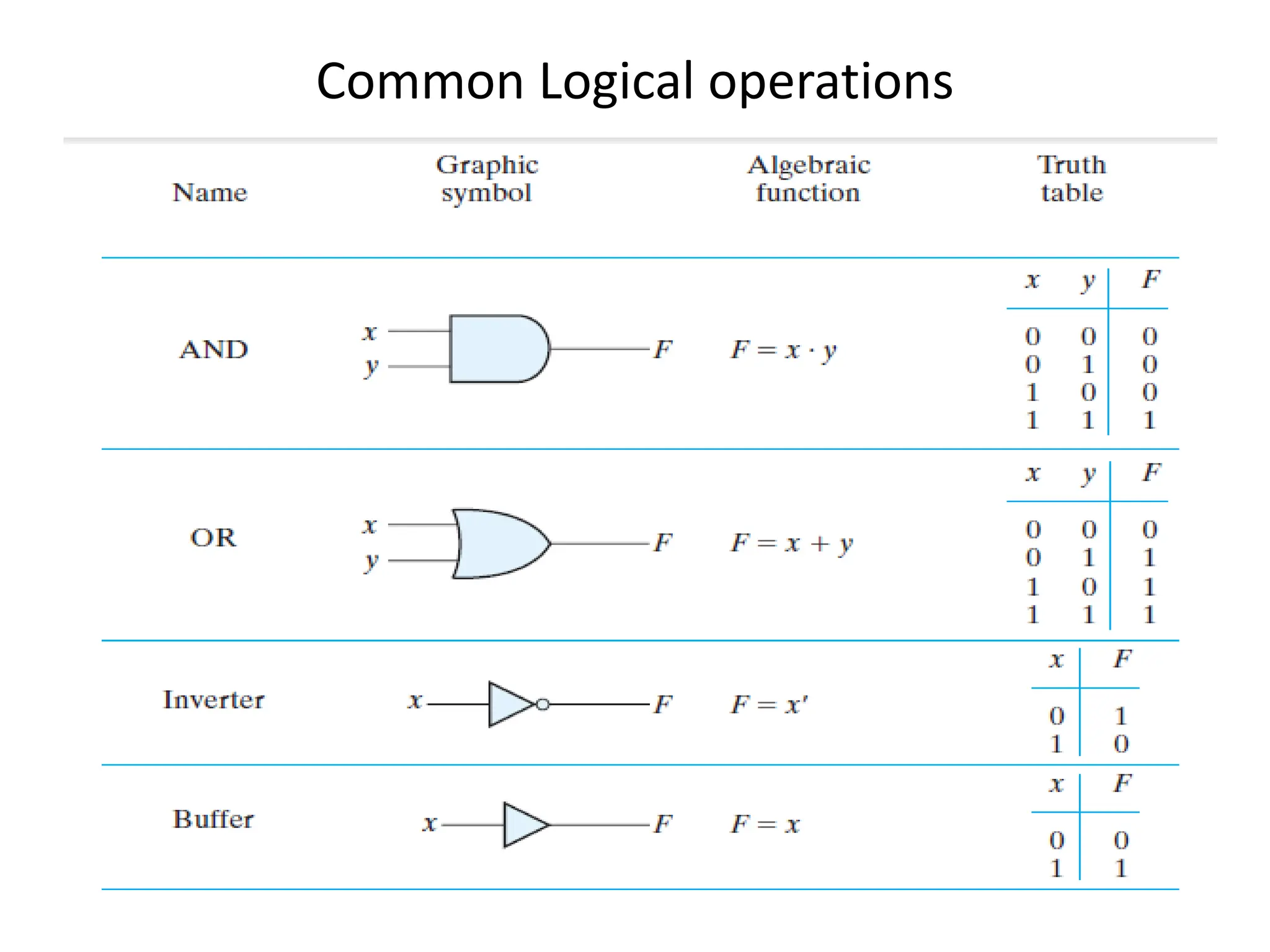
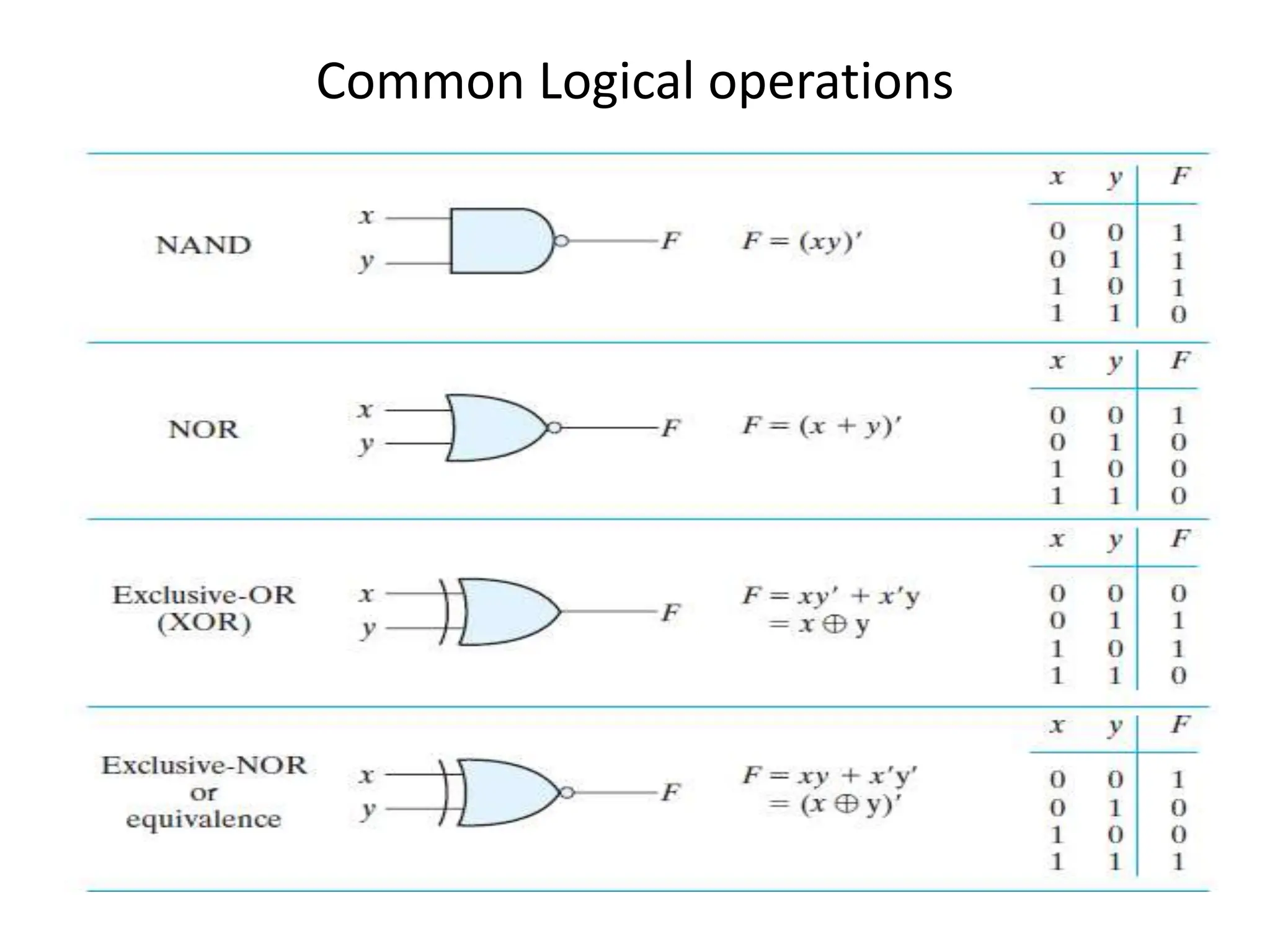
Common Logical operations

Chapter 2-Boolean Algebra and Logic Gates.pptx

  • 1.
  • 3.
    F1= XY’ +X’Z X Y Z X’ Y’ XY’ X’Z F1 0 0 0 1 1 0 0 0 0 0 1 1 1 0 1 1 0 1 0 1 0 0 0 0 0 1 1 1 0 0 1 1 1 0 0 0 1 1 0 1 1 0 1 0 1 1 0 1 1 1 0 0 0 0 0 0 1 1 1 0 0 0 0 0 F1
  • 4.
    F2= X’Y’Z +X’YZ + XY’ X Y Z X’ Y’ X’Y’Z X’YZ XY’ F2 0 0 0 1 1 0 0 0 0 0 0 1 1 1 1 0 0 1 0 1 0 1 0 0 0 0 0 0 1 1 1 0 0 1 0 1 1 0 0 0 1 0 0 1 1 1 0 1 0 1 0 0 1 1 1 1 0 0 0 0 0 0 0 1 1 1 0 0 0 0 0 0
  • 5.
    X Y ZF1 F2 0 0 0 0 0 0 0 1 1 1 0 1 0 0 0 0 1 1 1 1 1 0 0 1 1 1 0 1 1 1 1 1 0 0 0 1 1 1 0 0 F 1 F2= X’Y’Z + X’YZ + XY’ F1= XY’ + X’Z
  • 6.
    F(x, y, z)= xy + x’z + yz = xy + x’z + yz.1 By Postulate 5(a) By Postulate 4(a) By Theorem 2
  • 7.
    CANONICAL FORMS • Howto express a boolean function algebraically from a given truth table? X Y Z F 0 0 0 0 0 0 1 1 0 1 0 0 0 1 1 1 1 0 0 1 1 0 1 1 1 1 0 0 1 1 1 0 F(x,y,z)=?
  • 8.
    Summation of Minterms •F(x,y,z)=? X Y Z Term Designation F 0 0 0 X’Y’Z’ m0 0 0 0 1 X’Y’Z m1 1 0 1 0 X’YZ’ m2 0 0 1 1 X’YZ m3 1 1 0 0 XY’Z’ m4 1 1 0 1 XY’Z m5 1 1 1 0 XYZ’ m6 0 1 1 1 XYZ m7 0
  • 9.
    Summation of Minterms •F(x,y,z)= m1+ m3 + m4 + m5 = X’Y’Z+X’YZ+XY’Z’+XY’Z =∑(1, 3, 4, 5) X Y Z Term Designation F 0 0 0 X’Y’Z’ m0 0 0 0 1 X’Y’Z m1 1 0 1 0 X’YZ’ m2 0 0 1 1 X’YZ m3 1 1 0 0 XY’Z’ m4 1 1 0 1 XY’Z m5 1 1 1 0 XYZ’ m6 0 1 1 1 XYZ m7 0
  • 10.
    Summation of Minterms •F(x,y,z)= m1+ m3 + m4 + m5 = X’Y’Z+X’YZ+XY’Z’+XY’Z =∑(1, 3, 4, 5) • F’ = m0 + m2 + m6 + m7 = X’Y’Z’+X’YZ’+XYZ’+XYZ X Y Z Term Designation F 0 0 0 X’Y’Z’ m0 0 0 0 1 X’Y’Z m1 1 0 1 0 X’YZ’ m2 0 0 1 1 X’YZ m3 1 1 0 0 XY’Z’ m4 1 1 0 1 XY’Z m5 1 1 1 0 XYZ’ m6 0 1 1 1 XYZ m7 0
  • 11.
    • F(x,y,z)=? X YZ Term Designation F 0 0 0 X + Y + Z M0 0 0 0 1 X + Y + Z’ M1 1 0 1 0 X + Y’ + Z M2 0 0 1 1 X + Y’ + Z’ M3 1 1 0 0 X’ + Y + Z M4 1 1 0 1 X’ + Y + Z’ M5 1 1 1 0 X’ + Y’ + Z M6 0 1 1 1 X’ + Y’ + Z’ M7 0 Multiplication of Maxterms
  • 12.
    By MinTerms, F= m1+ m3 + m4 + m5 = X’Y’Z+X’YZ+XY’Z’+XY’Z F’ = m0 + m2 + m6 + m7 = X’Y’Z’+X’YZ’+XYZ’+XYZ . => F = (X’Y’Z’+X’YZ’+XYZ’+XYZ)’ =(X+Y+Z) (X+Y’+Z) (X’+Y’+Z) (X’+Y’+Z’) X Y Z Term Designation F 0 0 0 X + Y + Z M0 0 0 0 1 X + Y + Z’ M1 1 0 1 0 X + Y’ + Z M2 0 0 1 1 X + Y’ + Z’ M3 1 1 0 0 X’ + Y + Z M4 1 1 0 1 X’ + Y + Z’ M5 1 1 1 0 X’ + Y’ + Z M6 0 1 1 1 X’ + Y’ + Z’ M7 0 Multiplication of Maxterms
  • 13.
    Multiplication of Maxterms By MinTerms, F = m1+ m3 + m4 + m5 = X’Y’Z+X’YZ+XY’Z’+XY’Z F’ = m0 + m2 + m6 + m7 = X’Y’Z’+X’YZ’+XYZ’+XYZ . => F = (X’Y’Z’+X’YZ’+XYZ’+XYZ)’ = (X+Y+Z) (X+Y’+Z) (X’+Y’+Z) (X’+Y’+Z’) = M0 + M2 + M6 + M7 = ∏ ( 0, 2, 6, 7) X Y Z Term Designation F 0 0 0 X + Y + Z M0 0 0 0 1 X + Y + Z’ M1 1 0 1 0 X + Y’ + Z M2 0 0 1 1 X + Y’ + Z’ M3 1 1 0 0 X’ + Y + Z M4 1 1 0 1 X’ + Y + Z’ M5 1 1 1 0 X’ + Y’ + Z M6 0 1 1 1 X’ + Y’ + Z’ M7 0
  • 14.
    Boolean functions expressedas a sum of minterms or product of maxterms are called canonical form By MinTerms, F = m1+ m3 + m4 + m5 = ∑(1, 3, 4, 5) (function gives 1) By MaxTerms, F = M0 M2 M6 M7 = ∏ ( 0, 2, 6, 7) (function gives 0) X Y Z MinTerms Designation MaxTerms Designation F 0 0 0 X’Y’Z’ m0 X + Y + Z M0 0 0 0 1 X’Y’Z m1 X + Y + Z’ M1 1 0 1 0 X’YZ’ m2 X + Y’ + Z M2 0 0 1 1 X’YZ m3 X + Y’ + Z’ M3 1 1 0 0 XY’Z’ m4 X’ + Y + Z M4 1 1 0 1 XY’Z m5 X’ + Y + Z’ M5 1 1 1 0 XYZ’ m6 X’ + Y’ + Z M6 0 1 1 1 XYZ m7 X’ + Y’ + Z’ M7 0 Conversion Between Canonical Forms
  • 15.
    Function Expression inCanonical Form Express the Boolean function F = A + B’C as a sum of minterms (All variables must be present in each term) Process: 1 • In each term, for each missing variable P, multiply (P+P’), until all the variables appear in each term • Finally, if same term appears multiple times, discard multiple copies F = A + B’C = A(B+B’) + B’C(A+A’) = AB + AB’ + B’CA + B’CA’ = AB(C+C’) + AB’(C+C’) + B’CA + B’CA’ = ABC + ABC’ + AB’C + AB’C’ + AB’C + A’B’C = ABC + ABC’ + AB’C + AB’C’ + A’B’C = m7 + m6 + m5 + m4 + m1
  • 16.
    Conversion to CanonicalForm Express the Boolean function F = A + B’C as a sum of minterms. Process: 2 • Draw the Truth Table • Read the minterms from the truth table F = m1 + m4 + m5 + m6 + m7
  • 17.
    Conversion to CanonicalForm Express the Boolean function F = xy + x’z as a product of maxterms Process: 1 • Convert the function into OR terms using the distributive law F = xy + x’z = (xy + x’) (xy + z) = (x + x’)(y + x’) (x + z)(y + z) = (x’ + y)(x + z)(y + z) • For each missing variable P, add the PP’ with each term, until all the variables appear in each term. F = (x’ + y)(x + z)(y + z) = (x’ + y + zz’) (x + z + yy’) (y + z + xx’) = (x’ + y + z)(x’ + y + z’) (x + y + z)(x + y’ + z) (x + y + z)(x’ + y + z) = (x’ + y + z)(x’ + y + z’) (x + y + z)(x + y’ + z) Distributive Law: 1. X(Y+Z) = XY + XZ 2. X+(YZ) = (X+Y) (X+Z)
  • 18.
    Conversion to CanonicalForm Express the Boolean function F = xy + x’z as a product of maxterms Process: 2 • Draw the Truth Table • Read the maxterms from the truth table F = M0M2M4M5 X Y Z F 0 0 0 0 0 0 1 1 0 1 0 0 0 1 1 1 1 0 0 0 1 0 1 0 1 1 0 1 1 1 1 1
  • 19.
    Standard Form • Eachterm in the function may contain one, two, or any number of literals F = y + xy + xyz • Either the sum of products or the products of sums, not both! F = AB + C(D + E)  Non Standard Form = AB + CD + CE  Standard Form Some Standard Functions: F1 = y’ + xy + x’yz’ (sum of products) F2 = x(y’ + z)(x’ + y + z’) (product of sums)
  • 20.
  • 21.