STAR Testing Review
8th Grade Science
Structure of Matter
Periodic Table
Solids, Liquids and Gases
STATES OF MATTER!!!
 All matter is made of atoms and
molecules, which we will call particles.
 All particles vibrate or move because they
have energy.
 The state of matter they are in depends on
how strongly they are attracted to each
other.
 Matter that has defined shape and volume
is considered to be solid.
 Particles in a solid have high attraction for
each other. The particles vibrate in place
and don’t have enough energy to get away
from each other
 Two types of solids:
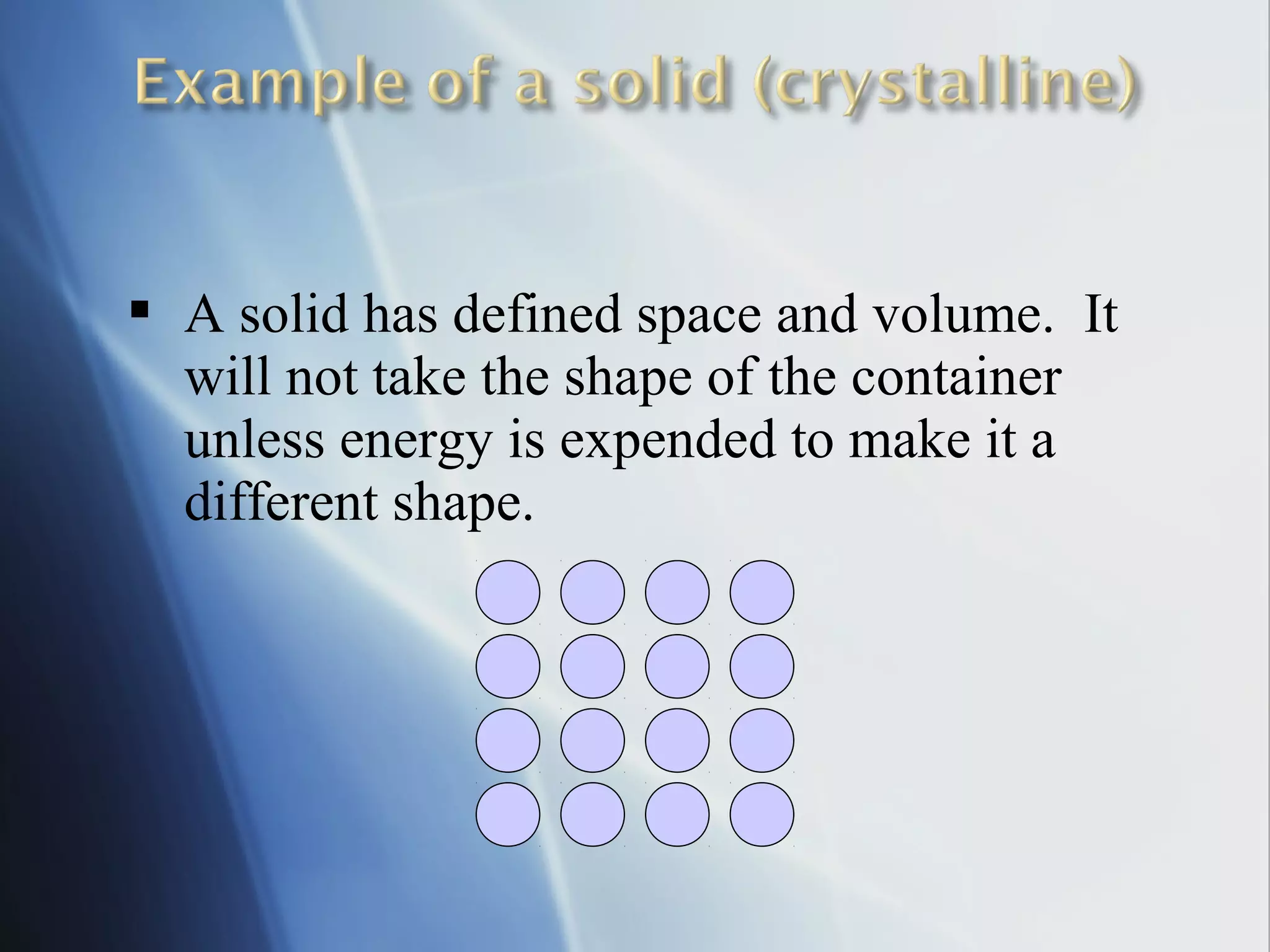
 Crystalline – particles in a repeating formation
 Amorphous – randomly oriented particles
 A solid has defined space and volume. It
will not take the shape of the container
unless energy is expended to make it a
different shape.
 Liquids have defined volume but not defined
shape
 The particles in a liquid can slide past each
other, and are less attracted to each other than in
a solid.
 Two properties of a liquid:
 Surface tension – the liquids tend to ball up and stick
together
 Viscosity – a measure of how well the liquid flows.
Water is low viscosity, molasses is high viscosity.
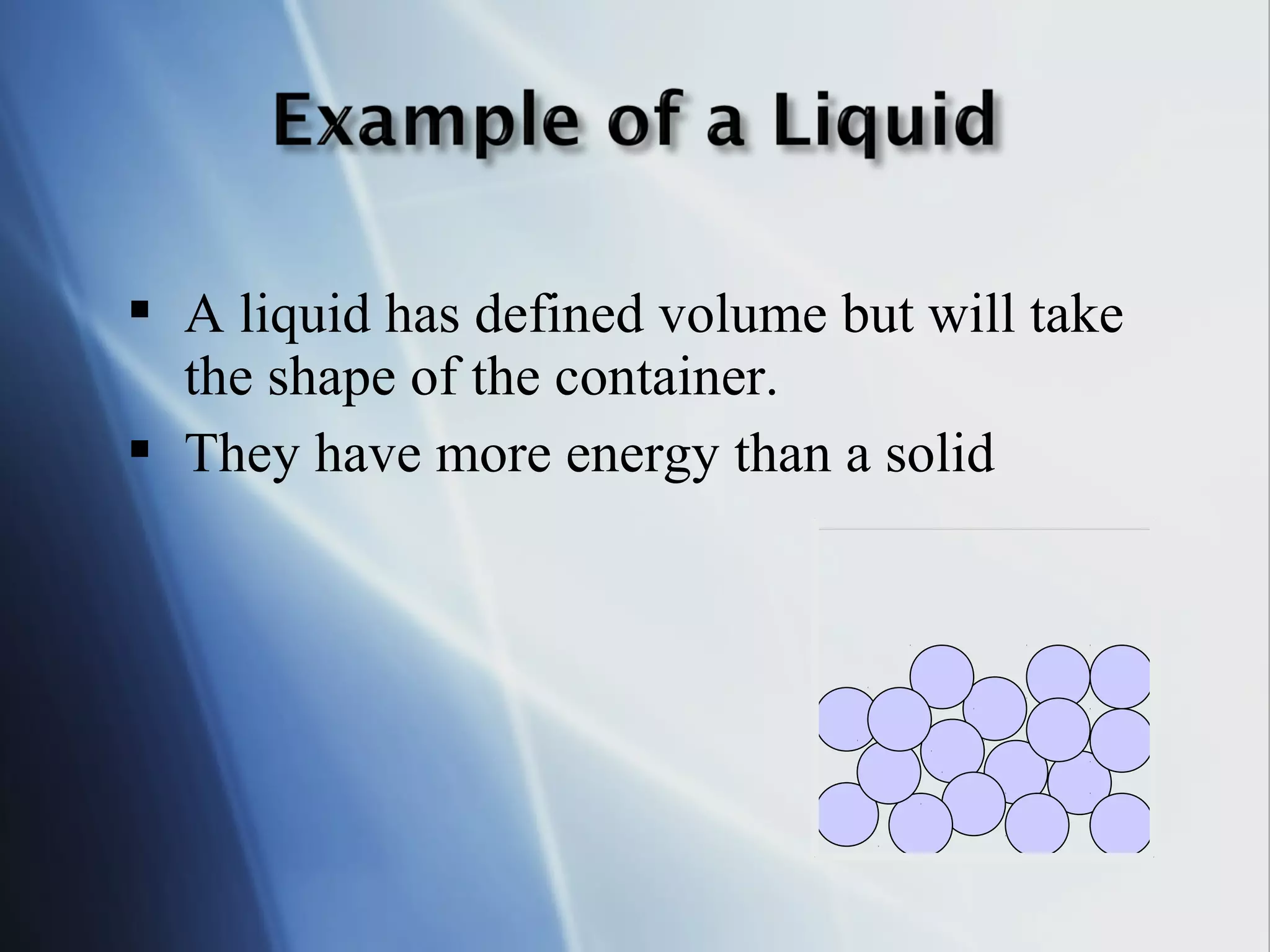
 A liquid has defined volume but will take
the shape of the container.
 They have more energy than a solid
 Gases have no defined shape or volume.
They can be compressed by pressure and
change their volume and will fill all the
space they are given.
 The particles in a gas are moving fast
enough to break away from each other and
each particle moves independently.
 In a gas, there is empty space between
particles.
 Pressure can effect all gases. High pressure
means that you have forced a large amount of
gas particles in a small space – like inside a
tire or basketball.
Gases
Phase Change!!!!
Solid--> Liquid--> Gas-->and back!
What IS phase change??
 Phase change is the change of the state (solid, liquid, gas)
that the matter is in.
 This change begins by either taking away energy or adding
energy to the particles of matter.
 These changes can start at any state and end at any state.
Melting!
 Melting involves ANY solid becoming a
liquid.
 Melting is ENDOTHERMIC- energy in the
form of heat is ENTERING the reaction.
 The molecules are gaining enough energy
to break away from their rigid structure and
move among the group.
Melting!
 Every substance has a “melting point”.
 The melting point is the temperature at
which the substance begins to melt.
 The melting point of a substance is a
physical property.
 **ALL substances have DIFFERENT
melting points! It’s not all the same as
water!!!!!!!
Freezing
 Freezing involves ANY liquid becoming
a solid.
 Freezing is an EXOTHERMIC reaction-
energy is EXITING the reaction in the
form of heat (heat is leaving).
 The molecules are losing energy- and
forced to stay in a rigid structure.
Freezing
 Every Substance has a “freezing point”
 The freezing point is the temperature
where the substance begins to freeze or
solidify.
 The freezing point of a substance is a
physical property and varies for each
substance.
Condensation
 Condensation is when a gas becomes a
liquid.
 This is an EXOTHERMIC reaction-
energy LEAVING in the form of heat.
 The molecules are losing energy and
become a group again after being totally
independent.
Vaporization
 Evaporation is any liquid becoming a gas
 This reaction is ENDOTHERMIC-
energy is ENTERING in the form of
heat!
 The molecules are gaining SO much
energy that they are becoming totally
independent and fly away on their own!
Vaporization
 There are two types:
 Boiling
 Evaporation
Boiling
 Boiling is…
 a relatively quick change from a liquid to a gas
 Occurs by adding a lot of heat all at once
 Happens at a specific temperature
 The change happens within the ENTIRE fluid-
all molecules are being affected.
Evaporation
 Evaporation is…
 A relatively slow process
 Occurs overtime from gas particles crashing
onto the surface of the liquid and passing on
their energy to the liquid molecules.
 No specific temperature associated with this
change (can happen at room temp!)
 Happens only on the surface of the liquid.
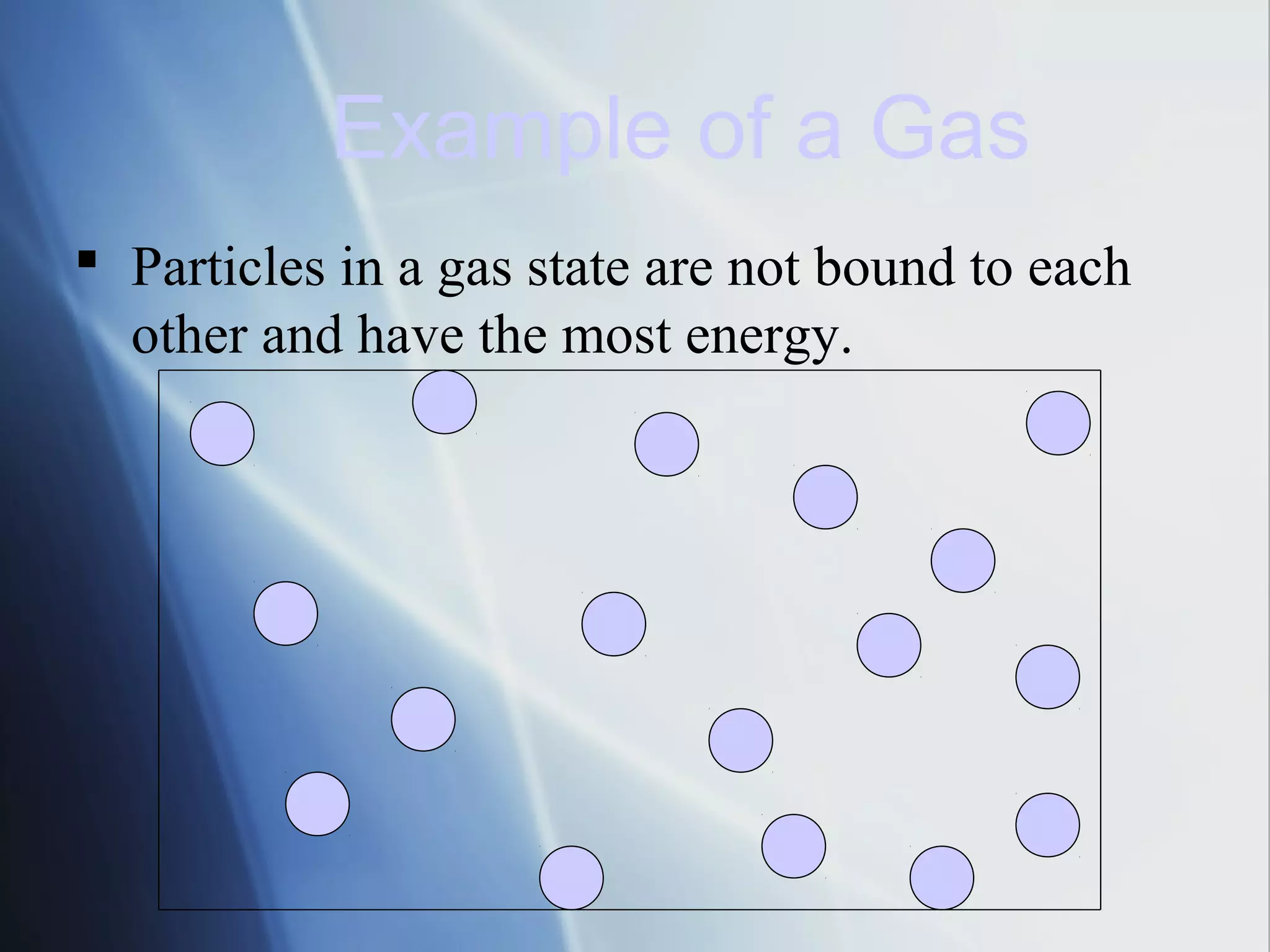
 Particles in a gas state are not bound to each
other and have the most energy.
Example of a Gas
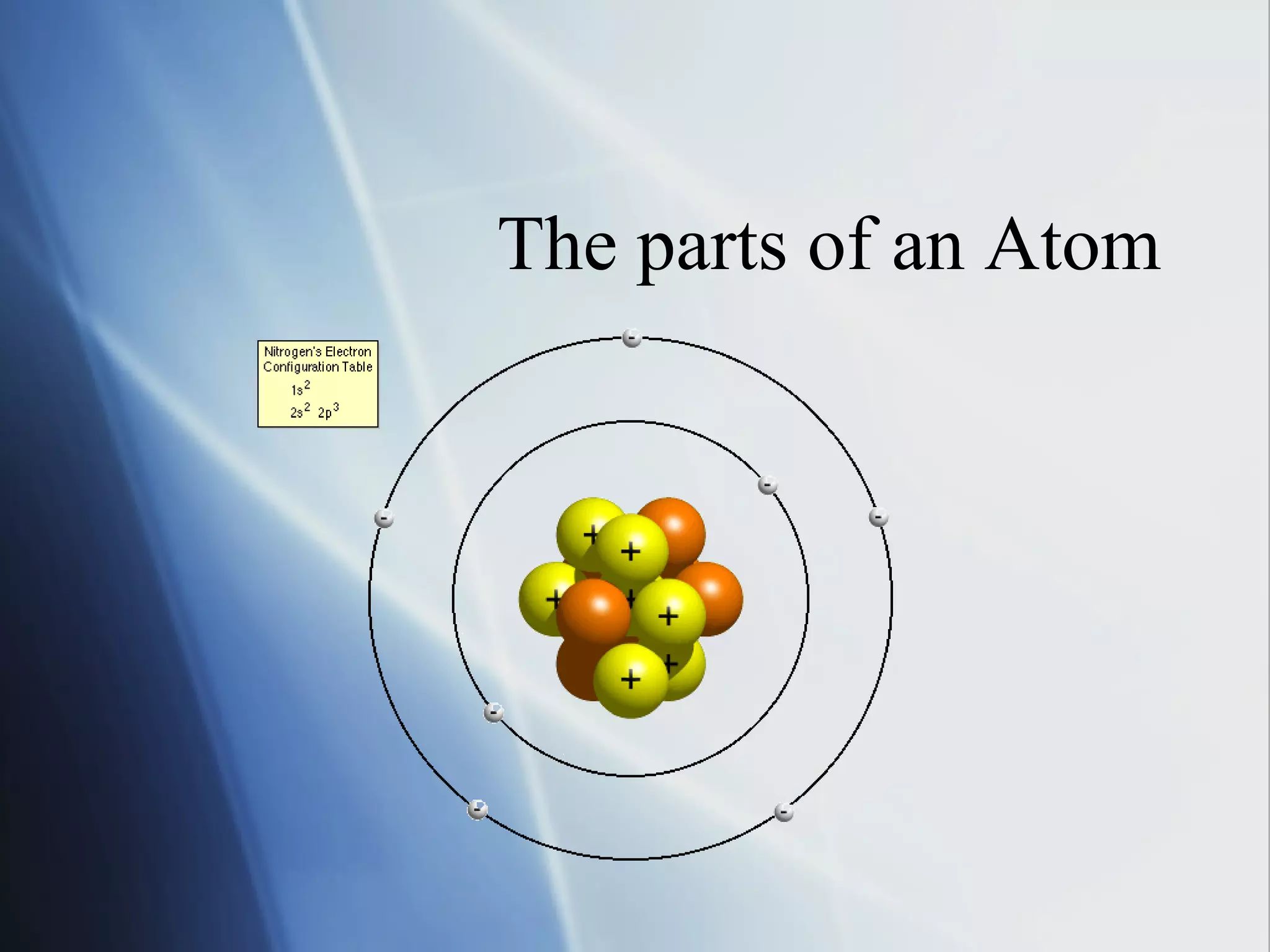
The parts of an Atom
The atom
 An Atom: The most basic unit of matter.
 An atom has a dense nucleus and a cloud of
negatively charged electrons around it.
 If matter is what everything is made of, and
matter is made of atoms…
 Then, everything is really made of atoms!
The Parts:
 Electron: A subatomic particle with a negative
electrical charge. (no mass)
 Nucleus: The dense center of an atom
containing protons and neutrons.
 A Proton: A subatomic particle within the
nucleus of an atom that has a positive charge.
 A Neutron: A subatomic particle within the
nucleus of an atom that has a neutral charge.
Energy Level
 The energy level of an atom is as follows:
 2,8,8
 The first shell has two electrons
 The second shell has 8 electrons
 The third shell has 8 electrons
MEMORIZE: 2,8,8!!!!!!!!!!
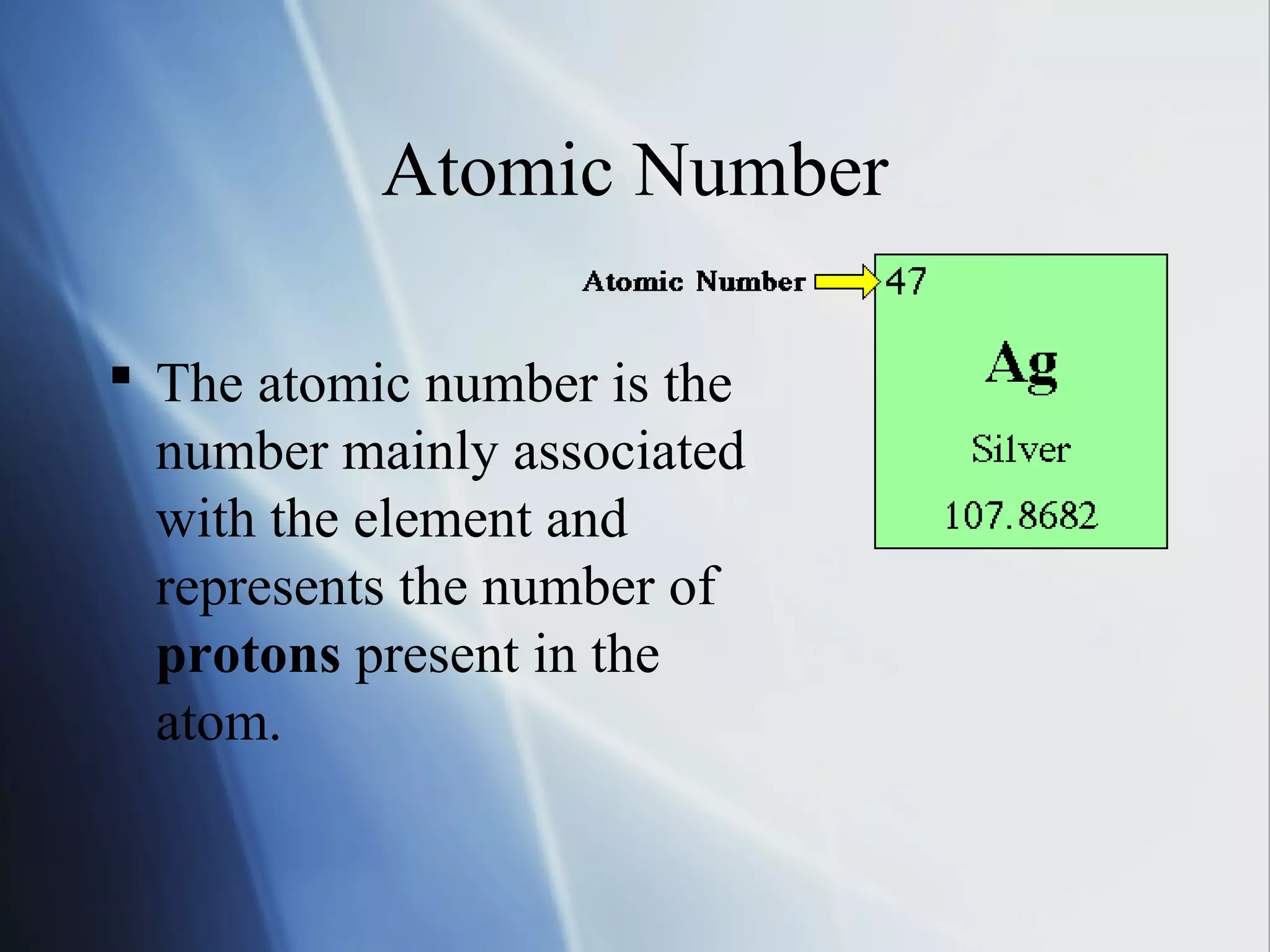
Atomic Number
 The atomic number is the
number mainly associated
with the element and
represents the number of
protons present in the
atom.
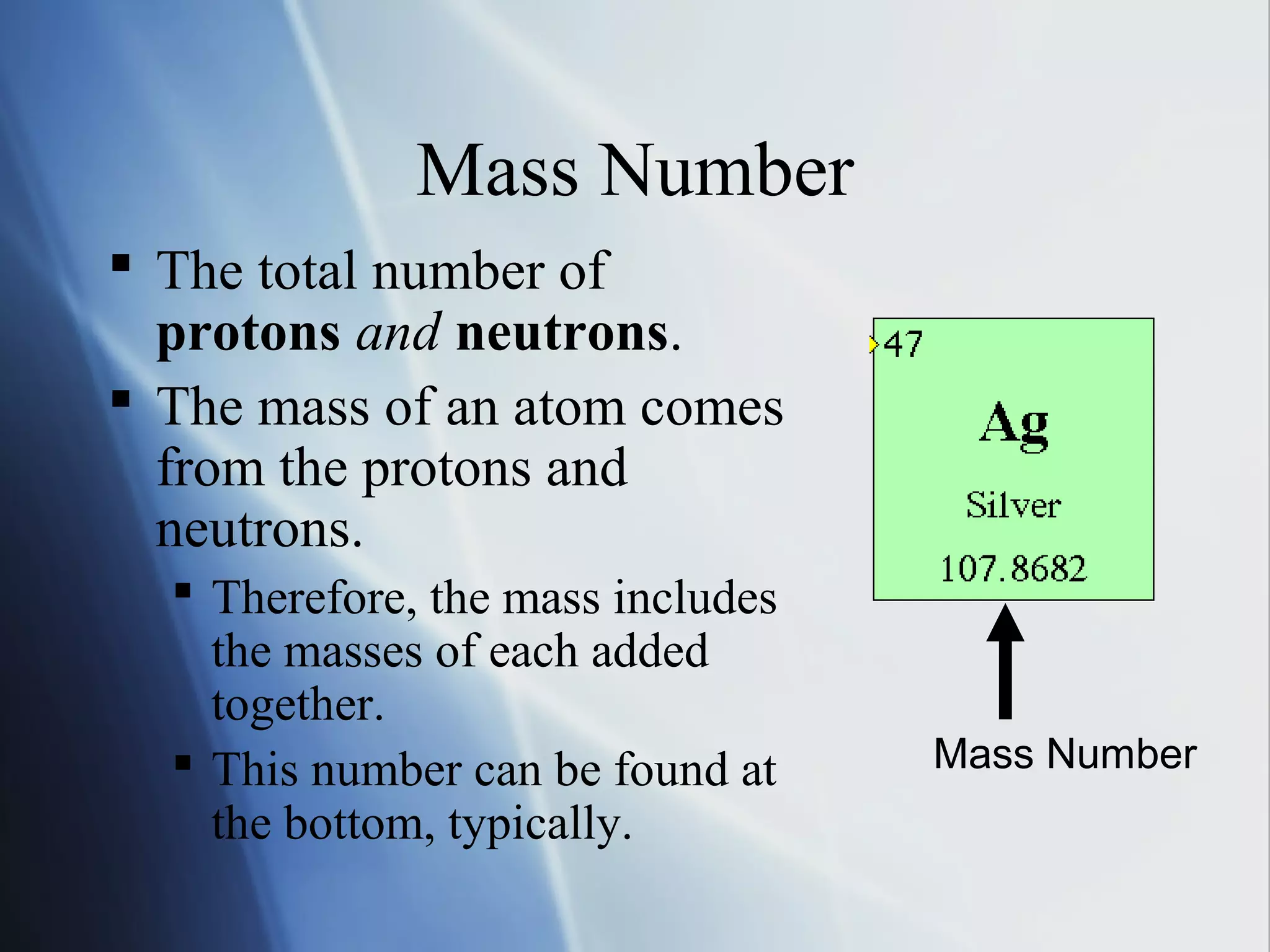
Mass Number
 The total number of
protons and neutrons.
 The mass of an atom comes
from the protons and
neutrons.
 Therefore, the mass includes
the masses of each added
together.
 This number can be found at
the bottom, typically.
Mass Number
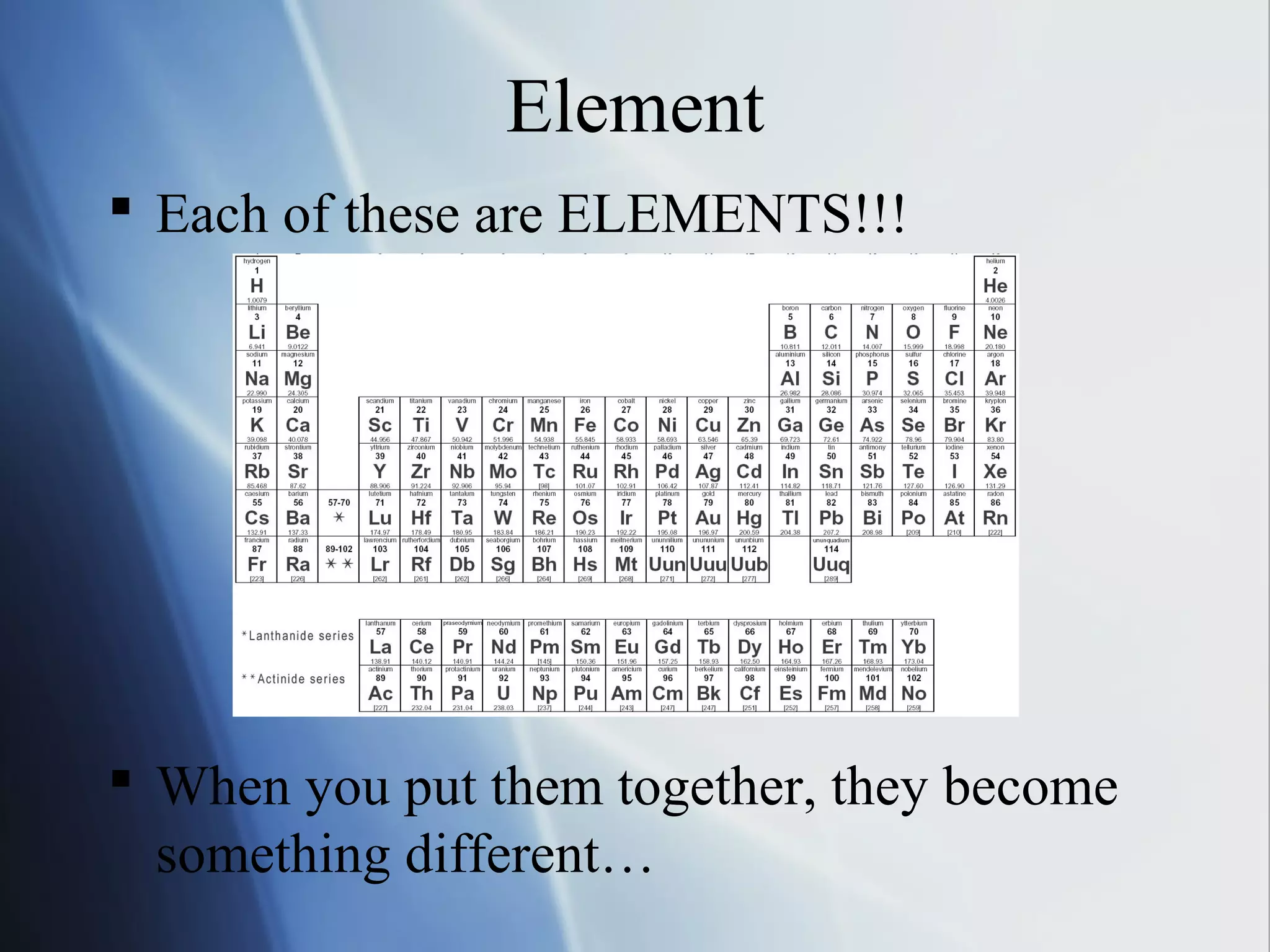
Element
 Each of these are ELEMENTS!!!
 When you put them together, they become
something different…
Compounds!
 Remember that compounds are merely the
result of combining two or more elements.
 H2O is a compound! NaCl is a compound!
 REMEMBER- compounds have different
properties than the elements they are made
of when alone.
 Hence why table salt (NaCl) doesn’t blow up
How can you identify Elements?
 What are the elements in the following
compounds?
 H2O
 NaCl
 CO2
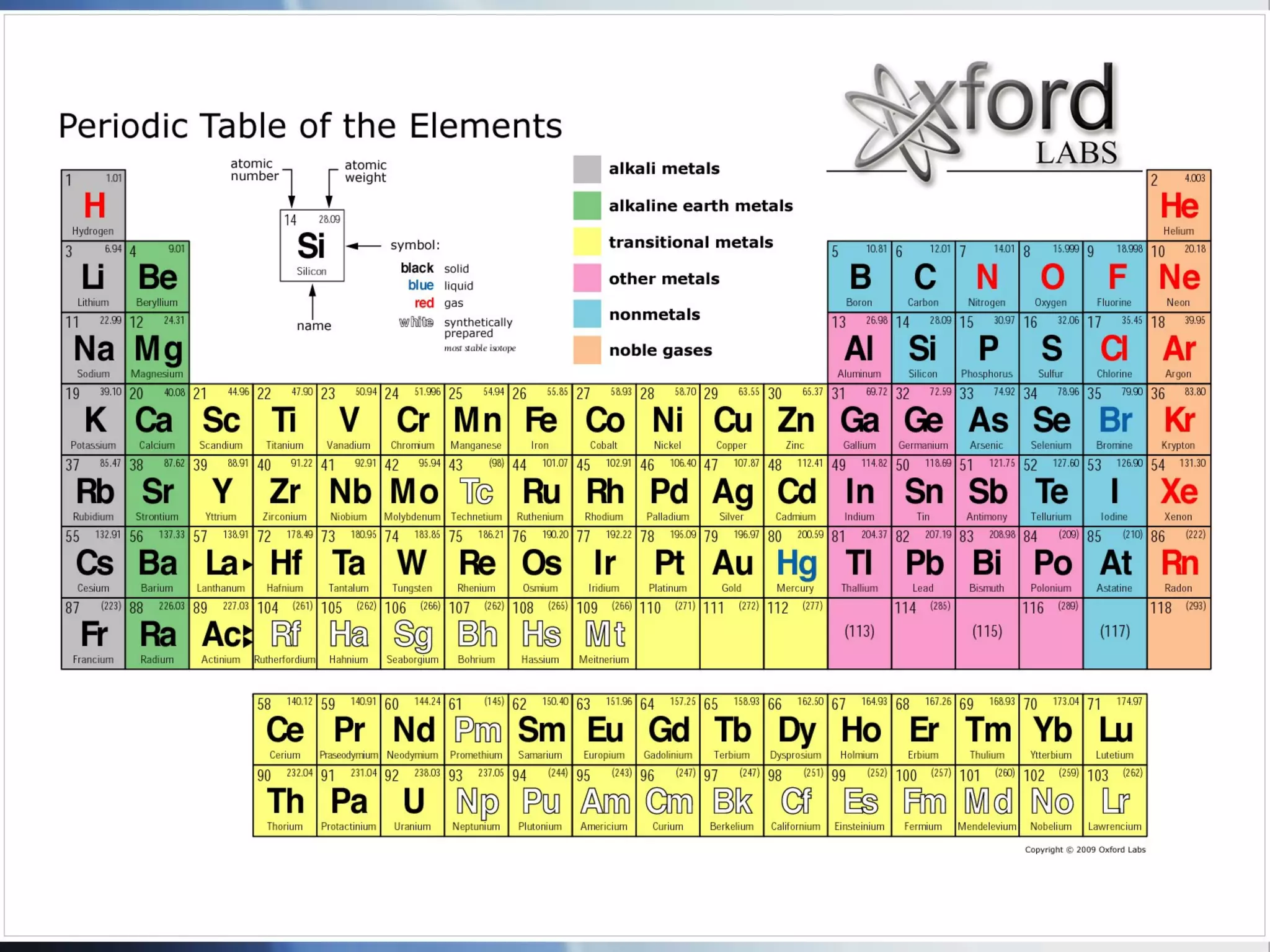
Periodic Table!!
 Remember that beautiful display of
elements?
 It’s time to remember how to use it!
Time to test your knowledge!
 How many groups are there?
 Which group number are the noble (inert) gases?
 Why are the noble gases important?
 Where are the metals located?
 Where are the semi-metals?
 Where are the Alkali metals located?
 Where are the Alkaline Earth metals located?
Review of Chemical Bonding
Ionic, Covalent, Metallic
Ionic Bonds
 Ionic Bonds occur between metals and non-
metals.
 Metals always lose their extra valence
electrons and non-metals always try to gain
extra valence electrons.
 Metals become positive ions and non-
metals become negative ions.
Ionic Bonds
 Properties of Ionic Bonds:
 Brittle (breaks easily)
 Extremely high melting and boiling points
 Conduct electricity
 Form between ions (metals & non-metals)
Covalent Bonds
 Covalent bonds occur between non-metals
and non-metals
 Since non-metals are always trying to find
extra electrons rather than get rid of them,
Covalent bonds always share their electrons
(how nice of them!)
Covalent Bonds
 Properties of Covalent Bonds
 Malleable (can be formed/manipulated)
 Low melting and boiling points
 Do not conduct electricity or heat
Metallic Bonds
 Metallic bonds occur between metals and
metals.
 Remember that all metals are always trying
to lose their extra electrons to become
happy.
 In Metallic bonds metals “pool” their
electrons and all become ions while
“swimming” around in the pool of electrons
(AKA the “sea of negativity”)
Metallic Bonds
 Properties of Metallic Bonds:
 Malleable
 Ductile (can be stretched into wires)
 Conducts heat and electricity
Structure of matter (STAR review)

  • 1.
    STAR Testing Review 8thGrade Science Structure of Matter Periodic Table
  • 2.
    Solids, Liquids andGases STATES OF MATTER!!!
  • 3.
     All matteris made of atoms and molecules, which we will call particles.  All particles vibrate or move because they have energy.  The state of matter they are in depends on how strongly they are attracted to each other.
  • 4.
     Matter thathas defined shape and volume is considered to be solid.  Particles in a solid have high attraction for each other. The particles vibrate in place and don’t have enough energy to get away from each other  Two types of solids:  Crystalline – particles in a repeating formation  Amorphous – randomly oriented particles
  • 5.
     A solidhas defined space and volume. It will not take the shape of the container unless energy is expended to make it a different shape.
  • 6.
     Liquids havedefined volume but not defined shape  The particles in a liquid can slide past each other, and are less attracted to each other than in a solid.  Two properties of a liquid:  Surface tension – the liquids tend to ball up and stick together  Viscosity – a measure of how well the liquid flows. Water is low viscosity, molasses is high viscosity.
  • 7.
     A liquidhas defined volume but will take the shape of the container.  They have more energy than a solid
  • 8.
     Gases haveno defined shape or volume. They can be compressed by pressure and change their volume and will fill all the space they are given.  The particles in a gas are moving fast enough to break away from each other and each particle moves independently.  In a gas, there is empty space between particles.  Pressure can effect all gases. High pressure means that you have forced a large amount of gas particles in a small space – like inside a tire or basketball. Gases
  • 9.
  • 10.
    What IS phasechange??  Phase change is the change of the state (solid, liquid, gas) that the matter is in.  This change begins by either taking away energy or adding energy to the particles of matter.  These changes can start at any state and end at any state.
  • 11.
    Melting!  Melting involvesANY solid becoming a liquid.  Melting is ENDOTHERMIC- energy in the form of heat is ENTERING the reaction.  The molecules are gaining enough energy to break away from their rigid structure and move among the group.
  • 12.
    Melting!  Every substancehas a “melting point”.  The melting point is the temperature at which the substance begins to melt.  The melting point of a substance is a physical property.  **ALL substances have DIFFERENT melting points! It’s not all the same as water!!!!!!!
  • 13.
    Freezing  Freezing involvesANY liquid becoming a solid.  Freezing is an EXOTHERMIC reaction- energy is EXITING the reaction in the form of heat (heat is leaving).  The molecules are losing energy- and forced to stay in a rigid structure.
  • 14.
    Freezing  Every Substancehas a “freezing point”  The freezing point is the temperature where the substance begins to freeze or solidify.  The freezing point of a substance is a physical property and varies for each substance.
  • 15.
    Condensation  Condensation iswhen a gas becomes a liquid.  This is an EXOTHERMIC reaction- energy LEAVING in the form of heat.  The molecules are losing energy and become a group again after being totally independent.
  • 16.
    Vaporization  Evaporation isany liquid becoming a gas  This reaction is ENDOTHERMIC- energy is ENTERING in the form of heat!  The molecules are gaining SO much energy that they are becoming totally independent and fly away on their own!
  • 17.
    Vaporization  There aretwo types:  Boiling  Evaporation
  • 18.
    Boiling  Boiling is… a relatively quick change from a liquid to a gas  Occurs by adding a lot of heat all at once  Happens at a specific temperature  The change happens within the ENTIRE fluid- all molecules are being affected.
  • 19.
    Evaporation  Evaporation is… A relatively slow process  Occurs overtime from gas particles crashing onto the surface of the liquid and passing on their energy to the liquid molecules.  No specific temperature associated with this change (can happen at room temp!)  Happens only on the surface of the liquid.
  • 20.
     Particles ina gas state are not bound to each other and have the most energy. Example of a Gas
  • 21.
    The parts ofan Atom
  • 22.
    The atom  AnAtom: The most basic unit of matter.  An atom has a dense nucleus and a cloud of negatively charged electrons around it.  If matter is what everything is made of, and matter is made of atoms…  Then, everything is really made of atoms!
  • 23.
    The Parts:  Electron:A subatomic particle with a negative electrical charge. (no mass)  Nucleus: The dense center of an atom containing protons and neutrons.  A Proton: A subatomic particle within the nucleus of an atom that has a positive charge.  A Neutron: A subatomic particle within the nucleus of an atom that has a neutral charge.
  • 24.
    Energy Level  Theenergy level of an atom is as follows:  2,8,8  The first shell has two electrons  The second shell has 8 electrons  The third shell has 8 electrons MEMORIZE: 2,8,8!!!!!!!!!!
  • 25.
    Atomic Number  Theatomic number is the number mainly associated with the element and represents the number of protons present in the atom.
  • 26.
    Mass Number  Thetotal number of protons and neutrons.  The mass of an atom comes from the protons and neutrons.  Therefore, the mass includes the masses of each added together.  This number can be found at the bottom, typically. Mass Number
  • 27.
    Element  Each ofthese are ELEMENTS!!!  When you put them together, they become something different…
  • 28.
    Compounds!  Remember thatcompounds are merely the result of combining two or more elements.  H2O is a compound! NaCl is a compound!  REMEMBER- compounds have different properties than the elements they are made of when alone.  Hence why table salt (NaCl) doesn’t blow up
  • 29.
    How can youidentify Elements?  What are the elements in the following compounds?  H2O  NaCl  CO2
  • 30.
    Periodic Table!!  Rememberthat beautiful display of elements?  It’s time to remember how to use it!
  • 31.
    Time to testyour knowledge!  How many groups are there?  Which group number are the noble (inert) gases?  Why are the noble gases important?  Where are the metals located?  Where are the semi-metals?  Where are the Alkali metals located?  Where are the Alkaline Earth metals located?
  • 33.
    Review of ChemicalBonding Ionic, Covalent, Metallic
  • 34.
    Ionic Bonds  IonicBonds occur between metals and non- metals.  Metals always lose their extra valence electrons and non-metals always try to gain extra valence electrons.  Metals become positive ions and non- metals become negative ions.
  • 35.
    Ionic Bonds  Propertiesof Ionic Bonds:  Brittle (breaks easily)  Extremely high melting and boiling points  Conduct electricity  Form between ions (metals & non-metals)
  • 36.
    Covalent Bonds  Covalentbonds occur between non-metals and non-metals  Since non-metals are always trying to find extra electrons rather than get rid of them, Covalent bonds always share their electrons (how nice of them!)
  • 37.
    Covalent Bonds  Propertiesof Covalent Bonds  Malleable (can be formed/manipulated)  Low melting and boiling points  Do not conduct electricity or heat
  • 38.
    Metallic Bonds  Metallicbonds occur between metals and metals.  Remember that all metals are always trying to lose their extra electrons to become happy.  In Metallic bonds metals “pool” their electrons and all become ions while “swimming” around in the pool of electrons (AKA the “sea of negativity”)
  • 39.
    Metallic Bonds  Propertiesof Metallic Bonds:  Malleable  Ductile (can be stretched into wires)  Conducts heat and electricity