Lewis Structures and Bond Formation
With Teacher Mary Grace
1.Draw the Lewis structure of an atom.
2.Draw Lewis structure of molecular covalent
compounds
3.Apply the Octet rule in the formation of molecular
covalent compounds
4.Write the formula of molecular compounds formed by
the non-metallic elements of the representative block.
Most Essential Learning Competency
What are the bonding electrons?
A. Central Atom
B. Lone Pairs
C. Formula Type
D. Bonding Pairs
What are the unbonded electrons?
A. Central Atom
B. Lone Pairs
C. Formula Type
D. Bonding Pairs
What is a letter description of the
components of molecular compound?
A. Central Atom
B. Lone Pairs
C. Formula Type
D. Bonding Pairs
What is usually the least electronegative
atom with the lowest subscript in the
molecular formula?
A. Central Atom
B. Lone Pairs
C. Formula Type
D. Bonding Pairs
What do you call to the representation of
covalent bonding in which shared electron
pairs are shown either as lines or as pairs of
dots between two atoms?
A. Chemical structure
B. Atomic Structure
C. Electron structure
D. Lewis Electron
Dot Structure
What are the bonding electrons?
A. Central Atom
B. Lone Pairs
C. Formula Type
D. Bonding Pairs
What are the unbonded electrons?
A. Central Atom
B. Lone Pairs
C. Formula Type
D. Bonding Pairs
What is a letter description of the
components of molecular compound?
A. Central Atom
B. Lone Pairs
C. Formula Type
D. Bonding Pairs
What is usually the least electronegative
atom with the lowest subscript in the
molecular formula?
A. Central Atom
B. Lone Pairs
C. Formula Type
D. Bonding Pairs
What do you call to the representation of
covalent bonding in which shared electron
pairs are shown either as lines or as pairs of
dots between two atoms?
A. Chemical structure
B. Atomic Structure
C. Electron structure
D. Lewis Electron
Dot Structure
Types of Bonding and their Properties
With Teacher Mary Grace
Types of Bonding
1. Ionic Bond-is formed when metals on
the left side (Group 1(A) and Group 2(A) of
the periodic table and nonmetals on the
right side (except noble gases, group 8A)
interact.
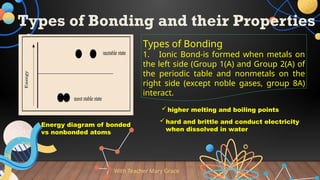
Energy diagram of bonded
vs nonbonded atoms
higher melting and boiling points
hard and brittle and conduct electricity
when dissolved in water
Types of Bonding and their Properties
With Teacher Mary Grace
Types of Bonding
2. Covalent Bond-formed when atoms
reach stability by sharing electrons (rather
than fully gaining or losing them).
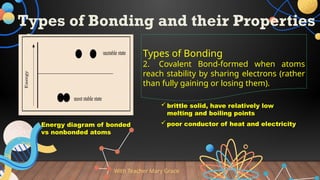
Energy diagram of bonded
vs nonbonded atoms
brittle solid, have relatively low
melting and boiling points
poor conductor of heat and electricity
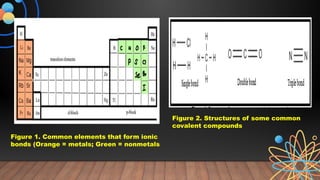
Figure 1. Common elements that form ionic
bonds (Orange = metals; Green = nonmetals
Figure 2. Structures of some common
covalent compounds
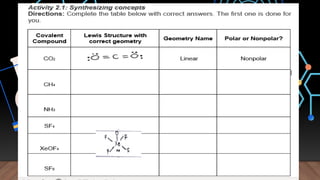
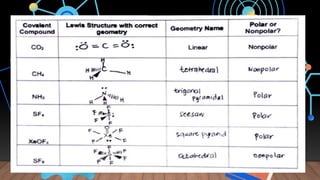
Lewis Structure
A Lewis Structure is a
representation of covalent
bonding in which shared electron
pairs are shown either as lines or
as pairs of dots between two
atoms, and lone pairs are shown
as pair of dots on individual
atoms
Lewis Structure
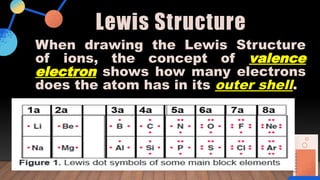
When drawing the Lewis Structure
of ions, the concept of valence
electron shows how many electrons
does the atom has in its outer shell.
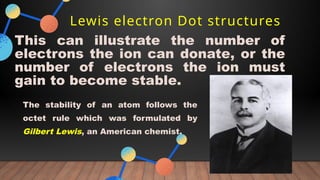
Lewis electron Dot structures
This can illustrate the number of
electrons the ion can donate, or the
number of electrons the ion must
gain to become stable.
The stability of an atom follows the
octet rule which was formulated by
Gilbert Lewis, an American chemist.
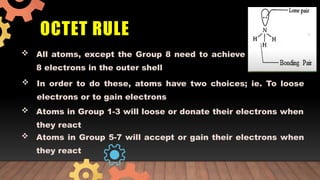
OCTET RULE
 All atoms, except the Group 8 need to achieve
8 electrons in the outer shell
 In order to do these, atoms have two choices; ie. To loose
electrons or to gain electrons
 Atoms in Group 1-3 will loose or donate their electrons when
they react
 Atoms in Group 5-7 will accept or gain their electrons when
they react
STEPS IN DRAWING THE LEDS
1. Write the skeletal structure of the compound using
chemical symbols of the elements involved in the reaction
2. Draw a single covalent bond between the central atom and
each of the surrounding atoms.
3. In some cases, If the central atom did not meet the octet
rule, adding a double bond or triple bond can be tried to figure
out the best configuration
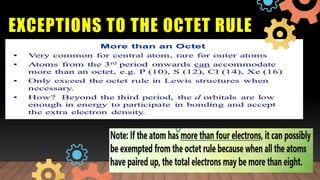
EXCEPTIONS TO THE OCTET RULE
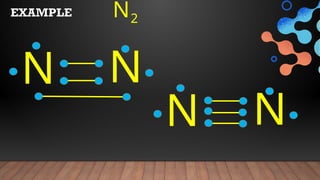
N2
N N
N N
EXAMPLE
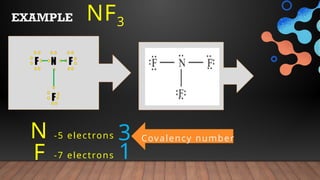
NF3
EXAMPLE
F N F
F
N -5 electrons 3
F -7 electrons 1
Covalency number
H2O
Try this
O2
NaCl
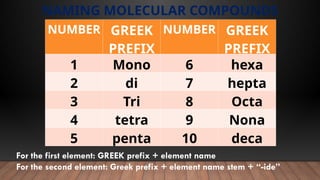
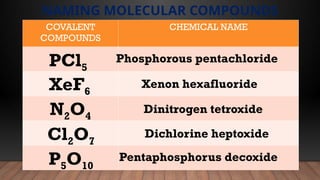
NAMING MOLECULAR COMPOUNDS
NUMBER GREEK
PREFIX
NUMBER GREEK
PREFIX
1 Mono 6 hexa
2 di 7 hepta
3 Tri 8 Octa
4 tetra 9 Nona
5 penta 10 deca
For the first element: GREEK prefix + element name
For the second element: Greek prefix + element name stem + “-ide”
COVALENT
COMPOUNDS
CHEMICAL NAME
NAMING MOLECULAR COMPOUNDS
PCl5
XeF6
N2O4
Cl2O7
P5O10
Phosphorous pentachloride
Xenon hexafluoride
Dinitrogen tetroxide
Dichlorine heptoxide
Pentaphosphorus decoxide
THANK YOU
See you on Monday!
THANK YOU
See you on Monday!

QTR2 WEEK2-Lewis Structures and Bond Formation.pptx

  • 1.
    Lewis Structures andBond Formation With Teacher Mary Grace 1.Draw the Lewis structure of an atom. 2.Draw Lewis structure of molecular covalent compounds 3.Apply the Octet rule in the formation of molecular covalent compounds 4.Write the formula of molecular compounds formed by the non-metallic elements of the representative block. Most Essential Learning Competency
  • 2.
    What are thebonding electrons? A. Central Atom B. Lone Pairs C. Formula Type D. Bonding Pairs
  • 3.
    What are theunbonded electrons? A. Central Atom B. Lone Pairs C. Formula Type D. Bonding Pairs
  • 4.
    What is aletter description of the components of molecular compound? A. Central Atom B. Lone Pairs C. Formula Type D. Bonding Pairs
  • 5.
    What is usuallythe least electronegative atom with the lowest subscript in the molecular formula? A. Central Atom B. Lone Pairs C. Formula Type D. Bonding Pairs
  • 6.
    What do youcall to the representation of covalent bonding in which shared electron pairs are shown either as lines or as pairs of dots between two atoms? A. Chemical structure B. Atomic Structure C. Electron structure D. Lewis Electron Dot Structure
  • 7.
    What are thebonding electrons? A. Central Atom B. Lone Pairs C. Formula Type D. Bonding Pairs
  • 8.
    What are theunbonded electrons? A. Central Atom B. Lone Pairs C. Formula Type D. Bonding Pairs
  • 9.
    What is aletter description of the components of molecular compound? A. Central Atom B. Lone Pairs C. Formula Type D. Bonding Pairs
  • 10.
    What is usuallythe least electronegative atom with the lowest subscript in the molecular formula? A. Central Atom B. Lone Pairs C. Formula Type D. Bonding Pairs
  • 11.
    What do youcall to the representation of covalent bonding in which shared electron pairs are shown either as lines or as pairs of dots between two atoms? A. Chemical structure B. Atomic Structure C. Electron structure D. Lewis Electron Dot Structure
  • 12.
    Types of Bondingand their Properties With Teacher Mary Grace Types of Bonding 1. Ionic Bond-is formed when metals on the left side (Group 1(A) and Group 2(A) of the periodic table and nonmetals on the right side (except noble gases, group 8A) interact. Energy diagram of bonded vs nonbonded atoms higher melting and boiling points hard and brittle and conduct electricity when dissolved in water
  • 13.
    Types of Bondingand their Properties With Teacher Mary Grace Types of Bonding 2. Covalent Bond-formed when atoms reach stability by sharing electrons (rather than fully gaining or losing them). Energy diagram of bonded vs nonbonded atoms brittle solid, have relatively low melting and boiling points poor conductor of heat and electricity
  • 14.
    Figure 1. Commonelements that form ionic bonds (Orange = metals; Green = nonmetals Figure 2. Structures of some common covalent compounds
  • 15.
    Lewis Structure A LewisStructure is a representation of covalent bonding in which shared electron pairs are shown either as lines or as pairs of dots between two atoms, and lone pairs are shown as pair of dots on individual atoms
  • 16.
    Lewis Structure When drawingthe Lewis Structure of ions, the concept of valence electron shows how many electrons does the atom has in its outer shell.
  • 17.
    Lewis electron Dotstructures This can illustrate the number of electrons the ion can donate, or the number of electrons the ion must gain to become stable. The stability of an atom follows the octet rule which was formulated by Gilbert Lewis, an American chemist.
  • 18.
    OCTET RULE  Allatoms, except the Group 8 need to achieve 8 electrons in the outer shell  In order to do these, atoms have two choices; ie. To loose electrons or to gain electrons  Atoms in Group 1-3 will loose or donate their electrons when they react  Atoms in Group 5-7 will accept or gain their electrons when they react
  • 19.
    STEPS IN DRAWINGTHE LEDS 1. Write the skeletal structure of the compound using chemical symbols of the elements involved in the reaction 2. Draw a single covalent bond between the central atom and each of the surrounding atoms. 3. In some cases, If the central atom did not meet the octet rule, adding a double bond or triple bond can be tried to figure out the best configuration
  • 20.
  • 21.
  • 22.
    NF3 EXAMPLE F N F F N-5 electrons 3 F -7 electrons 1 Covalency number
  • 23.
  • 24.
    NAMING MOLECULAR COMPOUNDS NUMBERGREEK PREFIX NUMBER GREEK PREFIX 1 Mono 6 hexa 2 di 7 hepta 3 Tri 8 Octa 4 tetra 9 Nona 5 penta 10 deca For the first element: GREEK prefix + element name For the second element: Greek prefix + element name stem + “-ide”
  • 25.
    COVALENT COMPOUNDS CHEMICAL NAME NAMING MOLECULARCOMPOUNDS PCl5 XeF6 N2O4 Cl2O7 P5O10 Phosphorous pentachloride Xenon hexafluoride Dinitrogen tetroxide Dichlorine heptoxide Pentaphosphorus decoxide
  • 26.
  • 27.

Editor's Notes

  • #12 Ionic Bond An ionic bond is formed when metals on the left side (Group 1(A) and Group 2(A) of the periodic table and nonmetals on the right side (except noble gases, group 8A) interact. This type of interaction is observed between atoms with large differences in their tendencies to lose or gain electrons and is achieved via electron transfer. Once the electrons have been transferred to the non-metal, both the metal and the non-metal become ions. The metal becomes positively charged and the nonmetal becomes negatively charged. An ionic compound is formed when the two oppositely charged ions attract each other. For instance, positively charged sodium ions and negatively charged chloride ions attract each other to make sodium chloride, or table salt. Ionic compounds tend to have higher melting and boiling points. They are hard and brittle and conduct electricity when dissolved in water. Some common ionic compounds are magnesium bromide (MgBr2), magnesium oxide (MgO), and potassium bromide (KBr).
  • #13 Covalent Bond Covalent bonds are formed when atoms reach stability by sharing electrons (rather than fully gaining or losing them). Covalent bonds are more common than ionic bonds in the molecules of living organisms. These bonds mostly occur between nonmetals or between two of the same (or similar) elements. One, two, or three pairs of electrons may be shared between atoms, resulting in single, double, or triple bonds, respectively. The more electrons that are shared between two atoms, the shorter and stronger their bond will be. Compounds formed through covalent bonding are brittle solid, have relatively low melting and boiling points, and are poor conductor of heat and electricity. Several covalent compounds have high vapor pressure, which makes them volatile and good as fuels. Propane, methane and gasoline are all covalent compounds that readily undergo combustion, producing energy as a bi-product. Water and almost all the biomolecules that govern the chemistry in our body are formed through covalent bonds.
  • #17 Valence electrons of an atom are better represented with Lewis dot symbols. From the previous module, the number of valence electrons of a main block element is usually equivalent to its group number. For instance, Carbon is a Group 4(a) element, thus it has 4 valence electrons. The number of valence electrons of Fluorine is 7 because it is in Group7(a). Magnesium has 2 valence electrons because it belongs to Group2(a). Lewis dot symbol is very useful when learning about chemical bonding, and chemical reactions. It consists of the symbol of an element and one dot for each valence electron in an atom of the element. The dots are placed on the four sides of the symbol—top, bottom, left, and right—and each side can accommodate up to two electrons. The choice on which sides to place two electrons rather one electron is arbitrary since all four sides are equivalent. It is recommended that we spread out the dots as much as possible. In general, we cannot write simple Lewis dot symbols for the transition metals, lanthanides, and actinides because they all have incompletely filled inner shells.
  • #18 The tendency of an atom to form bonds until it is surrounded by eight valence electrons.
  • #19 1. Write the skeletal structure of the compound using chemical symbols of the elements involved in the reaction The one with the least number of atoms in the compound is generally the central atom. Usually, the hydrogen and elements in the halogen group occupy the terminal (end) position of the Lewis structure 2. Draw a single covalent bond between the central atom and each of the surrounding atoms. Complete the octets of the atoms bonded to the central atom
  • #22 Elements with higher covalency number will be the central atom
  • #25 Covalent-2 or more non-metallic compound