Covalent Bonds
Covalent Bonds
• Covalent bonds occur when atoms
  share electrons.
• Covalent bonds generally form
  between nonmetals.
• Atoms that are covalently bonded form
  molecules.
Covalent Bonds
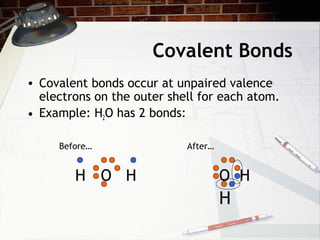
• Covalent bonds occur at unpaired valence
  electrons on the outer shell for each atom.
• Example: H2O has 2 bonds:

     Before…                After…


        H O H                        O H
                                     H
Covalent Bonds
• Covalent bonds create neutral
  molecules when they come together.
• How many bonds between 2 atoms?
  – Covalently bonded atoms can bond up to 3
    times. They cannot exceed 3 bonds
    between two atoms.
Covalent Bonds
• Double bonds: When two atoms share
  two pairs of electrons.
  – EX: O2
• Triple bonds: When two atoms share
  three pairs of electrons.
  – EX: N2
Covalent Bonds
• Properties of Covalent Bonds:
  –   Low melting points
  –   Low boiling points
  –   Poor conductor of electricity
  –   Between nonmetals and nonmetals

Covalent bonds

  • 1.
  • 2.
    Covalent Bonds • Covalentbonds occur when atoms share electrons. • Covalent bonds generally form between nonmetals. • Atoms that are covalently bonded form molecules.
  • 3.
    Covalent Bonds • Covalentbonds occur at unpaired valence electrons on the outer shell for each atom. • Example: H2O has 2 bonds: Before… After… H O H O H H
  • 4.
    Covalent Bonds • Covalentbonds create neutral molecules when they come together. • How many bonds between 2 atoms? – Covalently bonded atoms can bond up to 3 times. They cannot exceed 3 bonds between two atoms.
  • 5.
    Covalent Bonds • Doublebonds: When two atoms share two pairs of electrons. – EX: O2 • Triple bonds: When two atoms share three pairs of electrons. – EX: N2
  • 6.
    Covalent Bonds • Propertiesof Covalent Bonds: – Low melting points – Low boiling points – Poor conductor of electricity – Between nonmetals and nonmetals