Chemical Bonding
Group Chemistry!
Members: Qadr Arslan,
Akash, Roshaf, Anus.
Introduction
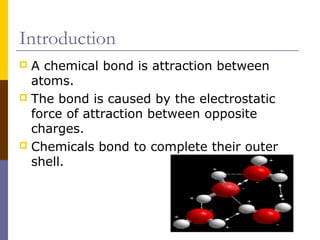
 A chemical bond is attraction between
atoms.
 The bond is caused by the electrostatic
force of attraction between opposite
charges.
 Chemicals bond to complete their outer
shell.
Ionic Bonding
 From the word “ION” meaning charges.
 Between metals and non-metals.
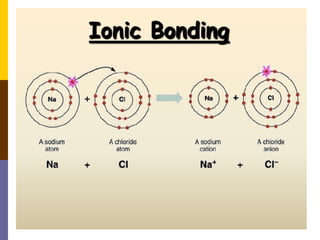
 Complete transference of a electron leads
to the gain of a charge, which then held
the atoms together.
 Strong bond.
 Can be represented by dot and cross
diagram.
 Example: Sodium Chloride (NaCl)
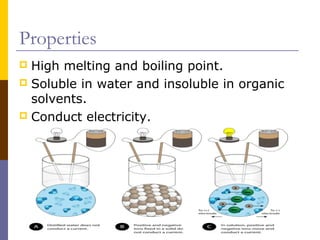
Properties
 High melting and boiling point.
 Soluble in water and insoluble in organic
solvents.
 Conduct electricity.
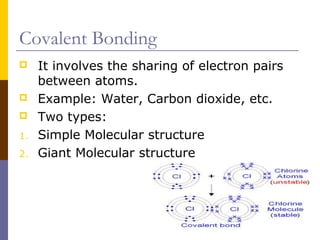
Covalent Bonding
 It involves the sharing of electron pairs
between atoms.
 Example: Water, Carbon dioxide, etc.
 Two types:
1. Simple Molecular structure
2. Giant Molecular structure
Types and properties
Simple Molecular
Structures
Giant Molecular
Structures
 Low melting and
boiling points.
 High melting and
boiling points.
 Insoluble in water and
soluble in organic
solvents.
 Insoluble in both water
and organic solvents.
 Do not conduct
electricity.
 Do not conduct
electricity.
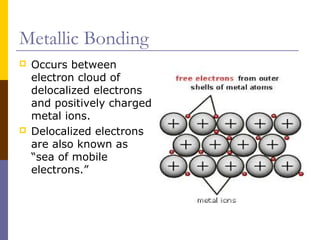
Metallic Bonding
 Occurs between
electron cloud of
delocalized electrons
and positively charged
metal ions.
 Delocalized electrons
are also known as
“sea of mobile
electrons.”
Properties
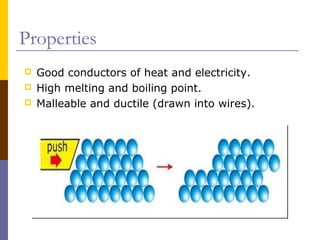
 Good conductors of heat and electricity.
 High melting and boiling point.
 Malleable and ductile (drawn into wires).
Properties
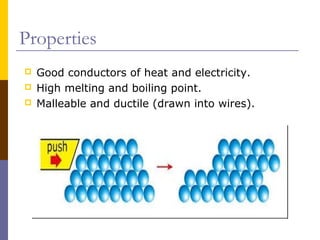
 Good conductors of heat and electricity.
 High melting and boiling point.
 Malleable and ductile (drawn into wires).

Chemical bonding

  • 1.
    Chemical Bonding Group Chemistry! Members:Qadr Arslan, Akash, Roshaf, Anus.
  • 2.
    Introduction  A chemicalbond is attraction between atoms.  The bond is caused by the electrostatic force of attraction between opposite charges.  Chemicals bond to complete their outer shell.
  • 3.
    Ionic Bonding  Fromthe word “ION” meaning charges.  Between metals and non-metals.  Complete transference of a electron leads to the gain of a charge, which then held the atoms together.  Strong bond.  Can be represented by dot and cross diagram.  Example: Sodium Chloride (NaCl)
  • 5.
    Properties  High meltingand boiling point.  Soluble in water and insoluble in organic solvents.  Conduct electricity.
  • 6.
    Covalent Bonding  Itinvolves the sharing of electron pairs between atoms.  Example: Water, Carbon dioxide, etc.  Two types: 1. Simple Molecular structure 2. Giant Molecular structure
  • 7.
    Types and properties SimpleMolecular Structures Giant Molecular Structures  Low melting and boiling points.  High melting and boiling points.  Insoluble in water and soluble in organic solvents.  Insoluble in both water and organic solvents.  Do not conduct electricity.  Do not conduct electricity.
  • 8.
    Metallic Bonding  Occursbetween electron cloud of delocalized electrons and positively charged metal ions.  Delocalized electrons are also known as “sea of mobile electrons.”
  • 9.
    Properties  Good conductorsof heat and electricity.  High melting and boiling point.  Malleable and ductile (drawn into wires).
  • 10.
    Properties  Good conductorsof heat and electricity.  High melting and boiling point.  Malleable and ductile (drawn into wires).