Covalent BondsUnit 11
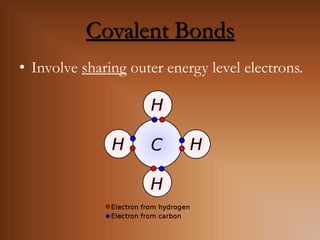
Covalent BondsInvolve sharing outer energy level electrons.
How Are They Different Than Ionic?Ionic bonds work by electromagnetic attraction. A positively charged ion is attracted to a negative ion.Covalent bonds work by sharing electrons. They do not have charges, but are hard to separate due to this sharing.
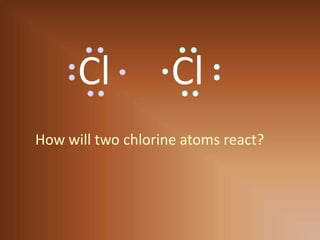
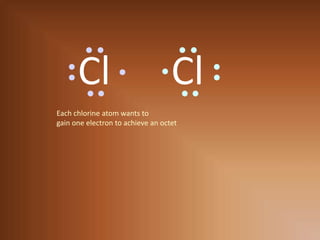
ClClHow will two chlorine atoms react?
ClClEach chlorine atom wants to gain one electron to achieve an octet
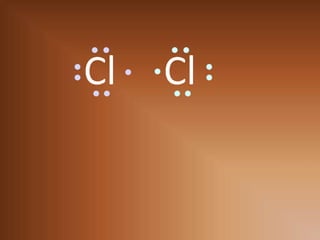
ClCl
ClCl
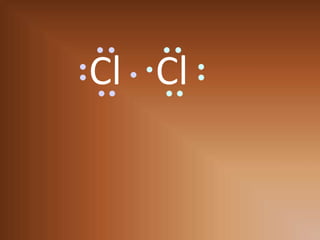
ClCl
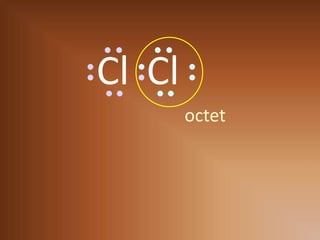
ClCloctet
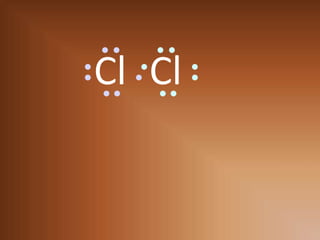
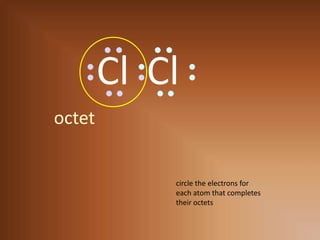
ClCloctetcircle the electrons foreach atom that completestheir octets
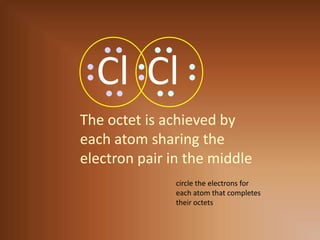
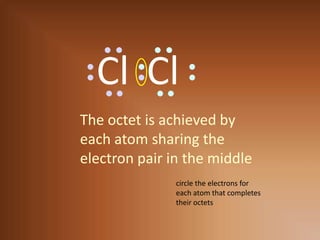
ClClThe octet is achieved byeach atom sharing theelectron pair in the middlecircle the electrons foreach atom that completestheir octets
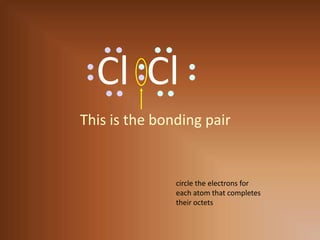
ClClThis is the bonding paircircle the electrons foreach atom that completestheir octets
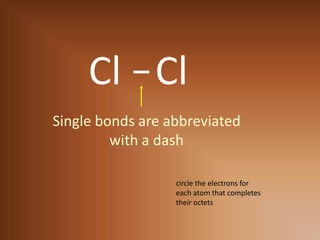
ClClSingle bonds are abbreviatedwith a dashcircle the electrons foreach atom that completestheir octets
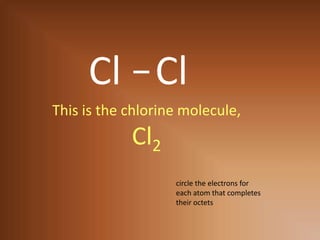
ClClThis is the chlorine molecule,Cl2circle the electrons foreach atom that completestheir octets
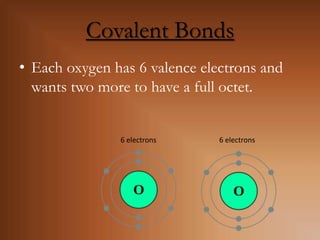
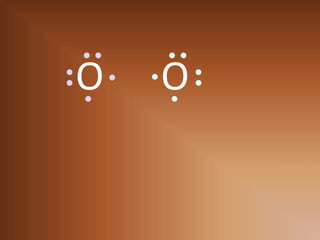
Covalent BondsEach oxygen has 6 valence electrons and wants two more to have a full octet.6 electrons6 electrons
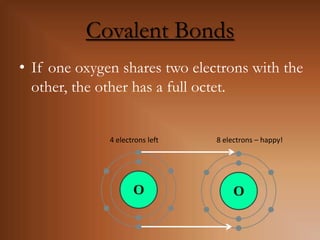
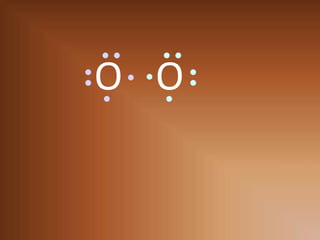
Covalent BondsIf one oxygen shares two electrons with the other, the other has a full octet.8 electrons – happy!4 electrons left
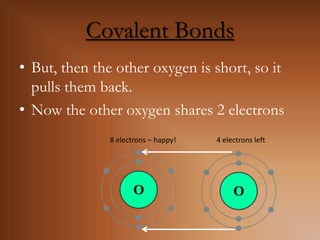
Covalent BondsBut, then the other oxygen is short, so it pulls them back.Now the other oxygen shares 2 electrons4 electrons left8 electrons – happy!
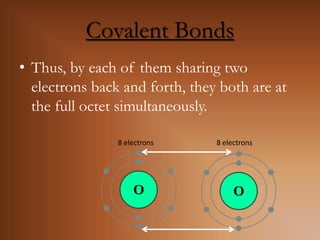
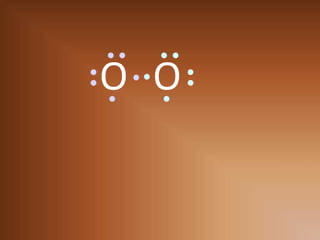
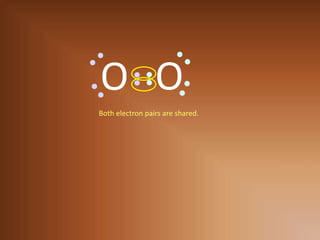
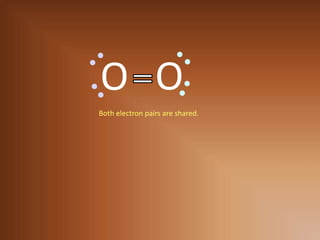
Covalent BondsThus, by each of them sharing two electrons back and forth, they both are at the full octet simultaneously.8 electrons8 electrons
OO
OO
OO
OO
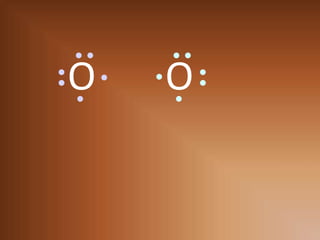
OOBoth electron pairs are shared.
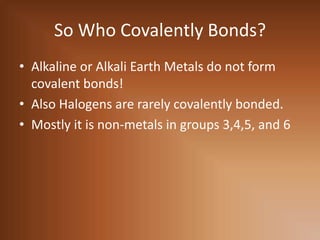
So Who Covalently Bonds?Alkaline or Alkali Earth Metals do not form covalent bonds!Also Halogens are rarely covalently bonded.Mostly it is non-metals in groups 3,4,5, and 6
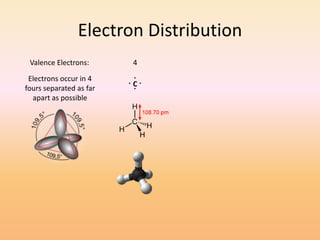
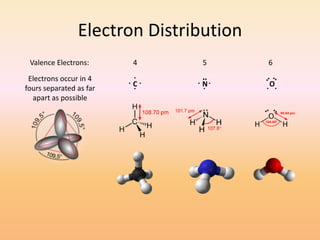
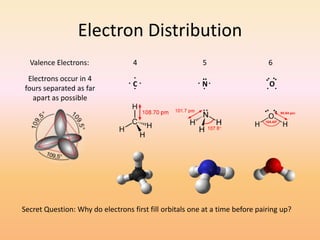
Electron Distribution... C.Valence Electrons:		    4Electrons occur in 4 fours separated as far apart as possible
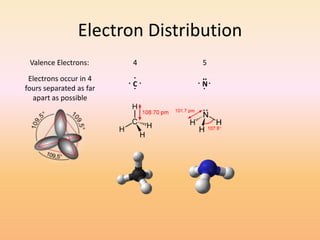
Electron Distribution..... N C..Valence Electrons:		    4		       5Electrons occur in 4 fours separated as far apart as possible
Electron Distribution..... N C..O..Valence Electrons:		    4		       5		        6Electrons occur in 4 fours separated as far apart as possible
Electron Distribution..... N C..O..Valence Electrons:		    4		       5		        6Electrons occur in 4 fours separated as far apart as possibleSecret Question: Why do electrons first fill orbitals one at a time before pairing up?
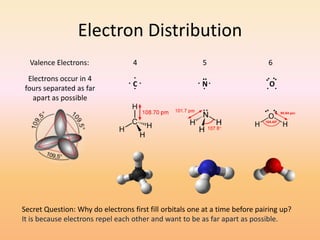
Electron Distribution..... N C..O..Valence Electrons:		    4		       5		        6Electrons occur in 4 fours separated as far apart as possibleSecret Question: Why do electrons first fill orbitals one at a time before pairing up?It is because electrons repel each other and want to be as far apart as possible.
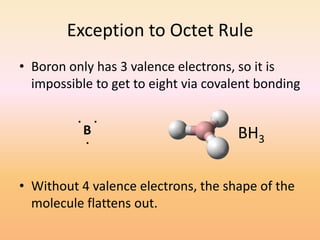
Exception to Octet RuleBoron only has 3 valence electrons, so it is impossible to get to eight via covalent bondingWithout 4 valence electrons, the shape of the molecule flattens out.BH3B...
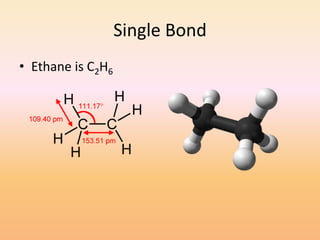
Single BondEthane is C2H6
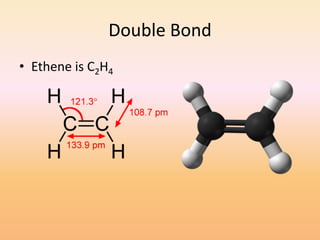
Double BondEthene is C2H4
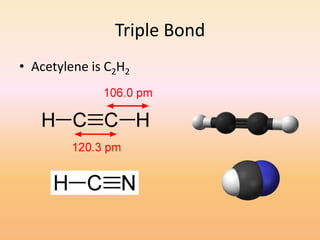
Triple BondAcetylene is C2H2
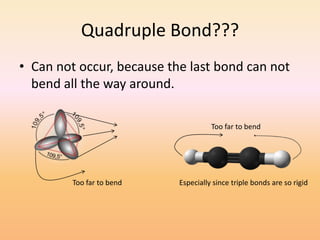
Quadruple Bond???Can not occur, because the last bond can not bend all the way around.Too far to bendToo far to bendEspecially since triple bonds are so rigid
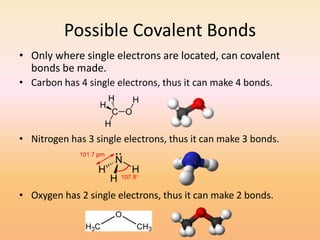
Possible Covalent BondsOnly where single electrons are located, can covalent bonds be made.Carbon has 4 single electrons, thus it can make 4 bonds.Nitrogen has 3 single electrons, thus it can make 3 bonds.Oxygen has 2 single electrons, thus it can make 2 bonds.
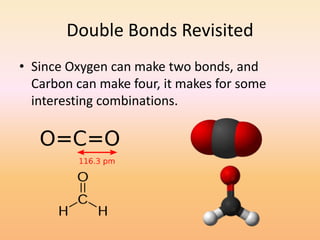
Double Bonds RevisitedSince Oxygen can make two bonds, and Carbon can make four, it makes for some interesting combinations.
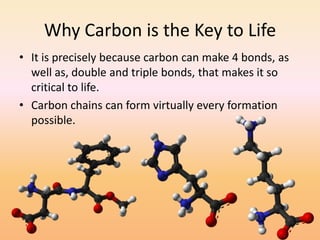
Why Carbon is the Key to LifeIt is precisely because carbon can make 4 bonds, as well as, double and triple bonds, that makes it so critical to life.Carbon chains can form virtually every formation possible.
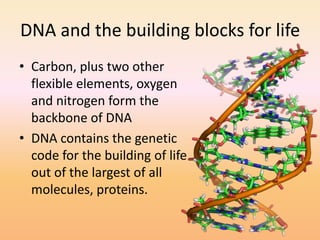
DNA and the building blocks for lifeCarbon, plus two other flexible elements, oxygen and nitrogen form the backbone of DNADNA contains the genetic code for the building of life out of the largest of all molecules, proteins.
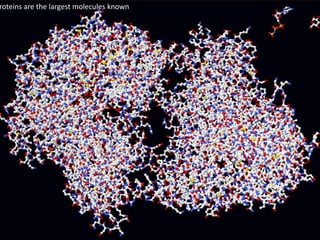
Proteins are the largest molecules known

Unit 11 - Covalent Bonding

  • 1.
  • 2.
    Covalent BondsInvolve sharingouter energy level electrons.
  • 3.
    How Are TheyDifferent Than Ionic?Ionic bonds work by electromagnetic attraction. A positively charged ion is attracted to a negative ion.Covalent bonds work by sharing electrons. They do not have charges, but are hard to separate due to this sharing.
  • 4.
    ClClHow will twochlorine atoms react?
  • 5.
    ClClEach chlorine atomwants to gain one electron to achieve an octet
  • 6.
  • 7.
  • 8.
  • 9.
  • 10.
    ClCloctetcircle the electronsforeach atom that completestheir octets
  • 11.
    ClClThe octet isachieved byeach atom sharing theelectron pair in the middlecircle the electrons foreach atom that completestheir octets
  • 12.
    ClClThe octet isachieved byeach atom sharing theelectron pair in the middlecircle the electrons foreach atom that completestheir octets
  • 13.
    ClClThis is thebonding paircircle the electrons foreach atom that completestheir octets
  • 14.
    ClClSingle bonds areabbreviatedwith a dashcircle the electrons foreach atom that completestheir octets
  • 15.
    ClClThis is thechlorine molecule,Cl2circle the electrons foreach atom that completestheir octets
  • 16.
    Covalent BondsEach oxygenhas 6 valence electrons and wants two more to have a full octet.6 electrons6 electrons
  • 17.
    Covalent BondsIf oneoxygen shares two electrons with the other, the other has a full octet.8 electrons – happy!4 electrons left
  • 18.
    Covalent BondsBut, thenthe other oxygen is short, so it pulls them back.Now the other oxygen shares 2 electrons4 electrons left8 electrons – happy!
  • 19.
    Covalent BondsThus, byeach of them sharing two electrons back and forth, they both are at the full octet simultaneously.8 electrons8 electrons
  • 20.
  • 21.
  • 22.
  • 23.
  • 24.
  • 25.
  • 26.
    So Who CovalentlyBonds?Alkaline or Alkali Earth Metals do not form covalent bonds!Also Halogens are rarely covalently bonded.Mostly it is non-metals in groups 3,4,5, and 6
  • 27.
    Electron Distribution... C.ValenceElectrons: 4Electrons occur in 4 fours separated as far apart as possible
  • 28.
    Electron Distribution..... NC..Valence Electrons: 4 5Electrons occur in 4 fours separated as far apart as possible
  • 29.
    Electron Distribution..... NC..O..Valence Electrons: 4 5 6Electrons occur in 4 fours separated as far apart as possible
  • 30.
    Electron Distribution..... NC..O..Valence Electrons: 4 5 6Electrons occur in 4 fours separated as far apart as possibleSecret Question: Why do electrons first fill orbitals one at a time before pairing up?
  • 31.
    Electron Distribution..... NC..O..Valence Electrons: 4 5 6Electrons occur in 4 fours separated as far apart as possibleSecret Question: Why do electrons first fill orbitals one at a time before pairing up?It is because electrons repel each other and want to be as far apart as possible.
  • 32.
    Exception to OctetRuleBoron only has 3 valence electrons, so it is impossible to get to eight via covalent bondingWithout 4 valence electrons, the shape of the molecule flattens out.BH3B...
  • 33.
  • 34.
  • 35.
  • 36.
    Quadruple Bond???Can notoccur, because the last bond can not bend all the way around.Too far to bendToo far to bendEspecially since triple bonds are so rigid
  • 37.
    Possible Covalent BondsOnlywhere single electrons are located, can covalent bonds be made.Carbon has 4 single electrons, thus it can make 4 bonds.Nitrogen has 3 single electrons, thus it can make 3 bonds.Oxygen has 2 single electrons, thus it can make 2 bonds.
  • 38.
    Double Bonds RevisitedSinceOxygen can make two bonds, and Carbon can make four, it makes for some interesting combinations.
  • 39.
    Why Carbon isthe Key to LifeIt is precisely because carbon can make 4 bonds, as well as, double and triple bonds, that makes it so critical to life.Carbon chains can form virtually every formation possible.
  • 40.
    DNA and thebuilding blocks for lifeCarbon, plus two other flexible elements, oxygen and nitrogen form the backbone of DNADNA contains the genetic code for the building of life out of the largest of all molecules, proteins.
  • 41.
    Proteins are thelargest molecules known